
A brand voice guide is a starting point, not proof that a campaign sounds consistent. The difficult part comes after different writers, agencies and AI tools adapt the same approved message for ads, email, social and product pages. A useful brand voice audit finds tone drift, changing promises, contradictory product names and audience mismatches before they reach customers.
This is an operational quality-assurance guide, not another list of brand voice software or a tutorial on creating a style guide. It assumes an approved brand reference already exists, then explains how to sample content, classify deviations, route corrections and keep the audit separate from legal review. No AI detector or brand score can establish factual or legal correctness on its own.
Freeze the approved reference before sampling
Select a versioned reference packet: brand attributes, preferred vocabulary, prohibited clichés, approved taglines, audience examples, spelling conventions and the facts the brand is allowed to promise. Include two examples of good copy and two of what not to say. If the guide contradicts itself, resolve that first rather than training reviewers to guess.
Assign an owner and review date to the packet. Brand identity evolves, but an audit needs a stable baseline. Separate matters of voice (‘direct, calm and helpful’) from matters of fact (‘returns accepted within the published window’). This distinction makes it possible to escalate a false promise immediately without arguing about whether its tone is on brand.
Sample the same message across four channels
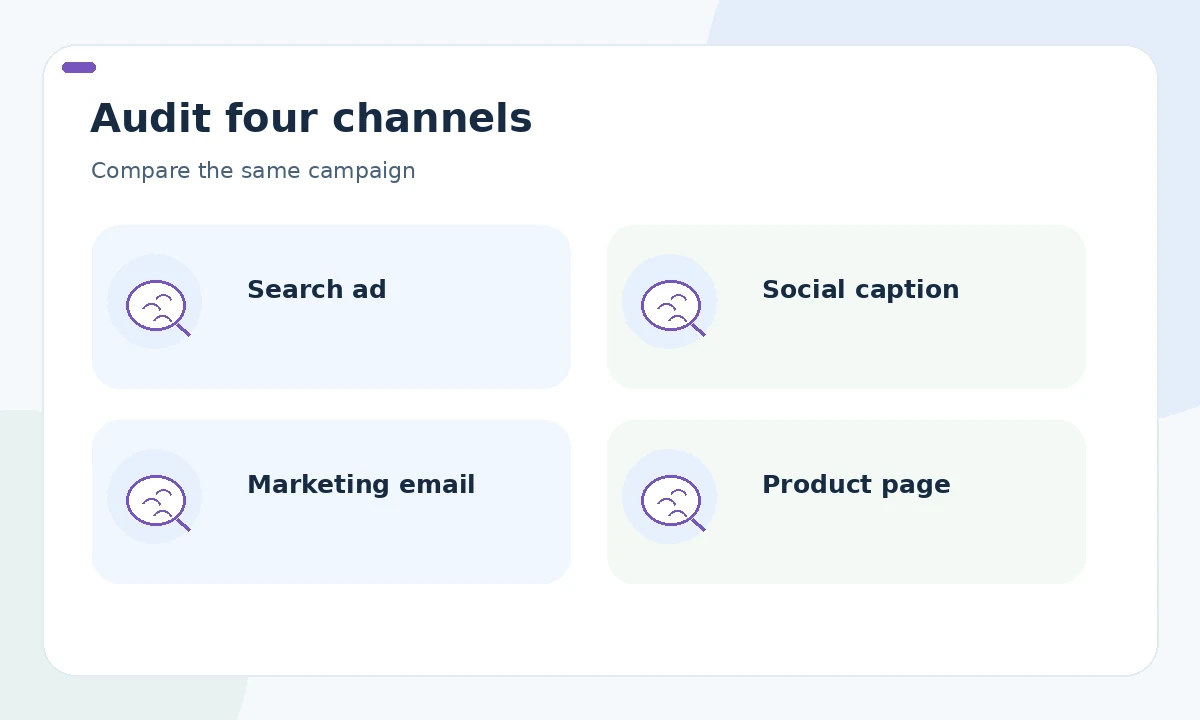
Collect one campaign family: a search ad set, a social caption, an email and a corresponding product or landing page. Capture the visible text and meaningful context, including images, disclaimers and the destination page. Do not compare random copy written for unrelated goals; controlled sampling reveals whether the same claim drifts as it passes between channel owners.
Record audience, market, language, creator, approval history and the date each asset was live or drafted. Distinguish a necessary channel adaptation from a contradiction. A short paid-search headline may omit detail that a landing page properly explains, but it must not imply an unconditional offer when a material eligibility condition exists.
Build an audit matrix with meaningful labels
Use columns for vocabulary, tone, message hierarchy, factual alignment, visual context and accessibility. For each asset mark ‘consistent,’ ‘needs edit’ or ‘escalate’ and provide the exact evidence. Avoid averaging all findings into one unexplained score; a single unsupported health or performance claim can matter far more than several harmless synonyms.
An AI assistant can highlight repeated phrases, compare variants against the guide and group potential violations. Ask it to quote the conflicting sentences and name the rule allegedly broken. Reviewers should confirm every flag and may reject false positives. Automated style labels are only triage, because irony, local idioms and necessary compliance language can fool simple classifiers.
Distinguish cosmetic drift from claim risk
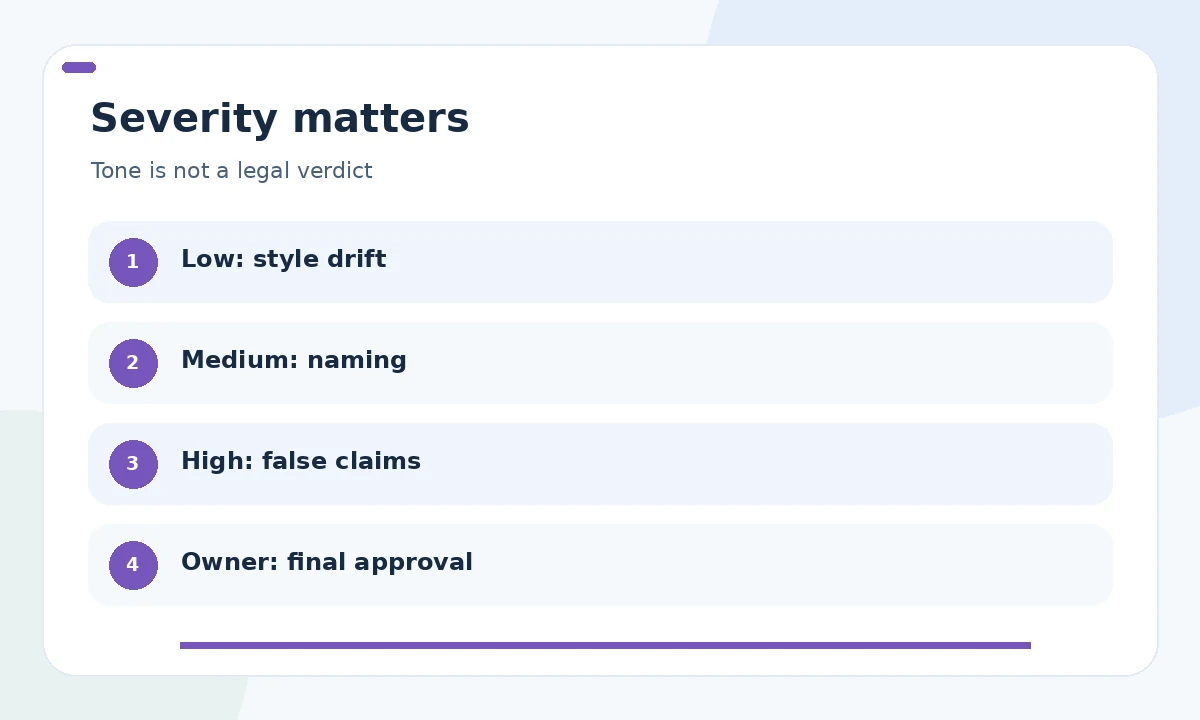
A cosmetic issue might be one email sounding unusually playful while the rest of the campaign is restrained. A medium-severity issue might change the product’s standard name or omit an important supporting qualifier. A high-severity issue is a false feature, fabricated testimonial or implied guarantee. Create separate routing paths so high-risk content cannot be hidden inside a general copy-edit queue.
FTC advertising guidance looks at express and implied statements, including how words and visuals interact. Verify the final customer impression rather than editing only for preferred adjectives. Someone with claim authority should approve substantiation; a brand designer can approve tone and layout. These are complementary roles, not interchangeable signatures.
Use AI as a reviewer with narrow authority
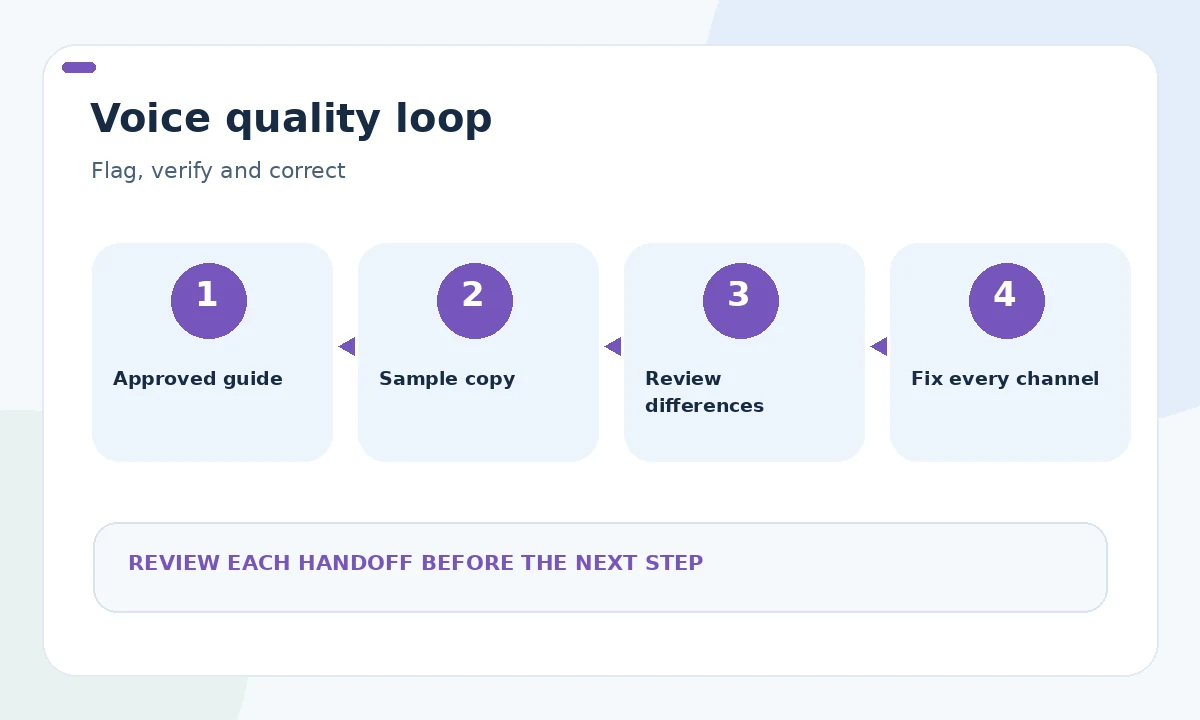
Provide the approved guide and the sampled material, then instruct an assistant to return a structured list: location, exact excerpt, applicable guide rule, potential revision and uncertainty. Prohibit it from changing prices, specifications or legal disclosures. Give it one channel family at a time so it does not merge unrelated offers into a fictitious campaign.
Compare the model’s suggestions with a human reviewer, especially when the proposed fix shortens important conditions. If a sentence appears both in an ad and on the landing page, changes must be synchronized. Maintain a visible before-and-after diff and assign one person to decide which revision is final. That accountability matters more than making every sentence sound identical.
Tool choice depends on governance maturity
A small team can begin with an approved shared document and a spreadsheet audit log. Jasper documents Brand Voice settings based on supplied writing samples and a preview workflow, which may help teams standardize drafts. Adobe describes brand-guideline validation and approval routing for GenStudio for Performance Marketing. Evaluate current availability, role restrictions and integration details against your actual operating model.
Neither tool description means automated validation is complete. Test whether the product displays the violated rule, supports exceptions, saves decisions and can distinguish a style preference from a legal claim. Avoid declaring a solution ‘enterprise safe’ without checking contract terms, connected data scope and how rejected content is preserved or deleted.
Close the loop after corrections
Issue a short audit report with the sample scope, defects found, owners, correction deadlines and what was not examined. Update the central guide only when repeated findings expose a genuinely ambiguous rule. Otherwise repair the affected assets and train the relevant creators. Sampling the same campaign again after a correction can confirm that the fix propagated.
Keep an exception log for justified departures, such as a required legal phrase that sounds less conversational than the normal brand tone. Periodically review actual support questions and content complaints for signs that brand messaging is misleading. The objective is recognizable, accurate communication—not artificial uniformity or a glossy score that masks unresolved customer risk.
How We Research
We compared the public primary documentation for Adobe GenStudio brand governance, Jasper Brand Voice help, and FTC advertising guidance, reviewed on October 26, 2026. We mapped documented features and obligations to a specific user task, separated vendor descriptions from our editorial reasoning, and flagged areas that require account-level verification. We did not run paid campaigns, access merchant accounts, purchase subscriptions, or measure financial or ranking outcomes. Changes to platform interfaces, policies, access and plans should be checked before making an operational commitment.
Frequently Asked Questions
Guidelines define the desired style. An audit checks actual cross-channel assets against a versioned reference and records what must be corrected.
No. It can flag candidate mismatches, but reviewers must judge context, audience adaptation and whether a claimed violation is real.
No. Search ads, email and product pages require different lengths and emphasis, while core facts and recognizable language should remain consistent.
No. Tone and design checks do not replace factual substantiation, channel policy review, rights clearance or required legal approval.
Sample important launches and recurring campaign families, then repeat after major guideline, product or audience changes; adjust frequency to observed defects.