
An AI blog writer can produce an outline and several hundred words almost instantly. That speed does not answer whether the resulting post is worth publishing. Generic summaries, misplaced quotes and nonworking references can make a fast draft actively unhelpful. Google’s guidance on generative AI content emphasizes accuracy, relevance and original value, and warns against scaled production that adds little for readers.
This article provides a production procedure for a new post, not a product ranking or a promise of search traffic. Its concrete deliverable is an evidence packet linked to each section of the draft. Unlike a guide to refreshing an old post, the workflow begins with a reader question that does not yet have a suitable article on your site.
Choose a reader problem your existing library does not solve
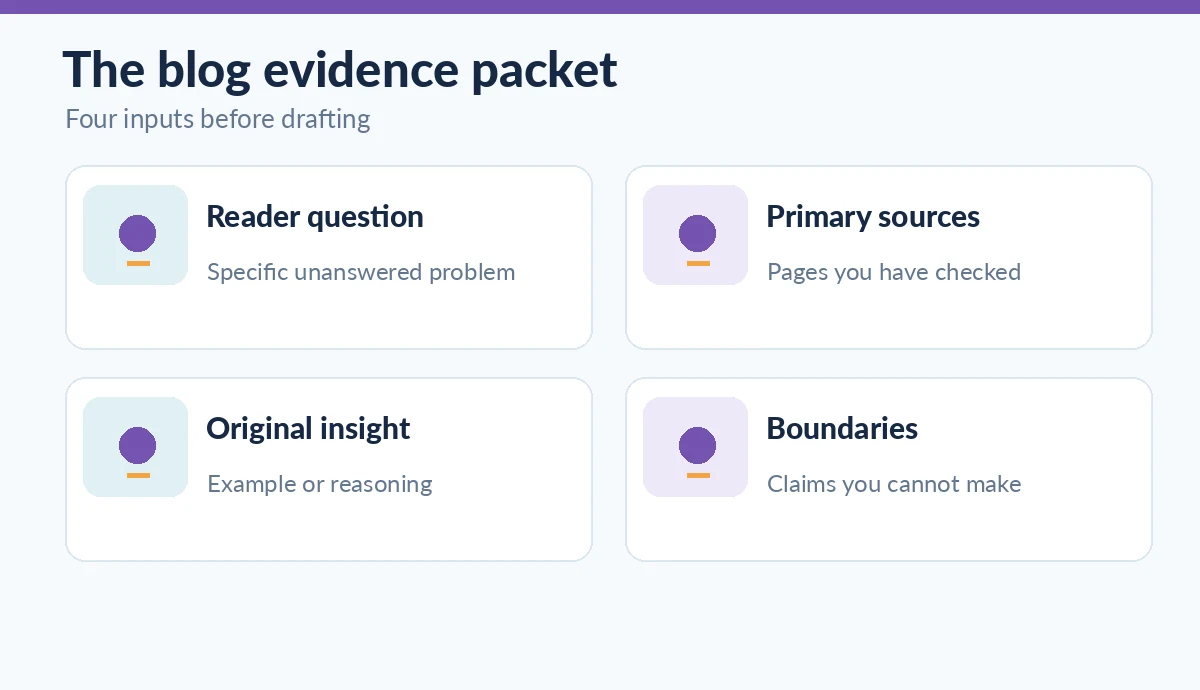
Write the question in plain English: “How do I compare the total cost of two automation plans when they bill in different units?” That is more useful than “Everything about AI automation.” Search your own site first and record the closest canonical article. If an existing page already solves the exact problem, improve that page rather than manufacturing another URL with slightly different phrasing.
Examine the search results to understand what a reader probably wants: a process, a comparison, a definition or a current price. Do not imitate top-ranked pages paragraph for paragraph. Your contribution might be a decision worksheet, a clearly scoped example or original reporting. If you cannot describe that unique contribution before drafting, the topic is not ready.
Create a source packet with claim-level notes
Collect current primary pages for any product feature, plan, policy or limitation you intend to mention. Save the title, access date, URL and exact claim supported by each source. For complex subjects, distinguish official documentation from commentary and personal experience. A secondary article may suggest what to investigate, but a quoted vendor limit should be checked against the vendor rather than inherited from a summary.
Attach a claims ledger to the outline. For every factual statement, note the source and what remains uncertain. Label illustrative examples as hypothetical. If the example says a software plan costs $20, the reader may infer that this is a real published price; either use a verified dated figure or omit the number. Precise-looking unsupported details erode credibility.
Outline around an answer, not a keyword quota
Begin with the reader’s actual question and a concise answer. Then plan sections that help someone complete a task or make a decision. A useful how-to article might cover prerequisites, the sequence, common failure modes, cost boundaries, a verification checklist and alternatives. The outline should become shorter if material is redundant. SEO terms are demand signals, not orders to repeat a phrase in every heading.
Ask an assistant for possible omissions rather than an “SEO-perfect outline.” Compare its suggestions to the source packet and user task. Reject sections that only repeat definitions, and add a clear limitation or failure case where it materially changes the decision. Link to an existing detailed guide when a subtopic would otherwise make the new article unfocused.
Draft sections from bounded, attributable evidence
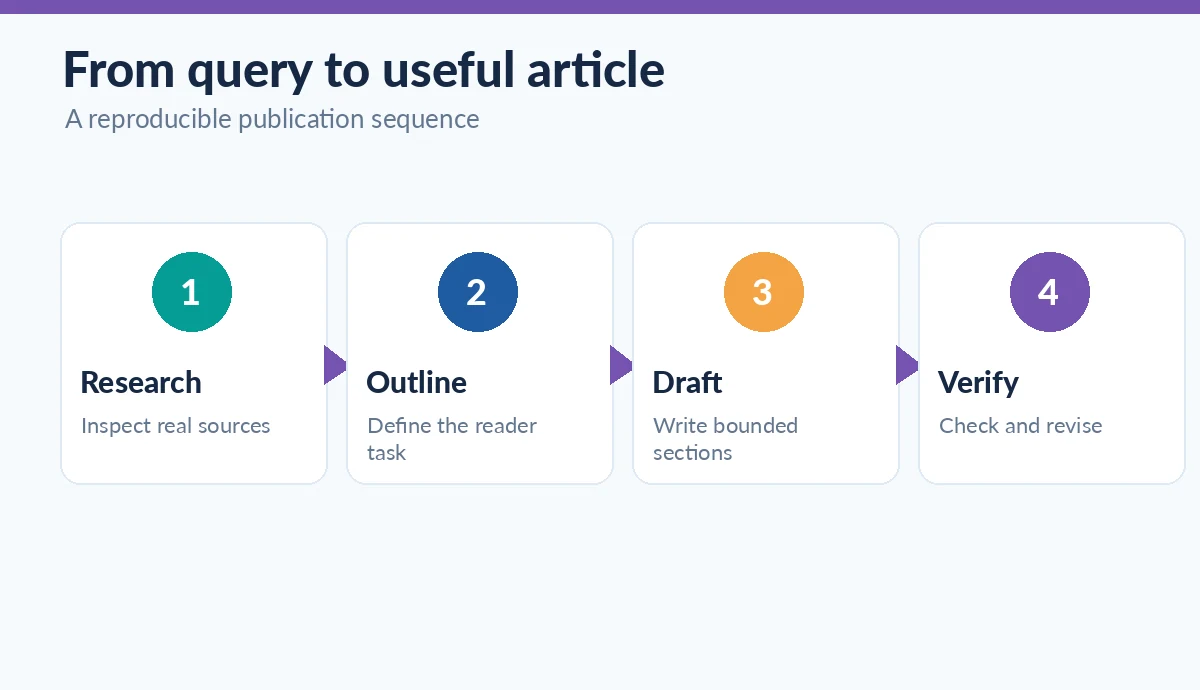
Give the AI only the relevant notes and a narrowly defined job: “Draft a practical explanation of the setup step using sources A and B; mark anything unsupported as an open question.” Have it work section by section so you can examine claims before they spread across the whole article. Keep user-facing language natural rather than appending robotic citations to every phrase.
If the assistant invents a reference, stop and remove it. Do not ask it to guess a statistic or pretend to have tested a tool. Add examples only when you can explain their assumptions. For a hypothetical budget worksheet, mark each input as a hypothetical value and show how a reader would replace it with an official source figure.
Add a unique value unit the model cannot infer
A generic generated summary offers little reason to publish another page. Add a worksheet, a problem-to-solution matrix, a quality rubric, a sourced limitation analysis or an original expert perspective. These do not require fabricated hands-on testing. A carefully designed comparison rubric can be useful if it explains the choice criteria and states that the products were not independently benchmarked.
For example, an article about a research assistant could include an evidence audit that separates search-result snippets, opened primary sources and unsupported claims. Explain how to fill the audit sheet and show how a false citation would be caught. The useful artifact should stand on its own, not be a decorative “checklist” that repeats the same six generic tips.
Run separate source, comprehension and editorial checks
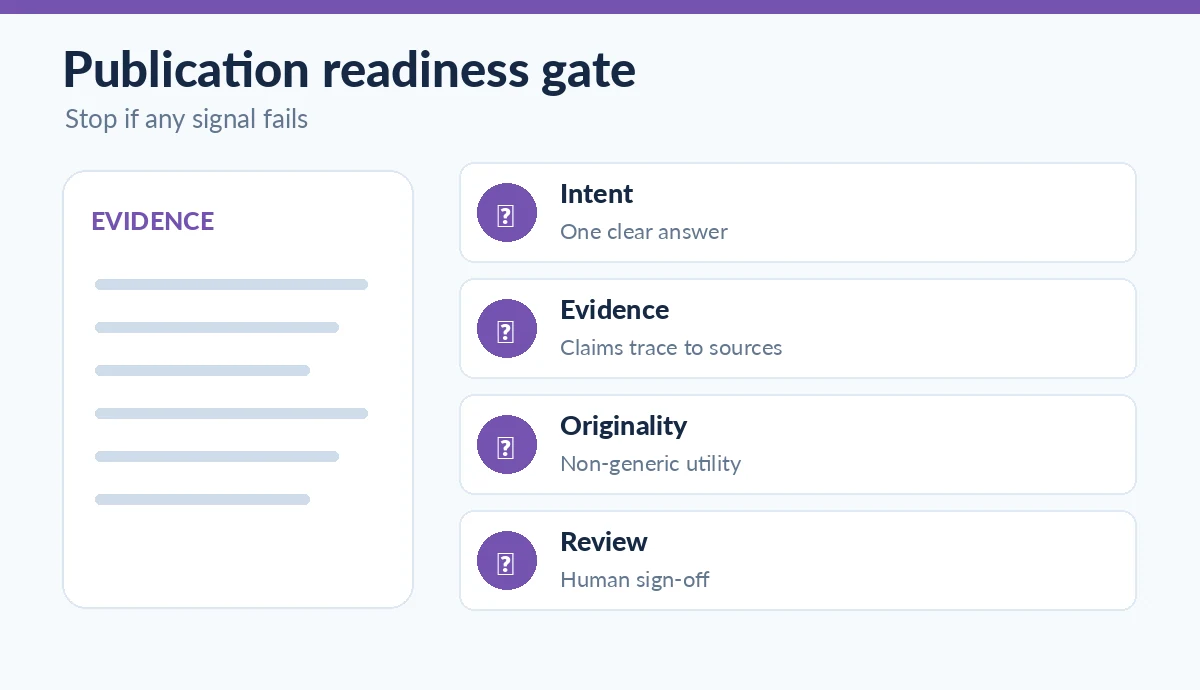
First open each referenced source and confirm that it actually supports the claim in its local context. Then read the article as the intended beginner or buyer: does it skip a prerequisite or imply that a workflow guarantees success? Finally review grammar, internal links, image alt text and clear descriptions of tools that may change. Do not substitute AI self-evaluation for independent fact checking.
Check SEO metadata too: the title and description should describe the actual article without promising a test, exclusive access or numerical result that the page does not contain. Review each chart for units, labels and truthfulness. A clean document has to be substantively helpful before a readability score or content grade means anything.
Publish with transparent boundaries and a maintenance trigger
Record the review date and identify what was not measured. If the article contains current product facts, assign an owner and an event that triggers rechecking: product retirement, a pricing redesign, a platform policy update or user-reported breakage. A 2026 label is not permission to keep out-of-date advice indefinitely. Google advises against changing page dates purely to create an illusion of freshness.
Monitor whether visitors find the answer, not only whether the page attracts impressions. If later research shows that your claim was inaccurate, correct the article with a clear editorial note when appropriate. Publishing fewer, better-supported posts often leaves a more trustworthy content library than maximizing the volume of superficially different AI-generated pages.
How We Research
We examined Google Search Central’s guidance on generative AI content and its people-first content questions, alongside the editorial tasks discussed in Frase’s official optimization workflow, checked October 26, 2026. This is a practical editorial design; we did not run search-ranking experiments, promise traffic or claim a model wrote a verified public blog.
Frequently Asked Questions
That creates avoidable risk. Verify sources, add unique value, review intended readers’ needs and check claims and metadata before publishing.
No blanket prohibition is described in its guidance. Google emphasizes quality, accuracy, original value and its scaled-content-abuse policy.
Link consequential claims to meaningful sources where appropriate. Citations should help readers verify facts, not serve as decoration.
Search the existing library, define a separate reader task and update a canonical page when the proposed article would answer the same question.
A useful decision worksheet, transparent worked example, source comparison or clearly bounded expert process can add value when presented honestly.