
Why bursty ticket traffic needs a queue policy
A small museum opens registration for a free evening exhibition and receives a sudden wave of reservations. The booking database can accept the signups quickly, but its outgoing mail provider allows far fewer confirmation requests at once. Pushing every message directly from the booking form risks timeouts and duplicate retries. Google Cloud Tasks offers queue-level rate controls so workers receive tasks at a bounded pace. The control protects the downstream service, not the uniqueness of each visitor message. Design the ticket record and delivery ledger first, then choose dispatch limits that suit the mail provider’s published or observed operational constraints.
Understand the rate and concurrency knobs
The Cloud Tasks Queue resource exposes rateLimits including maxDispatchesPerSecond, maxConcurrentDispatches and an output-only maxBurstSize. The first controls the maximum task dispatch rate, while the second limits simultaneous in-flight attempts. They answer different questions: a worker that takes many seconds can fill a concurrency slot even if its dispatch rate is modest. The platform uses a token-bucket mechanism, so an average rate does not imply an evenly spaced, one-message-at-a-time stream. Review quotas and queue settings for the selected location. Do not present a hypothetical rate as a guaranteed capacity for all museum campaigns.
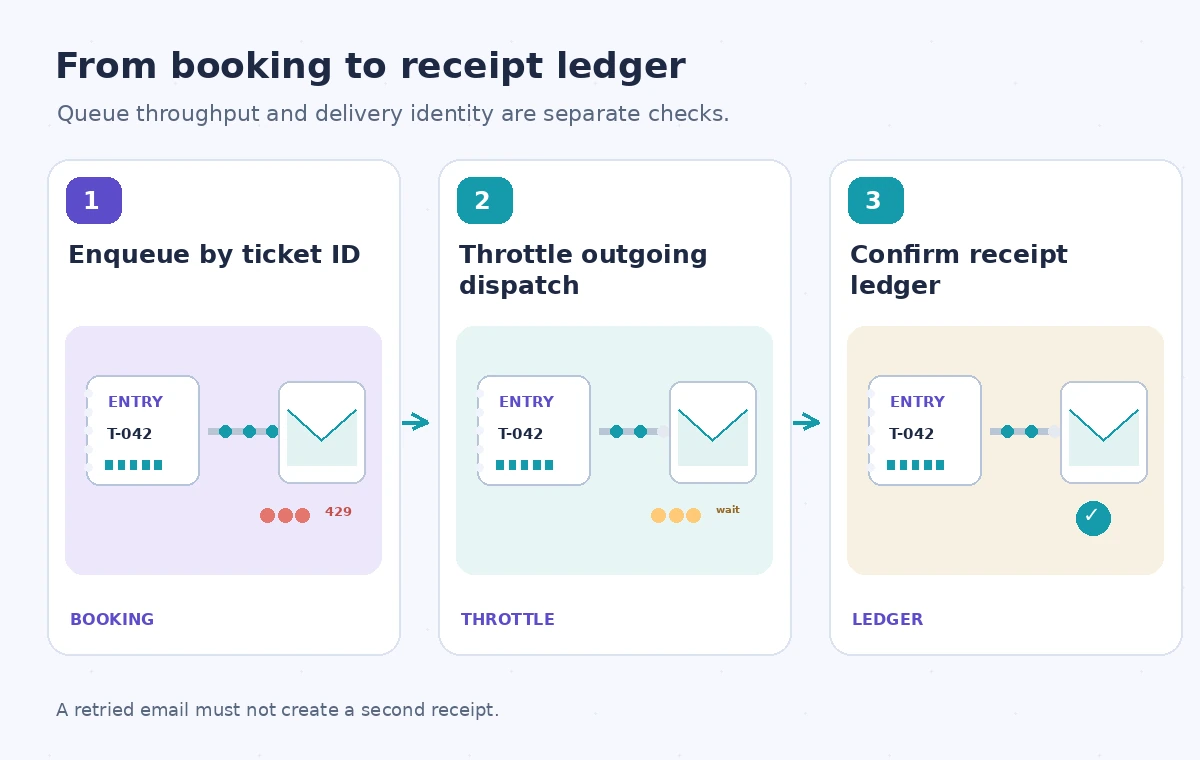
Create one durable intent per booking
Assign each receipt operation a stable internal intent key based on the approved booking identifier and notice type. Store whether an email has been accepted by the sending provider before the worker reports completion. If the same task is attempted again, the worker should consult the ledger and avoid a second irreversible send when the first attempt already succeeded. Personal addresses should stay in the protected booking system; logs and task names should use non-sensitive references. The ledger makes the business effect idempotent even when task execution is repeated. Separate this design from Cloud Tasks task-name deduplication, which addresses task creation rather than every external side effect.
Set a conservative first rate
Begin from the provider’s documented request policy, the worker’s expected latency and available retry headroom. For example, an illustrative design might reserve capacity for manual corrections instead of saturating the endpoint during an event opening. Set maxDispatchesPerSecond and maxConcurrentDispatches together, then inspect actual backlog growth and worker completion times. Do not increase concurrency automatically when there are error spikes: long requests may reflect an overloaded service rather than an artificial queue bottleneck. Document why the starting settings were chosen and who is authorized to change them. The aim is predictable delivery and auditability, not maximal dispatch throughput.
Expect retries and automatic backoff
Google documents that queues can slow down on response failures; HTTP 429, 503 or high error rates may trigger stronger system throttling than configured retry backoff. The Retry-After header can influence timing. Newly created or idle queues can also ramp up gradually, so a burst does not necessarily drain at a constant theoretical maximum. A worker that receives a retry must not assume the prior request had no effect: the mail endpoint may have sent a message before the connection failed. Use provider-side delivery identifiers and your internal ledger to reconcile ambiguous outcomes before dispatching another confirmation.
Compare overload, throttling and safe delivery
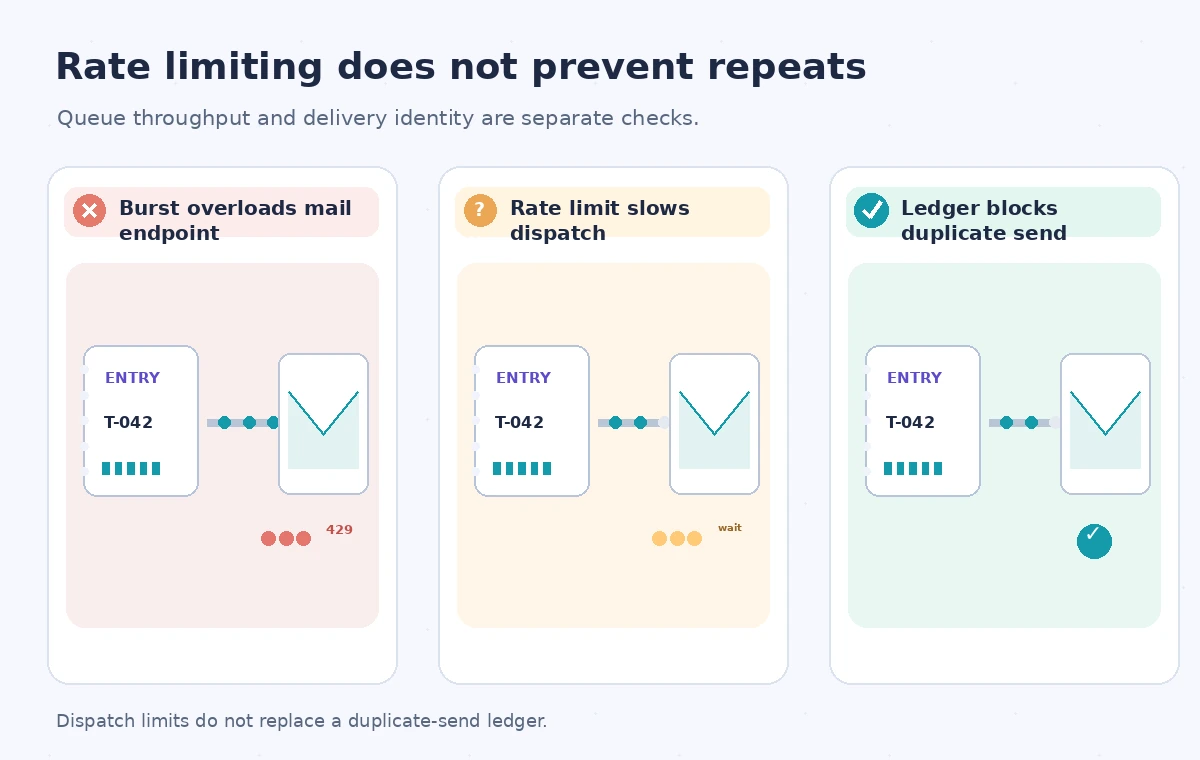
The instructional comparison shows three states. In the first, many tasks race into a mail endpoint that returns 429 responses. In the second, queue controls slow dispatch, yet one network retry can still produce a duplicate if the handler has no ledger. In the third, bounded dispatch is paired with a receipt status check, so a repeated attempt sees the already recorded result. This is a conceptual workflow, not a measured service benchmark. Track queued count, attempt rate, successful receipts, deferred sends and duplicate-prevention events separately. A green queue metric is not proof that every visitor received the correct message.
Keep queue errors distinct from booking errors
When an outgoing notice fails, the booking itself should remain valid. Mark the notification as pending, failed or requires review without mutating the ticket allocation. Establish a safe handling path for permanently invalid addresses rather than replaying them indefinitely. When the endpoint changes its API or authentication policy, pause dispatch until credentials and payload shapes are reviewed. Use an operations view that connects the task identifier, booking intent and provider outcome without displaying confidential visitor data to every engineer. This separation prevents a delivery problem from silently creating or canceling seats.
Reconcile a campaign after the rush
At the end of a busy registration period, compare accepted reservations with the set of unique receipt intents. Investigate bookings with no successful notification, receipts without a matching booking and multiple provider messages for one intent. Do not equate Cloud Tasks acceptance with delivery to a recipient inbox; the mail provider may acknowledge the API request and later bounce an email. Record the method of the reconciliation and its reporting window. An accessibility team may also need an alternative confirmation channel for visitors who cannot receive email, which must be coordinated with consent and communication preferences.
Retest after changing the mail service
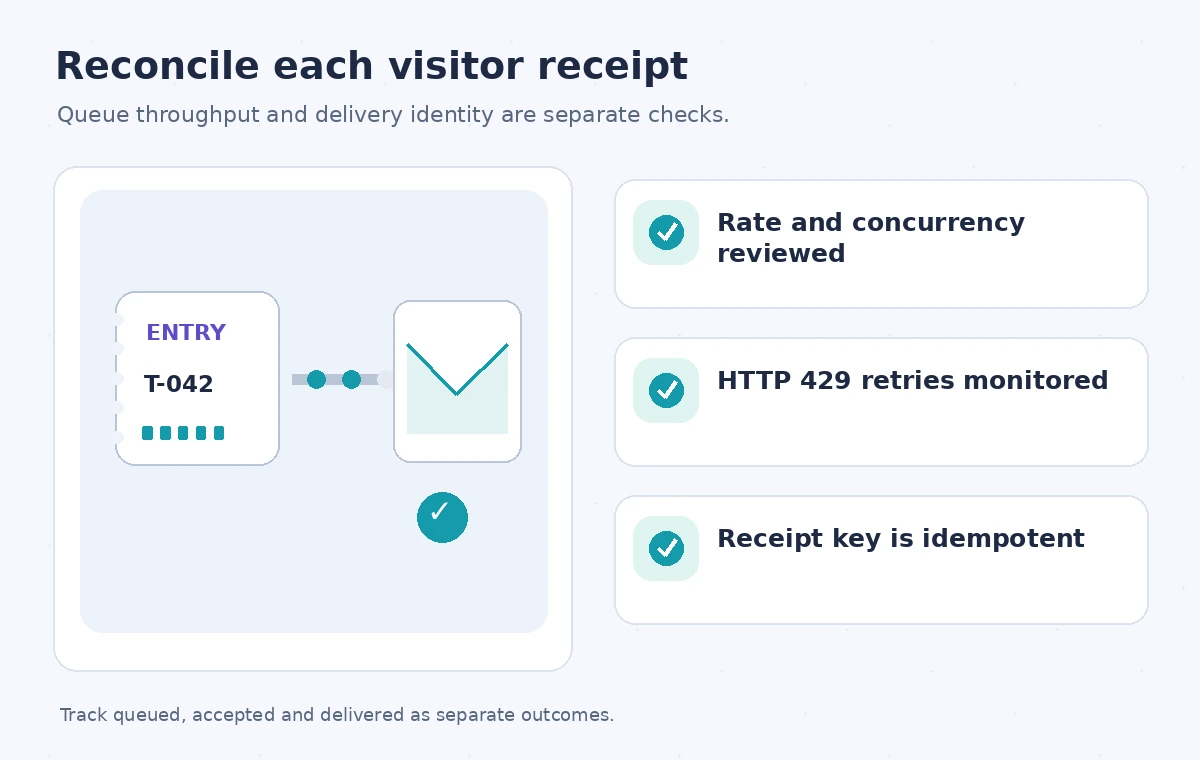
Rate controls, retries, handler latency and provider limits interact. Before a campaign, use an isolated test queue and approved test addresses to simulate successful sends, explicit 429 responses and ambiguous network failures. Confirm the booking ledger prevents duplicate effects during each scenario. Re-evaluate limits after a provider migration or significant template change, and ensure alert thresholds distinguish short initial ramp-up from a genuinely stalled worker. Human staff should approve any bulk replay of unresolved notices. The right operational outcome is an accurate receipt history with recoverable failures, not merely an empty task queue.
How We Research
For this guide we consulted the official documentation: Google Cloud Tasks queue REST resource; Google Cloud Tasks issues and limitations. We compared named fields, supported behaviors and stated limitations, then developed an instructional museum scenario with explicit failure states. We did not run a live vendor API benchmark, inspect a production museum system, or measure vendor performance. The workflow and illustrations are proposed review steps; verify API-version support and your organization’s current policy before applying them.
Frequently Asked Questions
No. Queue rate limiting can allow bursts, and initial ramp-up and system backoff affect dispatch timing.
It limits concurrent in-flight attempts, which matters when a mail handler responds slowly.
Yes. Design the handler and provider reconciliation so a repeated attempt does not send another receipt.
Cloud Tasks can apply stronger backoff and consider Retry-After; monitor the resulting backlog and investigate overload.
No. Compare unique booking intents with provider delivery statuses, bounces and unresolved errors.