
Why editing a live index is not always safe
A regional museum wants to add a new rights field and improve OCR handling in its public object catalog. Some Azure AI Search index schema changes cannot be made in place because field definitions affect the underlying index structures. Rebuilding the only live index risks an interruption and could expose a partially populated catalog. Index aliases let the application use a stable reference that maps to a physical index. The museum can build a new version beside the existing one, test it, and then update the alias mapping. This is a routing technique, not proof that the replacement contains the right records or respects the required publication restrictions.
Know what an index alias points to
An Azure AI Search alias has a name and a target index. Current alias definitions support one target index rather than a list of federated catalog indexes. A client can use the alias for supported search or document operations, and an alias update can redirect the stable name to a different physical index. Keep the alias name distinct from both index names to avoid confusing old and new artifacts in deployment logs. Do not assume an alias can substitute everywhere that an index name appears; the service explicitly limits its use in administrative and indexer-related operations. Record the actual alias definition before and after a release.
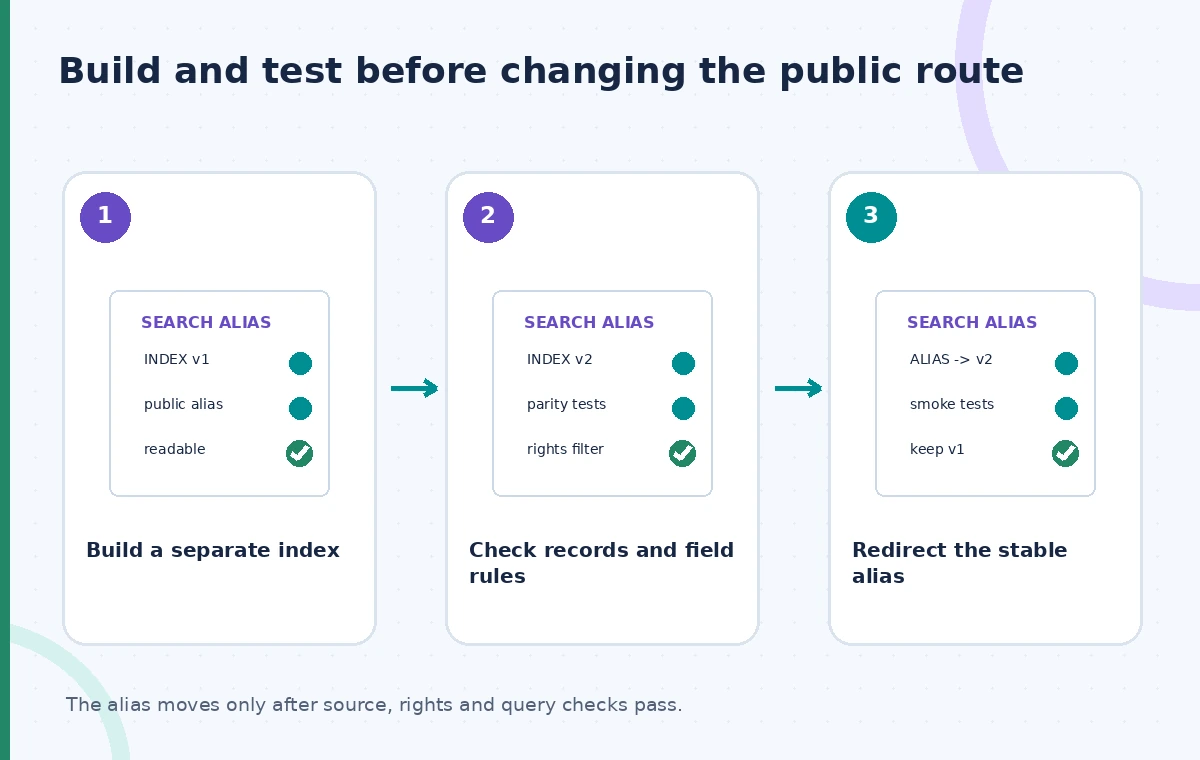
Prepare a parallel, isolated replacement index
Create a new physical index with the intended field schema, analyzers, vector configuration and visibility settings. Populate it from the authoritative catalog export, not from an unverified subset of recent search results. Freeze a source revision or record its change watermark so staff can reconcile updates made while the new index is filling. The data loader and indexer should target the physical index name; Microsoft documents that an alias cannot be specified as an indexer’s targetIndexName. Keep public and restricted data boundaries explicit in the ingestion process. A brand-new index that accidentally exposes private acquisition notes is not ready merely because the indexing run reported success.
Define parity tests before shifting readers
Select stable test cases from the existing approved index: a known accession ID, an object with a restricted image, a loan return date, an OCR synonym and a record intentionally removed from public view. Query both index versions with the same authorization and filter context. Compare identifiers, selected fields, scoring where relevant, and the presence or absence of blocked records. Index statistics and document totals can help flag a large mismatch, but counts alone cannot establish that the correct rights record accompanies each accession. Keep results attached to the frozen source revision and require a human reviewer for any changed public-facing interpretation.
Compare three phases of the cutover
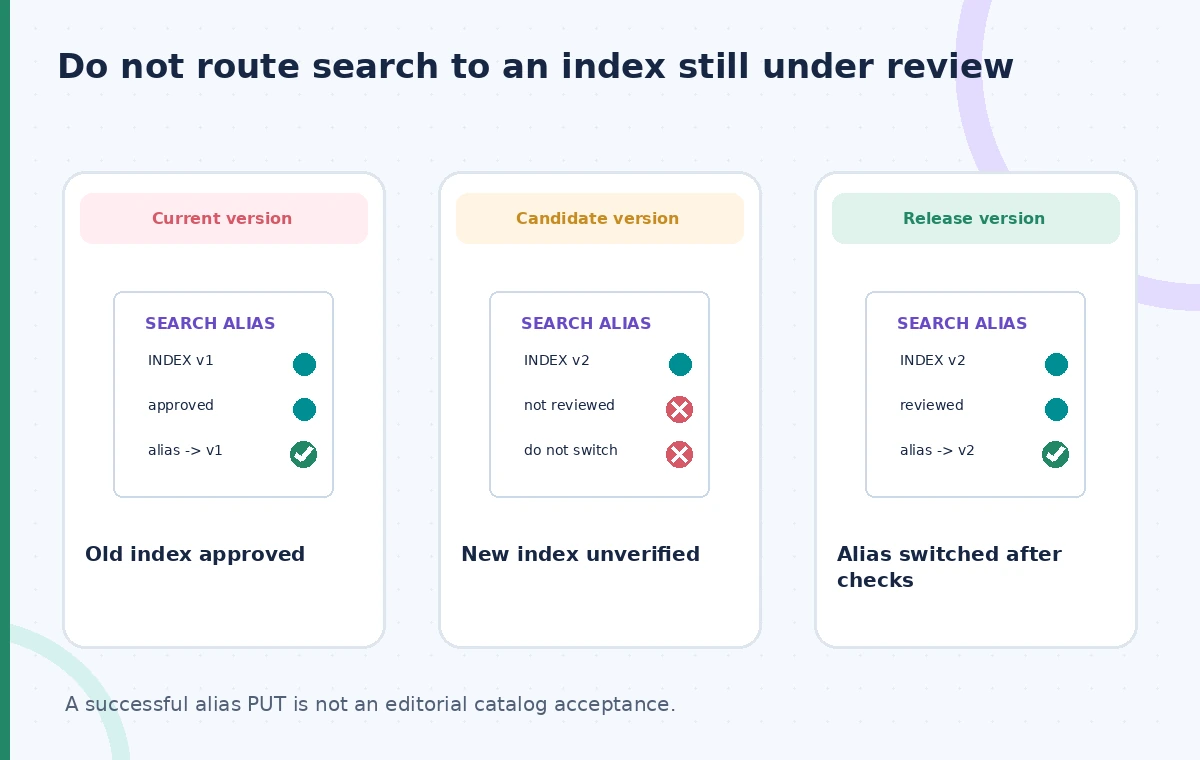
The diagram contrasts the incumbent approved index, a rebuilt index that has not yet passed parity checks, and a released alias pointing at a verified replacement. In the middle phase, the new physical index may exist and respond to queries while still missing a rare object type. Therefore do not route public traffic there yet. In the final phase, update the alias deliberately and verify real client queries through the alias name itself. These are conceptual states rather than a claim that a specific Azure service has performed a zero-downtime migration. A rollback requires the previous index and permissions to remain available.
Understand propagation and client caching
Azure documentation notes that an updated alias mapping can take a short time to propagate. Do not delete the old index immediately after the API returns success; Microsoft recommends waiting at least ten seconds before attempting cleanup. For a responsible public-catalog release, allow additional time for end-to-end smoke tests and clients that may cache responses or connections. Confirm that the API version and SDK your project uses support the intended alias operations. Use supported conditional requests or change governance where appropriate to avoid one release overriding another. An alias update is an operational switch, not a transactional approval of every related data source.
Avoid unsupported alias uses
An alias can be used for supported document operations, but it cannot be used to delete an index or test text tokenization, and it cannot serve as an indexer’s targetIndexName or a knowledge source target. A deployment script that assumes all endpoints accept aliases may pass the search smoke test and fail only when its background ingestion pipeline starts. Separate physical index identifiers from the public alias in configuration. Keep indexer definitions and skillsets tied to the correct staged index and update them through a controlled process. Do not rename or delete a physical index in the belief that the alias will automatically relocate everything associated with it.
Plan rollback and audit evidence
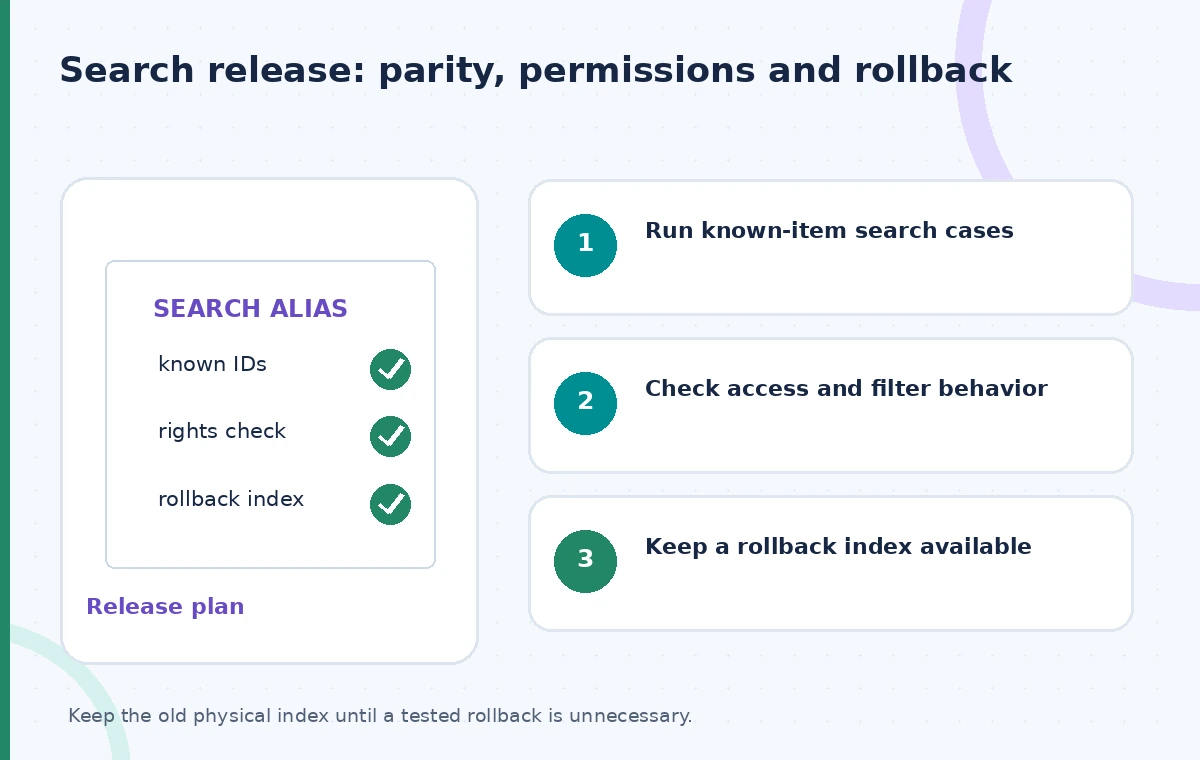
Retain the old physical index for an approved rollback window, provided organizational retention and cost rules allow it. Record old and new index names, the alias update request, time, operator, source manifest and test results. If a rare object class disappears after cutover, update the alias back to the verified version rather than hot-patching the new index without a diagnosis. Then reconcile changes that occurred after the previous index was built so rollback does not silently resurrect an older rights state. A rollback plan should test the actual query client and permissions, not only successful administrative API responses.
Release only after catalog and rights review
The final gate should verify common searches, known exceptions, missing-record reports, language behavior, public filters, indexing warnings and a representative set of image rights. Keep the editorial team involved because an index can be technically available while still presenting an inaccurate provenance note or the wrong thumbnail. Publish an internal release note explaining what changed and how to report a suspected missing item. Review real traffic after cutover for unexpected empty searches. Azure index aliases minimize coupling between the application and an index name; they do not perform content QA, access control design or historical data reconciliation for the museum.
How We Research
Our research consulted these named official documents: Microsoft Learn: Create an index alias; Microsoft Learn: Create a search index; Azure Search REST API: Aliases. We checked tool behavior, version-specific options, and stated limitations against an illustrative museum scenario. The examples are suggested implementation and editorial review procedures, not production tests. We did not call the services with live patron records, benchmark latency or accuracy, measure storage savings, or obtain third-party consent. All images are original explanatory drawings rather than screenshots or claimed measured results. Verify provider documentation, service availability, access policies and current organization rules before adoption; keep final publication approval with authorized staff.
Frequently Asked Questions
No. The alias definition maps to one target index in the documented API.
No. Configure the indexer with the target physical index name.
No. Validate source coverage, rights filters and known record queries before and after cutover.
No. Allow mapping propagation and a verified rollback window; test live client queries first.
Keep the previous index and its access settings, plus a plan for updates that occurred after it was built.