
The duplicate-email problem begins before delivery
A museum gift shop completes a ticket purchase and asks a background worker to send an electronic receipt. The checkout service times out while creating a Cloud Tasks task, even though the API may have accepted the request. The client retries, and with automatically generated task names it might enqueue another job. Later, a transient mail-provider error could also cause the handler to run more than once. These are two different duplication paths: duplicate task creation and duplicate side effects during delivery. Google Cloud Tasks supports caller-chosen task IDs to help with the first path. A safe receipt workflow must additionally make the downstream send decision idempotent, because a unique task name does not give end-to-end exactly-once email delivery.
Derive a stable key from the purchase record
Use the payment or order record as the source of truth. The task key should represent a specific business operation, such as send receipt for order 7F21, rather than a newly generated ID on each HTTP attempt. Avoid placing an email address, card details or visitor name in the task name. A hashed order identifier with a uniformly distributed prefix is a better starting point than sequential IDs that may create hot spots. Google documents that user-specified task names incur an additional lookup cost, and sequential task names or prefixes can increase latency and errors. Store the mapping between internal order ID, task name and receipt version inside your application. If a corrected receipt is an intentionally new operation, version its key deliberately.
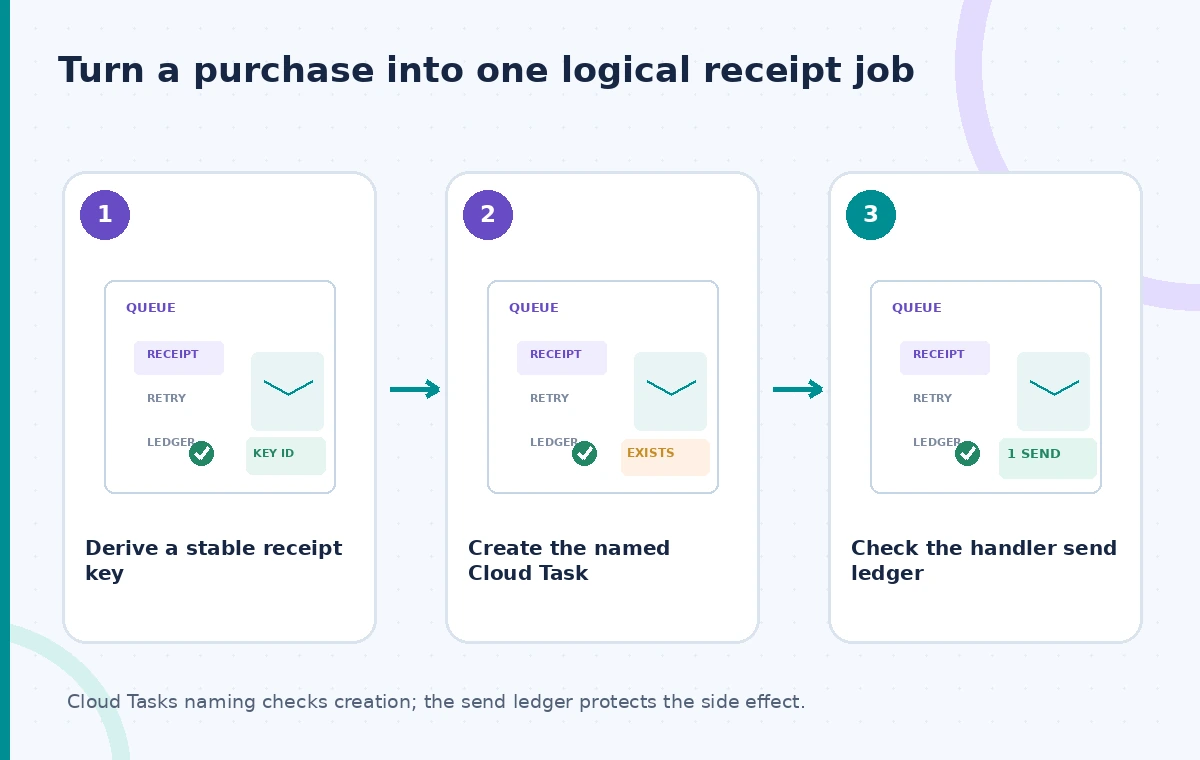
Understand the task creation response
When CreateTask specifies an explicit name, a request with an ID still in use or recently used can fail with ALREADY_EXISTS. The documented deduplication window is limited; it is not permanent reservation of a business ID. Older App Engine queue configurations can have different retention rules for recently used IDs. Treat ALREADY_EXISTS as a reason to check the existing operation record, not as independent evidence that an email reached the buyer. Cloud Tasks assigns a random unique task ID if the caller omits a name. Record the request identifier and the final task name so you can distinguish the original create, a duplicate request and a genuine new receipt revision during incident review.
Separate task acceptance from receipt dispatch
A named task tells the queue which work item to schedule. It does not control the entire behavior of the HTTP handler or external email service. Cloud Tasks can retry delivery when the handler fails or does not acknowledge the work under its retry policy. The handler therefore needs an idempotency key checked against an application ledger before it triggers a send. Put the ledger state and related side effects in a transaction where feasible, and understand the gap between recording a send request and receiving confirmation from a mail provider. Some providers support their own idempotency keys; if yours does, evaluate them. Otherwise design a reconciliation path for ambiguous send outcomes instead of blindly retrying an email that might already exist.
Compare three actual operational states
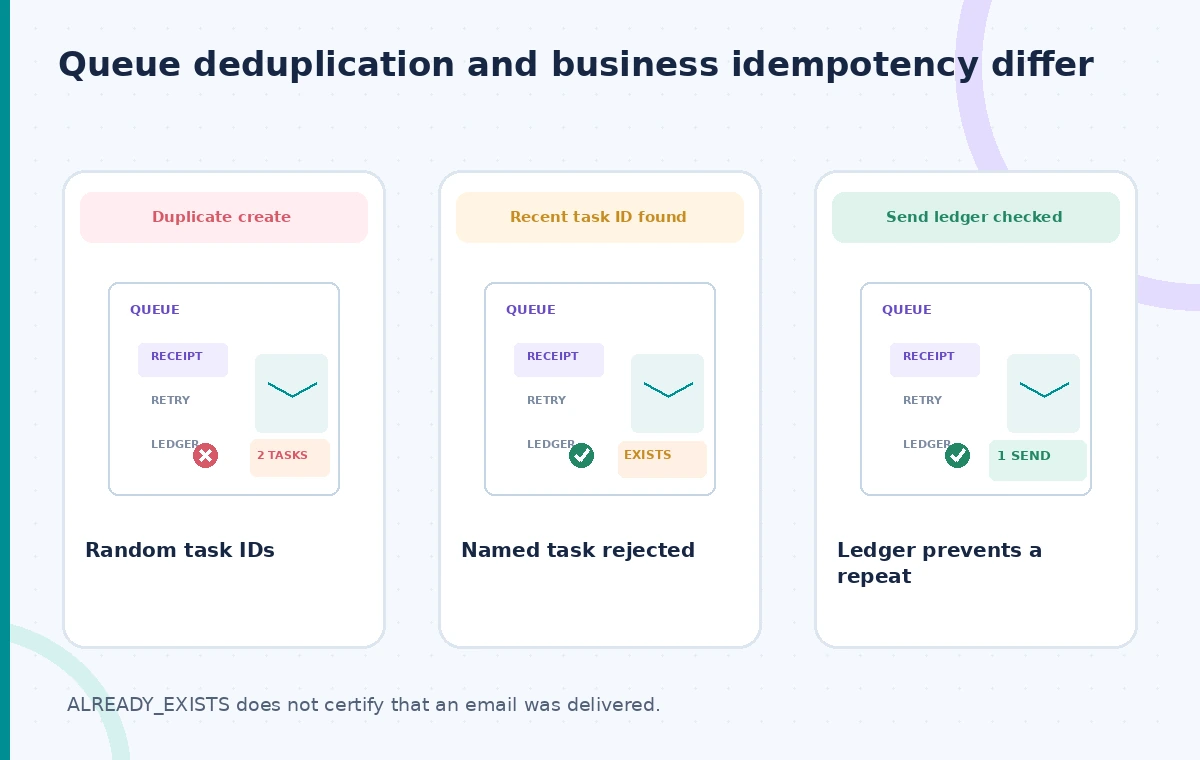
The illustration contrasts a client retry that creates two randomly named tasks, a second create that is recognized as the same named task, and a consumer that consults an application ledger before sending. The middle picture limits duplicate queue entries during the supported time window, but does not guarantee a customer receives exactly one message. The final state shows a separate business guard, plus an outcome that can be audited. These scenes are explanatory, not screenshots from a real checkout. Do not claim an exactly-once guarantee because both queue delivery and an external mail API can have ambiguous failure conditions. Record which boundary each guard actually covers.
Test the ambiguous timeout case
Create a synthetic order in a sandbox and submit a task with a fixed name. Repeat its creation as if the first client request had timed out. Confirm that the application handles ALREADY_EXISTS without adding a second logical operation. Next, arrange for the handler to be invoked again using a controlled retry, and verify that the send ledger prevents a duplicate receipt. Use a test mailbox or stubbed email adapter, never real patron addresses. Include an intentionally new corrected receipt version to prove that a valid second communication is not permanently blocked. Preserve timestamps, task IDs and ledger decisions so staff can distinguish a test from a production customer contact.
Do not make a task name carry private information
Task names may appear in logs, diagnostic URLs and staff tooling. A stable name should be opaque and have no directly readable visitor data. Keep sensitive receipt content in protected application storage with limited retention, and let a handler look it up using an authorized internal key. Review which service identity can create tasks, which identity can invoke the HTTP target and which system can mark a receipt sent. A task ID is neither a secret nor an authorization token. Security reviews should include failed dispatches, queue backlog and permission changes, not just duplicate counts. An apparently quiet queue can still hide a provider-side delivery error.
Monitor two ledgers, not one green metric
A useful operations view reconciles completed purchases, logical receipt jobs and the mail-provider status. Alert on purchases without a recorded receipt attempt, retries that cannot determine whether an email was sent, and multiple send records for the same receipt version. Watch task creation errors and handler failures separately. If staff resend a receipt manually, record that intervention as a new authorized action with a clear reason. A dashboard showing no duplicate Cloud Tasks IDs is not evidence that no duplicate emails were sent. The distinction matters for visitor trust, charge disputes and support investigations. Use the underlying order record as the final reconciliation anchor.
Write a safe recovery playbook
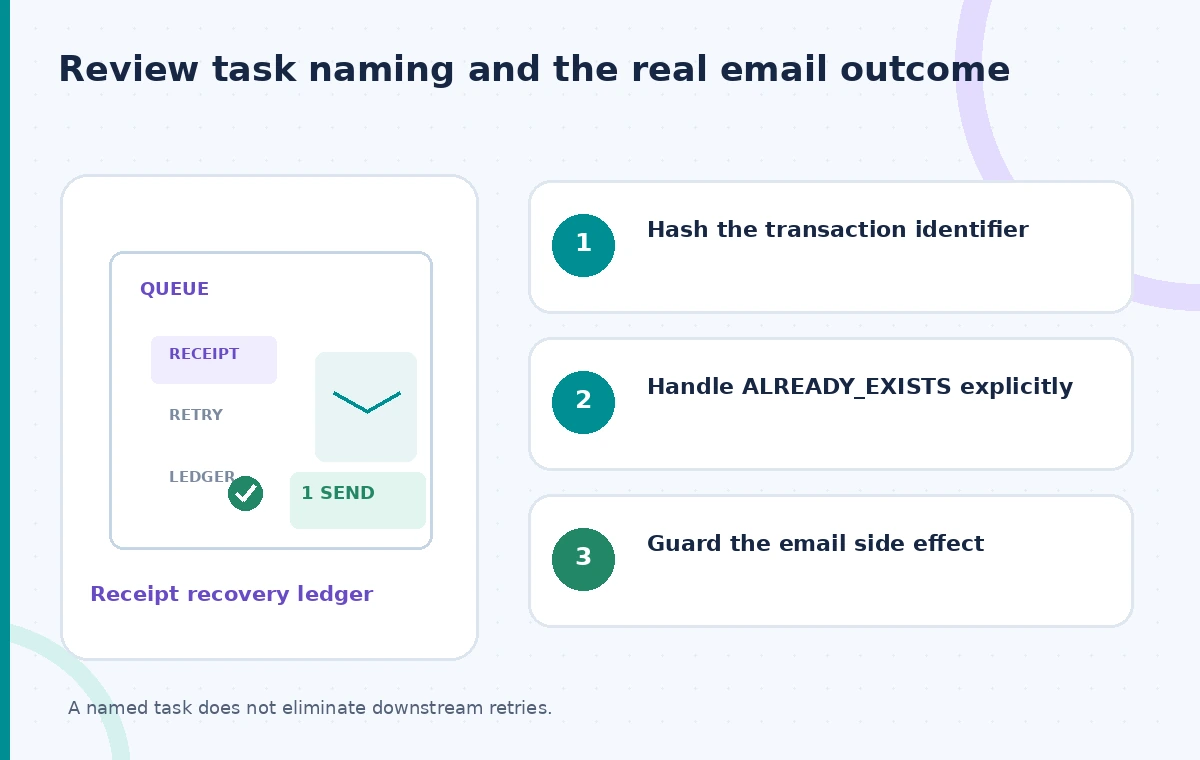
When a purchase confirmation is missing, customer service should look up the order ID, the corresponding named task, the handler ledger and the mail provider outcome before rescheduling. If the original send is confirmed, offer a deliberate resend rather than fabricating a lost-task failure. If the outcome remains unknown, route to a human review policy. Retest the workflow when queue settings, send provider, retry configuration or application key generation changes. The strongest lesson is that task-name deduplication helps reject recent duplicate creates, while idempotent business logic and human recovery prevent a queue detail from becoming a customer-facing mistake.
How We Research
Our research consulted these named official documents: Google Cloud: Create Cloud Tasks tasks; Google Cloud: Cloud Tasks v2 RPC reference; Google Cloud: Understand Cloud Tasks. We checked tool behavior, version-specific options, and stated limitations against an illustrative museum scenario. The examples are suggested implementation and editorial review procedures, not production tests. We did not call the services with live patron records, benchmark latency or accuracy, measure storage savings, or obtain third-party consent. All images are original explanatory drawings rather than screenshots or claimed measured results. Verify provider documentation, service availability, access policies and current organization rules before adoption; keep final publication approval with authorized staff.
Frequently Asked Questions
No. Cloud Tasks can generate a random task ID, but an explicit stable ID enables creation-time deduplication.
Only that a matching task name is still reserved by the service; it does not prove the receipt was delivered.
No. The documented deduplication window is limited and depends on queue history.
A handler can be retried and a mail provider may have an ambiguous outcome after a timeout.
It should not. Prefer opaque identifiers so logs and resource names do not reveal patron information.