
What the previous response header can tell you
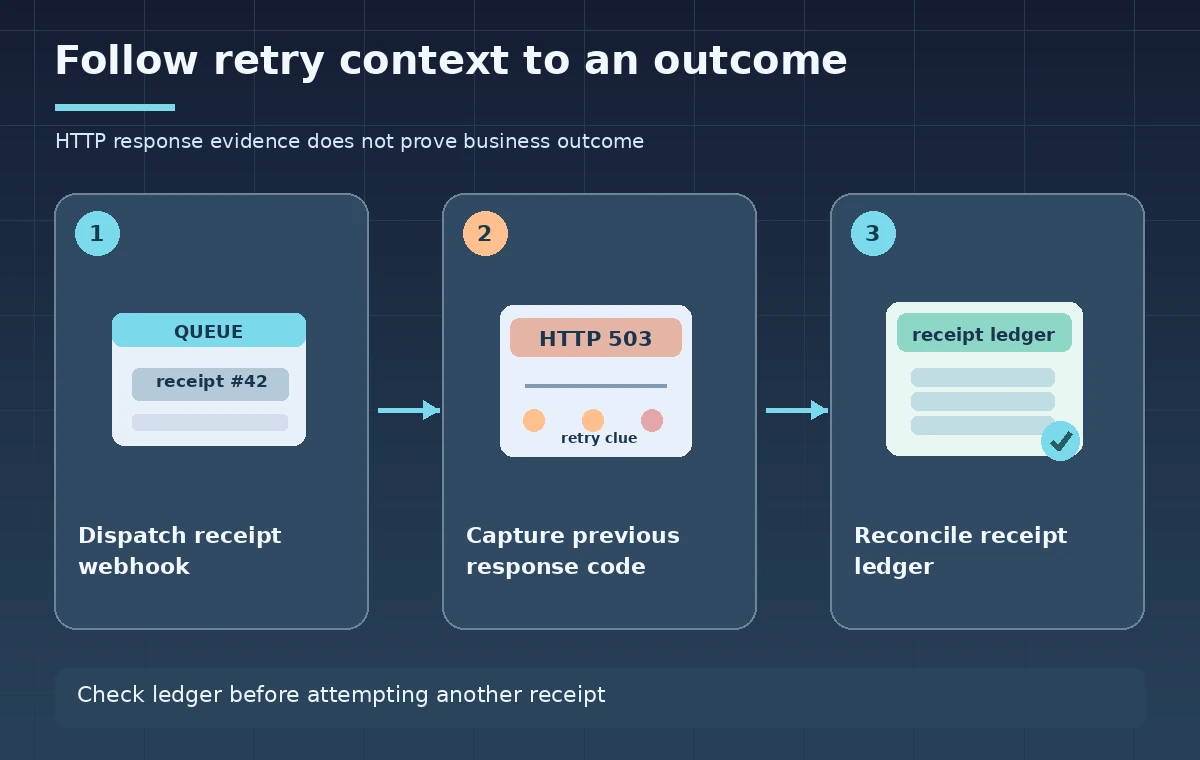
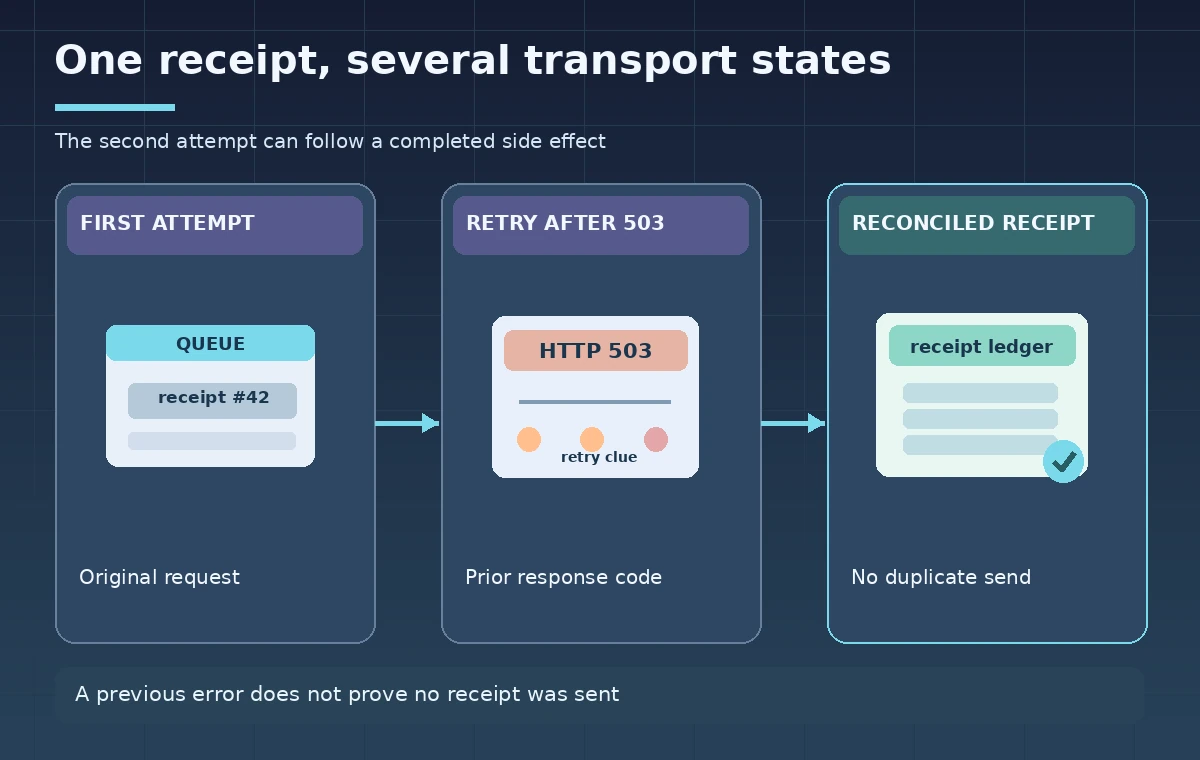
A museum sends one receipt notification through an HTTP Cloud Tasks queue. If the worker reports an error, a later attempt may arrive with `X-CloudTasks-TaskPreviousResponse`, a Cloud Tasks header containing the previous retry response code. It is useful for diagnosis, but the documentation lists it among headers that might be present, not a durable accounting record. A 503 from a prior attempt does not reveal whether the worker wrote a receipt before the connection failed. A production handler should treat the header as contextual telemetry and reconcile the business event through a separate persistent ledger.
Understand the delivery envelope first
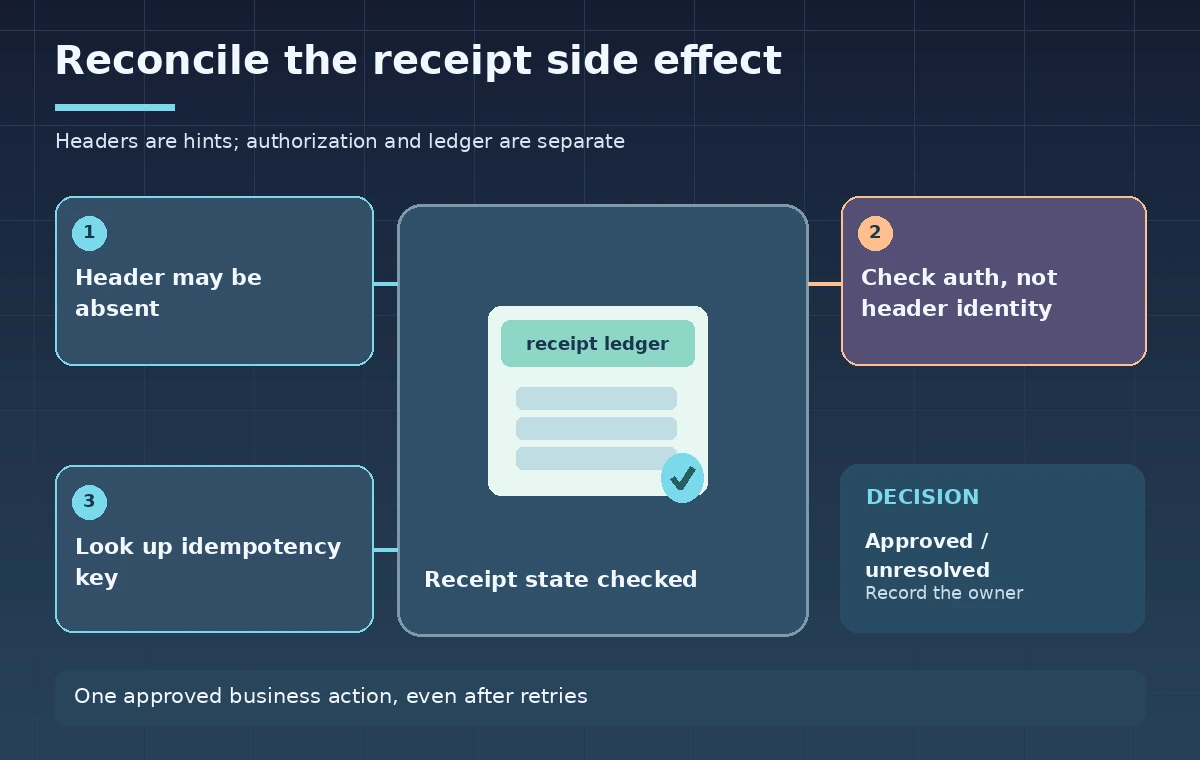
Google documents task-related headers such as queue name, task name, retry count, execution count, estimated dispatch time, and optional previous-response details. HTTP target handlers receive ordinary HTTP requests with additional metadata. Those headers are informational; they are not a substitute for authenticating the sender. Before reading any retry signal as trusted context, verify the intended service identity with the appropriate OIDC mechanism or the supported authentication for the target. Restrict who can enqueue tasks and what endpoint the queue can call. A public endpoint that accepts spoofed task headers is not made safe by logging the header values.
Identify an idempotency key independent of retries
Use an application-level receipt identifier associated with the approved transaction, not a changing attempt counter or a timestamp. Persist it in a table that can atomically mark an operation as completed or pending. The same logical notification might be retried because of network uncertainty; a task name can help trace delivery, but the business key must match the record whose side effect you are protecting. For example, a membership payment receipt may have a stable payment-event ID with a uniqueness constraint. The worker should check that record before attempting to send another message, then store completion status and provider response under the same key.
Handle missing or misleading header data
A first attempt ordinarily has no previous retry response to report. An optional header can also be unavailable for other reasons, so the handler must not fail solely because it is missing. Store the presence or absence of the header, the current request time, and a sanitized task identifier in operational logs. Do not put visitor email addresses, full payloads, OAuth credentials, or payment details in a publicly accessible trace. If an operator sees a prior 429 or 503, that is a clue about earlier delivery attempts, not enough evidence to decide whether a receipt already reached the external provider.
Separate transport failures from business failures
Consider a worker that successfully sends a receipt, then crashes before returning HTTP 2xx to Cloud Tasks. The platform can retry because it did not receive a successful acknowledgment, even though the message may already have been delivered. Conversely, a 2xx response from a handler that skipped required validation can conceal an unfinished business operation. The team should track three states independently: the platform attempt, the worker’s internal operation, and the downstream provider’s acceptance. A retry header describes only part of that story. Apply a unique constraint, atomic update, or provider-supported idempotency key to prevent duplicate externally visible side effects.
Read retry count and execution count carefully
Google’s documented `X-CloudTasks-TaskRetryCount` counts retries, including some unsuccessful attempts that never reached handler execution, while `X-CloudTasks-TaskExecutionCount` counts attempts for which the handler returned a response. Those measures should not be treated as interchangeable. A higher retry count does not necessarily mean the receipt-generation code ran repeatedly. Link the count and previous-response clue to the queue’s retry policy, handler access logs, and ledger state before drawing conclusions. Alerting may use these signals to prioritize investigation, but it must not automatically authorize duplicate sends or broaden credentials.
Prepare a narrow, privacy-safe operational trace
A useful diagnostic record includes a pseudonymous task reference, approved receipt key, current attempt timestamp, optional previous response code, current HTTP result, and whether the idempotency ledger recorded a completed side effect. Keep the trace under restricted retention; staff investigating retries should not need full payment or visitor payloads. When testing, use synthetic identifiers and a staging queue. Reproduce a simulated timeout after a ledger write to confirm that an additional attempt exits harmlessly. Such an exercise proves the logic of the test environment only; it is not evidence about production delivery rates or completed receipts.
Reconcile ambiguous cases before taking action
Imagine a hypothetical webhook with a previous response code of 503 and a ledger row showing receipt issuance completed. The safe next step is to return success without sending again, after verifying the ledger’s integrity and the worker’s authorization. If the row is pending, reconcile the provider-side transaction using the provider’s documented lookup operation before retrying the side effect. Do not infer that all 503 attempts failed before reaching the service. The same response code can arise from several different failure points. Record uncertain cases explicitly and escalate them for human investigation when reconciliation cannot establish a safe next action.
Use controlled changes instead of blind replays
Fix recurring failures by verifying endpoint routing, rate limits, queue retry configuration, worker timeouts, and downstream capacity. Review errors over time without changing live queue behavior during an unresolved incident. A manual replay should be treated as a new operational action requiring a documented business-key check, not as a routine cure for a bad status code. Maintain a runbook that explains where attempt logs, ledger rows, and provider receipts are found. The right success criterion is one authorized receipt per approved transaction, not merely a green task status or a low retry count.
How We Research
Primary official sources reviewed November 11, 2026: Google Cloud: Create HTTP target tasks; Google Cloud: Task retry behavior; Google Cloud Tasks API: Task. We compared Google Cloud’s HTTP task-handler header reference and Cloud Tasks delivery guidance, then designed a hypothetical receipt workflow with distinct transport and business state. We did not observe live Cloud Tasks, payment systems, or webhook traces. All sample identifiers, interface states, examples, images, and comparisons in this article are editorial teaching materials, not test results, measured figures, actual API calls, or vendor screenshots. Product parameters, model support, region availability, quotas, access requirements, and prices may change. Confirm current vendor documentation and institutional permission before using any workflow with real data.
Frequently Asked Questions
No. Google describes it as a header that might be present. A first attempt may not have a previous response to report.
No. A handler can perform the external action and fail before acknowledging the task. Inspect the idempotency ledger and provider state.
No. Treat Cloud Tasks task headers as information, not identity. Verify the request with the supported authentication configuration.
Some failed dispatch attempts never produce a response from the handler. The two headers count different stages.
A stable business-event identifier and durable, atomic idempotency logic, backed by downstream reconciliation when status is uncertain.