
Why a rejected accession update is useful information
A registrar opens an accession record while a conservator updates the item’s condition notes. When the registrar saves an old revision, an optimistic-concurrency condition can reject the write instead of overwriting the conservator’s newer edit. DynamoDB provides ReturnValuesOnConditionCheckFailure to return existing item attributes when an appropriate conditional operation fails. That can help the application explain what changed without an additional read. It does not decide which revision should win, and returning a full item can create a privacy exposure. The example here uses invented accession records and no live database. The objective is a safe conflict-review interface, rather than a feature comparison based on made-up latency or billing numbers.
Require a condition before interpreting the failure
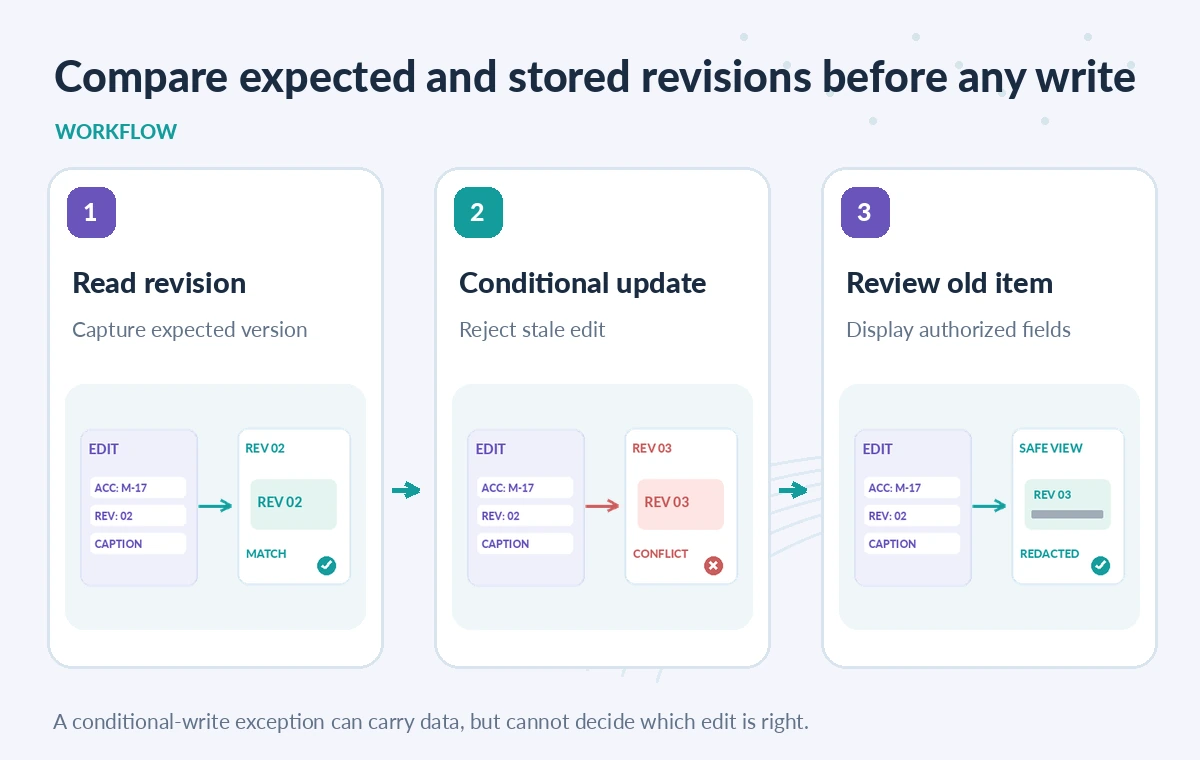
The feature becomes meaningful only when the write is protected by a ConditionExpression. For example, an UpdateItem request could require an expected revision number before replacing a caption. If the stored revision differs, DynamoDB rejects that conditional update. The default ReturnValuesOnConditionCheckFailure is NONE, so the exception does not normally provide the current item. Specifying ALL_OLD permits existing attributes to come back with a ConditionalCheckFailedException. Store the expected revision separately from user-entered text, so the UI can clearly identify which version the editor reviewed. Avoid an unconditional retry with the same candidate caption: doing so can overwrite the newer approved work that the condition was designed to preserve.
Distinguish ReturnValues from failure return values
Two similarly named API options behave differently. ReturnValues controls what can be returned for a successful update, including OLD or NEW attribute selections. ReturnValuesOnConditionCheckFailure controls the returned old item when a condition check fails, and its documented choices are NONE or ALL_OLD. A successful write is not the same state as a failed one; the two response paths deserve separate tests. In a test fixture, deliberately submit a stale version, check the returned failure type and verify that the stored item was not modified. Then submit an allowed revision and verify only the intended fields changed. Do not write a UI message that says the application saved successfully merely because it received a useful diagnostic payload.
Limit who can see the returned existing item
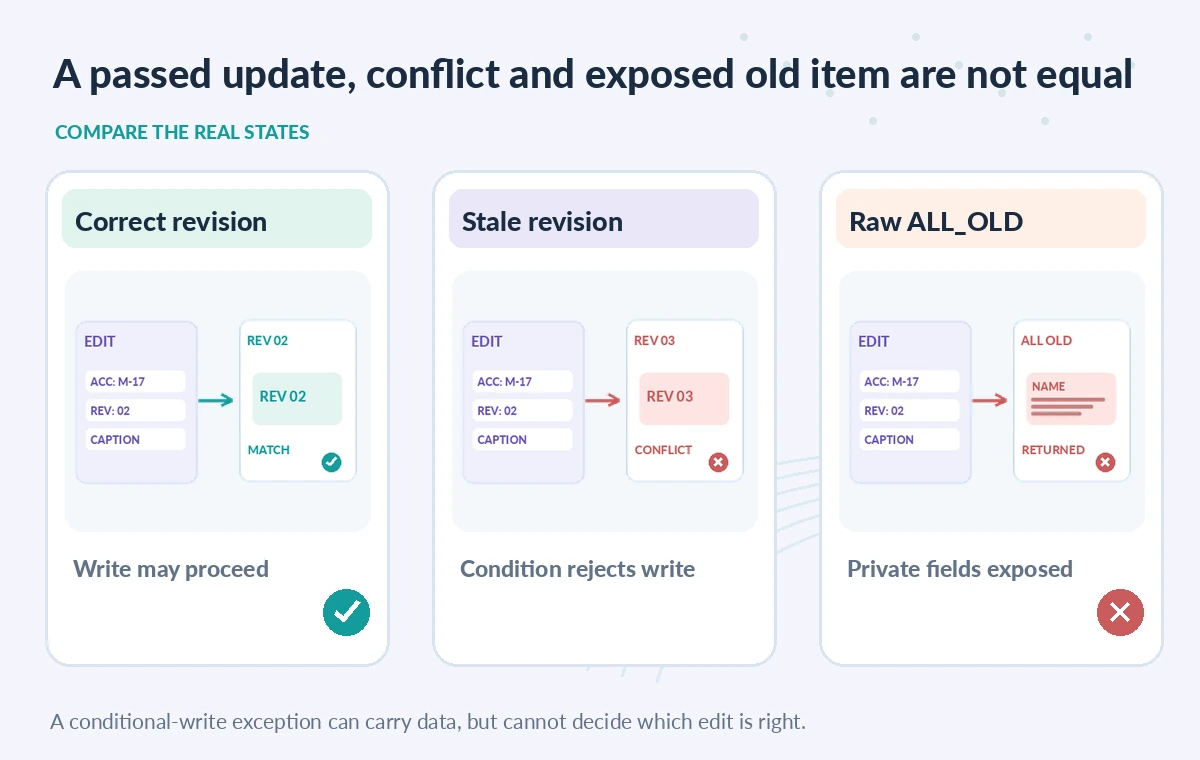
ALL_OLD may include every stored attribute: private donor details, loan agreements or a staff contact that the current editor does not need to see. The response should not be forwarded unchanged to a web client, incident channel or analytics stream. Apply least-privilege IAM and application authorization for the entire item, then select a minimal set of fields in the trusted service before showing a conflict summary. If the caller is not authorized to inspect the existing record, prefer the default NONE behavior and an ordinary generic conflict message. This is a security decision separate from the conditional-write mechanism. A useful diagnostic feature can become a disclosure channel if developers mistake database access for end-user permission.
Compare three conflict-resolution outcomes
Picture an editor who changes a photograph caption while another editor adjusts a conservation restriction. An unconditional update may erase the restriction; that is a process failure even if the database returns success. A conditional update with NONE prevents overwrite but gives the UI little immediate context, so the editor may need an authorized refresh. A conditional update with ALL_OLD can provide a controlled summary of the newer revision while the write remains rejected. These are conceptual states, not measurements. Importantly, the old item should not be labeled an approved replacement merely because it was returned by DynamoDB. Its editorial status still comes from the record’s provenance and the museum’s review workflow.
Design a field-level merge review, not an automatic winner
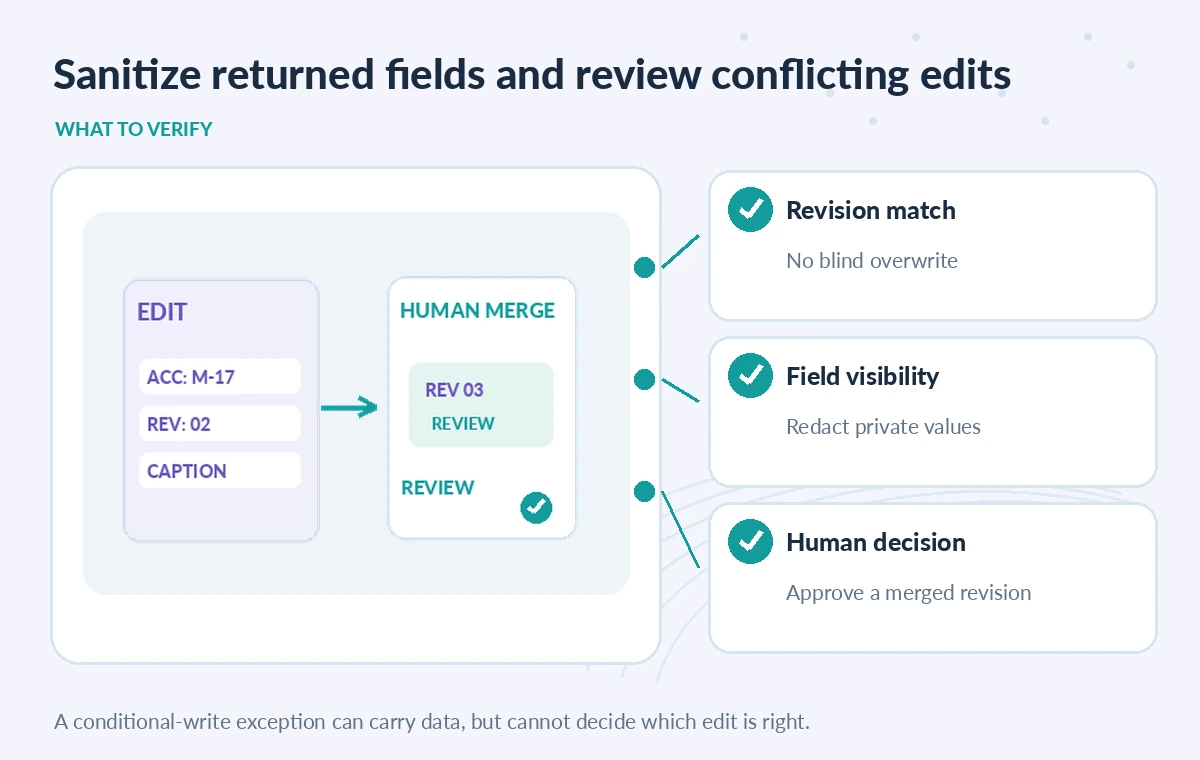
When a conflict occurs, show a three-column comparison of the editor’s proposed change, the current authorized value and the source document or review note. Use a fresh expected revision for the next conditional request, and require a reviewer to explicitly choose which changes to retain. Avoid blindly merging arrays such as collection tags or rights notes, where ordering and meaning may matter. The recovery flow should record a pseudonymous record ID, compared revision numbers and an approval decision, without persisting a raw ALL_OLD payload in a general audit log. For critical rights restrictions, escalate to a designated registrar. The database can detect disagreement; it cannot determine factual or legal priority among edits.
Count consumed capacity and error-handling costs accurately
AWS documentation notes that condition failures still consume write capacity, even though the intended update did not succeed. Returning old attributes does not itself add read capacity charges, but it does increase response size and handling complexity. Do not promise that ALL_OLD makes every workflow cheaper, nor turn the documentation into a numeric speedup claim. In an internal benchmark, compare exception-handling requests, retry rate, sanitized response size and operator resolution time on an authorized test dataset. A failed conditional update is a planned branch of the business workflow, not necessarily a system outage. Alerting every conflict as a high-severity service failure will hide more important operational incidents.
Verify table and transaction behavior separately
Different write APIs and transaction structures have their own parameters and exception formats. The relevant DynamoDB API references cover UpdateItem and transactional operations such as ConditionCheck. Confirm the chosen SDK’s response fields and exception handling rather than assuming every failure exposes identical serialized attributes. Test missing-item cases, stale revisions, access-denied conditions and malformed expressions separately. A missing item does not authorize an implicit create unless the business rule allows it. Preserve original source document identifiers and restrict any replay of failed edits. If a staff client was offline during a revision change, its next write should be treated as a proposed change against the latest authorized baseline, not as a guaranteed successful synchronization.
Give registrars an audit-ready conflict checklist
The handoff should state the conditional expression, revision field, failed-write response policy, allowed viewer roles and sanitization boundary. Include a failure example with invented data showing what was rejected and which current fields are safe to display. Require a second reviewer for rights or condition-sensitive edits, and record the resolved version’s source citation. A successful technical retry still needs normal editorial signoff. ReturnValuesOnConditionCheckFailure is valuable because it can provide diagnostic state in the same failed operation, but the organization must ensure that returned state is neither misinterpreted as approval nor exposed beyond authorized staff. Preserve the conflict as evidence of concurrent work, not as a reason to discard either contribution automatically.
How We Research
For this guide, we reviewed the official product documentation on November 8, 2026: AWS DynamoDB Working With Items, AWS DynamoDB UpdateItem API, AWS DynamoDB ConditionCheck API. We checked the named setting or feature against its published behavior, mapped the documented constraints to the specific hypothetical scenario, and reviewed whether the topic duplicated titles in the supplied LabFin WordPress inventory or earlier LabFin draft article packages. No authenticated vendor service was run; we did not perform a benchmark, observe real customer data, verify third-party rights or claim operational outcomes. All illustrated records and comparisons are teaching examples. Confirm product documentation and security requirements again before implementing a workflow in a real organization.
Frequently Asked Questions
It can return attributes of the existing item with a conditional-write failure for supported operations.
No. ReturnValues relates to successful updates; the other option controls data returned when a condition fails.
The rejected update does not apply, but you should separately verify retries and concurrent operations.
AWS documents no additional read capacity consumption from requesting the returned values, though failed conditional writes consume write capacity.
Not by default. Restrict and sanitize attributes according to the operator’s permissions, or use NONE.