
Supplier Marketing Text Is Not the Same as Safety Evidence
A small museum asks an assistant to compare a supplier’s claims about an adhesive used in conservation work. The assistant produces a polished summary with a citation to a reseller page, but the buyer still needs to know whether the claim appears in a current manufacturer document, an outdated sales sheet, or a third-party summary. OpenAI’s Responses API supports hosted web search and an optional include value named web_search_call.action.sources, which provides source details from the web-search tool call. That list is an audit aid, not certification that a material is safe for fragile collections. This fictional purchasing scenario makes no claim that we queried a live supplier, reviewed chemical data, or validated a product.
Enable Web Search and Request the Source List Deliberately
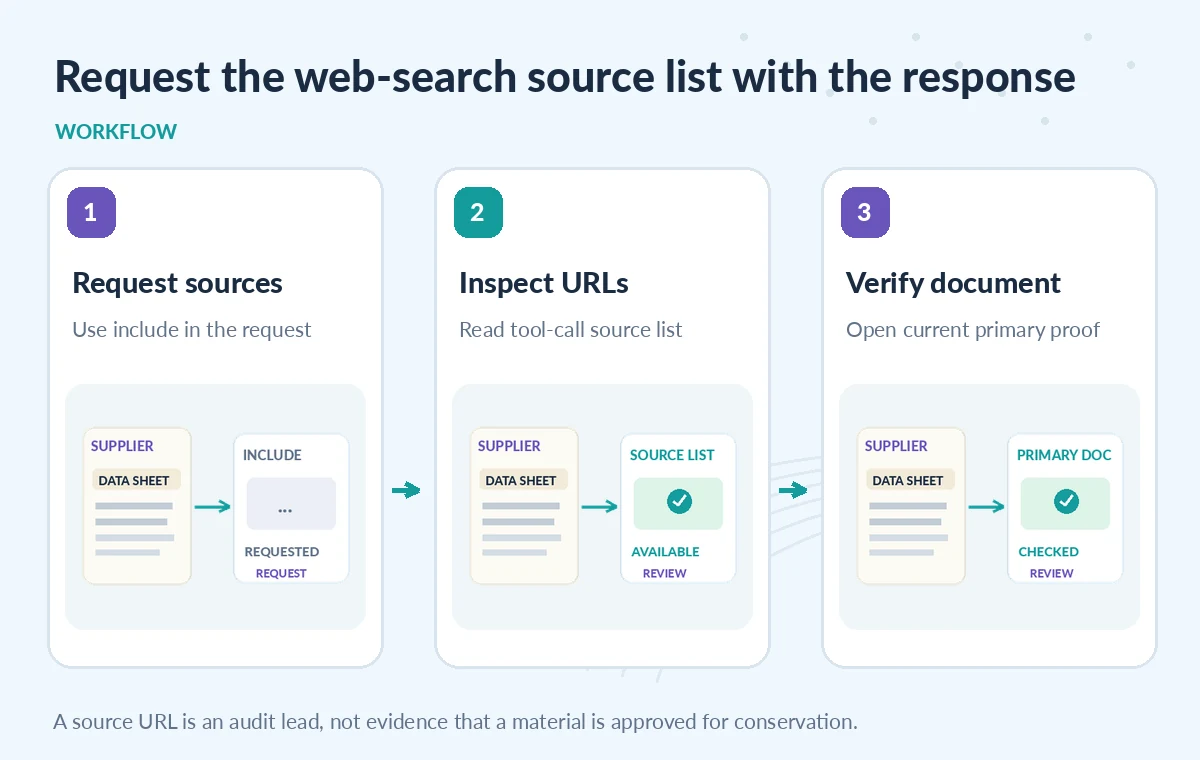
For a Responses API integration using the hosted web_search tool, the documented include option web_search_call.action.sources asks the response to include the sources of that call. It is different from merely instructing a model in plain English to ‘show every source.’ The application should record its request configuration, the returned tool-call items, the output text, and any source information exposed by the chosen SDK. Do not assume that adding the include option automatically forces a search: the web-search documentation explains that with tool_choice set to auto, tool execution is optional. Check that a search actually occurred before labeling a source list complete for that response. Keep unsearched drafts visibly separate from web-assisted research.
Do Not Confuse Answer Citations With the Full Search Trail
Final text might contain a handful of inline citations selected to support particular sentences. The returned web-search tool details can expose additional sources consulted, which are useful for investigating omissions, conflicting versions, or weak evidence. Treat these outputs as different views of one research process. A displayed citation is a pointer for a claim; a broader list is a candidate set for human inspection, not proof that every page supports the final wording. The list is bounded by what the web-search tool accessed during that response, not the whole internet. If a claim depends on an inaccessible certificate or a private supplier document, no convenient URL list can fill the evidence gap.
Review Who Published Each Page and When
For the adhesive claim, sort the returned URLs into manufacturer documentation, authoritative standards, distributor listings, news articles, and independent commentary. Open each relevant source and verify that it genuinely addresses the named material, grade, and use case. If a page has no visible date, record that uncertainty rather than inventing an update timestamp. Product pages can change without an archival notice, and a current sales page may still quote an older technical specification. Save the exact document revision or retrieval date in the procurement record. Avoid copying a model’s paraphrase as the source text; the buyer should compare the claim against the visible original and seek clarification when the wording diverges.
Compare a Citation, a Source Inventory and a Verified Document
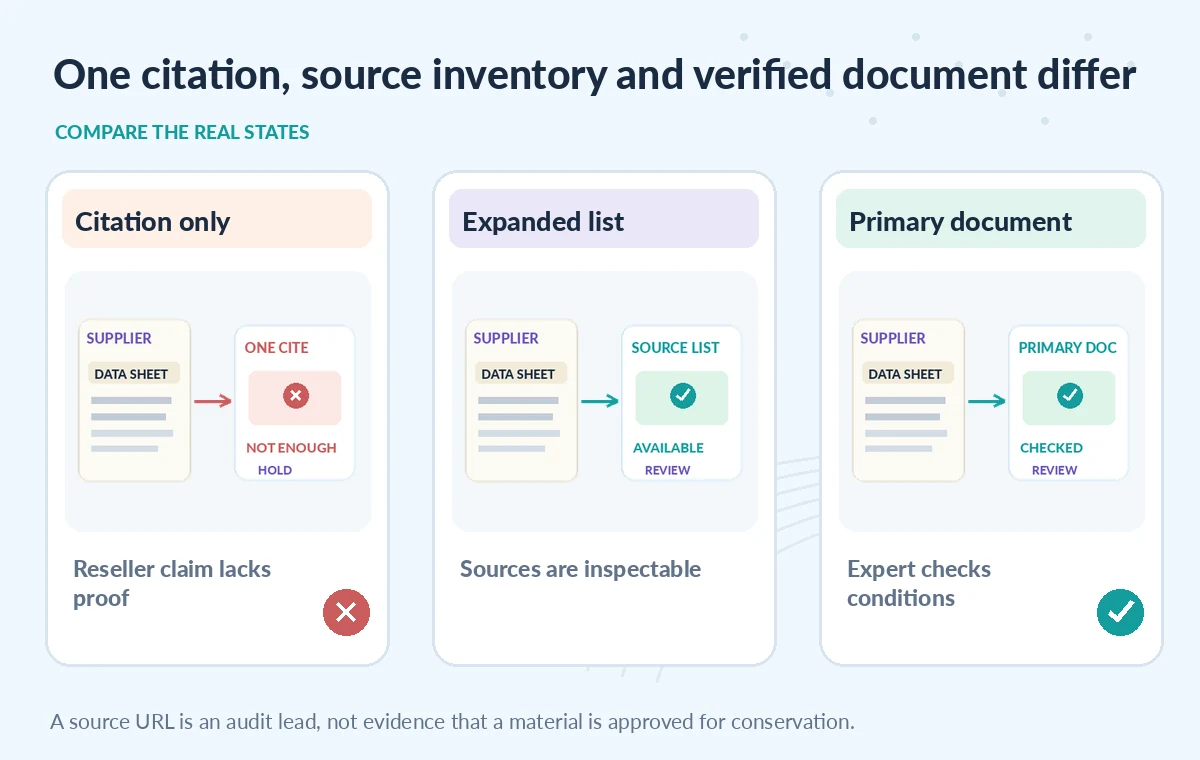
Consider three teaching states. First, an answer cites a reseller’s short marketing statement but gives no independently reviewed technical evidence; that is insufficient for approval. Second, the application requests web_search_call.action.sources and captures a list of manufacturer, distributor, and standards-related pages; the research trail is more inspectable, but the claimed suitability remains unverified. Third, a conservator opens an applicable, current manufacturer document and confirms its conditions and limitations against the proposed use. Even that does not automatically authorize purchase, because organizational policy may require safety review or compatibility tests. The purpose of the diagram is to separate visibility of sources from the reliability and authority of a specific conclusion.
Treat Domain Filters and Tool Choice as Distinct Controls
The OpenAI web search guide documents hosted tool controls, including domain filtering in supported configurations, and notes differences from older preview integrations. A reviewer may choose to focus an initial search on manufacturer or standards sites, but that is not a universal truth filter: a vendor’s own site may contain marketing claims, and independent concerns may appear elsewhere. Log the domains requested and the actual returned URLs. If web search is mandatory for a particular audit, configure the documented tool choice instead of hoping that auto will invoke it. The application still needs to reject output when no usable sources are returned. Domain constraints organize retrieval; they cannot establish that a certificate is genuine.
Capture a Claim-to-Source Table Without Publishing Raw Logs
Use a small review table: claim text, source URL, publisher, visible date or revision, relevant passage, reviewer, and unresolved question. For example, ‘suitable for paper conservation’ is a much broader claim than ‘approved for one coated board under stated conditions.’ Link the actual relevant section, not merely the top of a product catalog. Store sensitive procurement terms and supplier correspondence in an authorized internal system, not in a public AI report. A tool source list may contain material irrelevant to the final answer; filtering it for the table requires judgment. Do not automatically convert search results into endorsements, purchase orders, or public conservation instructions.
Handle Missing and Conflicting Evidence Explicitly
If the final answer cites a page that is unreachable, a technical datasheet lacks the cited condition, or a newer manufacturer’s edition contradicts a reseller’s wording, mark the claim unresolved. The assistant may be useful for listing questions to ask, but it cannot decide the museum’s safety standard or replace an expert conservator. If the tool call returned no sources, say so directly and do not manufacture a plausible citation. Keep retries or revised searches separate and dated so a later source list is not silently attached to an earlier answer. A gap is a legitimate research result; a confident but unsupported claim could lead to damage to an irreplaceable object.
Build an Auditable Procurement Gate
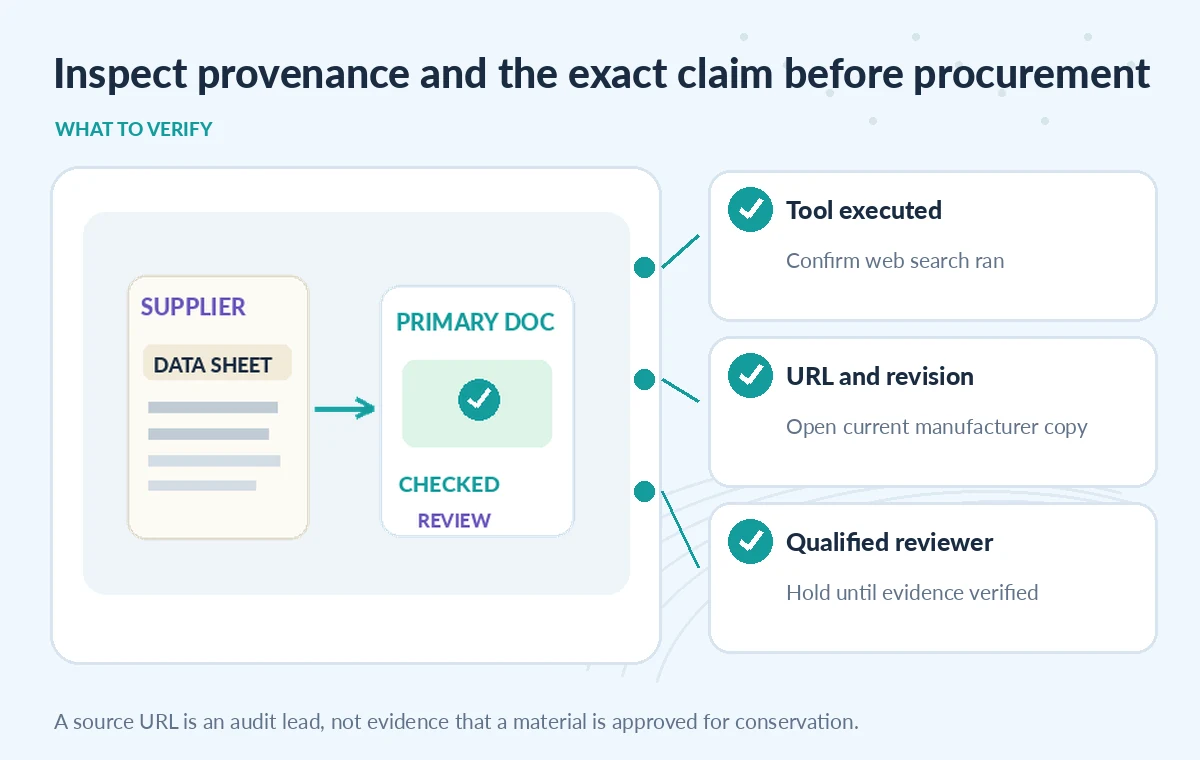
A workable release gate requires a recorded tool invocation, a reviewed source list, a claim-to-source comparison, the current primary documentation, and explicit sign-off from the responsible person. The buyer should also verify material specifications, usage constraints, and the approved product identity with the supplier. Stage a test using fabricated URLs representing an authoritative current document, an obsolete sheet, and a promotional summary; confirm the workflow blocks purchase when only promotional evidence exists. This is a proposed internal test, not one we performed. web_search_call.action.sources makes the evidence trail more visible, but a visible trail is not a safety verdict. Approval belongs to the museum’s own qualified reviewers.
How We Research
For this guide, we reviewed the official product documentation on November 8, 2026: OpenAI web search guide, OpenAI Responses create reference, OpenAI Responses include options. We checked the named setting or feature against its published behavior, mapped the documented constraints to the specific hypothetical scenario, and reviewed whether the topic duplicated titles in the supplied LabFin WordPress inventory or prior B0267–B0278 ZIPs. No authenticated vendor service was run; we did not perform a benchmark, observe real customer data, verify third-party rights or claim operational outcomes. All illustrated records and comparisons are teaching examples. Confirm product documentation and security requirements again before implementing a workflow in a real organization.
Frequently Asked Questions
Use the documented include setting with web_search_call.action.sources and inspect the web-search tool call output; the tool must actually run for it to have sources.
No. URLs show material surfaced for a search call. Validate each claim against the current primary documentation and the museum’s own purchasing policy.
Citations shown in final text and optional web-search source details are separate outputs. Check tool execution and the include configuration.
Not when tool_choice is auto. The web-search tool may be available without being invoked; inspect returned output items.
Record the conflicting pages and versions, ask the supplier for original technical documentation, and hold approval until the responsible expert resolves the conflict.