
A Green Build Can Still Omit an Entire Language
A museum publishes exhibition captions in English, Spanish and French. Its CI workflow tests spelling, caption length and missing alt text, but a newly added language is absent from the job matrix. Every job that ran is green, yet a whole translation never received review. GitHub Actions matrix strategies create variations of a job from configuration values; include and exclude modify those combinations. The release process must examine which combinations were scheduled, not only whether their statuses are green. Use a source-controlled language manifest and an expected-job checklist so that a quietly missing row becomes a blocked release. These are hypothetical examples, not actual GitHub workflow executions.
Understand the Default Cartesian Expansion
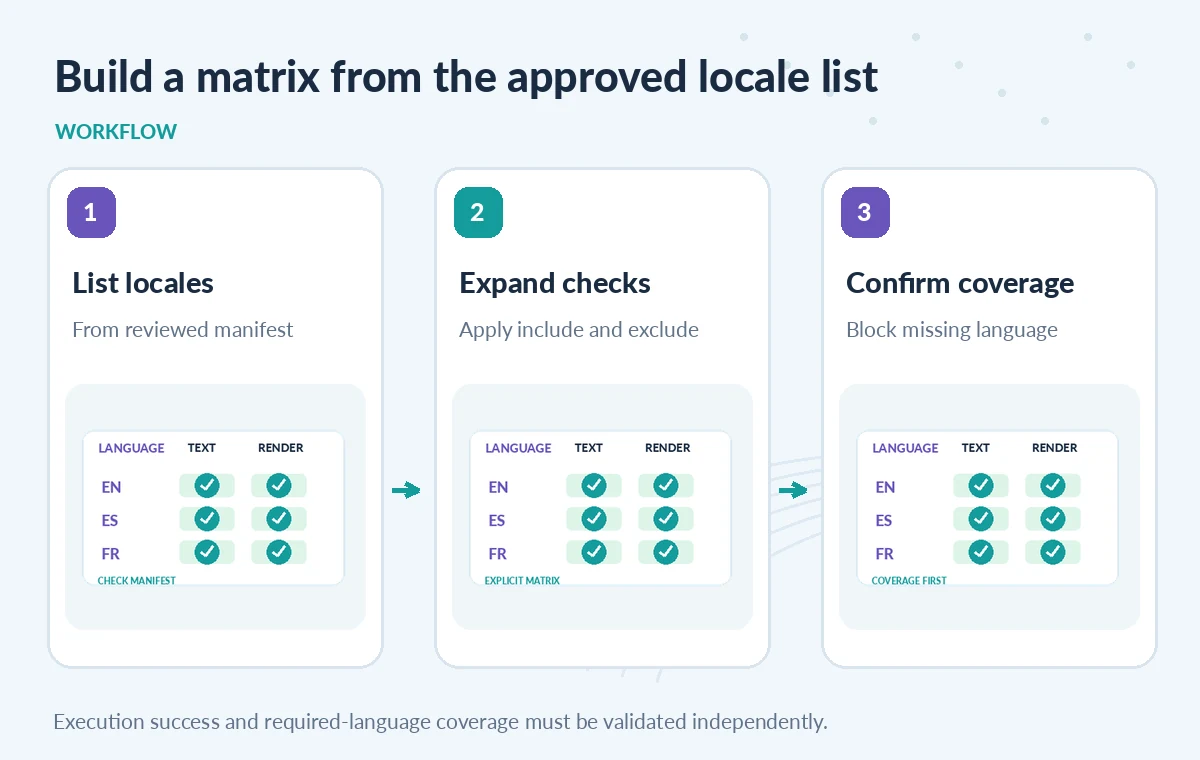
A matrix with language values en, es and fr and an operating-system axis can generate one job for each supported pair. That cross-product is useful, but can create unnecessary checks and unexpected resource use if a second axis is added carelessly. Before creating combinations, decide what validation actually depends on operating system and what depends only on language. A caption-linting job may run on a single Linux runner for all three languages, while a rendering check needs another test environment. Treat the list of required languages as an editorial contract. A matrix is simply an execution plan; it cannot detect that a newly approved translation should exist unless another check compares the plan with the manifest.
Learn Exactly How include Adds or Extends Jobs
GitHub documents that strategy.matrix.include tries to add key-value pairs to original matrix combinations without overwriting original matrix values. If an include object cannot be applied to any original combination, it creates a new combination. Added values may themselves be replaced by later include entries. For a translation workflow, use include to attach an expected locale-specific dictionary or a named rendering profile. Do not assume include always means ‘add one new job’; depending on the keys, it can decorate several existing jobs. This distinction matters when a reader sees four include lines and expects exactly four runs. Inspect the expanded matrix shown by the workflow configuration and execution logs.
Treat exclude as a Recorded Exception, Not a Shortcut
The exclude list removes matching configurations, and a partial match can exclude multiple rows. That is convenient when a test truly cannot run in one environment, but hazardous when a YAML edit accidentally removes every check for an important locale. Each exclusion should have a reason and an alternative source of assurance. If Spanish caption rendering is excluded on a particular OS, make sure Spanish still receives the required content validation elsewhere. GitHub’s reference also notes that include combinations are processed after exclude and can add back combinations. Review the complete result rather than interpreting each YAML section independently. A removed job is not a passing job.
Compare a Complete Matrix, an Accidental Omission and a Deliberate Override
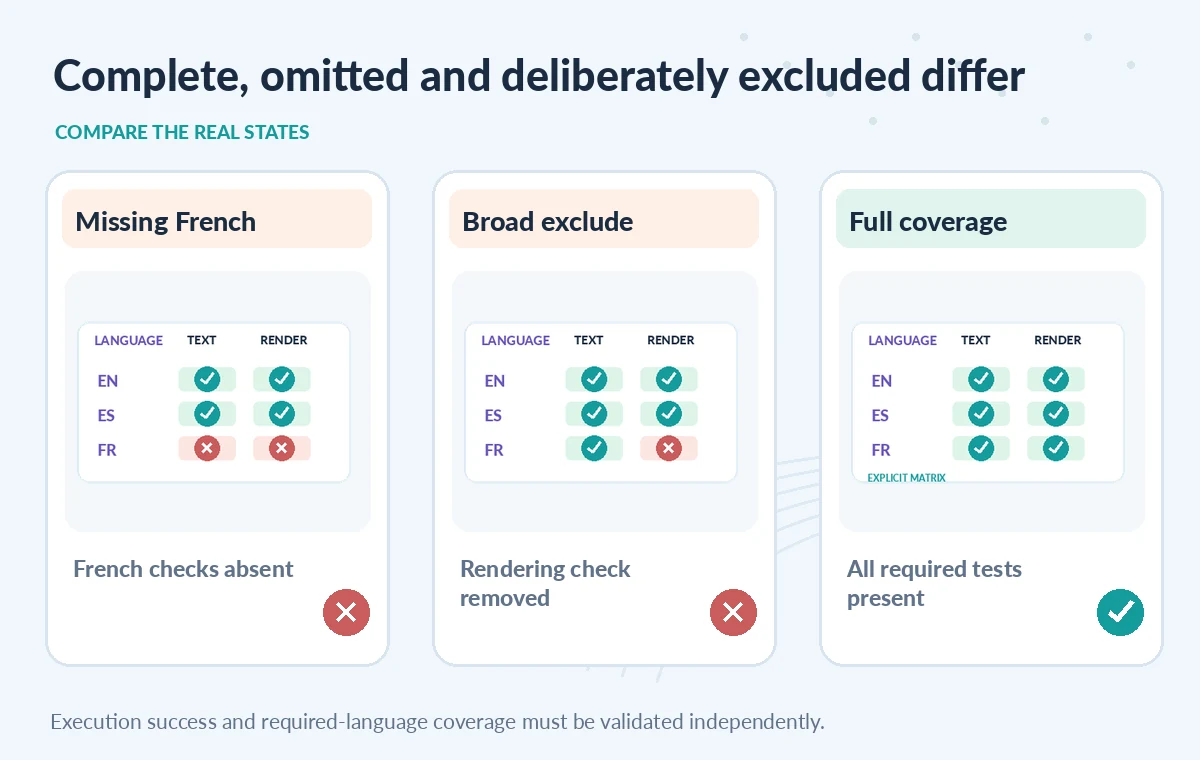
Imagine a six-cell grid of three locales by two test types. A complete grid covers all required checks. In the second state, a broad exclusion of the French locale removes two checks, leaving four green jobs but an incomplete release. In the third, an intentionally documented exception changes a rendering profile while preserving the mandatory French text checks. These diagrams show configuration logic, not observed GitHub output. Label each scheduled, omitted and replaced combination so the QA reviewer can see actual coverage. A ‘success’ banner for the jobs that executed must never be used to infer that the missing tests passed. Coverage is a separate assertion from execution results.
Use a Source Manifest to Verify Expected Coverage
Keep a machine-readable list of approved caption languages and mandatory check types in the repository, reviewed alongside translation files. A small preflight job can derive expected combinations, compare them with the intended matrix configuration, and fail when a required language or check is absent. For dynamic matrix generation, validate and sanitize the generated JSON before passing it to a downstream job; do not allow untrusted pull-request text to inject runner or command values. Record which commit produced the language list, because a release built from a different revision could pass checks against the wrong manifest. This design detects absence rather than relying on GitHub to know the organization’s publishing obligations.
Keep Failure Behavior Separate From Missing Coverage
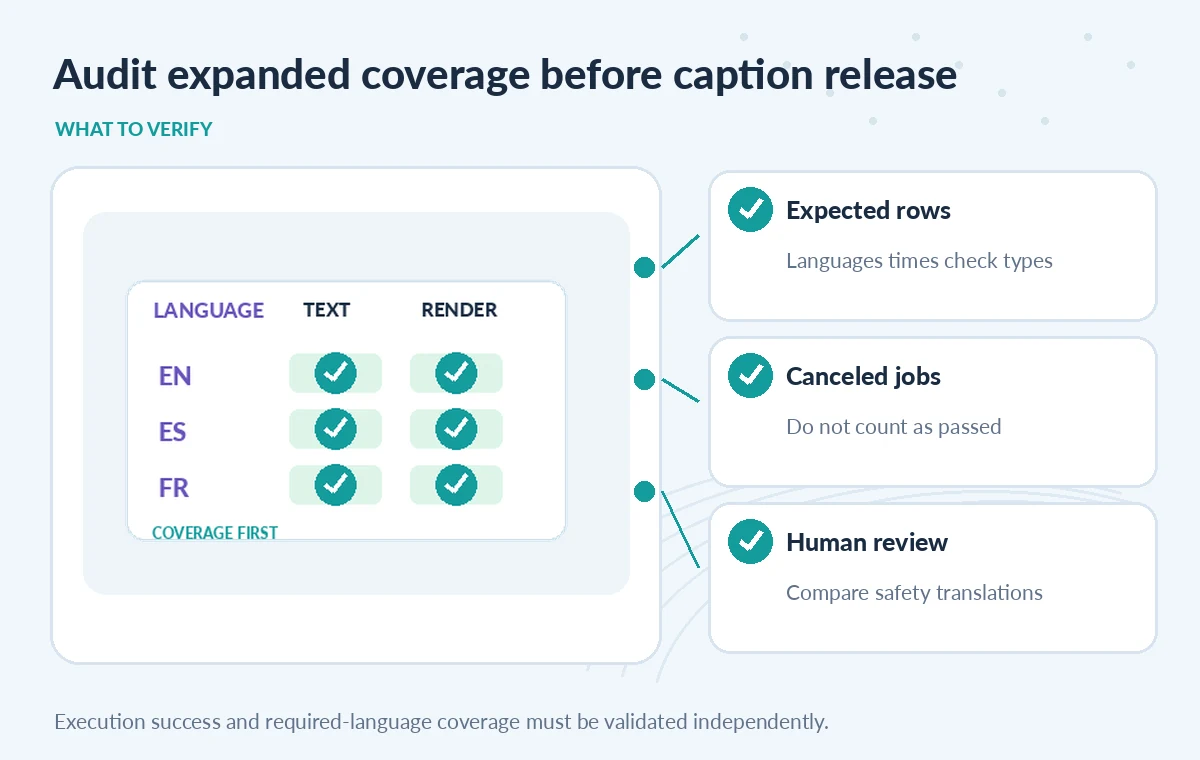
GitHub’s matrix fail-fast setting defaults to true, so a failed job can cancel other in-progress or queued matrix jobs. That can be useful for reducing wasted compute, but it also means a canceled job has not provided positive evidence. Decide whether caption QA benefits from collecting all language failures in one run; for an editorial release, fail-fast false may give a fuller report, with resource implications. Job-level continue-on-error is another feature with different semantics and must not be used to mark required caption checks optional. Keep failed, canceled, skipped and not-scheduled states separate in the release summary. None of these statuses should be automatically interpreted as approved translation copy.
Review Content and Permissions After the Matrix Runs
Machine checks can catch missing files and length regressions, but they do not establish that a French translation preserves a safety warning or that a Spanish caption attributes the correct donor. Human reviewers should open the actual captions, compare them with approved source text, and sign off on sensitive passages. Restrict access to unpublished translations and use minimal CI token permissions; uploads and reports can include private draft text. A build result is useful evidence only when it names the exact file revisions tested. Store the release manifest and reviewer decisions outside the transient matrix display so the museum can reconstruct why a particular language was published.
Stage Three Coverage Failures Before Publishing
Test the workflow with a normal three-language manifest, a newly added fourth language missing from the matrix, and an exclude rule that unintentionally removes a mandatory locale. Confirm that the preflight logic detects both omissions before deployment. Inspect GitHub’s matrix expansion and job statuses rather than assuming a YAML snippet behaves as intended. This article does not report any measured CI run or successful deployment. After the tests, require every mandatory language and check combination to be scheduled, completed successfully, and accompanied by source-based editorial approval. Matrix include/exclude is a powerful way to organize checks, but the publication contract must remain explicit and independently auditable.
How We Research
For this guide, we reviewed the official product documentation on November 8, 2026: GitHub job matrix variations, GitHub workflow syntax for matrix, GitHub Actions contexts. We checked the named setting or feature against its published behavior, mapped the documented constraints to the specific hypothetical scenario, and reviewed whether the topic duplicated titles in the supplied LabFin WordPress inventory or prior B0267–B0278 ZIPs. No authenticated vendor service was run; we did not perform a benchmark, observe real customer data, verify third-party rights or claim operational outcomes. All illustrated records and comparisons are teaching examples. Confirm product documentation and security requirements again before implementing a workflow in a real organization.
Frequently Asked Questions
No. It may add values to existing original combinations, or create a new combination when it cannot apply to an original one.
Yes. An exclusion that partially matches several combinations can remove all of them.
GitHub documents that include is processed after exclude and can add combinations back.
GitHub reports statuses for scheduled jobs; a required language absent from the matrix never ran.
No. A canceled, skipped, omitted or failed required check needs explicit handling and must not be treated as approval.