
A Relevant Repair Paragraph Can Belong to an Outdated Guide
An archive team searches for instructions about treating fragile paper labels, but the index holds a superseded conservation manual beside the current approved revision. Full-text relevance may promote an older paragraph because it matches the query closely. Azure AI Search supports the OData functions search.ismatch and search.ismatchscoring, allowing text queries to become part of Boolean filter expressions. A carefully constructed query can combine text matches with explicit version or approval criteria. This is not permission management by itself, and a higher score never certifies a conservation instruction as safe. The diagrams here use invented document labels and scores only to illustrate decision structure, not results obtained from an Azure index.
Know What search.ismatch Does Differently
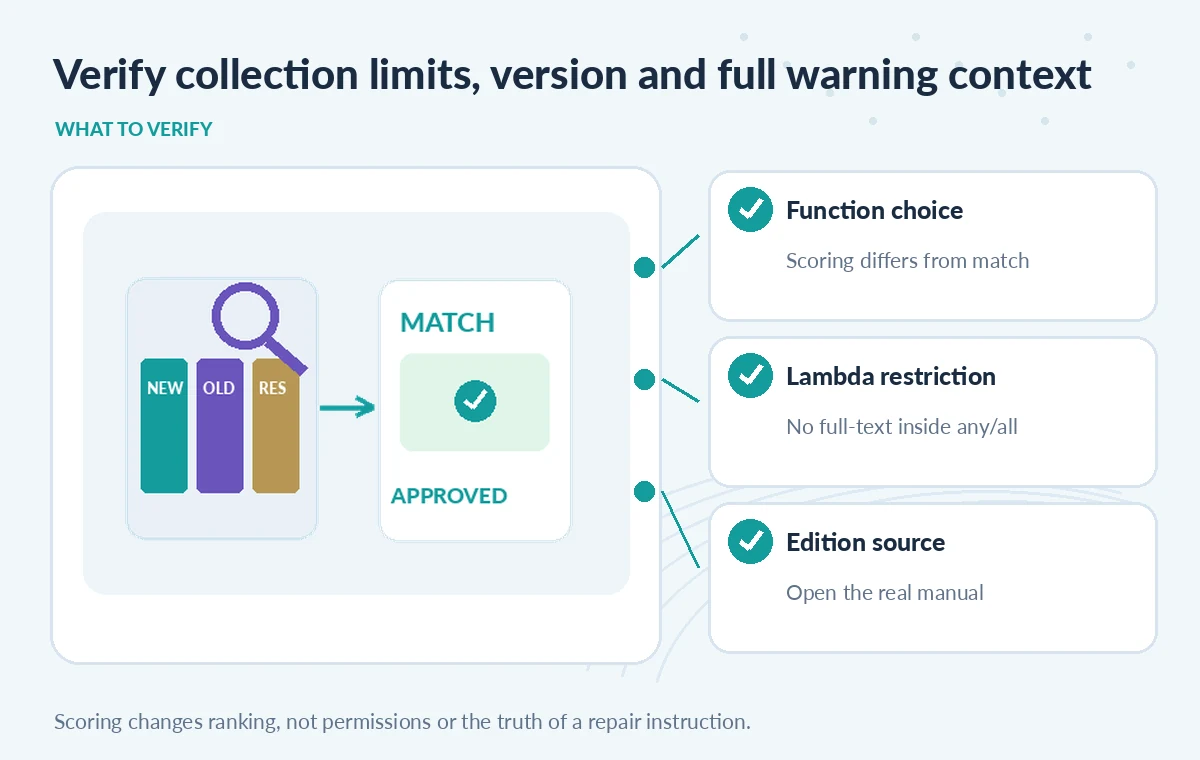
The Microsoft reference describes search.ismatch as a function that returns true when the document matches its embedded text query; it can be combined with Boolean filter expressions. It does not itself change the document’s relevance score. search.ismatchscoring also tests for a match, but its query contributes to the document’s overall relevance score. This difference is easy to miss if an interface displays only the final ranked list. Choose the non-scoring form when you want a hard match condition without additional scoring influence, and the scoring form when that text criterion should also affect ranking among eligible documents. Both functions remain subject to the index schema and specified search fields.

Put Approval Rules in Separate Explicit Clauses
A hypothetical conservation library might define an approved revision field and an access classification field. A query can require approved=true and use a text function to match ‘paper acidity’ or a relevant manual phrase. The exact field names and data model are organization choices, not Azure defaults. Keep those explicit eligibility conditions visible in the application’s query builder, and evaluate permissions before displaying restricted material. A term match can find useful text in the wrong edition; scoring alone cannot tell whether a newer safety notice overrides a technique. For high-consequence repair instructions, editors must open the actual document, confirm its edition, and read the complete warning—not just the ranked snippet.
Test Syntax and Search Field Scope Deliberately
Both functions accept text query arguments and can specify searchable fields; additional parameters select simple or full query syntax and any or all term matching. The official reference notes that fielded Lucene syntax can override a provided searchFields list. If a client expects a query to inspect only approved body text, that behavior deserves a test. Escape OData string values and quote nested query terms correctly; a copied text box full of symbols should not be spliced into a filter without appropriate handling. Build the filter from vetted components rather than accepting a raw filter from an untrusted user. Field scope, syntax, and Boolean precedence materially affect which manuals appear.
Compare Matching, Scoring and Source Approval
In the first fictional state, the text ‘paper labels’ matches a current approved guide; it passes the eligibility filter. In the second, an older manual also matches and would rank strongly by text, but an explicit approval rule removes it from the public result set. In the third, two approved guides both match and the scoring variant can influence their order. This illustrates that document membership, ranking, and release approval are not the same operation. Do not label invented scores as actual measurements. A search engineer should capture query settings and index revision during a controlled evaluation so editors can tell whether a change came from a filter, a relevance function or modified source material.

Respect the Lambda Expression Limitation
Microsoft documents that search.ismatch and search.ismatchscoring are not supported inside lambda expressions over collections. That means you cannot simply nest full-text evaluation inside any or all for a complex collection and assume Azure will correlate text with a specific nested object. If your archive index holds multiple edition objects inside one parent document, redesign the query or index schema so text and approval conditions have the intended relationship. Flattening content can also lose context, so document the tradeoff and test representative records. This limitation is not a minor syntax quirk: an incorrect correlation might present a warning from one edition beside an approval flag that belongs to another edition.
Run Adversarial Queries Against Known Documents
Assemble a reference set with an approved guide, a superseded edition using identical words, a document mentioning an unrelated hazard, and a restricted attachment. Compare search.ismatch, search.ismatchscoring and a top-level text query while keeping the same explicit eligibility filters. Have the conservator score whether the returned paragraph includes the necessary caution and the correct material type. Record false positives and false negatives; a result that is absent might be a filter bug rather than evidence that no manual exists. The test should include ‘no matching approved source’ as a legitimate outcome. This article proposes that test design but did not execute searches against a live Azure service.
Never Treat a Snippet as an Authoritative Procedure
A user sees a few highlighted terms, then assumes the technique applies to a fragile object. That is a common information-design failure unrelated to raw relevance. Show the guide’s title, edition, author or issuing department, review date, and an openable source link. If the document has a safety note on a later page, the retrieval interface must not hide it. Restrict access based on backend authorization before fetching private manuals; a user-controllable OData filter is not a boundary. Encourage a conservator to inspect the whole instruction in context and flag inconsistent advice for editorial resolution. Search should help find evidence, not act as a substitute for trained approval.
Maintain an Audit Trail for Ranking Changes
When adjusting scoring behavior, log the query definition, searchable fields, filter clauses, index version, approved-source snapshot and evaluation cases. Review the results with the conservation team before deployment. An improvement in apparent relevance may conceal fewer results from an important minority category, such as treatment notes for delicate photographs. Use measured evaluations only after they have actually been performed; do not publish synthetic diagrams as benchmarking outcomes. The practical success condition is that approved documents are discoverable with source context and excluded editions stay excluded. search.ismatchscoring is useful as a precise query-building tool, but the lasting trust comes from version governance and human review.
How We Research
For this guide, we reviewed the official product documentation on November 8, 2026: Microsoft OData full-text search functions, Microsoft OData expression syntax, Microsoft OData collection filter troubleshooting. We checked the named setting or feature against its published behavior, mapped the documented constraints to the specific hypothetical scenario, and reviewed whether the topic duplicated titles in the supplied LabFin WordPress inventory or prior B0267–B0278 ZIPs. No authenticated vendor service was run; we did not perform a benchmark, observe real customer data, verify third-party rights or claim operational outcomes. All illustrated records and comparisons are teaching examples. Confirm product documentation and security requirements again before implementing a workflow in a real organization.
Frequently Asked Questions
Both test full-text membership in an OData filter; the scoring form also contributes relevance score.
No. Combine explicit eligibility rules with backend authorization. A filter submitted by a user is not a security boundary.
No. Microsoft documents that search.ismatch and search.ismatchscoring are unsupported inside lambda expressions.
No. Scores reflect query matching, while the document edition and approval must be checked separately.
Compare fixed cases for approved, outdated and restricted documents; save query settings and have an expert review retrieved passages.