
Why one early failure can hide a multilingual regression
A museum website publishes accessibility captions in English, Spanish, and French. A matrix of GitHub Actions jobs checks each locale for missing files, malformed timing data, and unsupported language tags. By default, a failing matrix job can cancel other in-progress or queued matrix children, leaving reviewers without the full set of language results. That cancellation can be useful for expensive test suites, but harmful when the team must collect evidence for every required language before an accessibility release. GitHub’s strategy.fail-fast setting controls this behavior. This article uses a fictional localization project and conceptual job statuses, not a real workflow run or claimed test outcome. The design priority is complete evidence and an explicit publication gate.
Define required locales separately from the matrix
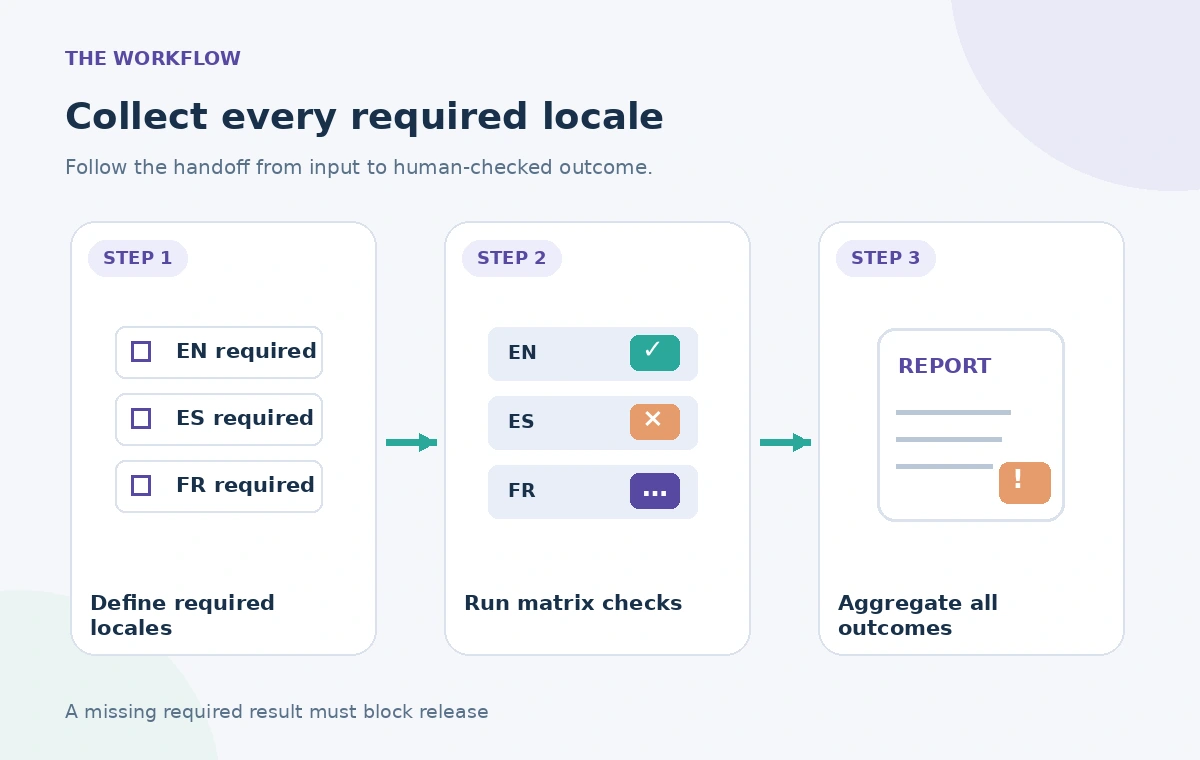
Begin with a reviewed list of languages that the site actually promises to support. Generate the matrix from that approved set, or verify that hard-coded matrix values match it during CI. Do not let the presence of one green English result silently stand in for the Spanish and French deliverables. Each job should produce structured output stating which locale was tested, which caption files were found, and what checks completed. Avoid sending private transcript text into logs or artifacts when a pass/fail summary is sufficient. Make the language list an input to a separate release decision, not a value inferred from whichever jobs happened to run. This matters when a matrix changes after new languages are added.
Use strategy.fail-fast deliberately
The workflow syntax supports jobs.
Use max-parallel to control resource contention
GitHub also supports strategy.max-parallel, which limits simultaneous matrix jobs. A museum running automated caption checks against a shared test database or third-party validation endpoint may need to constrain concurrency. This is different from fail-fast: max-parallel controls how many jobs can execute at once, while fail-fast controls what happens to siblings after a qualifying failure. A smaller parallel limit does not guarantee all jobs finish if fail-fast remains enabled. Choose a value based on real runner capacity and external quotas, then verify the workflow under load. Do not make claims about runtime savings without a benchmark. A stable and complete set of results is more useful than an impressive but poorly explained concurrency number.
Compare cancelled jobs, completed checks, and release approval
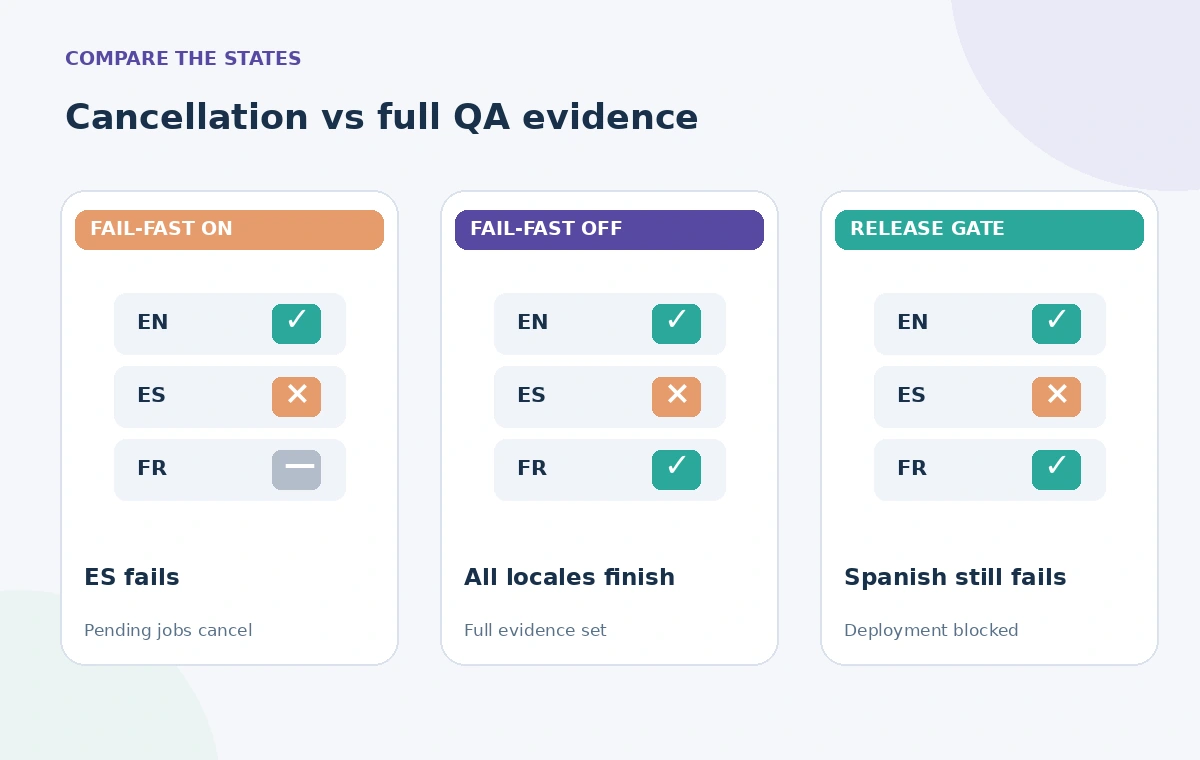
Imagine Spanish caption validation fails immediately. With fail-fast enabled, remaining locale jobs may be cancelled before they produce evidence. With fail-fast disabled, the remaining children can finish and report their own states, while Spanish remains failed. A third review step should then verify that every expected locale has a complete result and that no required locale failed or was cancelled. These are three different pictures, not screenshots of an actual GitHub run. The aggregator must not call a partial result set successful merely because it can find one passed artifact. Nor should it treat cancellation as a pass. Preserve cancellation reasons for debugging and make the public release dependent on the reviewed complete matrix.
Distinguish tolerated failures from required failures
continue-on-error can be useful for genuinely experimental or optional checks, but it changes how failure is treated in the workflow conclusion. Do not use it as a shortcut to make all caption jobs green. If a locale is mandatory for a public release, its validation should count as a blocking failure. Optional languages can be reported as advisory results, clearly separated from the required set. Keep the declared severity in configuration, not hidden inside an ad hoc step expression. A matrix may contain mixed release-critical and experimental tasks; the final gate should read that classification rather than assuming that every child has identical policy. The goal is a truthful report, not uniformly green badges.
Produce one result for every expected locale
After the matrix, a separate job can inspect required job conclusions and retrieve per-locale reports, while using conditions that allow the aggregator to run after a failure. Its first check should compare the expected locale set with the actual completed reports. Missing, cancelled, timed-out, or failed required children should block deployment. A successful artifact upload from one job does not prove another job ran. Keep report names stable and avoid accidentally merging files from two locale variants into one ambiguous file. If the upload/download layer returns no file, treat that as a validation failure rather than reconstructing a fake report. Protect the aggregation script with code review because a minor logic change can alter release policy.
Test cancellation paths before relying on the gate
Use a test branch with synthetic caption fixtures that intentionally pass in English, fail in Spanish, and run slowly in French. Compare the observed job states with fail-fast enabled and disabled. Then simulate a missing artifact and a matrix child that never starts. Check that the aggregator reports the difference between failed, cancelled, and absent, and that the deploy job remains blocked. Do not use real unpublished interview transcripts in a public CI demonstration. Record the job IDs and artifact names so another maintainer can reproduce the scenario. Avoid presenting schematic timelines as measured execution traces, and avoid inferring that production is safe from only one successful test case.
Make the final release gate explicit and reviewable
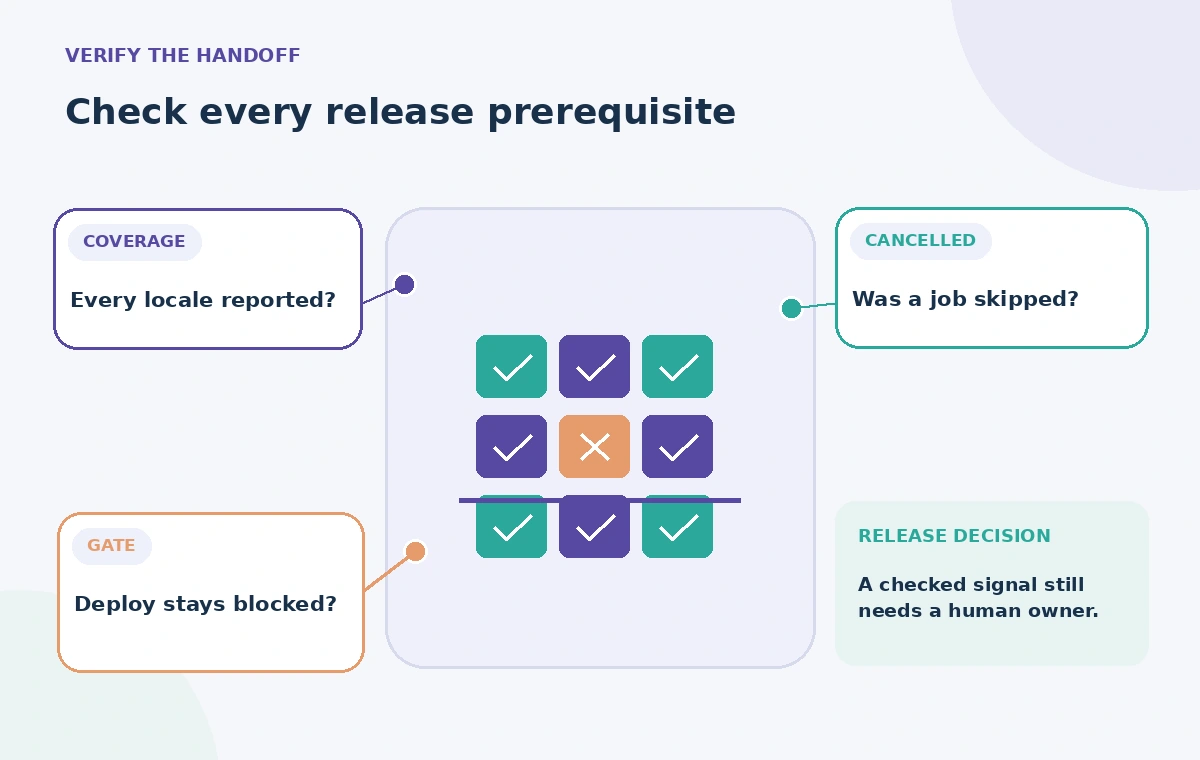
The final workflow should document required locales, fail-fast policy, max-parallel limit, optional checks, artifact naming, aggregate failure rules, and deployment approval permissions. Show reviewers a concise table of each locale and its completion status, linking to the relevant job logs and retained evidence. Re-run the full release gate when a mandatory locale changes or a validation action is updated. Keep a human publication checkpoint where policy requires it: successful CI only indicates that configured technical checks completed. It does not prove a translation captures historical nuance, secures interview consent, or respects legal publishing permissions. Those responsibilities remain with the museum’s editorial team.
How We Research
We reviewed current named primary documentation: GitHub Workflow syntax: strategy, GitHub Actions contexts: strategy, GitHub matrix jobs guide. The guide compares documented API controls with a hypothetical museum workflow; any record IDs, ranking diagrams, timelines or outcomes shown are illustrative. We did not access a customer account, perform a live service benchmark, submit a grant, apply an irreversible lock, process a real queue, or publish a site. Product capabilities and limits can change, so implementers should recheck official references and test in authorized nonproduction environments before a live deployment.
Frequently Asked Questions
With fail-fast true, a qualifying failure can cancel in-progress or queued matrix jobs. False lets siblings continue running.
Yes. GitHub documents true as the default for matrix strategy fail-fast.
No. It allows more results to be collected but failures remain failures and should be enforced by a separate release gate.
max-parallel limits how many matrix children run at once; it does not determine whether a failure cancels siblings.
Only if project policy declares it optional. Required locales need full, passing checks and editorial approval before release.