
A Review Request Is Not a Finished Grant Brief
A nonprofit museum prepares a grant application, and staff want an assistant to compare a draft budget with a long funder’s guidance packet. The review may involve substantial reasoning; a short web request could time out before the result arrives. A tempting interface would display the most recent text fragment as soon as the request starts. That would be an editorial mistake: a partly generated response might overlook a disqualifying exception near the end of the source packet. OpenAI’s Responses API has a background mode for long-running model requests. It lets an application start a request asynchronously and retrieve the resulting response later. This guide describes a proposed workflow built around a fictional grant packet. We did not create a background response, submit documents, measure latency, or inspect a live grant decision. The important distinction is between a model’s processing state, the completeness of its output, and an editor’s authority to publish.
Prepare a Verifiable Input Before Starting the Job
Assign a unique review record to the application, not just to the API call. Store the current grant guidelines’ document ID, revision or retrieval date, the budget-draft version, and the requested questions: eligible expenses, deadlines, matching funds, and exclusions. Provide only authorized, relevant excerpts and keep the source documents accessible to reviewers. Do not assume that a model can discover the funder’s current rules from an unlinked prompt. Write a narrow task specification that asks the model to distinguish quoted conditions from its interpretations and to identify unresolved questions. Reserve publication decisions for staff. A suggested response such as “equipment purchases may be eligible if listed in Appendix C” is not equivalent to a verified funding determination. If the funder changes its instructions while the job runs, the output should remain attached to the old input revision until someone explicitly compares it with the new one.
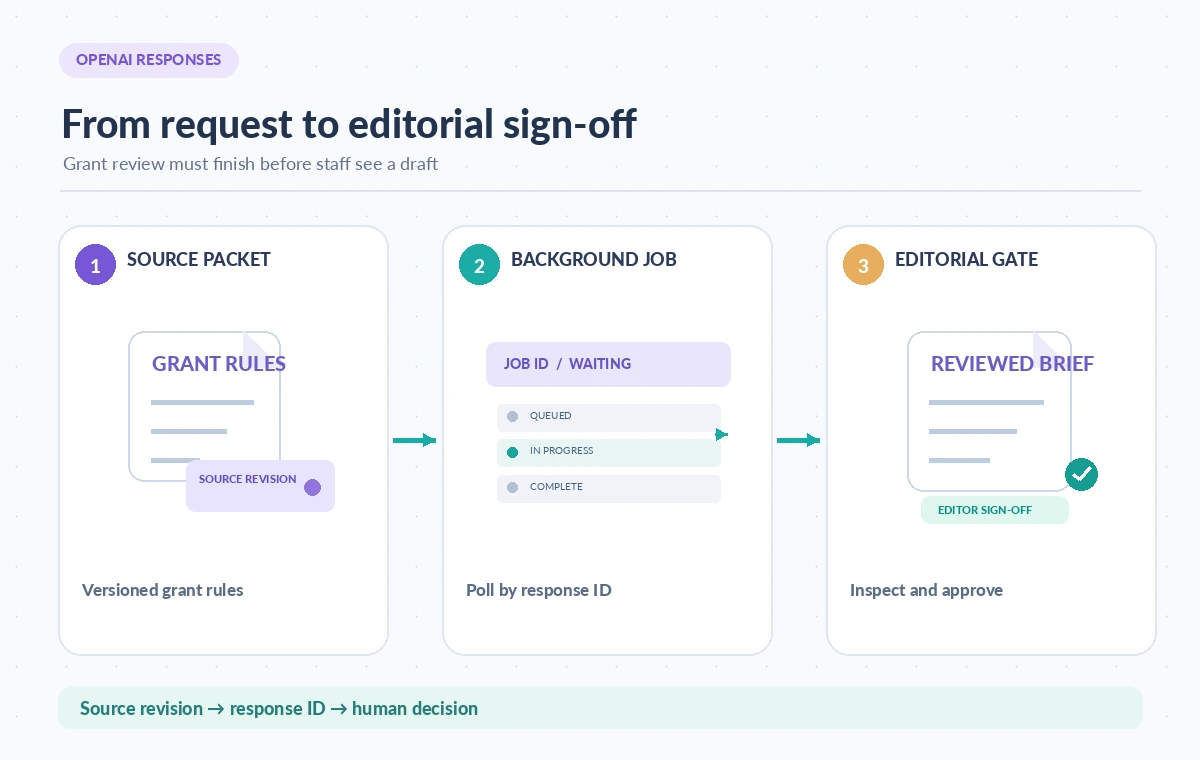
Start Background Mode and Persist the Response ID
OpenAI documents creating a Responses request with `background` set to `true`. The application receives a response object, including an ID and a status, rather than waiting on a long synchronous connection for the entire answer. Persist that ID against the museum’s own review record. Do not treat the act of receiving the ID as proof that the model completed the task or accepted any proposed budget line. Store safe metadata, such as source version, creation time, model configuration and responsible editor, separately from sensitive prompt content. The response ID is useful for later retrieval but is not itself an audit trail of the grant rules. Because model availability and storage behavior may vary by project, check the current API guide and your organization’s retention policy before sending confidential donor information or grant materials into an asynchronous pipeline.
Poll States Without Inventing Progress
The documented polling pattern retrieves a response by ID while its status is `queued` or `in_progress`. A queued state means the job has not produced a final result. An in-progress state also is not an output approval. Your interface can show “waiting” or “analyzing” without claiming a percentage completed or a finish time that the API did not provide. Store the last observed status and the time of the check for troubleshooting. When the response leaves those active states, inspect the actual terminal status. Completion and failure must lead to different paths. A terminal status alone is insufficient if it represents cancellation, incomplete work, or a failed request. Require the expected response content to exist and be legible before opening an editorial review. An application’s network error while polling may mean only that it lost visibility; do not launch a duplicate expensive job before reconciling the original ID.
Distinguish Completed Output From Approved Output
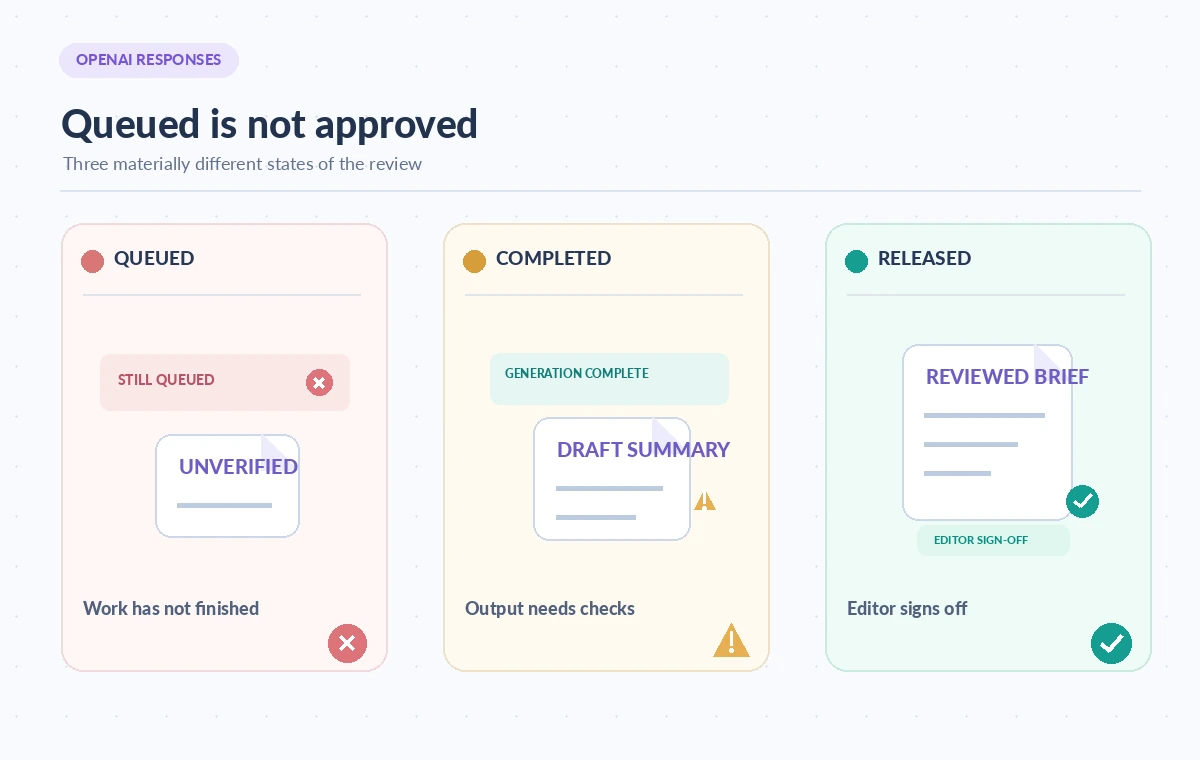
In the comparison illustration, the first card is a job still queued, the second is a completed model response, and the third is an approved, source-checked summary. These states deliberately look different. A completed response may contain incorrect claims, omit a crucial exception, or cite an obsolete version of guidance. The API status tells you whether generation ended, not whether a grant officer would accept the interpretation. Give the editor a side-by-side view of each extracted requirement and its source passage. Ask staff to verify eligibility exceptions, amounts, deadlines, and the distinction between mandatory and optional criteria. Mark unresolved issues as open questions rather than filling them with plausible language. Only the editorial approval record should make the material eligible for a site, email, or application export.
Plan for Cancellation, Errors, and Retrieval Windows
OpenAI’s background documentation includes a cancellation operation for background responses. Cancellation is a request-management tool, not a guarantee that downstream files, emails, or external actions are undone. If staff replace the source packet, they may cancel the earlier response and create a new review with a different revision ID. Both actions should remain visible in the local audit record. Background execution involves temporary storage for polling. The official guide describes a roughly ten-minute polling storage period for certain storage configurations and states that background requests are temporarily stored even with `store=false`. Those details matter for privacy and delayed retrieval; do not promise indefinite access to a response object. Save approved, permitted outputs in your own controlled records after verification, while keeping sensitive material subject to established retention rules.
Make Network Recovery Explicit
A browser refresh should not create a new grant review automatically. Design the page so that it loads the local review ID, retrieves the corresponding API response status when possible, and shows the most recent confirmed state. If an error occurs before the application saves a response ID, treat the outcome as uncertain and use request logs or a human reconciliation procedure instead of assuming that the request never ran. Use retries for retrieval errors with sensible backoff. Keep request creation separate from status polling so a transient HTTP failure does not cause repeated model work and competing draft summaries. If the response is no longer retrievable, show that limitation and offer a fresh, explicitly authorized review rather than showing a cached partial draft as a successful result. This is an application recovery design, not a documented promise of automatic deduplication.
Test the Approval Boundary With Synthetic Documents
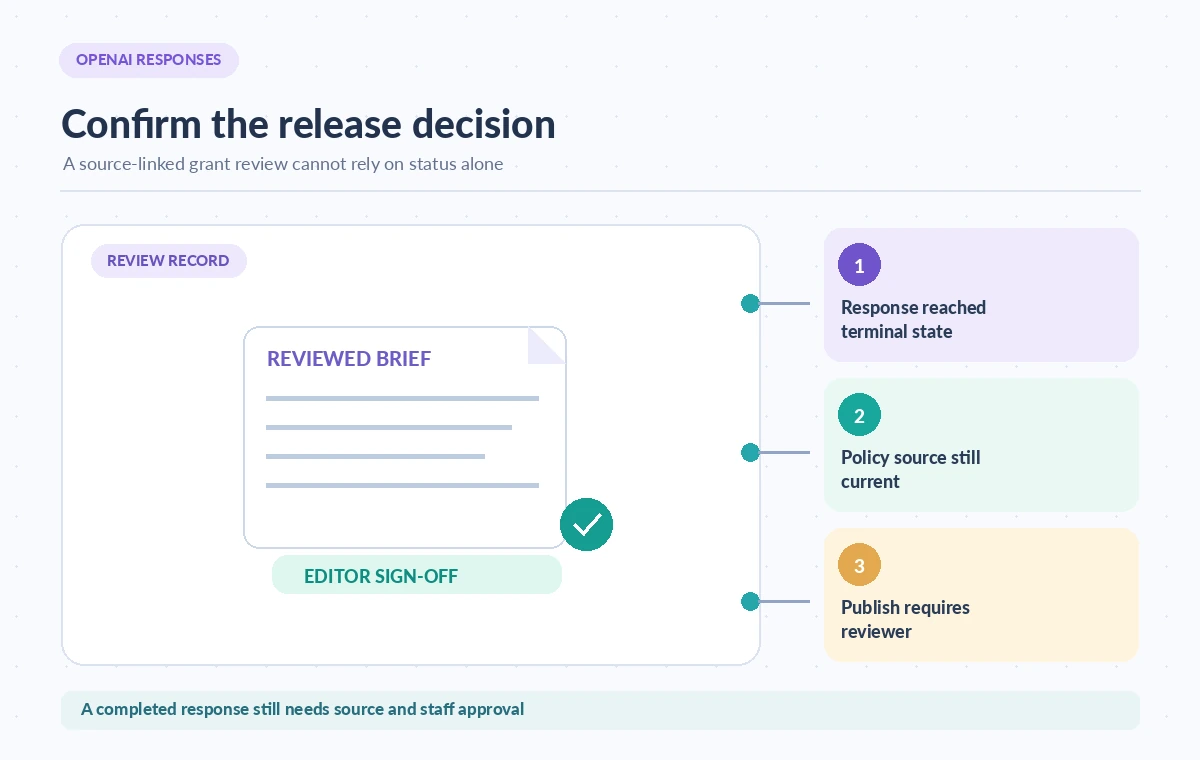
Create a dummy funder packet that has an attractive general rule and a hidden exception, such as an equipment grant that excludes installation labor. Simulate the user interface for queued, in-progress, completed, canceled and failed states. Check that none of the non-completed states enables the Publish action. Then feed a completed but deliberately inaccurate summary into editorial review and verify that the exception remains an unresolved issue. A successful release test should show the response ID, source version, human reviewer, approval time and exact approved text. Repeat with a source-document replacement while generation is running. The key outcome is not a simulated model score: it is proof that the application keeps “generated,” “verified” and “published” as separate events. Background mode can make a lengthy request manageable, but it cannot certify the resulting grant advice.
How We Research
We checked the named primary documentation on November 8, 2026: OpenAI: Background mode, OpenAI: Responses API reference, OpenAI: Conversation state. Our source review focused on the supported feature, input and result semantics, and the practical failure paths used in this fictional scenario. We also compared the proposed title with the WordPress title inventory supplied by LabFin. We did not connect to a product account, submit a live API request, measure accuracy, test regional availability or verify actual client outcomes. Artwork and example records are original conceptual illustrations. Confirm the current feature and model support, terms, costs, permissions and privacy requirements before implementation.
Frequently Asked Questions
It starts generation asynchronously so the client can retrieve the response by ID instead of holding one long synchronous request open.
No. Queued only describes request processing. It says nothing about grant eligibility, accuracy or publication approval.
No. Completion is a model execution state. Staff still need to compare the content with current source documents and sign off.
The documented API supports cancellation of background responses. That does not reverse any external action an application may already have performed.
Do not assume so. Retrieval and storage depend on the configured retention behavior; consult the current background-mode guide before relying on delayed polling.