
A Mixed Comment Is Not a Simple Thumbs-Up
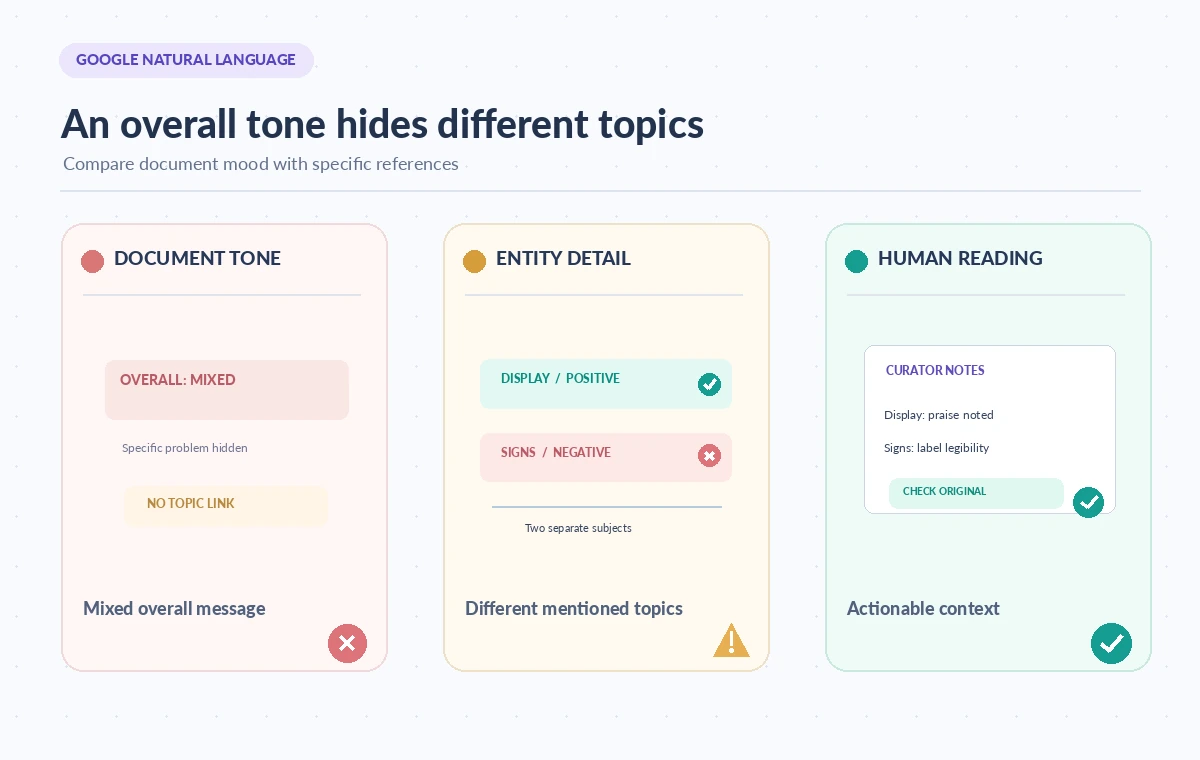
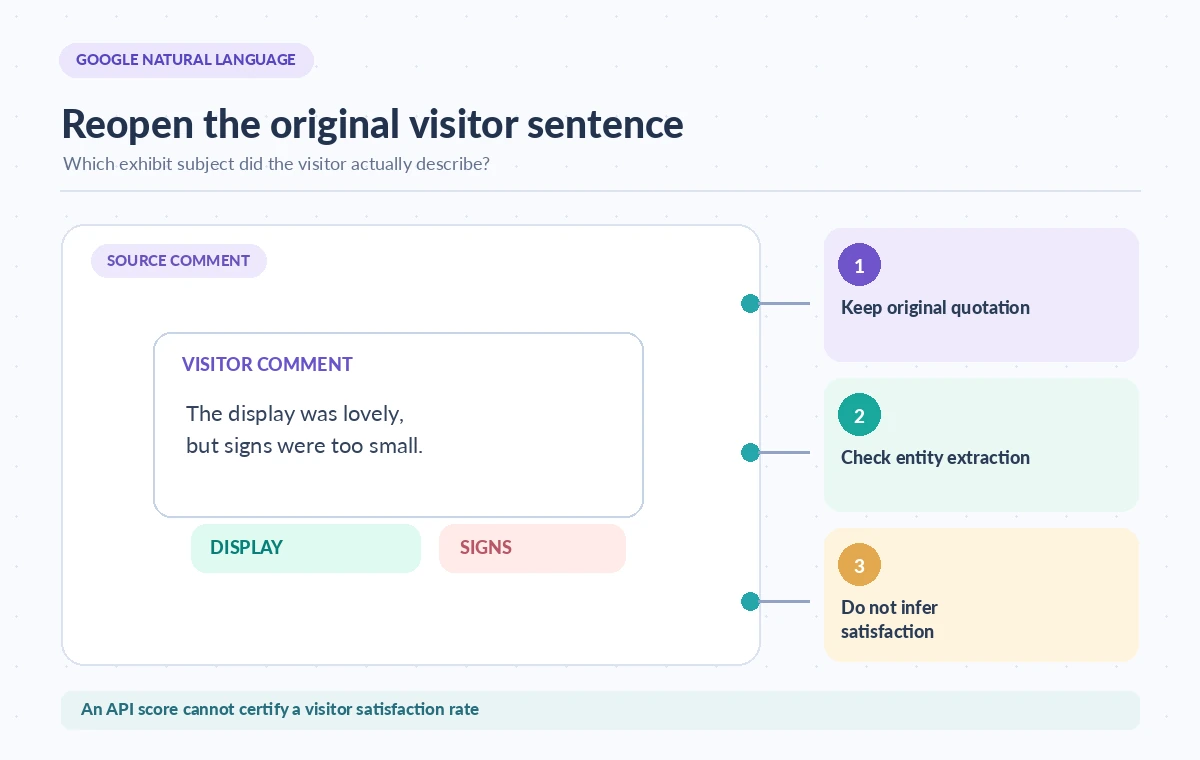
Suppose a visitor leaves this invented note after an exhibition: “The ceramics display was wonderful, but the gallery signs were hard to read.” A single positive or negative label would hide the useful distinction. The ceramics display and the signs are different subjects, and the visitor feels differently about each. Even if a general sentiment model returned a neutral overall score, the organization would still need to know which part of the experience may require attention. Google Cloud Natural Language offers entity sentiment analysis, which combines entity recognition with estimates of sentiment about recognized entities. It returns entity and mention information with numerical score and magnitude fields. This guide sketches a source-linked feedback review, not a satisfaction measurement. We did not send real visitor comments to Google, run a sentiment experiment, or establish any performance statistics. All sample comments and visual scores are illustrative.
Define the Unit of Feedback Before Measuring
Start with a single review or response as the unit that can be traced back to the form and date it came from. Assign a pseudonymous internal record ID, preserve the original wording, and document whether the feedback is authorized for analysis. Do not publish personal contact details in an analytics dashboard. Short comments about accessibility, safety or discrimination can carry sensitive context that deserves staff attention regardless of any numerical sentiment. Choose a narrow use case such as spotting repeated complaints about exhibit labels, audio guides or room temperature. Entity sentiment should help reviewers find passages, not score individual visitors. A polite criticism, a sarcastic compliment, and a report of a concrete accessibility barrier may appear different to the model. Human review is particularly important when a proposed action changes public-facing visitor guidance or decides which complaint receives a response.

Use the Correct Analysis Endpoint
Google documents `documents:analyzeEntitySentiment` for this task. A request can contain plain text or supported document input, with a language setting if appropriate; otherwise the API may detect the language. The response includes recognized entities and the mentions associated with them. The documentation also shows how `encodingType` affects text offsets. Preserve those offsets only with an encoding scheme your application can map reliably to the stored source text. Do not substitute an ordinary `analyzeSentiment` result when the question is which exhibit aspect received praise or criticism. Overall document sentiment and entity-level sentiment answer different questions. The API’s recognized entity may also be broader or less precise than the curator’s desired label, so use a controlled mapping table. For example, “signs,” “labels,” and “wall captions” may refer to related experiences, but merge them only after verifying the original quotation.
Read Score and Magnitude as Signals, Not Grades
The entity sentiment response includes a score indicating polarity and a magnitude indicating how much sentiment is expressed, both as model outputs. Google aggregates mention sentiment into entity-level information. A near-zero aggregate score can reflect weak sentiment or mixed positive and negative mentions; it should not automatically become a score of “average satisfaction.” Model values are not a scientific survey of visitor satisfaction or evidence that the mentioned problem was solved. Avoid selecting a universal numerical threshold without validation on the museum’s own annotated material. A comment that mentions a gallery twice in opposite tones can be especially revealing: a single average might conceal that difference. In a review table, store the original sentence, the entity name, the mention context, a model-derived value if retained, and a human interpretation. That preserves an explanation for a future editor without presenting machine polarity as fact.
Inspect Mentions and Text Boundaries
The process illustration follows a comment from original text to recognized mentions and finally to curator review. A named entity can be repeated in a sentence, and the endpoint may return information for individual mentions as well as an aggregate. Show the source passage next to each detected item. This helps staff find cases where the model attached an emotion to the wrong object or split a name into several entities. Check proper names, ambiguous exhibit titles and quoted remarks. In the invented comment “I hated the old sign saying ‘Do Not Touch,’ not the art itself,” a naive extraction could make the object of dislike unclear. Highlight the exact words that were analyzed, and distinguish what the visitor wrote from the curator’s paraphrase. If extraction misses the relevant subject entirely, keep the comment reviewable as an unclassified record instead of silently discarding it.
Avoid Turning Feedback Into an Automated Priority Queue
Entity sentiment can group related remarks for editorial triage, but it does not measure safety risk. If a visitor reports that an exit sign is obscured, staff should follow the facility’s safety process, not wait for the comment to accumulate a sufficiently negative sentiment. Likewise, an enthusiastic sentence does not prove that an accessibility problem is resolved. Any automated sorting should have an override for urgent subjects and a visible human owner. Think of the result as an index into comments rather than a decision engine. It can help a curator gather examples about exhibition labels, but the reviewer must check frequency, representativeness and whether several comments came from the same incident. A public statement about “visitor opinion” requires a legitimate research design, consent and sampling, not merely a bar chart of API scores.
Evaluate Errors by Topic and Language
Prepare a small consented or synthetic evaluation set with staff-annotated subjects and passages. Include comments containing both praise and criticism, negation, sarcasm, quotations and local exhibit names. Have two reviewers agree on what each sentence refers to before comparing model outputs. Log missed mentions and wrong-topic assignments separately from polarity mistakes; those errors create different editorial risks. Confirm current supported languages before using multilingual feedback, and do not assume that translating comments preserves their tone. A translated phrase may shift which noun appears to receive the emotion. Keep the original-language text and an authorized translation side by side if your workflow needs one. Evaluate the pipeline again after changing prompt pre-processing, translation tools or your entity-mapping dictionary.
Publish Findings Without Pretending to Have a Survey
A responsible report might say, “Several reviewed comments mention difficulties with label readability,” if the source records actually support that statement. It should not claim “satisfaction fell 20%” from an uncalibrated entity sentiment score. Preserve quotations, count distinct records carefully, and explain what was included or excluded from analysis. Strip personal information and follow publication permissions before quoting any visitor. The final verification checklist asks three questions: can a curator open the exact source sentence, does the entity reflect what the visitor meant, and is the proposed action justified independently of the model score? If those conditions hold, entity sentiment can be a navigation aid for feedback. It remains a machine-generated interpretation of language, not a replacement for reading people’s words.
How We Research
We checked the named primary documentation on November 8, 2026: Google Cloud: Analyzing entity sentiment, Google Cloud: Natural Language basics, Google Cloud: Sentiment analysis. Our source review focused on the supported feature, input and result semantics, and the practical failure paths used in this fictional scenario. We also compared the proposed title with the WordPress title inventory supplied by LabFin. We did not connect to a product account, submit a live API request, measure accuracy, test regional availability or verify actual client outcomes. Artwork and example records are original conceptual illustrations. Confirm the current feature and model support, terms, costs, permissions and privacy requirements before implementation.
Frequently Asked Questions
Entity sentiment estimates sentiment about recognized subjects in text, while general sentiment summarizes the prevailing sentiment of the document or its sentences.
No. It may indicate weak or conflicting sentiment, and it is not a calibrated visitor-satisfaction measure.
No. Safety and accessibility reports need separate human-owned escalation criteria.
They let reviewers verify exactly which words were attributed to an entity and correct misassignments.
Not without review. Translation can alter references and tone; retain the source-language statement when permission permits.