
A repair café keeps public guides alongside technician-only and superseded instructions. A visitor asks how to replace a damaged plug, and the system must retrieve current public material without exposing restricted records. Azure AI Search supports vectorFilterMode choices that change when metadata filtering is applied to approximate vector results. The choice can change recall, especially when the filter is highly selective. This instructional example shows why a short result list is not evidence that no eligible guide exists.
Define a filterable record schema
Keep each guide’s source revision, access tier, effective date, equipment type and status in nonvector fields configured as filterable. A vector field encodes semantic meaning; it is not itself an OData metadata filter. The public query in this example needs approved current guides only. Write the eligibility predicate explicitly, rather than relying on the model to infer what public access should mean.
Separately implement authorization at the application and storage layers, including source document access. A filter in a search query is not a security boundary if the caller can remove or modify it. For production, derive permission predicates from trusted server-side identity and validate that document downloads enforce equivalent rules. Label teaching diagrams as hypothetical through their alt text, not through publisher production banners.
Understand preFilter traversal
Microsoft documents preFilter as applying qualifying metadata during HNSW traversal on each shard, then collecting matching candidates. This favors recall for selective filters, particularly when k is small, at a possible CPU or latency cost. The docs recommend it by default for vector search, although older indexes can have different default behavior. An index created before roughly October 15, 2023 may require recreation for preFilter support.
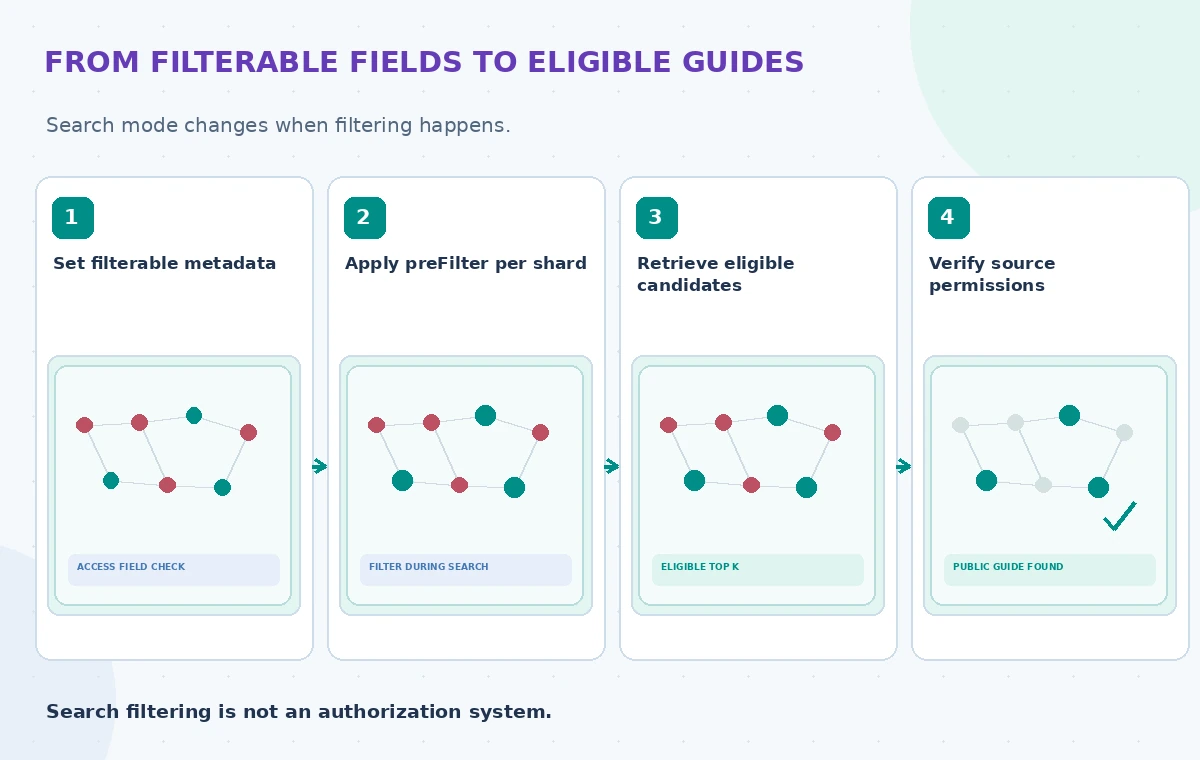
Do not describe preFilter as a guarantee that the entire archive has been semantically understood. It improves the chance that matching documents within the eligible subset are returned; it cannot correct bad labels, stale index content or a flawed embedding model. In diagrams, show the permission boundary at candidate selection, and then a second check of the actual document before release.
Recognize postFilter false negatives
With postFilter, the engine finds unfiltered candidates within each shard and then removes disallowed documents before merging the results. A current public manual may be excluded if the local top-k is filled with restricted or irrelevant items. In a fictional test with a narrow category, the user might see only one result despite several eligible records being indexed.
That missing result is a retrieval limitation, not proof that the document was deleted. Compare output against a small, manually curated expected set and an exhaustive or prefiltered baseline when feasible. If postFilter is selected for performance, document its tradeoff and avoid presenting a short list as complete. Keep results from superseded guides hidden even if they score highly.
Treat strictPostFilter as preview behavior
Microsoft also describes strictPostFilter, currently a preview capability, which applies filtering after global unfiltered top-k candidates have been selected. A selective predicate can therefore return zero results even when matching documents exist outside the global top-k. This is especially risky for missing safety instructions, research evidence or legally significant records. Verify preview API availability and current terms before use.
Do not create a misleading chart where strictPostFilter improves recall. For this workflow, the important difference is the stage at which eligibility is applied. A defensible comparison should put three visibly different candidate sets side by side and show that only a prefiltered traversal was asked to seek eligible guides from the start.
Compare three genuinely different outcomes
Illustrate an unfiltered neighborhood containing approved guides and restricted drafts; a postfiltered result that loses an approved guide; and a prefiltered outcome that searches within approved material. Use fictional inventory identifiers rather than resembling an Azure portal screenshot. The practical question is not which mode produces the most attractive graphic, but whether the user receives the correct currently permitted source document.
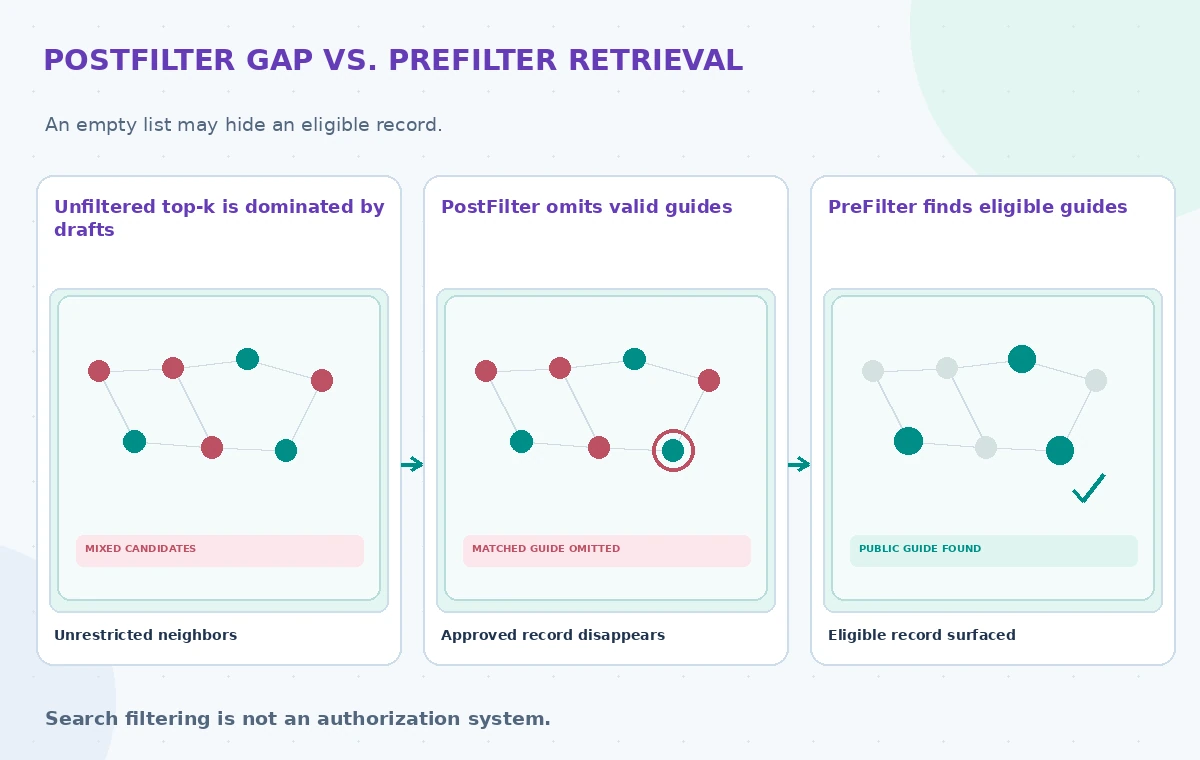
A repair manual may contain a specific warning about unplugging a tool before opening the case. If the approved source is missed, a model must not invent that warning from general knowledge. The safer response says the required revision could not be verified and routes the query to staff. This preserves trust even when the vector search returns a technically successful HTTP response.
Control k, latency and index compatibility
Log query parameters such as k, top, filter selectivity, mode, index version and API version without storing private document text. Microsoft notes that a larger k may reduce false negatives for postfiltering, while preFilter can incur higher work on very selective predicates. Neither is a universal tuning rule; test on your own data distribution and service tier.
Confirm whether the existing index actually supports the requested mode instead of silently falling back. A failed preFilter request from an older index should trigger a migration plan rather than a hidden change to search semantics. Test for result quality and request cost together, but never report numeric performance improvements that have not been measured.
Run a permission-aware recall evaluation
Create a synthetic corpus with current public guides, current restricted manuals, obsolete revisions and two similar part codes. Define expected results independently of vector similarity. Run each mode under the same filter and query so differences are attributable to placement. Inspect false negatives as carefully as inappropriate exposure. A missing public safety guide may matter just as much as a leaked restricted draft.
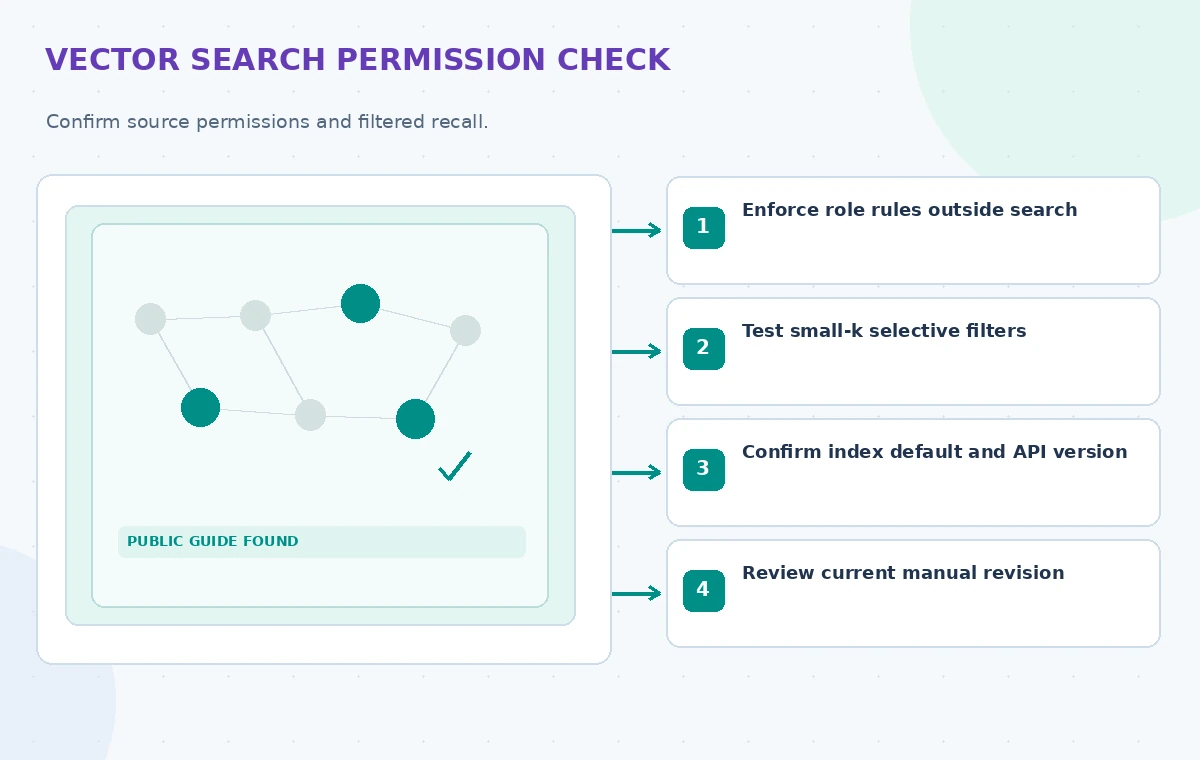
Repeat with low k and highly selective categories. Include an unusual but valid public manual ranked below the global neighbors. A useful test records which expected IDs appear and which authorized document can actually be opened. Do not treat index ranking, a semantic score or a model’s assertion as proof of document currency or public eligibility.
Release with a source and access review
Before publication, verify the search schema, the server-side filter logic, current manual revision and the destination document’s permissions. For visitors, display source titles and dates so they can distinguish an approved instruction from a suggestion. Set an explicit error path when the search yields no eligible records; ‘not found in this search’ is more accurate than ‘no guide exists.’
The diagrams are original teaching art, not screenshots or results from a live Azure index. Revisit the Microsoft documentation for preview status and API changes. Human staff still own final approval of any repair advice with electrical, chemical or other safety implications. The project should optimize reliable evidence, not merely a low median response time.
How We Research
We researched this November 2026 article from official documentation: Microsoft: Vector filters in Azure AI Search; Microsoft: Vector query guidance; Microsoft: Vector filter mode enum. We compared the vendors’ documented fields, feature boundaries, and relevant support conditions with one hypothetical community organization workflow. The diagrams are original fictional teaching art, not product screenshots, measured benchmarks or verified customer cases. We did not submit API requests, run a service, process real personal files or test search accuracy. Implementers must verify current API versions, models, region support, costs, data handling and source permissions; a qualified staff member must confirm factual or safety-critical outcomes.
Frequently Asked Questions
preFilter narrows candidates during vector traversal; postFilter removes nonmatching candidates after an unfiltered search stage.
Yes, especially with highly selective filters or small k values.
Microsoft documents it as preview; confirm current support before enabling it.
Not by itself. Enforce authorization in your application and on source document access.
No. The index, metadata, version and actual contents still require verification.