
The Search Filter Matches but the Guide Disappears
A museum has thousands of conservation manuals, but only a small group relates to a restricted material type. An AI-assisted search returns too few relevant results after a material filter is applied, even though the source index contains the required guide. Azure AI Search supports vectorFilterMode to control when a filter is evaluated during vector retrieval. Microsoft documents preFilter, postFilter and a preview strictPostFilter. Timing matters because approximate-nearest-neighbor search only examines particular candidates. A guide can satisfy the filter but still be missed when the algorithm chooses unfiltered neighbors first. This article uses an imaginary library of repair instructions; its comparisons are conceptual and not a benchmark or access-control evaluation.
Keep Candidate Selection Separate From User Permissions
Filters operate on filterable nonvector fields, such as material, approval_status or access_tier. Those fields must exist in the index schema with suitable configuration. A vector field itself is not made filterable by toggling vectorFilterMode. Decide first what a user’s authorized corpus is and enforce identity and access rights independently. Query filtering is useful for narrowing a retrieval domain but does not grant permission to see the underlying document. If restricted guides are mixed with public records, do not depend on a model remembering a warning in a prompt. Apply server-side authorization and avoid sending unauthorized text to a downstream model, even if a search result is only being used for summarization.

Understand Why preFilter Favors Recall
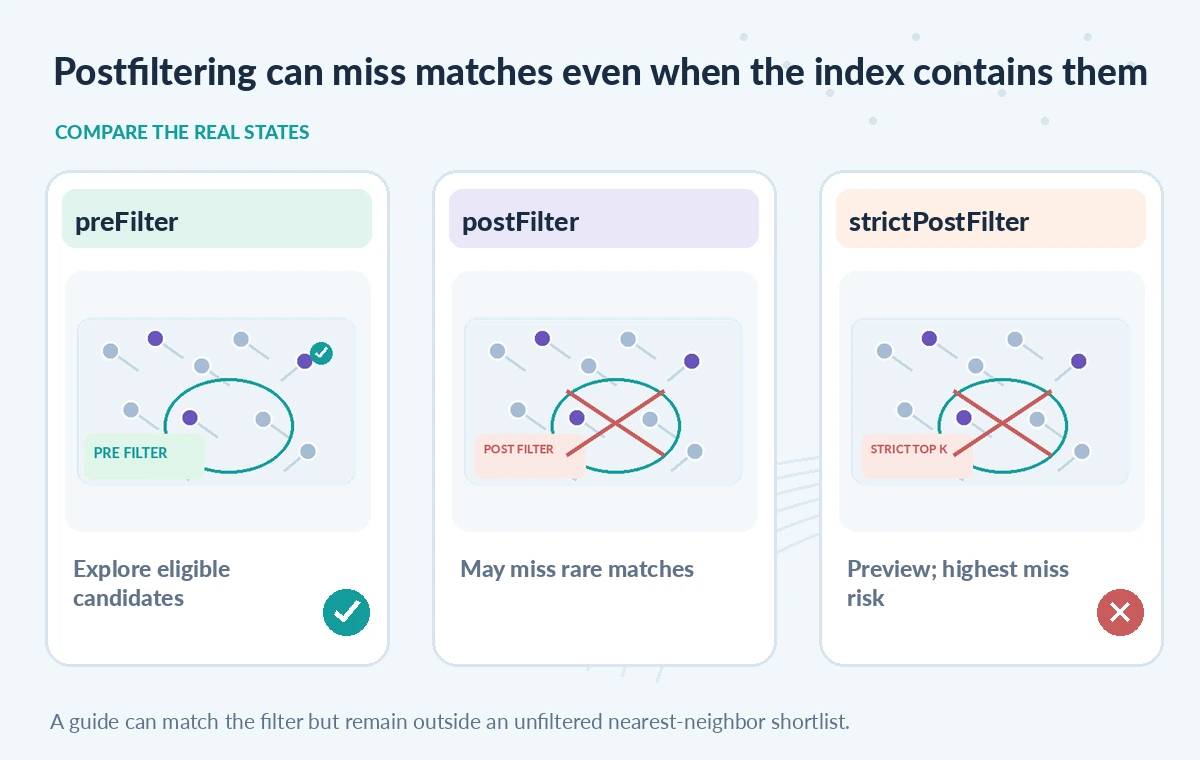
In preFilter mode, Azure applies the filter during the HNSW graph traversal on each shard and searches for qualifying candidates. Microsoft recommends it as the default approach when recall matters, particularly for highly selective filters and small k. It can traverse more of the vector graph, increasing CPU usage and latency compared with a less restrictive approach. That tradeoff should be evaluated on your index rather than assumed from general examples. A source-side permit or manual revision should remain traceable regardless of search mode. If the filtered collection contains fewer than the requested k results, that is not an error; record the actual corpus size rather than inventing missing neighbors.
Understand Why postFilter Can Hide Matches
PostFilter performs an unfiltered vector candidate search and intersects results with the filter at the shard level before aggregating the global result set. If the top candidates are mostly from another material category, a valid qualifying guide can fail to enter the candidate pool at all. That is a false negative from the retrieval configuration, not evidence that the indexed document is irrelevant or absent. Microsoft notes that increasing k may reduce this risk, but it does not turn postfiltering into a universal recall guarantee. When users search for safety-related instructions, a zero-result message should trigger an investigation into filter timing, field values and index coverage before anyone tells them that no guidance exists.
Treat strictPostFilter as a Preview With Greater Risk
Microsoft describes strictPostFilter as applying the filter after selecting the unfiltered global top-k candidates. It is a preview capability with the greatest false-negative risk for selective filters. An extreme case can return zero filtered matches despite qualifying indexed content, because none of those documents appeared in the initial global top-k. This might support certain interfaces that prioritize a predictable subset, but it is a poor choice where omitting an important conservation warning would be consequential. Check the latest preview API and index compatibility before considering it. Never present strict postfiltering as a more secure alternative: choosing where to filter vector neighbors does not enforce user identity or record-level authorization.
Compare the Same Query Across Modes Without Moving the Goalposts
A fair internal experiment should use the same index snapshot, vector query, query text if hybrid search is involved, filter predicate, k and result selection settings. Imagine a test where only the older adhesive-conservation guides qualify. A preFilter query may surface an eligible manual while a postFilter query returns fewer candidates because the initial neighbor list favored common topics. A strictPostFilter example may return none. Those are explanatory possibilities, not measured outcomes from LabFin or a claim about every index. Save the query parameters, count of eligible documents, retrieved IDs and human relevance labels, then decide whether the latency tradeoff justifies a different configuration in your environment.
Check Index Age and Filterable Metadata
Microsoft notes that newer vector indexes have preFilter as the default, while older indexes may default to postFilter and might require recreation to support the newer mode. Verify the service’s current API version and index capabilities rather than copying a settings snippet into an incompatible deployment. Inspect that document metadata has a consistent material code and that revisions are represented as intended. An empty result caused by a misspelled approval status is distinct from an empty result caused by vector filtering order. The evaluator should check query results with an exhaustive or keyword-based control where appropriate, making sure that access rules remain the same. Rebuilds and schema changes should have a versioned rollback plan.
Combine Recall Audits With Safety Review
For a sensitive repair collection, assemble a set of rights-cleared test questions paired with manuals that qualified staff have judged relevant. Include rare topics and records near filter boundaries, not just common guides. Evaluate missing expected documents per mode and inspect search logs for unexplained zero-result cases. Do not compare only clicks or attractive snippets; a user may click the first answer even when it omitted the critical caution. Record latency and computational cost separately from relevance, and avoid claiming a fixed performance multiplier without a measured dataset. If a retrieved guide conflicts with the latest official safety rule, a trained specialist must resolve the conflict before any practical work proceeds.

Explain the Mode and Its Limits to the Editorial Team
A reliable handoff contains the filter predicate, which fields are filterable, the selected mode, service and index version, representative test queries and the conditions that hold a zero-result answer for review. It should also identify who controls access to restricted manuals. The Azure setting influences which candidate documents are found; it cannot decide which restoration procedure is scientifically correct or legally cleared for distribution. Keep human interpretation and permission checks outside vector ranking. A conservative preFilter policy is a reasonable starting point for recall-sensitive collections, but its cost and results still deserve local evaluation with documented evidence rather than assumptions.
How We Research
For this guide, we reviewed the official product documentation on November 8, 2026: Microsoft Vector Query Filters in Azure AI Search, Microsoft Vector Search Overview, Microsoft OData Filter Syntax. We checked the named setting or feature against its published behavior, mapped the documented constraints to the specific hypothetical scenario, and reviewed whether the topic duplicated titles in the supplied LabFin WordPress inventory or prior B0267–B0281 ZIPs. No authenticated vendor service was run; we did not perform a benchmark, observe real customer data, verify third-party rights or claim operational outcomes. All illustrated records and comparisons are teaching examples. Confirm product documentation and security requirements again before implementing a workflow in a real organization.
Frequently Asked Questions
preFilter is the recommended default when recall matters, especially for selective filters.
Yes. Eligible documents may not enter the initial unfiltered nearest-neighbor candidate set.
Microsoft documents it as a preview capability; verify current API availability before use.
No. Server-side authorization and controlled source access remain essential.
Use the same index, filters, query and k, then check retrieved IDs against a human-reviewed relevance set.