
An archive search portal is due for a schema update, but curators cannot take its public catalogue offline while indexing a revised collection. Azure AI Search index aliases supply a stable name that can be repointed from an existing index to a replacement. An alias is not a second copy of data and does not create user permissions. The workflow below uses hypothetical collections and contains no claim of real service testing or measured zero-downtime performance.
Understand the difference between an alias and an index
An index stores searchable fields and documents. An alias is a service-level secondary name for an index; application requests can refer to that name rather than to a changing physical index. The schema, content and field settings remain properties of the underlying index. A public-facing alias such as `catalog-public` should point only to an index built for the intended audience. Do not name an alias and assume that its title enforces privacy.
Microsoft documents aliases for document operations and certain index-definition operations, with explicit limitations: an alias cannot be used to delete an index or for text-tokenization testing, and it cannot serve as the targetIndexName for an indexer. Build ingestion against an actual index name. Search clients can use the alias, but maintenance scripts and indexers may require direct physical index references. Check any feature restrictions for the API version in use.
Create a candidate index without overwriting the live one
Start by recording the current index schema, document count, access-filter design, source-revision metadata and critical example queries. A new physical index might be called `catalog-v2`. Load it from an approved snapshot or controlled ingestion process. Include the same public visibility rules and updated revision identifiers; a schema migration that drops an access field is a release blocker even if text relevance improves.
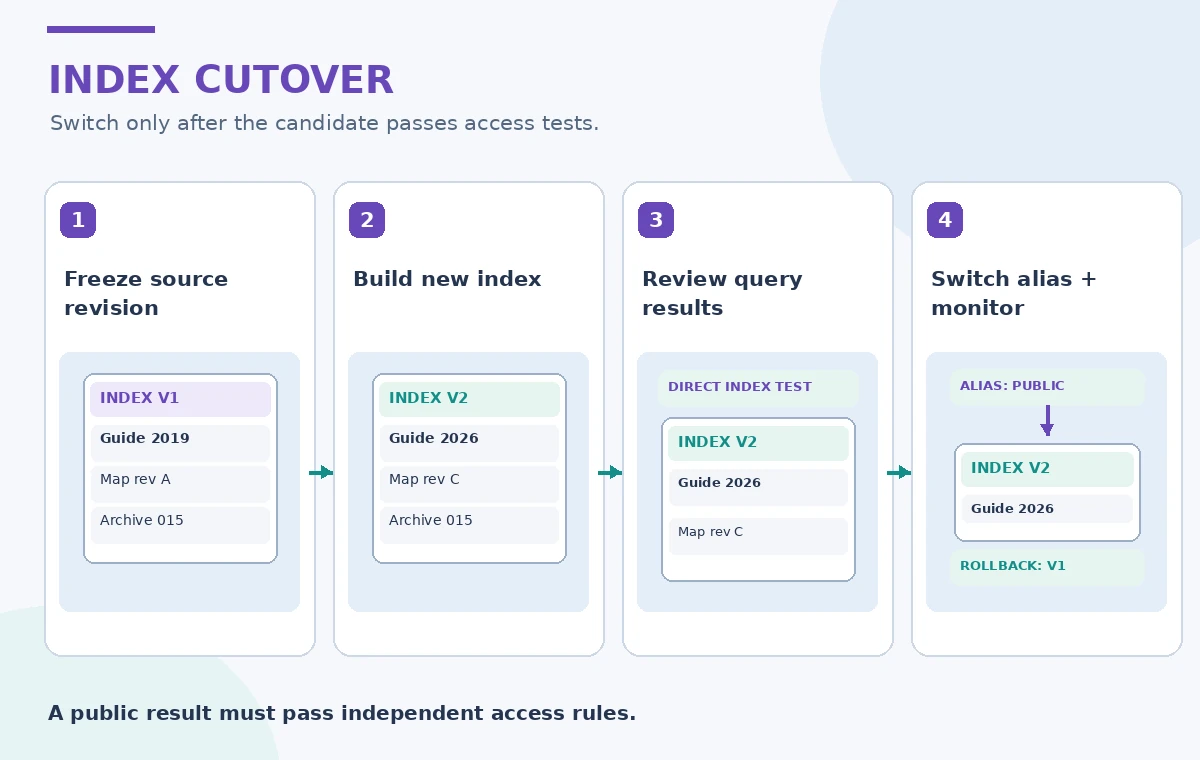
Run a representative query set against the old and new physical index names before the switch. Include a precise accession number, a name with unusual punctuation, a recently corrected exhibit label and a withdrawn catalog item. Save the observed responses in a local test report. Comparing the same query against two defined snapshots is more informative than comparing a successful search with an empty index.
Keep permissions independent of the index pointer
An alias routes requests; it does not determine who may see a record. Enforce authorization in the application and use a properly populated access filter or equivalent permission-aware retrieval pattern. A public catalogue must exclude private donor notes and embargoed oral histories even if those documents are accidentally indexed. The safe practice is not to load forbidden content into the public index at all.
Test an authorized staff identity and an anonymous visitor identity separately. Check not just result titles but counts, snippets, facets and citations, since these can inadvertently disclose the presence of restricted records. An access test should fail if an embargoed document appears anywhere in the response. Do not let an administrator-only rehearsal of the new index stand in for a public-role acceptance test.
Use a four-stage controlled cutover
The process diagram depicts a frozen source revision, a rebuilt candidate index, a query-and-permission review, and finally an alias update plus monitoring. Each stage produces evidence that the next stage can use. Keep the old index intact until the new mapping and public search behavior have been verified. Assign different owners to schema preparation and the final release approval where staffing permits.
Microsoft documents changing an alias mapping with an update request containing the alias name and the new index name. Update the alias only after comparing its existing definition with the intended target. A successful update response does not mean every reader has observed the change immediately. The documented propagation window may be up to ten seconds. Monitor actual application results instead of deleting the original index immediately.
Compare the old, candidate and live alias states
In the comparison graphic, the old index contains a superseded repair-guide label, the candidate has its corrected revision, and the final state shows the public alias pointing to the reviewed candidate. This is a conceptual migration illustration, not a screenshot or uptime benchmark. The critical difference is the route through the alias; the new index should already have passed its own content and access checks.
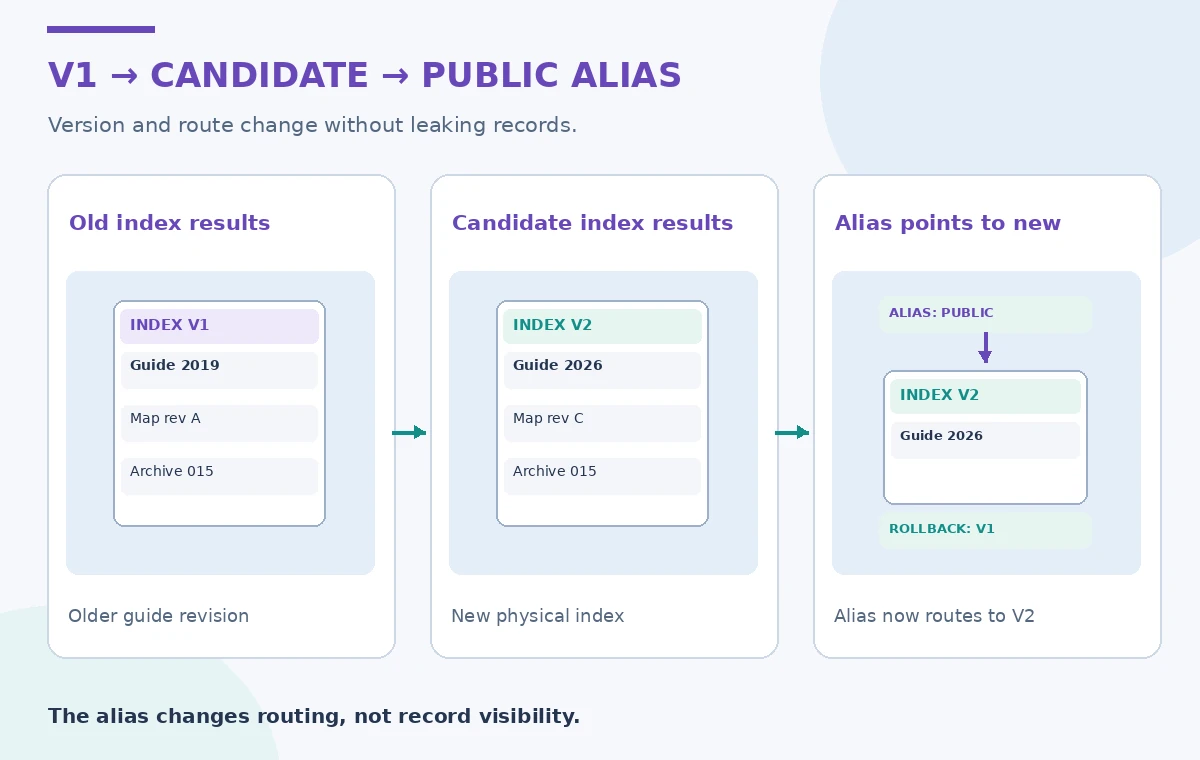
A query for a specific accession number must remain resolvable across the switch. If the new index changes analyzers, fields or vector configuration, evaluate recall and exact identifier matches separately. A corrected display title can be welcome, but a missing historical object is not an acceptable tradeoff without a documented exception. Preserve the old result ID-to-record mapping so previously issued citations can be reconciled.
Make rollback a tested option
Before cutover, confirm that the previous index still exists and can serve the expected query workload. Save the old alias definition. A rollback plan should identify who is authorized to repoint the alias, what evidence triggers rollback, and how the application will distinguish old from new content while propagation occurs. Deleting the older physical index immediately removes that safety net.
Aliases are not an all-purpose transaction around upstream ingest or downstream caching. A client may cache results created before the mapping changed. Version cache keys where necessary and log the index revision used to generate a citation. If an alias update is interrupted or a network timeout obscures the result, fetch the alias definition first; do not blindly repeat a state-changing request without checking its current destination.
Inspect the four checks before deleting anything
The verification diagram flags permissions, citation continuity, propagation, and rollback availability. Query the alias after cutover using a public account and a representative test set. Confirm that restricted content stays excluded and updated source metadata appears in results. Record timestamps and the actual returned index revision where your application makes it observable. A green API response by itself is not a complete release report.
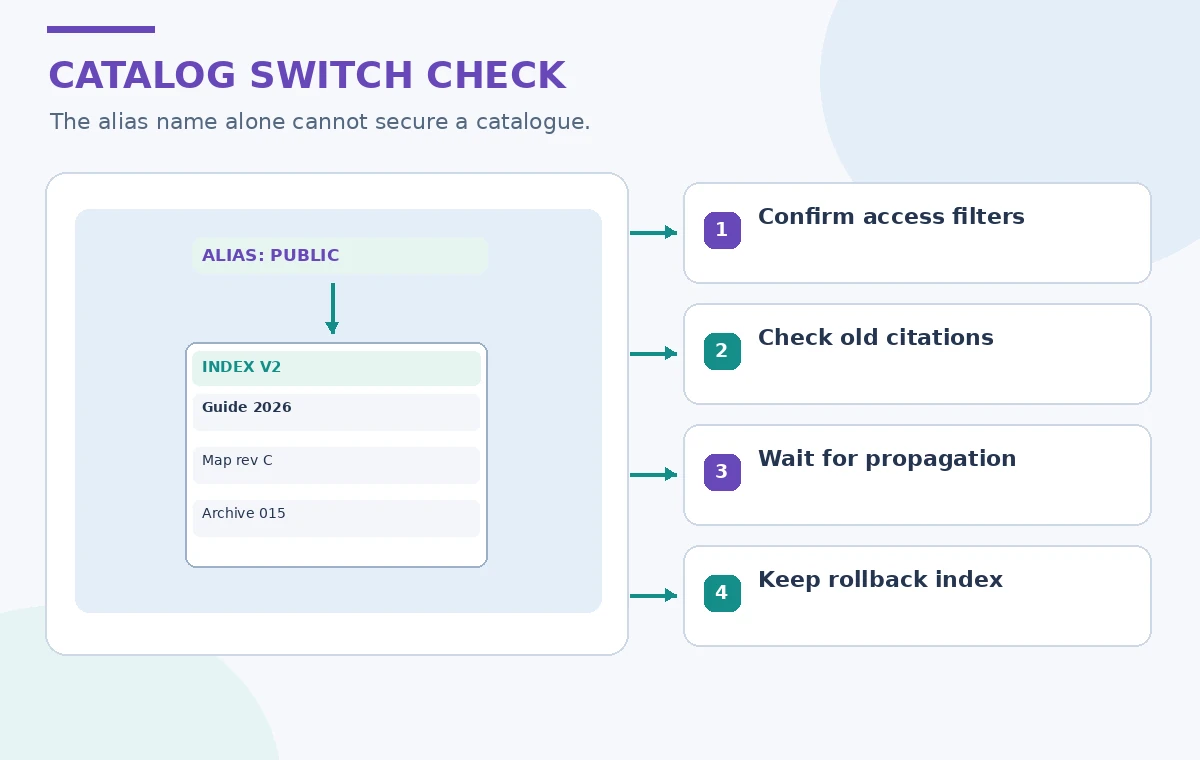
Microsoft notes that an alias update can require a propagation interval and that deleting an index still referenced by an alias fails. Use those facts to structure a safe release window, but do not claim exactly ten seconds of downtime or performance. If a query returns inconsistent content, preserve both indexes, investigate the routing and caches, and stop destructive cleanup. Release validation should be reversible.
Document the new catalogue edition
Record the alias name, old and new physical index names, source dataset revision, schema hash, query-test results, approver and rollback instructions. Keep a direct link from every public result to the authoritative catalogue record; an index is a discovery layer, not the source of truth. If a museum corrects a provenance date later, the catalogue revision should explain the change independently of the search-index rollout.
An alias is particularly useful when a schema change requires rebuilding an index. For a small catalogue that can tolerate a scheduled maintenance window, a simpler update plan may be reasonable. Choose the release strategy based on operational risk rather than using the word “zero downtime” as a guarantee. The important promise is that a tested route exists for changing and reversing the search destination.
How We Research
For our November 2026 source review, we consulted these named official developer references: Microsoft Learn: Create an index alias; Microsoft Learn: Update or rebuild an index; Microsoft Learn: Create a search index. We compared published feature scope, technical parameters, product restrictions and operational caveats with a fictional museum, archive or community-service example. We did not run paid API calls, test a live deployment, measure recognition quality, upload private documents or capture actual vendor screenshots. The 20 illustrations in this batch are original schematic teaching drawings, not measured model output. Service availability, terms, model versions and prices may change; verify the latest official documentation, permissions and an authorized local test before public deployment.
Frequently Asked Questions
No. It is a secondary name pointing to a physical index; documents and schema remain in the underlying index.
Microsoft documents that aliases cannot be specified as targetIndexName on an indexer; use a physical index name.
No. Authorization and access filtering must remain correctly implemented in the application and index design.
No. Allow the documented propagation window, validate live queries and preserve a rollback option until release checks pass.
No. Validate candidate content, identifiers, access rules and citations before repointing the alias.