
Disclosure: LabFin is reader-supported. If you sign up for a tool through links on this page, we may earn a commission at no extra cost to you. Commissions vary between providers and our ratings do not — here’s our full disclosure.
How to reduce AI hallucinations starts with knowing why they happen. OpenAI’s researchers argued in a 2025 paper that models guess for a simple reason. Training and tests reward a confident answer over an honest “I don’t know.” So the fixes below aim to make guessing less likely before the answer arrives. Our page on prompt frameworks that actually help covers what the Wharton tests found about personas and step-by-step prompts.
Most steps come from Anthropic’s own documentation, which lists techniques that work with any assistant. For checking an answer after it arrives, our guide to fact-checking AI output covers the other half.
How to Reduce AI Hallucinations: The Short Answer
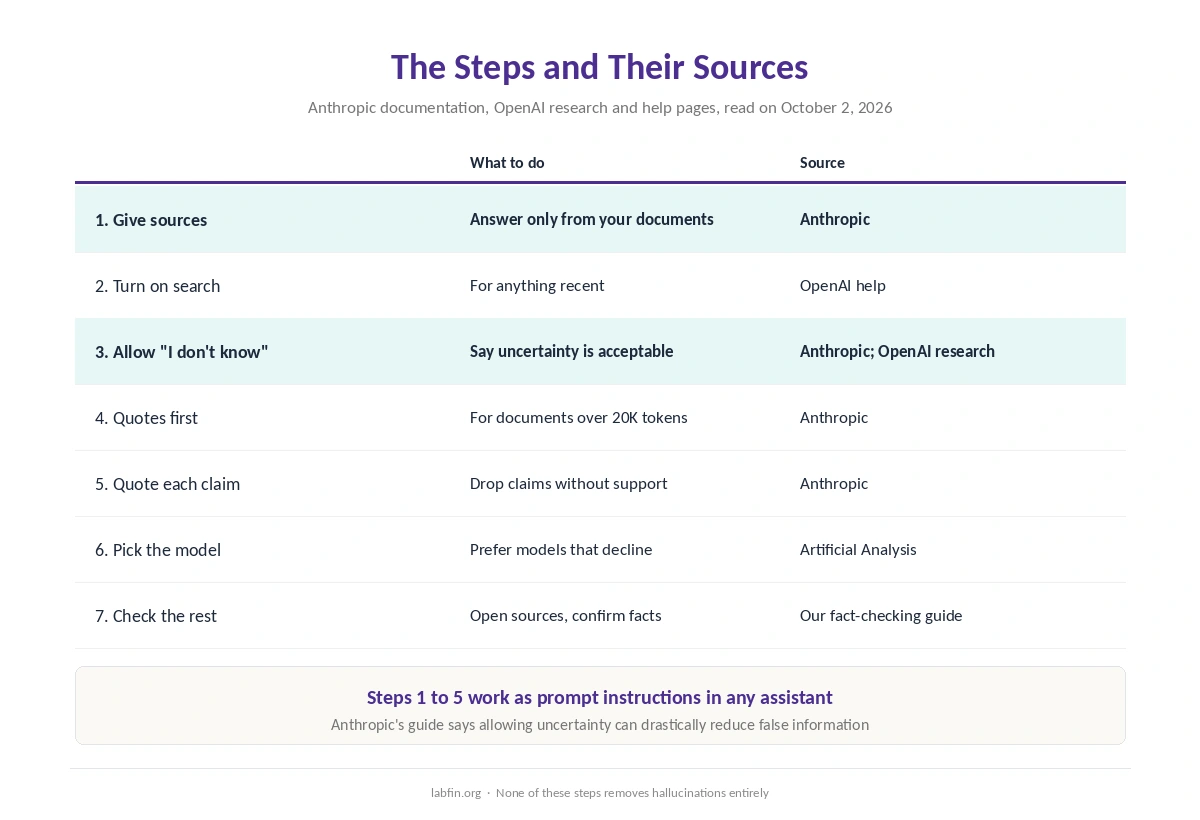
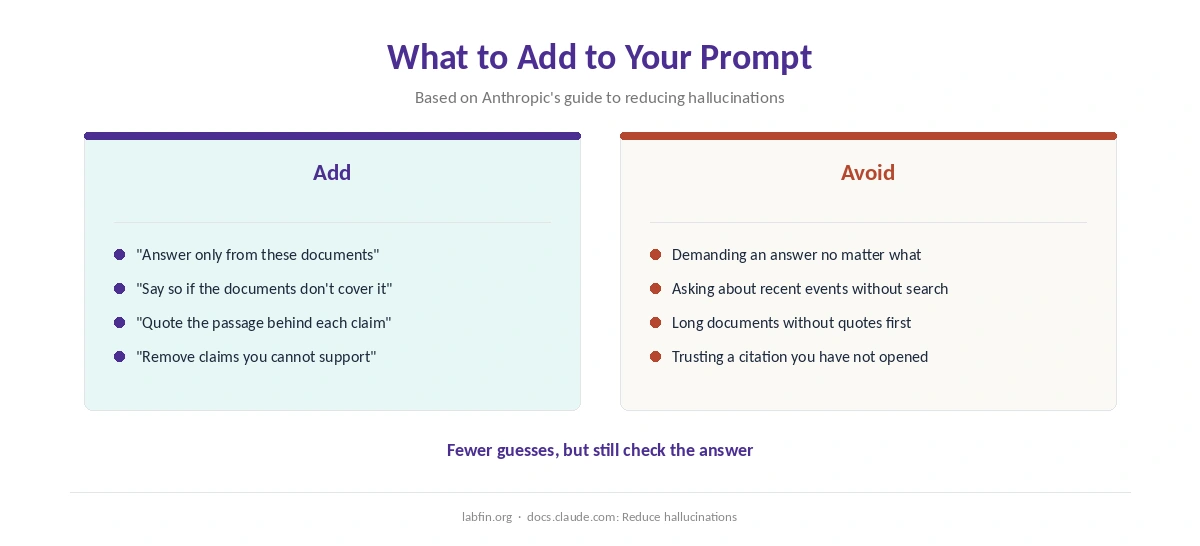
Give the model sources, permission to say “I don’t know,” and a rule to quote its evidence. Anthropic’s guide to reducing hallucinations says explicitly allowing uncertainty can drastically reduce false information. It also recommends asking for a supporting quote for each claim and dropping claims without one.
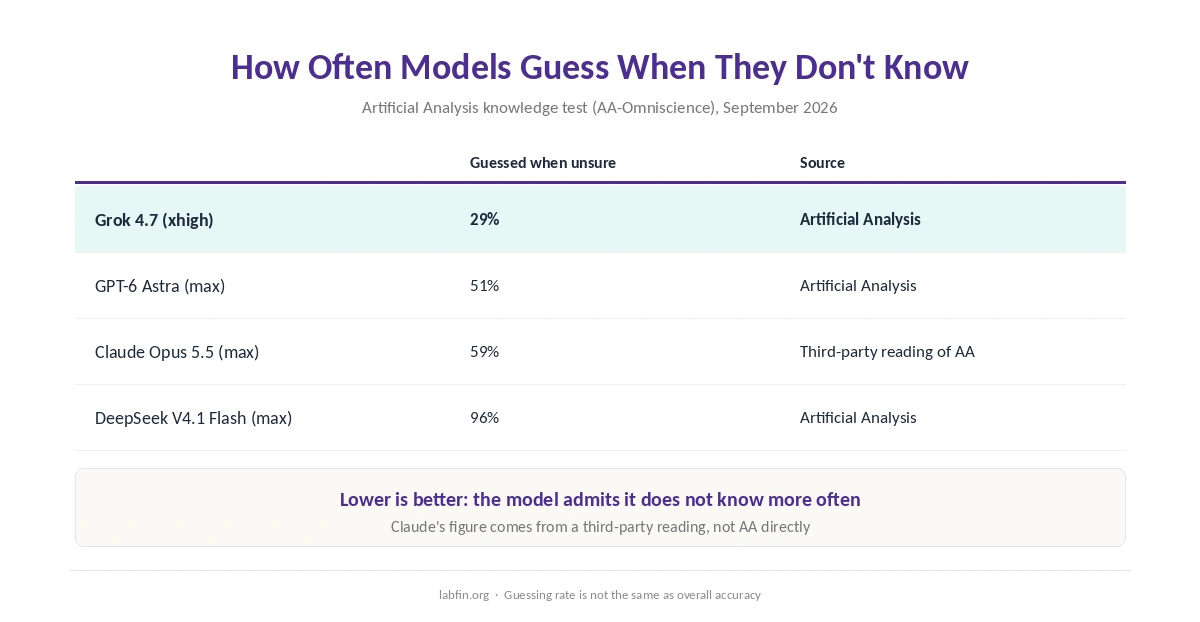
Model choice matters too. On Artificial Analysis’s knowledge test, Grok 4.7 guessed on 29% of the questions it could not answer. DeepSeek V4.1 Flash, in contrast, guessed on 96%. So, for factual work, prefer models that decline more often.
Step 1: Give the Model Your Sources
When figuring out how to reduce AI hallucinations, start with sources: a model that reads the answer is less likely to invent one. So paste or upload the documents, and tell the model to answer only from them. Anthropic’s own example does this with product briefs. Our guide on how to train AI on your own content sets out the steps.
Some tools build this in. For instance, Gemini Notebook answers from the sources you add and cites passages. Gemini’s Deep Research can also skip Google Search to use only your files, as our guide to Gemini for research covers.
Step 2: Turn On Search for Current Facts
Without search, a model answers from training data that stops at a cutoff, OpenAI’s help article explains. Therefore, for anything recent, make sure search is on, or use a research mode that cites its sources.
Search alone is not enough, however. In the EBU and BBC study of October 2025, sourcing problems still appeared in 15% to 72% of news answers. Our list of the best AI for research covers that study.
Step 3: Allow “I Don’t Know”
Tell the model directly that “I don’t know” or “the documents don’t say” is an acceptable answer. Anthropic’s guide calls this a simple technique that can drastically reduce false information.
This matches OpenAI’s research, which found that models guess partly because tests reward guessing. Giving explicit permission, therefore, removes some of that pressure. Our guide to writing better prompts covers how to phrase clear requests.
Step 4: For Long Documents, Ask for Quotes First
For documents over about 20,000 tokens, Anthropic’s guide recommends asking for word-for-word quotes before the task itself. The model then works from the quoted text rather than its memory of the document.
For example, ask first for every passage about payment terms, then ask for the summary based on those passages. Our list of the best AI for summarization covers tools that cite passages automatically.
Step 5: Require a Quote for Each Claim
Ask the model to back each claim with a quote or source, then to remove any claim it cannot support. Anthropic’s example even marks removed claims with empty brackets, so you can see what was cut.
This makes the answer auditable. Also, it turns a vague worry into a checklist you can verify line by line.
Step 6: Pick a Model That Guesses Less
On Artificial Analysis’s knowledge test, models differ widely in how often they guess when they do not know. Grok 4.7 guessed on 29% of those questions and GPT-6 Astra on 51%. By contrast, DeepSeek V4.1 Flash guessed on 96%, as our Grok vs DeepSeek comparison covers.
Claude Opus 5.5’s rate was 59%, according to a third-party reading of the same test. So no model is safe on its own, but some need much more checking than others.
Step 7: Check What Remains
These steps reduce hallucinations; they do not remove them. So open the cited sources and confirm numbers and names. Then quote originals rather than the chatbot, following the checks in the guide linked above.
Which Tools Make This Easier
Tools that ground answers in your own files make the steps above automatic. For example, Gemini Notebook cites passages in your sources. ChatGPT’s deep research also cites its sources in reports, as our guide to ChatGPT for research explains. Claude’s Research does too, as our guide to Claude for research covers.
For work with your own papers, our list of the best AI tools for researchers compares these features in detail.
How We Research
This guide on how to reduce AI hallucinations draws on Anthropic’s documentation and OpenAI’s 2025 research paper. We read them, and OpenAI’s help article, on October 2, 2026. Guessing rates come from Artificial Analysis, and we mark third-party readings as such.
We run no hallucination tests of our own. Our criteria live on our about page.
How to Reduce AI Hallucinations FAQ
Give the model your sources and allow it to say “I don’t know.” Then ask for quotes first on long documents, require a quote for each claim, and check what remains.
OpenAI’s 2025 research argues that training and evaluations reward a confident guess over admitting uncertainty, so models learn to guess.
On Artificial Analysis’s knowledge test, Grok 4.7 guessed on 29% of unknown questions and GPT-6 Astra on 51%. DeepSeek V4.1 Flash, however, guessed on 96%.
It helps with current facts, but no. The EBU and BBC still found sourcing problems in 15% to 72% of news answers from search-enabled assistants.
Explicitly allowing “I don’t know.” Anthropic’s guide says this simple technique can drastically reduce false information.
The Verdict
How to reduce AI hallucinations comes down to giving the model sources and permission not to guess. Then require evidence for each claim, and pick models that decline more often when they are unsure.
Even so, check what remains before you rely on it. These steps cut the errors; they do not end them.