
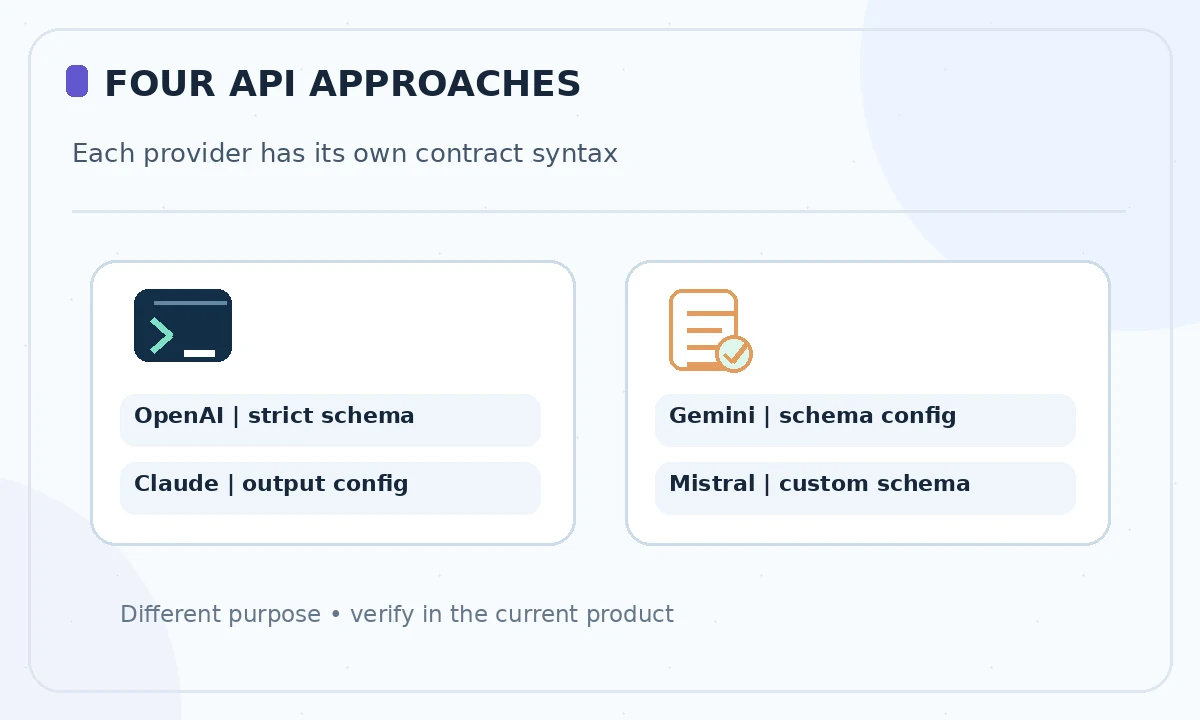
For a production AI feature that populates database fields or calls tools, pretty prose is not the acceptance criterion. You need a parseable response that matches an agreed schema and you must be able to handle refusals, missing source facts and invalid business values. Four major model API families publish ways to constrain output, but the mechanisms and model support are not interchangeable.
This guide compares OpenAI, Anthropic Claude, Google Gemini and Mistral specifically for structured JSON. It is not a universal “best AI API” ranking and does not claim independent latency testing, live account pricing or 100% factual reliability. Model versions, schema subsets and SDKs change; verify each against your deployed endpoint.
Start with the schema your application needs
Choose a small use case such as classifying a support ticket into department, urgency and explanation. Define exact types, required fields, allowed enumerations and how to represent “unknown.” Provide several tricky examples, including empty input, conflicting statements and deliberately irrelevant text. The schema is an interface contract, not a substitute for a correct labeling policy.
Keep a reference validation suite in ordinary code. The response should be parsed, verified against the contract and then checked for semantic plausibility. A model can return a valid urgency label that is wrong for the ticket. Route disputed or high-impact outcomes to a person.
OpenAI: schema-constrained outputs and tool calling
OpenAI documents Structured Outputs through model response formatting and function calling. The distinction is important: response schemas shape what the model returns to your program, while tool definitions control arguments passed into a function. The docs also describe how refusals and a restricted JSON Schema subset affect integrations.
Prefer strict schema constraints when the selected model and endpoint support them, and test the behavior of optional fields, arrays, nested objects and refusals. Do not assume that arbitrary JSON Schema keywords or older model snapshots behave identically. The best fit is an application whose existing SDK can enforce a clear response contract and whose engineers already validate the resulting domain values.

Claude: JSON responses and strict tool inputs
Anthropic’s current documentation describes JSON response formatting through output configuration and strict tool use for validated tool parameters. These are complementary, not equivalent: a schema for an extraction result does not automatically authorize an external action, and a safe tool schema does not establish that the model chose the right action.
Use an extraction fixture with missing values and contradictory documents to see whether the chosen Claude model produces honest unknowns. Check its documentation for model eligibility and SDK methods before copying an example between versions. For agent workflows, place separate authorization checks between structured tool arguments and the actual system operation.
Gemini: JSON schema with endpoint-specific syntax
Google’s Gemini API documentation supports generating outputs constrained to a provided JSON Schema, with current SDK examples showing schema objects and typed helpers. These are useful for classification and data extraction where an application needs a predictable object rather than freeform text.
Do not blindly translate an OpenAI request parameter into a Google API call: endpoint families and configuration fields can differ. Test the exact Gemini API or Interactions endpoint you plan to deploy, including required properties, nullability, enum values and response handling. Verify any grounding or other built-in tools independently from structured response generation.
Mistral: custom structured output versus JSON mode
Mistral documents both JSON mode and custom structured output. Its guidance says custom schema-driven output is more reliable when a specific field structure matters, while JSON mode enforces JSON syntax without the same level of control over your desired schema. The developer should choose consciously rather than using the words interchangeably.
Test Mistral with an application schema that contains a constrained enumeration and nested records. Confirm that the model, SDK and account support your desired structured mode. If a transformation fails, preserve the original input securely, show an actionable error and avoid silently interpreting unspecified fields as facts.
Compare using a shared, versioned test dataset
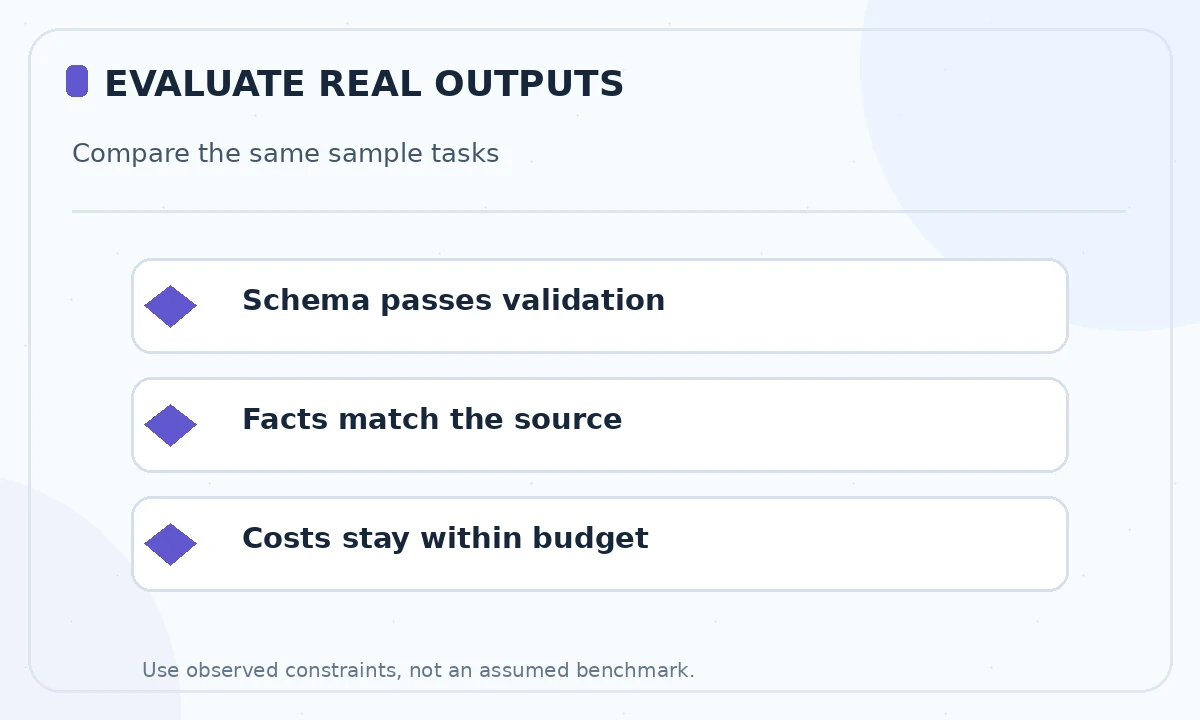
Build fifty representative inputs if you have enough real authorized examples, or start with a smaller labeled fixture and disclose the sample size. Include unanswerable requests, prompt-injection attempts inside documents, multilingual input if relevant and deliberately malformed dates. Send the same task intent and equivalent schema constraints to each provider, noting differences in supported schema features.
Score schema validity, correctness against human labels, refusal quality, error recovery, latency and actual billed usage. Run tests in staging and keep model IDs, dates and region or endpoint settings. A vendor’s syntactic guarantee is not evidence of better factual extraction on your documents.
Account for cost, residency and operational restrictions
Pricing is not just an advertised input-token rate. You may pay for output, cached content, tool activity or retries depending on the provider. Legal or privacy requirements can rule out otherwise attractive APIs. Check official data-use, retention, geographic and enterprise agreements for your account before sending sensitive documents.
Create a scorecard with columns for supported schema complexity, developer ergonomics, safety review, latency budget, quotas and all-in expected costs. Put unknowns in the matrix instead of filling them with guesses. A structured-output API is valuable only if the integration can be maintained and the resulting data can be trusted for its intended business purpose.
Make migration and fallback behavior explicit
Create a provider-neutral internal contract and put provider-specific request adapters behind it. Keep schema definitions and examples in version control. For fallback, validate that the secondary provider handles the same enums, nesting and refusal format before turning it on; otherwise, an outage can create bad downstream records.
Expect providers to evolve their supported schema subsets and SDK conveniences. Re-test after model upgrades or changed default endpoints. Start with the API that passes your own correctness gate at an acceptable operational cost, not one selected solely because it topped a general chatbot ranking.
How We Research
We reviewed the current primary-source documentation as of October 26, 2026: OpenAI structured model outputs; Claude structured outputs and strict tools; Gemini API structured outputs; Mistral custom structured outputs. We distinguished documented plan features and limits from editorial workflow suggestions, and we compared the intended reader task with the previously published LabFin material. We did not purchase plans, perform product benchmarks, run code or verify an individual account’s entitlements. Where product pages conflict or terms may change, we have identified the uncertainty and recommend confirming checkout or live account details.
Frequently Asked Questions
No. It helps enforce response shape, not factual truth. Compare values with the source and validate business rules and exceptions.
No. JSON mode normally enforces valid JSON syntax; a structured schema feature additionally constrains keys and types within its supported subset.
Use a shared internal contract, but confirm provider-specific schema subsets, endpoint syntax and model eligibility. Some constraints need adaptation.
Choose one that meets your verified accuracy, review, privacy and operational needs. Require human validation for consequential decisions regardless of the schema feature.
Only after testing that the fallback produces compatible schemas, error handling and safety behavior. Do not assume a second provider is a drop-in replacement.