
Old blog posts can age in two ways: their facts stop being accurate, or the reader’s question changes while the post stays the same. An AI assistant can identify suspicious passages and propose new explanations, but it cannot establish that the change is correct without checking source material. Updating a date or adding more words is not a substitute for maintaining usefulness.
This workflow starts with an existing canonical URL and ends with an evidence-backed revision log. It deliberately differs from drafting a brand-new article. Google Search Central cautions against changing dates merely to make pages look fresh, while Search Console provides real query- and page-level performance data that can help prioritize legitimate maintenance.
Build a small inventory before updating anything
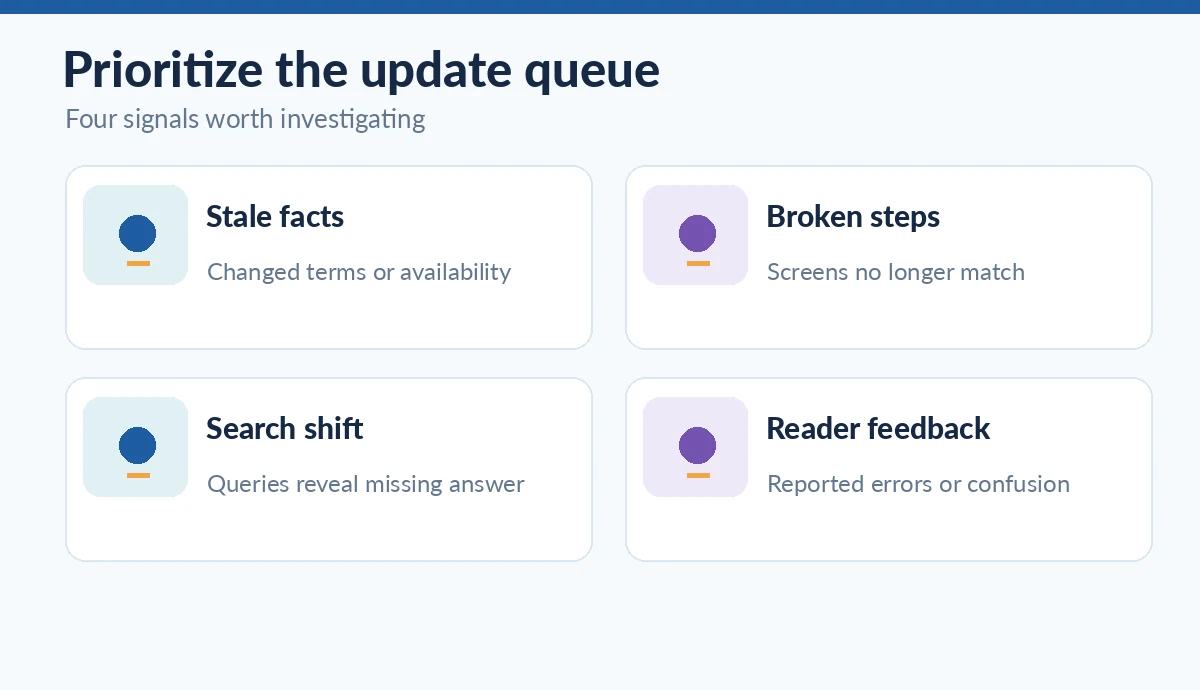
Export a list of published URLs, page titles, primary questions, owners and last substantive review dates. Add practical risk signals: prices mentioned, product names with known interface changes, time-limited offers, screenshots, broken downloads and policy statements. A high-performing evergreen definition may need less immediate work than a buying guide with out-of-date subscription details.
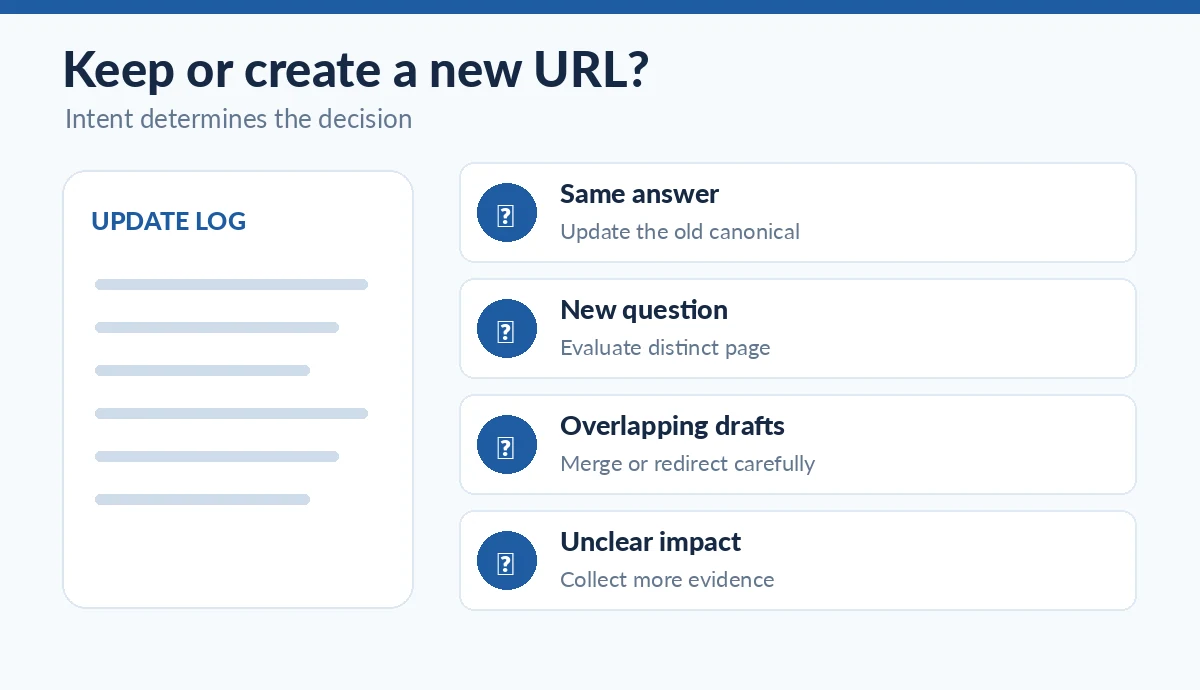
Classify each URL by purpose rather than only by keyword. Two guides might mention the same brand but serve different needs, such as choosing a tool and fixing a specific error. When reviewing drafts, do not create a second page that answers an existing canonical question. Decide whether to refresh, expand or merge before the assistant writes replacement paragraphs.
Use Search Console as a clue, not a verdict
Google Search Console’s Performance report groups data by queries and pages, which can reveal changes in impressions, clicks and the searches bringing visitors. Filter to a specific page and compare an appropriate period. Read the query mix: a post may be ranking for an intent it answers poorly or may simply be affected by seasonal demand. Neither situation is diagnosed by a single chart.
Write a hypothesis before editing: “The article promises setup instructions, but visitors now ask about a newly added step.” Check the actual page and current official documentation. Do not treat an optimization tool’s content score or a dip in clicks as proof that a paragraph should be rewritten. Measurements guide investigation; they do not replace reader-centered editorial judgment.
Audit facts and steps against primary sources
List factual claims in the post: plans, numbers, supported platforms, features, company names and safety instructions. Open the original official sources and verify current status. If a vendor has retired a product, replace the obsolete how-to with a clear explanation and helpful alternatives. If a feature has moved, update the steps and screenshots rather than hiding the issue under generic wording.
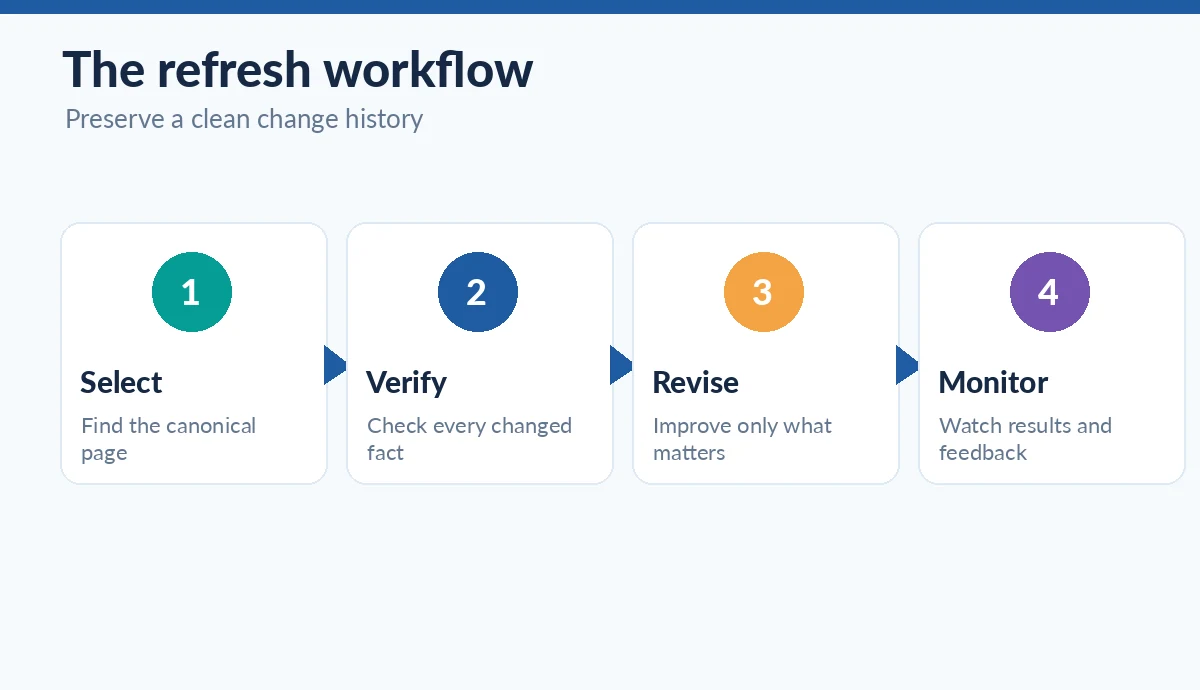
Keep a change ledger with four fields: old statement, new source, replacement statement and reason for the change. Treat ambiguous differences conservatively; a release note announcing a feature does not prove it is generally available in every region. If you cannot resolve a claim, qualify or remove it until it can be verified.
Use AI to propose targeted edits, not mass rewrites
Give the assistant the specific old paragraph and an approved new source excerpt. Ask it to preserve valid detail, revise only necessary sentences and list potential meaning changes. Keep the original text saved for comparison. A wholesale rewrite can delete useful context, change the author’s voice and introduce new unsupported assertions without addressing the reader’s actual problem.
Ask for alternative headings only if the page now answers a different subquestion. Preserve the original URL when the core intent remains the same. A substantial new intent may justify another article, but that requires its own source and cannibalization review. Avoid changing slugs solely because a generative tool produced a trendier phrase.
Restore utility with examples, links and clear decisions
Before expanding the word count, identify what a visitor still cannot do. The fix could be a three-step troubleshooting sequence, a dated comparison table, a screenshot of a changed interface, or an explanation of a newly important limit. Add one useful component at a time and check that it accurately reflects the current workflow. A larger article is not inherently a better article.
Recheck outbound sources, affiliate disclosures where applicable, and internal links to relevant already-published pages. Remove references to tools that were never tested rather than implying first-hand experience. Ensure illustrations are accurate and readable at mobile widths. When a post refers to a live price, state the verification context and avoid claims of permanent availability.
Handle dates, redirects and duplicate intent carefully
Google’s people-first guidance asks whether a page date was changed without substantial content improvement. Update the visible review or publication information in a way that reflects real editorial work, not simply a new calendar year. If you merge two overlapping articles, decide which canonical URL should remain and review whether a redirect is appropriate before changing the site structure.
Changes to canonical tags, redirects and sitemap entries can have lasting effects; follow existing publishing controls rather than letting an AI agent update production settings automatically. For complex migrations, coordinate with the site owner. A refresh should maintain the reader’s navigation and preserve evidence of why the change occurred.
Measure whether the refreshed page helps
Record the revision date, version, specific improvements and what success would look like: fewer support complaints, clearer next steps, accurate current facts and potentially better relevant search engagement. Compare Search Console data after a sensible observation period, allowing for seasonality and unrelated search changes. A rank change alone does not prove that the edits caused it.
If results worsen, investigate intent mismatch, technical changes or competitors rather than automatically producing more text. Keep the corrected version accessible internally so editors can compare. The refresh process succeeds when the published answer remains trustworthy and useful, even when traffic does not immediately increase.
How We Research
We reviewed Google Search Console’s reporting documentation, Google’s guidance on genuine content updates and dates, and Clearscope’s official content-inventory workflow, checked October 26, 2026. We did not access any private Search Console account or attribute ranking changes to AI editing. The sample update decisions here are illustrative.
Frequently Asked Questions
A date alone does not make a page more useful. Make substantive, evidence-backed improvements and show accurate review information.
Usually keep the existing canonical when its main reader question is unchanged. Consider a new page only for genuinely distinct intent after checking overlaps.
It can flag candidates for review. A person must check original sources and decide what is actually outdated or misleading.
There is no single universal metric. Compare query intent, page-level impressions and clicks, and actual reader usefulness together.
Set risk-based triggers: vendor changes, reader reports, major policy updates and periodic reviews for volatile articles. Avoid arbitrary rewriting schedules.