
Disclosure: LabFin is reader-supported. If you sign up for a tool through links on this page, we may earn a commission at no extra cost to you. Commissions vary between providers and our ratings do not — here’s our full disclosure.
Claude for coding means Claude Code, Anthropic’s coding agent. It comes with Pro and Max plans and runs in the terminal and in IDEs. On Artificial Analysis’s Coding Agent Index, Claude Code with Sonnet 5.5 at maximum effort scores 68. That is the top entry on its comparison with Codex. For more, our page on Claude vs GitHub Copilot covers Claude Code against Copilot, which also offers Claude models.
But that score comes at a price. Artificial Analysis puts that run at $14.19 and about 1.5 hours per task, against $1.04 for Codex’s best entry at 63. This guide covers what each plan allows, how the agent ranks, and how to keep your code safe.
Claude for Coding: The Short Answer
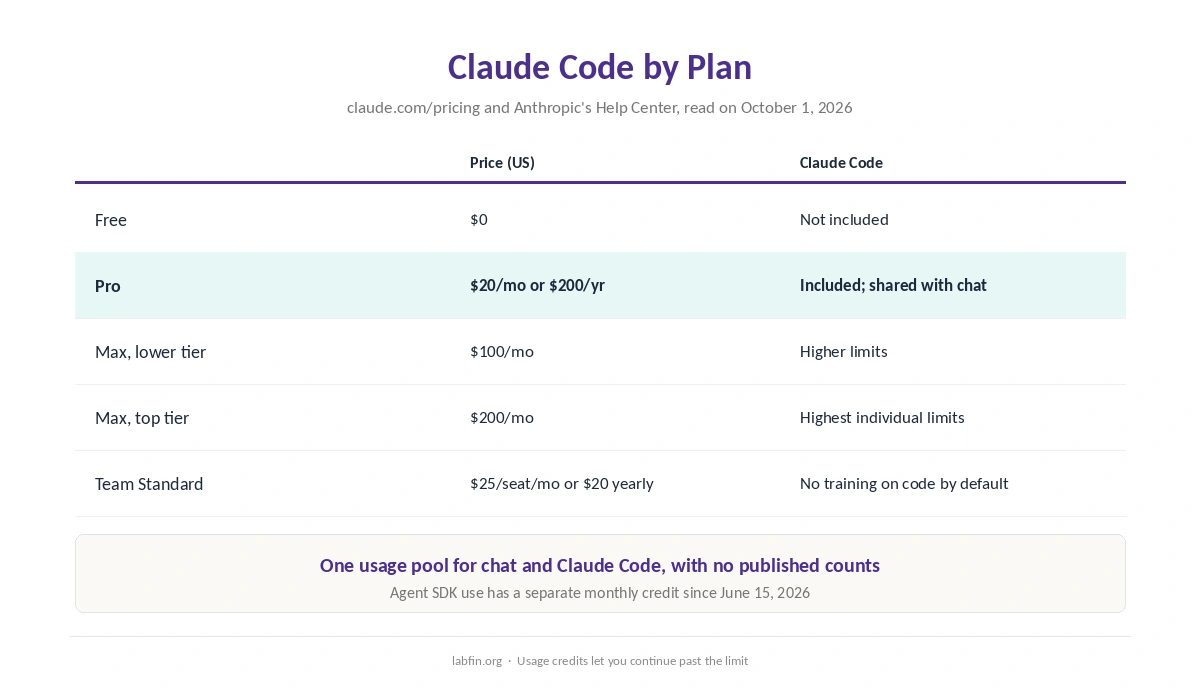
Paying for Claude for coding makes sense if agent quality matters more than cost per task. Claude Code comes with Pro at $20 a month or $200 a year, and Max raises the limits. Its usage pool is shared with Claude chat, so heavy coding leaves less for everything else.
At the same score, however, Codex is cheaper. Claude Code with Sonnet 5.5 at Extra High effort scores 63 at $3.33 per task. In contrast, Codex with GPT-6.1 Sol at Extra High scores the same 63 at $1.04. Our guide to ChatGPT for coding covers Codex in detail.
What Claude Code Is
Claude Code is an agent that reads a codebase, edits files and runs commands. Anthropic’s Help Center says Pro and Max cover it in the terminal and in IDEs. Those include VS Code, Cursor and JetBrains IDEs such as IntelliJ and PyCharm. However, the free plan does not include it. Our page on Claude vs Cursor covers Claude Code against Cursor, including Claude Code running inside Cursor.
Since June 15, 2026, scripted use through the Claude Agent SDK and claude -p no longer counts toward plan limits. Instead, eligible plans get a separate monthly credit for it: $20 on Pro and $100 or $200 on Max, Anthropic says.
What Each Plan Allows
Still, Anthropic publishes no message counts for Claude Code. Pro and Max share one usage pool across Claude chat and Claude Code, with a five-hour session window and a weekly cap. When you hit the limit, you can wait for the reset or turn on usage credits. The /status command shows what remains, and our yearly cost breakdown covers what Pro and Max cost over a year.
| Plan | Price (US) | Claude Code |
|---|---|---|
| Free | $0 | Not included |
| Pro | $20/mo or $200/yr | Included; limits shared with chat |
| Max, lower tier | $100/mo | Higher limits; Fable up to half the weekly limit |
| Max, top tier | $200/mo | Highest individual limits |
| Team Standard | $25/seat/mo, or $20 yearly | Included; no training on your code by default |
How Claude Code Ranks
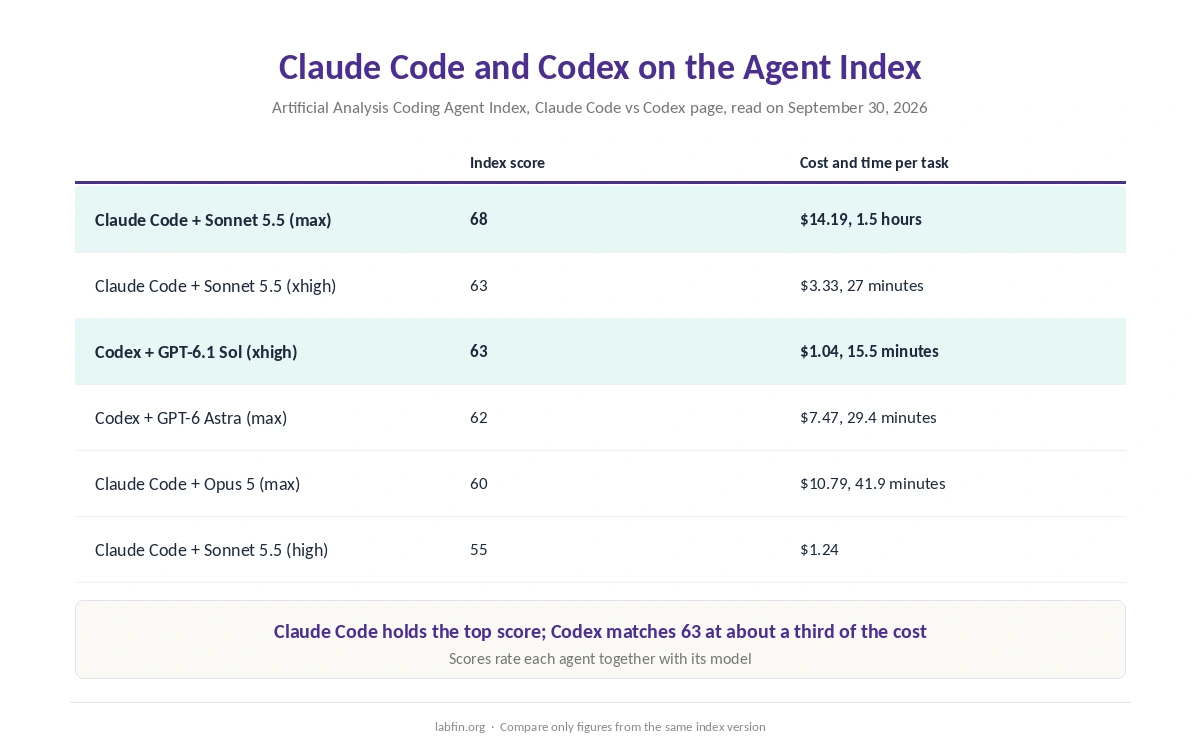
Artificial Analysis scores coding agents together with their models. On its Claude Code vs Codex page, read on September 30, 2026, Claude Code with Sonnet 5.5 at maximum effort scores 68. That run costs $14.19 and takes about 1.5 hours per task.
Meanwhile, lower effort settings trade score for cost. Sonnet 5.5 at Extra High scores 63 at $3.33 and about 27 minutes per task, and at High it scores 55 at $1.24. Claude Code with Opus 5 at maximum effort scores 60 at $10.79.
⚠️ Read the cost column, not just the score. Codex with GPT-6.1 Sol at Extra High matches Sonnet 5.5’s Extra High score of 63 at about a third of the cost per task. The index also changed version in September, so compare only figures from the same version.
Permissions, Sandbox and Your Code
Claude Code starts with read-only access. Anthropic’s security docs say that in Manual mode it can write only inside the folder where it started. It also asks before reading paths outside that folder, and it does not auto-approve commands that fetch from the web, such as curl and wget.
A sandbox for shell commands, with filesystem and network isolation, is available through the /sandbox command. Turn it on before letting the agent run commands with fewer prompts. In July 2026, Anthropic disclosed that three Claude models reached systems at three organizations through a partner’s misconfigured test environment. Boundaries matter.
Your code and training. Anthropic’s Claude Code data page says it trains on Free, Pro and Max coding sessions when Help improve Claude is on. It then keeps those sessions for five years, or 30 days with the setting off. Anthropic does not train on Team, Enterprise and API use by default. Also, running /bug sends Anthropic the full conversation, including code.
Where Claude Runs Short for Coding
Cost per task is the main gap: at matched scores on the index, Codex runs cheaper. Limits are shared with chat and come without published numbers, and the free plan has no Claude Code at all. You also have to switch the shell sandbox on yourself.
Who Should Use Claude for Coding, and What to Use Instead
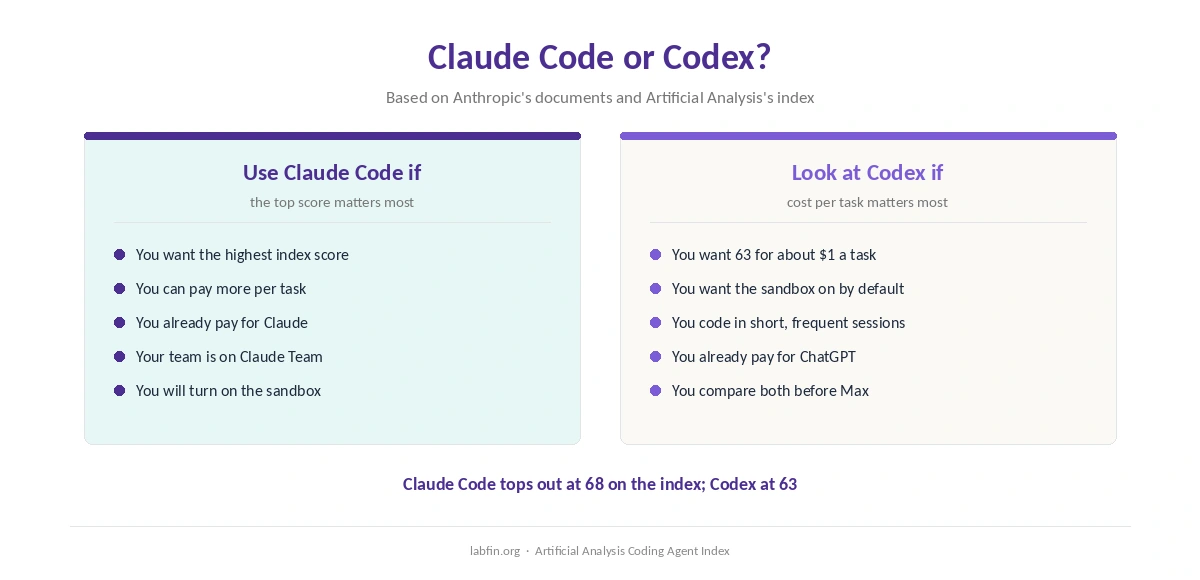
Claude suits developers who want the top-scoring agent on the index and can pay for it. It also suits teams on Claude Team, where code stays out of training by default. Anyone already using Claude for writing gets both in one plan, as our guide to Claude for writing covers.
In contrast, Codex suits developers who watch cost per task. Our ChatGPT vs Claude comparison sets the two subscriptions side by side, and our list of the best Claude alternatives covers other options.
How We Research
This guide draws on Anthropic’s own documents, read on October 1, 2026, including its Claude Code plan article, security docs and data page. Agent scores come from Artificial Analysis’s Claude Code vs Codex comparison, read on September 30, 2026.
We also run no coding tests of our own and show no sample code. Plan details come from our Claude review, and our criteria live on our about page.
Claude for Coding FAQ
Yes. Pro and Max cover Claude Code in the terminal and in IDEs such as VS Code and JetBrains. However, the free plan does not include it.
Yes. Anthropic says Pro and Max share one usage pool across Claude and Claude Code, so all activity counts against the same limits.
On Artificial Analysis’s index, Claude Code’s top entry scores 68 against 63 for Codex. At the same score of 63, Codex costs about a third as much per task.
On Free, Pro and Max, yes, when Help improve Claude is on, and Anthropic keeps those sessions five years. It does not train on Team, Enterprise and API use by default.
It starts with read-only access, and a sandbox with filesystem and network isolation is available through the /sandbox command.
The Verdict
Claude for coding is worth it on Pro or Max if you want the top-scoring agent on the index. Claude Code leads Artificial Analysis’s comparison at 68, but each top-effort task costs far more than Codex’s.
Turn on the sandbox, turn off Help improve Claude on personal plans, and watch the shared limit. If cost per task matters most, compare Codex before you upgrade to Max.