
Disclosure: LabFin is reader-supported. If you sign up for a tool through links on this page, we may earn a commission at no extra cost to you. Commissions vary between providers and our ratings do not — here’s our full disclosure.
Canva AI vs Adobe Firefly compares two AI design tools. Canva AI adds image generation, copywriting and chat-based design to Canva’s template editor. By contrast, Adobe Firefly generates images, vectors and short video, and edits photos with Generative Fill.
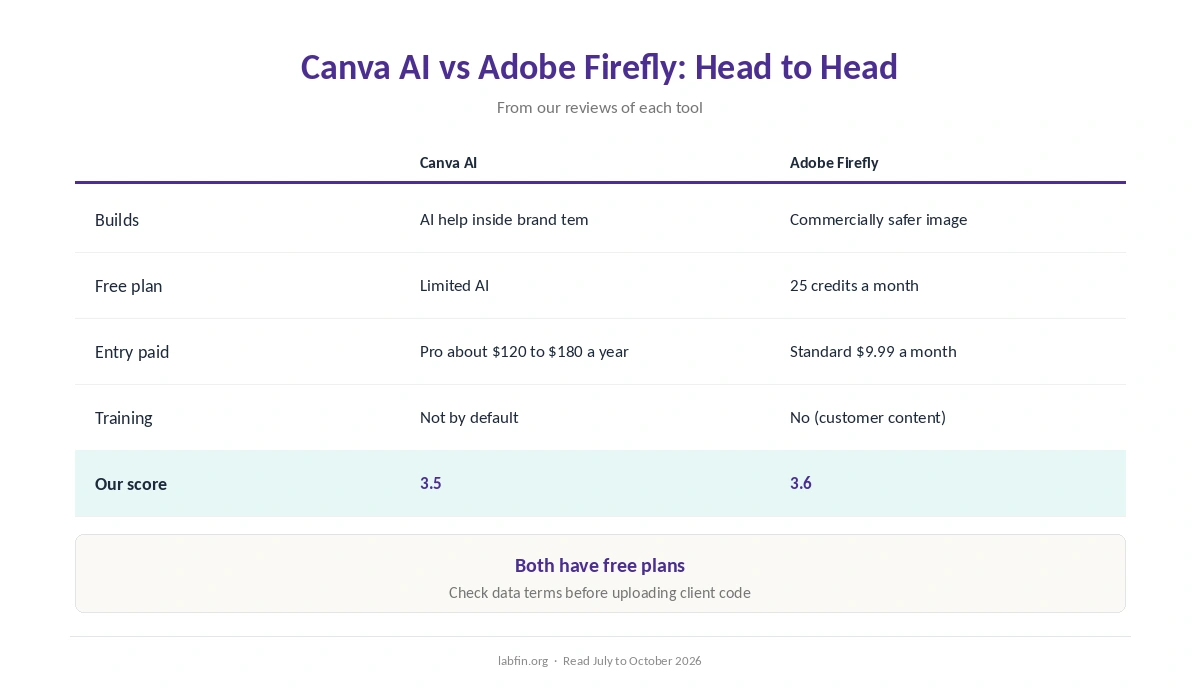
Our reviews, for example, score Canva AI 3.5 and Adobe Firefly 3.6. So the choice depends on the job and how much you care about data terms.
Canva AI vs Adobe Firefly: The Short Answer
Choose Adobe Firefly, first, on our scores: it scores 3.6 against 3.5 and fits commercially safer images and photo edits.
Choose Canva AI, however, if you want AI help inside brand templates; its entry paid plan is Pro about $120 to $180 a year. Our list of Canva AI alternatives also covers prices and data terms.
Head to Head
| Criterion | Canva AI | Adobe Firefly |
|---|---|---|
| Best for | AI help inside brand templates | Commercially safer images and photo edits |
| Works in | Web, desktop and mobile | Web; Photoshop, Illustrator, Express |
| Free plan | Limited AI | 25 credits a month |
| Entry paid plan | Pro about $120 to $180 a year | Standard $9.99 a month |
| Billing | AI credits per month | Premium credits per month |
| Training on your data | Not by default | No (customer content) |
| Our score | 3.5 | 3.6 |
What Each Does
To begin with, Canva AI adds image generation, copywriting and chat-based design to Canva’s template editor. As a result, it suits you if you want AI help inside brand templates.
In contrast, Adobe Firefly generates images, vectors and short video, and edits photos with Generative Fill. It suits you if you want commercially safer images and photo edits.
Prices and Billing
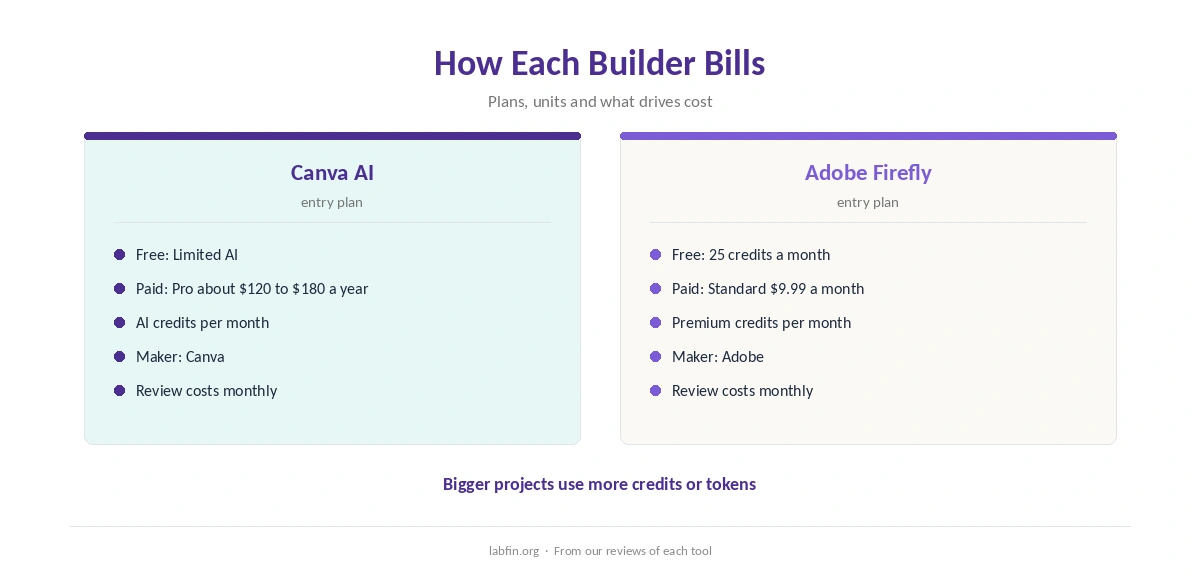
Canva AI starts with a free plan with limited AI uses, and its entry paid plan is Pro about $120 to $180 a year. Adobe Firefly, meanwhile, starts with 25 credits a month with watermarked outputs, with Standard $9.99 a month as its entry paid plan.
Billing also works differently. Canva AI uses plans with a monthly AI credit allowance, about 500 on Pro.
Adobe Firefly, however, uses monthly premium credits that do not roll over. Our list of the best AI design tools compares more options.
Data and Training
On training, for Canva AI, Canva says user content is not used for training by default. For Adobe Firefly, by contrast, Adobe says it does not train Firefly on customers’ content.
Therefore, keep client assets out until training terms are clear. Our guide to which AI tools train on your data compares more tools.
Rights and Review
Trackers report different Canva Pro prices, so check its pricing page. Firefly’s partner models follow their own terms, so note which model made each asset.
AI images can include odd details or echo existing work, so review every image and check each model’s terms before commercial use.
Our guide to fact-checking AI output also covers the checklist, and our list of the best AI for marketing ranks more tools.
Winners by Category
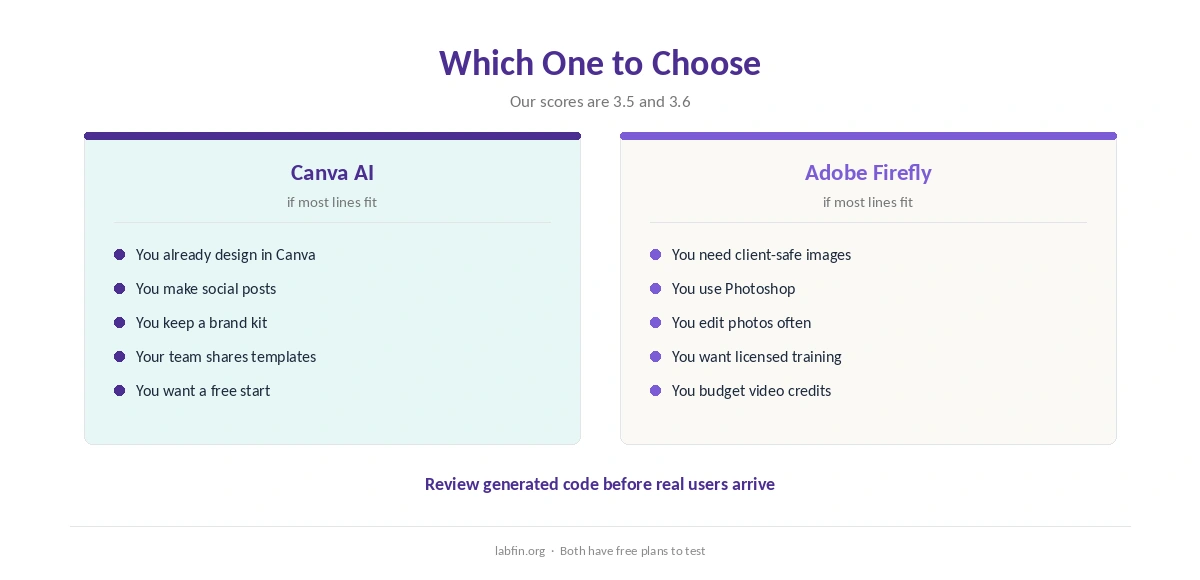
In short, Canva AI wins for AI help inside brand templates. The other tool, by contrast, wins for commercially safer images and photo edits.
Overall, in Canva AI vs Adobe Firefly our scores favor Adobe Firefly, 3.6 against 3.5.
Which One to Choose
Therefore, take Canva AI if you want AI help inside brand templates. Otherwise, the other tool may fit better.
Our pages on using AI for social media and using AI for repurposing content, in addition, cover other options.
Whichever you pick, our guides to creating brand voice guidelines for AI and the best AI for presentations also help.
Other pairings are covered in our Canva AI vs Ideogram and Adobe Firefly vs Ideogram comparisons.
How We Research
This Canva AI vs Adobe Firefly comparison reuses the sources behind our reviews of each tool, read between July and October 4, 2026, including Ideogram’s pricing page and Adobe’s Firefly plans page.
However, we run no tests of our own. Our about page explains the criteria, and our list of the best AI for business covers more tools.
Canva AI vs Adobe Firefly FAQ
Our scores favor Adobe Firefly, 3.6 against 3.5.
Entry paid plans are Pro about $120 to $180 a year and Standard $9.99 a month, in that order.
For Canva AI, Canva says user content is not used for training by default. For Adobe Firefly, Adobe says it does not train Firefly on customers’ content.
Adobe says its own Firefly models train on licensed content; check the other tool’s terms, and review every image.
Yes; many designers generate in one tool and lay out in the other.
The Verdict
Overall, Canva AI vs Adobe Firefly favors Adobe Firefly on our scores. The other, however, still wins for its own kind of job.
So pick by the job, check the output, and also keep sensitive material out of lower plans.