
A bucket name is not your whole provenance record
An archive team has more than one AWS account: a production repository, a public thumbnail bucket and a former migration account. A script that reads an object from the wrong account can still receive plausible metadata and silently attach it to the wrong museum item.
For a hypothetical glass-plate negative, the object key might be familiar in several environments. The safe question is not merely whether a HEAD request returned 200, but whether it targeted the intended account, exact key and relevant object revision. Ownership validation is one control within that larger provenance check.
Understand the expected owner request parameter
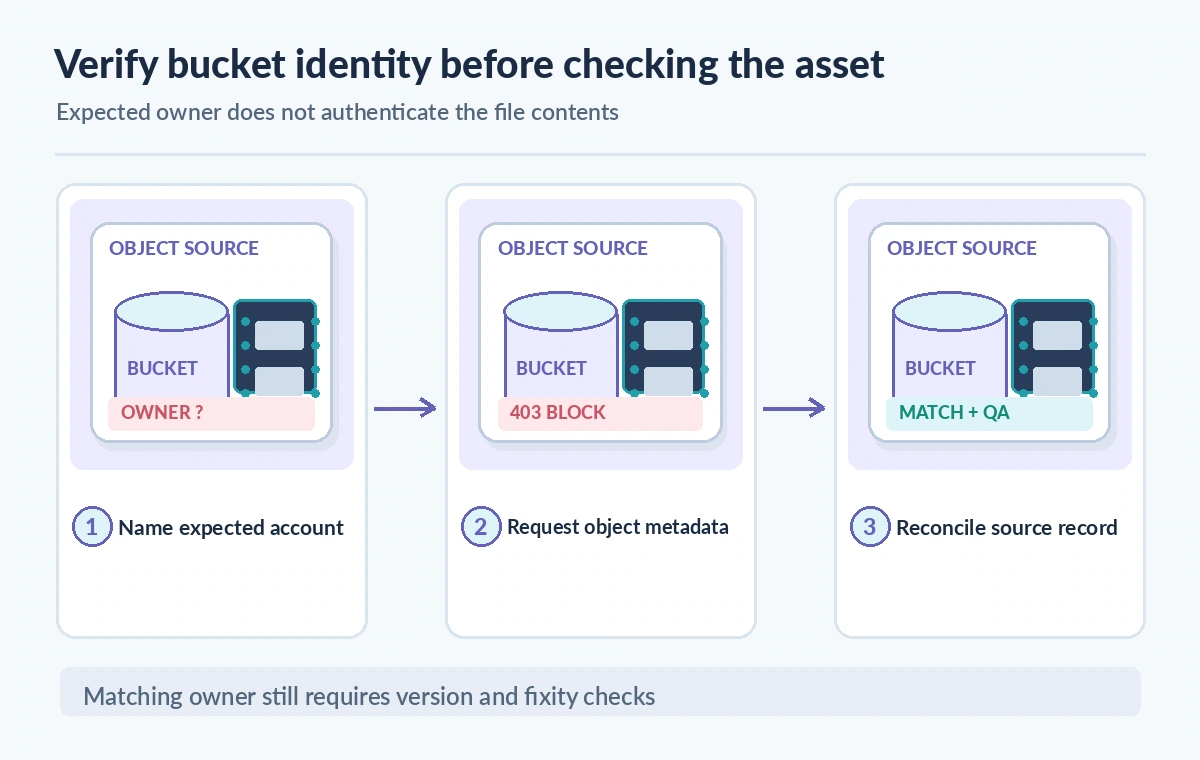
Amazon S3 HeadObject supports x-amz-expected-bucket-owner. The request supplies the AWS account ID the caller expects to own the bucket. AWS documents that if the supplied ID does not match the actual bucket owner, the request fails with HTTP 403 Forbidden.
The parameter is an explicit guard against unintended bucket identity; it is not a request to disclose the owner of any arbitrary bucket. A 403 can also arise from other permission and request failures, so an error alone should not be labeled a confirmed owner mismatch without checking reliable account configuration.
Keep expected identity outside free-form input
Set the expected owner ID from approved deployment configuration or a reviewed account inventory. Do not accept it from an untrusted upload form or from the same user input that selected the bucket, because that would make the check circular.
Map environment, bucket and expected account into a controlled configuration record with an approval history. If an account migration changes the intended owner, require a documented change. Silently updating the expected ID to whatever made a request succeed defeats the reason for including it.
Pair the guard with exact object versioning
A successful HeadObject call returns metadata about the specified object, subject to request permissions and bucket type. In a versioned general purpose bucket, choose a specific version ID when you need evidence about a historical archival master rather than the current object.
Keep the bucket, key, version ID, expected account, response headers and review date together in the audit row. An object key is not a unique content identity across time. An overwriting upload or current delete marker can change what an unversioned HEAD means for later retrieval.
Do not use a 403 as automatic proof of spoofing
S3 permissions, nonexistent objects, policies and request parameters can change the observed error. A failed HeadObject request does not necessarily reveal whether a requested object exists. The expected owner mismatch is one documented cause of 403, not the only possible reason.
When the guard fails, halt publication and let an authorized AWS operator inspect the bucket-account inventory and applicable IAM policy. Avoid repeated blind probes across guessed account IDs. Such retries add little assurance and can create unnecessary access logs or operational noise.
Compare three realistic audit states
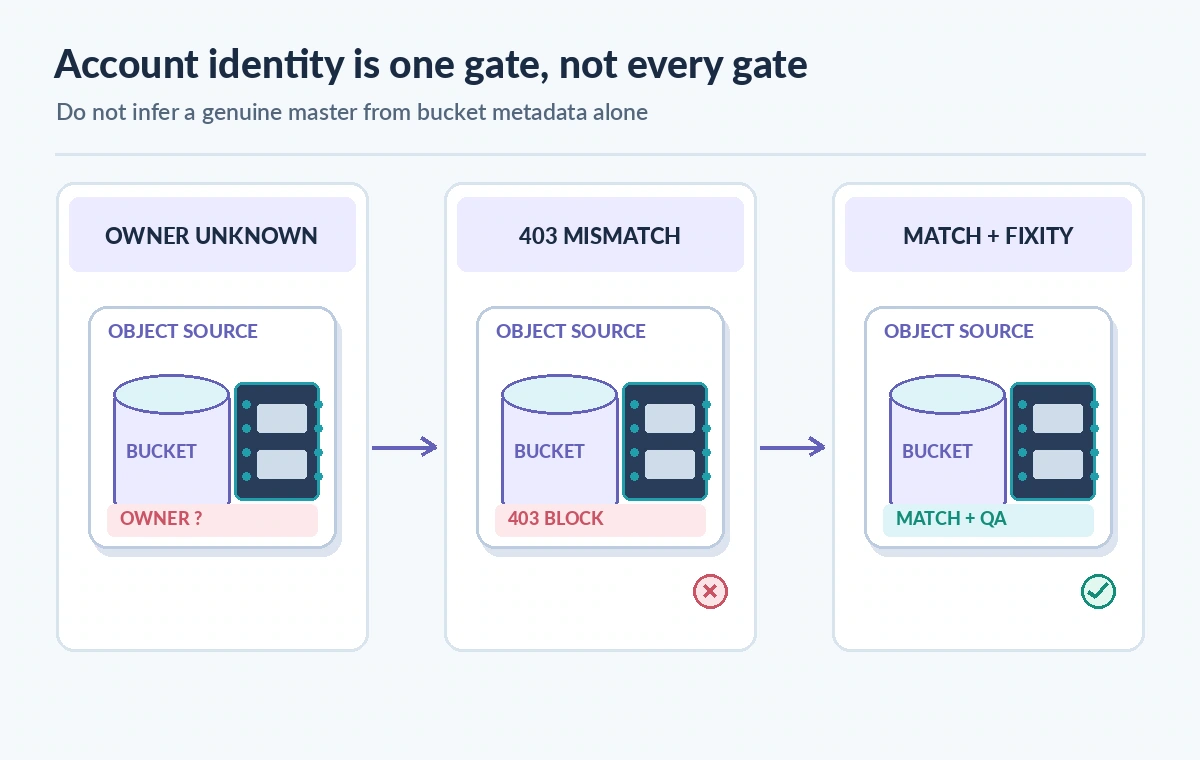
The visual comparison contrasts a requested bucket whose ownership was never checked, a request blocked by a mismatched expected owner and a correctly scoped request that still requires metadata and fixity review. These are drawn scenarios, not live S3 responses or measured detection rates.
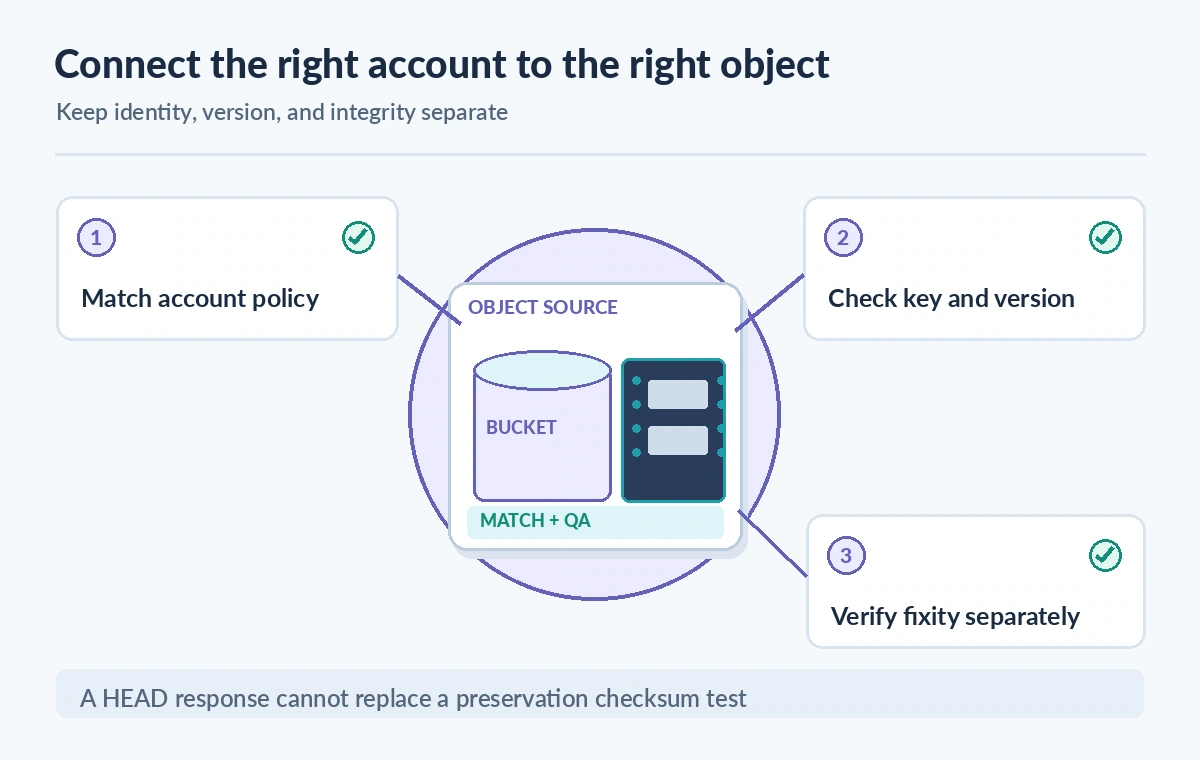
A matching account check should clear only the identity gate. It does not say the file is the right scan, the object was replicated, the checksum matches the source master or the reuse rights are valid. Each claim requires its own documented source or test result.
Treat ETag and returned checksums carefully
HeadObject can return ETag and other metadata. Do not always treat ETag as an MD5 checksum of the full object; multipart uploads and encryption conditions complicate that assumption. Where the archival workflow requires integrity evidence, use documented checksum mechanisms and understand whether a value represents a composite or full-object checksum.
Retrieving checksum metadata can require checksum mode and additional KMS permissions for encrypted objects. Even a returned stored checksum is not equivalent to an independent comparison with a preserved local master. State which algorithm, object version and validation method were actually checked.
Plan for bucket-type and encryption differences
S3 API behavior varies by bucket type, encryption and selected request headers. In particular, HeadObject on KMS-encrypted objects should not be sent with inappropriate x-amz-server-side-encryption headers. Directory bucket support and version semantics differ from general purpose buckets.
The operator should consult current AWS documentation for the exact deployment rather than copying a sample for another type of bucket. A scanner that masks all 403 responses as “not found” can hide both identity-configuration errors and missing grants. Surface a precise but non-sensitive failure category to the team.
Build a controlled cross-account test fixture
Use two approved test buckets or mocked API responses with deliberately similar keys and different expected owners. Verify that a mismatched expected owner stops further processing and cannot be overridden by untrusted input. Then test a matched owner with the wrong key or version to show why the next validation still matters.
Record expected account, source record ID and simulated response category in a secure test log. Do not use a production donation image or real account IDs in public examples. The illustration intentionally shows labels and records without exposing actual infrastructure information.
Approve publication only after a complete chain
Before a derivative is released, confirm the target account, bucket, key, version, storage integrity, accession metadata, permissions and rights clearance. ExpectedBucketOwner is a narrow but useful guard against one class of routing mistake, not a certificate that an archive object is ready for public use.
This guide reflects AWS published API details and a fictional archive scenario. We did not run AWS requests, audit accounts, measure failure rates or verify live checksums. Use current AWS SDK/API behavior and a reviewed organizational account inventory before enabling automated imports.
How We Research
Our November 11, 2026 desk review consulted the following named primary vendor documentation: Amazon S3 HeadObject API; Amazon S3 HeadBucket API; Amazon S3 data integrity documentation. We compared documented fields and failure semantics with a fictional museum workflow, distinguishing request-level facts from institutional approval decisions. The illustrations are original instructional graphics, not screenshots or observed service outputs. We did not execute API calls, access real museum records, run security or accuracy benchmarks, measure performance, or claim an actual success rate. Recheck version-specific service behavior, accounts, privacy, rights and independent source records before deploying a real workflow.
Frequently Asked Questions
It checks whether the actual bucket owner matches the account ID specified in the request.
AWS documents a 403 Forbidden response for an owner mismatch.
No. Other permission or request conditions can also produce 403 errors.
No. Confirm the exact object version and use an independent integrity comparison with approved source records.
No. It is one bucket identity guard, not permission, ownership-of-content or rights clearance.