
Preserving an Original Is Different From Publishing It
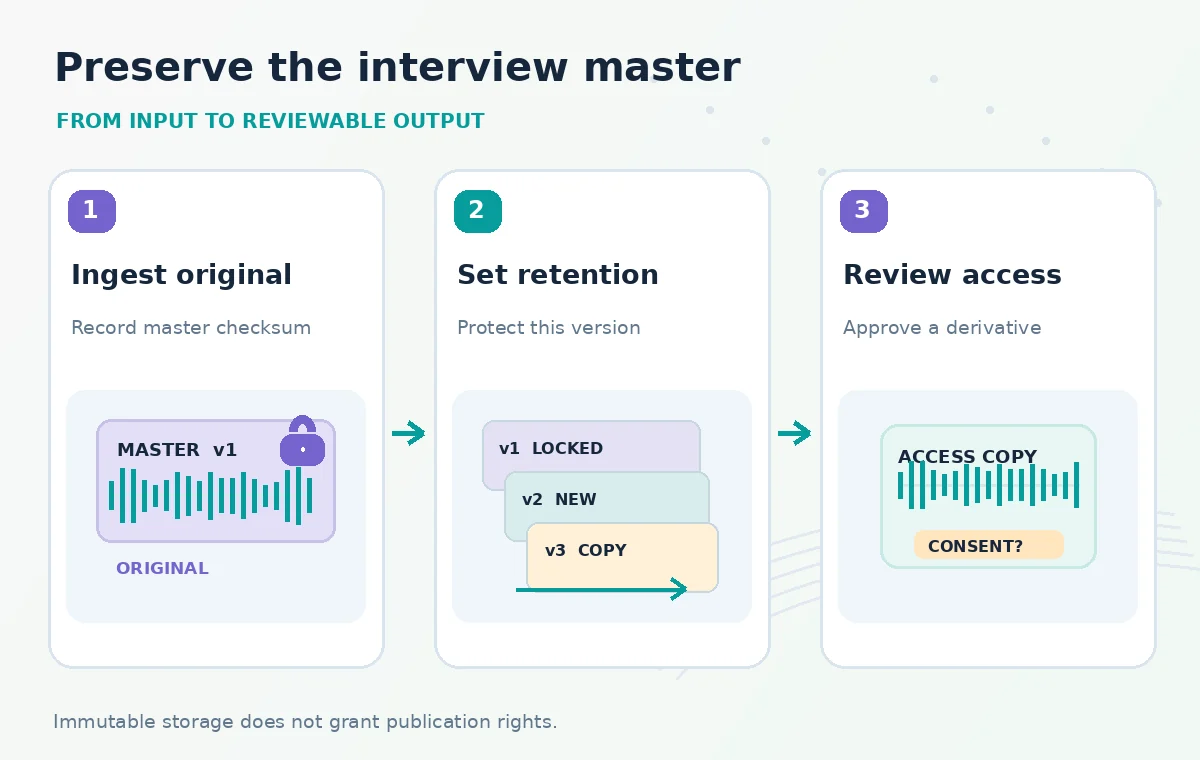
An oral-history archive receives a raw interview recording, a cleaned access copy and a signed restriction sheet. Staff want to protect the original from accidental deletion without making every work-in-progress edit impossible to replace. Amazon S3 Object Lock provides write-once-read-many-style protection for specific object versions, using retention periods or legal holds. That is an integrity measure, not a rights clearance or a backup plan by itself. A locked recording can still contain a speaker’s private address, and a public access copy may need to be withdrawn immediately. Keep the protected master distinct from derived files and from any public distribution decision.
Object Lock Protects Versions, Not Object Names
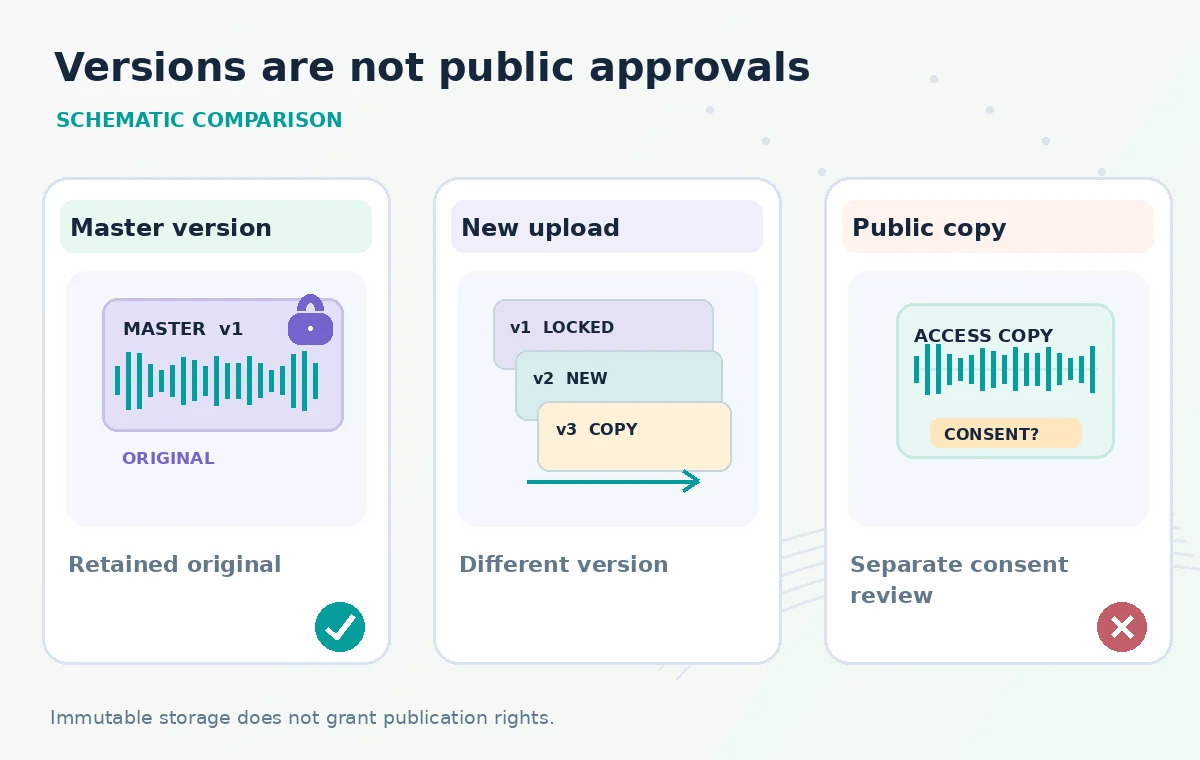
AWS states that Object Lock works with S3 Versioning and that retention is attached to a particular object version. Uploading another file under the same key creates a new version; the protected earlier version remains retained. Likewise, a delete marker may be placed on top of retained versions, changing what a simple key-based read returns while leaving the protected historical bytes in storage. This distinction makes a version-aware inventory essential. Record bucket, key, version ID, checksum, content type, acquisition date and associated consent record for each master. A familiar filename alone is not enough to prove you retrieved the retained original.
Choose Governance With an Explicit Bypass Policy
Governance mode generally prevents most users from deleting or shortening retention but permits authorized bypass under documented conditions. AWS specifies the s3:BypassGovernanceRetention permission and an explicit bypass indication for relevant operations; the console can supply that indication for permitted users. This flexibility can fit an archive that needs a controlled recovery path while refining its retention policy. It also creates an accountability risk: an overly broad administrator role could defeat protections that staff assumed were permanent. Limit bypass rights, require a review record and test alerts on retention changes. Never give a day-to-day upload service the same powers as an emergency retention administrator.
Use Compliance Only When Policy Really Requires It
Compliance mode is intentionally stricter. AWS explains that a protected version cannot be deleted during its retention period, even by the account root user. An archive should not enable this mode merely because ‘stronger security’ sounds attractive. A privacy request, mistaken acquisition, improperly licensed interview or legal restriction can collide with irreversible retention. Have counsel or the responsible records officer approve the applicable retention period, scope and legal basis before committing real data. Prototype the workflow with invented files and short, appropriate nonproduction periods. Keep a procedure for disabling public access without assuming that deleting protected storage will be possible.
Keep a Legal Hold Separate From a Timed Retention
Legal holds protect a version without an expiration date until an authorized actor removes the hold. They are independent of timed retention: removing a hold does not cancel an active retention period, and an expired period does not eliminate an active hold. That can be helpful for a pending dispute over an interview’s rights, but only if staff track who requested the hold and why. A legal hold is not an automatic declaration that the recording can be listened to or distributed. The diagram contrasts an active timed period, a removable legal hold and the separate publication gate. These are conceptual states, not screenshots of an AWS account.
Design a Three-Tier Oral-History Storage Plan
For a hypothetical oral-history program, store the immutable acquisition master in a tightly controlled bucket, keep preservation derivatives in a separate managed location and publish a redacted access version only after consent review. Connect the three through a manifest containing exact version identifiers and source checksums. Apply a retention policy to the original that has been reviewed by the records team. Do not assume new uploads inherit the prior version’s retention settings unless the bucket or request configuration actually enforces them. A replacement access edit should not change the original recording bytes, and a corrected transcript should be linked as a new derivative with its own review history.
Test Recovery Without Attempting a Destructive Shortcut
Before importing a large collection, verify version-aware reads, restore procedures, storage costs and the consequences of delete markers. Have a separate test demonstrate that a nonprivileged service account cannot erase a protected version. A second test should show that an authorized reviewer can identify the correct version after a new object is uploaded with the same key. Check whether backup or replication arrangements preserve needed protections and metadata; never assume that Object Lock replaces geographic redundancy. Document any governance bypass event separately from normal cleanup. These are recommended test cases, not evidence of a measured result in a live account.
Put Privacy and Retention Calendars Before Automation
Recorded interviews can include living people’s names, health information or details supplied under conditional consent. A long immutable retention window can amplify a privacy mistake even if public access is blocked. Set a review calendar for consent expiry, embargo changes and legal obligations before choosing the S3 configuration. Limit access to masters using IAM and key-management controls appropriate to the organization. An audit should record attempted reads and administrative actions without exposing the recording in logs. If the archive is subject to a formal records law, local regulations may dictate choices that this general technical guide cannot settle.
Make Version ID the Unit of Trust
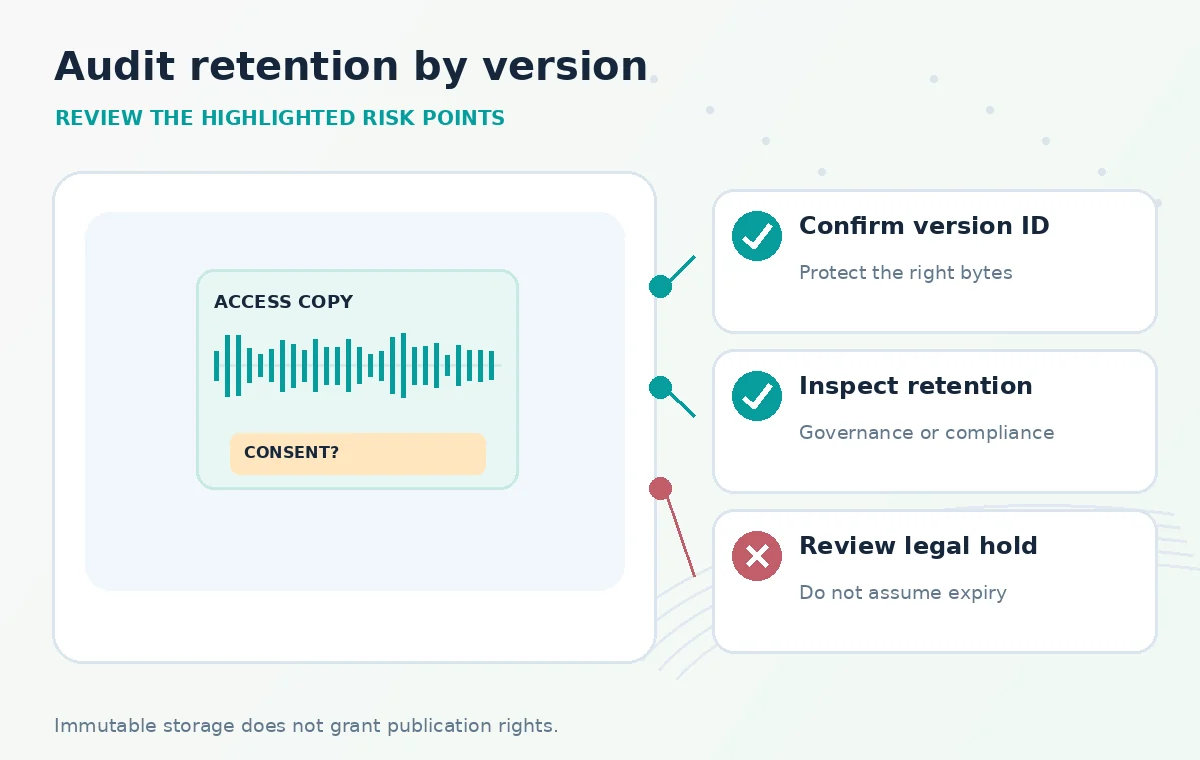
A preservation report should answer three independent questions: Which exact object version is protected, until when and by what mechanism? Which version is currently approved for staff or public use? Can the archive verify the original bytes against its recorded checksum? A green storage status is not enough. Publish only approved derivatives, retain a clear chain of custody, and make any disputed copy easy to disable at the delivery layer. Object Lock can support that chain of custody when paired with retention governance, independent backups and human rights review. The hypothetical archive examples are design patterns rather than deployment results.
How We Research
We reviewed the named official primary sources on November 8, 2026: AWS: Locking objects with Object Lock, AWS: Object Lock considerations and governance bypass. We compared documented parameter scope, practical boundary cases and implementation risks with the review workflow in this article. We checked the topic and slug against the WordPress title inventory supplied by LabFin and previous B0267–B0271 batches. We did not authenticate to a vendor account, run a live API request, conduct a performance benchmark, review real confidential archive material or verify deployment outcomes. All documents, sample states and diagrams are hypothetical teaching illustrations; product UI is not reproduced.
Frequently Asked Questions
No. It protects specified object versions; a new upload can create another version under the same key while the protected one remains.
An appropriately authorized principal can bypass governance mode under documented conditions. Restrict and audit that permission.
AWS describes compliance mode as preventing deletion of the protected version during the retention period, even by the root user.
No. A legal hold has no fixed expiry and remains until an authorized actor removes it; any separate retention period may still apply.
No. Immutability does not grant publication rights, redact sensitive content or establish participant consent.