
An upload failure can begin with the wrong Region
A preservation team receives photo masters from a partner and needs to send approved copies to an existing S3 bucket. A script assumes the bucket lives in the same Region as the worker, then begins reporting redirects or authorization-looking errors. The HeadBucket API offers a lightweight way to discover the bucket Region without listing or downloading archival contents. AWS documents that the x-amz-bucket-region response header is available for a bucket regardless of whether the requestor has bucket access permission. That makes the operation useful for routing, but unsuitable as proof of ownership or write access. This is a hypothetical intake issue, not a recorded production trace.
Read the documented HeadBucket contract
HeadBucket sends an HTTP HEAD request against a named bucket and returns headers without an object body. The AWS reference explains that general-purpose buckets use the s3:ListBucket permission for successful authorization, while directory buckets have different endpoint and permission conventions. The request can still reveal regional information even if the caller lacks permission to access the bucket. Choose the bucket type explicitly and follow the corresponding endpoint rules. Avoid assuming that an HTTP 403 means the bucket is absent, or that an HTTP 404 proves a naming typo without checking the documented error semantics and your request context.
Use x-amz-bucket-region for routing, not approval
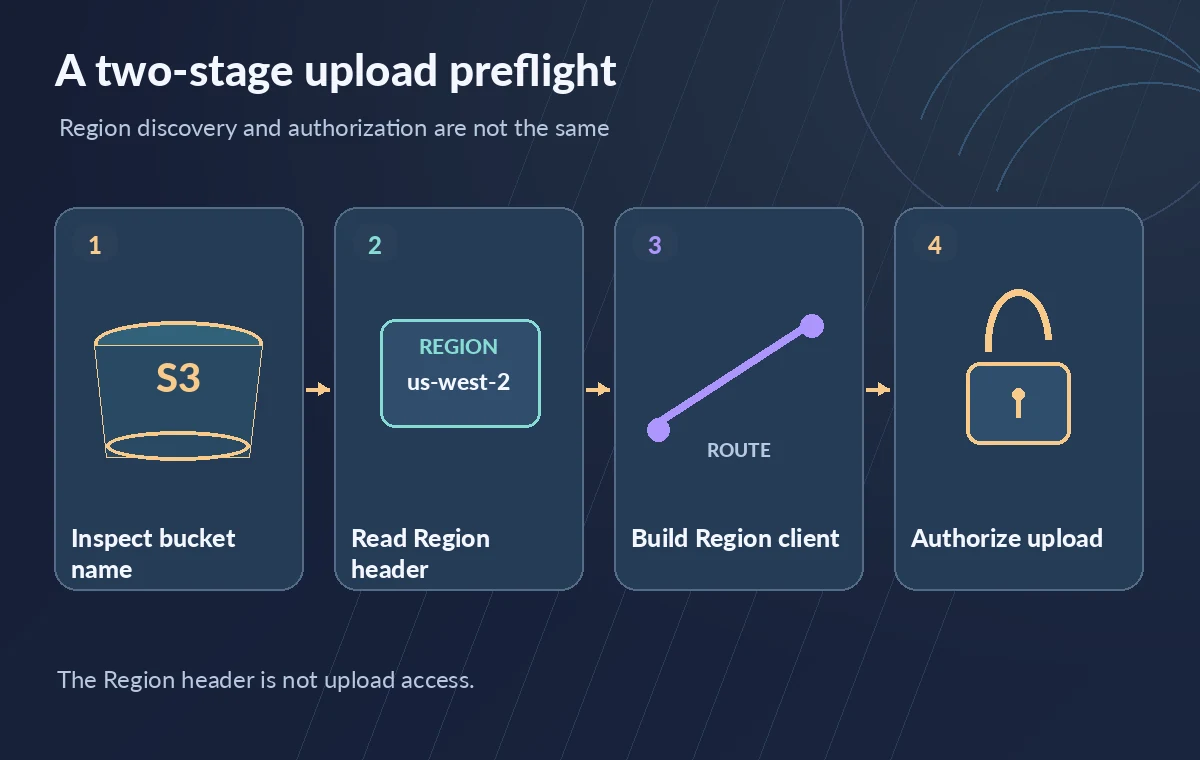
A client can read the Region header, select the matching regional endpoint, and then build a service client for the upload attempt. Region discovery should occur before transferring large masters, because failed cross-Region operations waste time and complicate logs. Do not let a region string by itself decide which account is authorized to receive the files. If an attacker or configuration error supplies a real but unintended bucket name, HeadBucket may still report its Region. Store the expected bucket name and account identity in a reviewed configuration, not in filenames or untrusted metadata supplied by a partner.
Distinguish 200, 301, and 403 observations
A successful HeadBucket response can confirm the bucket is reachable with adequate permissions under that request. An error response may still carry useful regional headers. SDKs and HTTP clients vary in how they expose non-2xx headers and redirects, so capture the relevant header and request identifiers using supported error handling rather than scraping human-readable messages. An error body is not a reliable explanation for all authorization and existence cases. The article’s three visual states illustrate an incorrect endpoint, Region discovery from a response, and a later authorized upload. They are conceptual; no specific latency, response code sequence, or bucket has been tested.
Apply the right credential and ownership safeguards
Before uploading, verify the intended bucket owner through an approved identity or account inventory workflow. S3 operations that support the expected bucket owner header can make some misrouting mistakes fail closed. HeadBucket also has its own documented bucket-owner request header and permission requirements; follow the relevant API and SDK contract rather than substituting a guessed account ID. An identity allowed to determine the Region might not be allowed to create objects, and a successful object creation does not imply an appropriate rights clearance. Use least-privilege write permissions, an approved encryption configuration, and separate object naming rules for incoming copies.
Keep directory bucket exceptions explicit
S3 Express One Zone directory buckets have different names, virtual-hosted endpoint patterns, zone-specific placement, and session-based access details. Do not reuse an ordinary regional bucket workflow without checking the separate directory-bucket HeadBucket section of AWS documentation. For a museum that has only general-purpose archival buckets, explicitly state that scope so reviewers do not accidentally carry the example into an unsupported environment. Likewise, do not assume all AWS SDK versions expose the same helper for endpoint discovery. Verify current service support, endpoint selection, and the organization’s Region residency rules before deploying a regional retry strategy.

Create a safe synthetic routing check
A test plan can include a known test bucket in one Region, an intentionally wrong configured Region, and a principal that can read only the minimal required metadata. Record response status, the bucket-region header if provided, chosen endpoint, and whether a separate upload operation is authorized. Use synthetic files rather than irreplaceable oral-history masters. If the Region can be discovered but write permission is absent, the correct outcome is a blocked upload with a clear error; the script should not search arbitrary other buckets for a destination. No real S3 requests or customer environments were used to create the illustrations in this guide.
Handle retries and copies without creating duplicates
After discovery, preserve an idempotent intake key and checksum information in your ingest ledger. If a first upload attempt times out, do not blindly retry a multipart or ordinary upload without checking which object version may already exist. Region selection fixes only one class of failure; it does not resolve ownership conflicts, conditional-write failures, missing encryption keys, or object integrity questions. A safe workflow logs the intended bucket ARN or name, account, Region, stable object key, source checksum, and confirmed transfer result. Sensitive source data should not be copied into broad operational logs or diagnostics.

Approve the destination before transferring a master
A release-ready route has a verified bucket name, Region, expected owner, IAM authorization, encryption policy, approved lifecycle rules, and a documented way to verify the resulting object. Treat missing fields as an intake hold, not a green path. HeadBucket answers a narrow location question; it does not authorize publication of media or certify retention obligations. Maintain the rights and consent review separately from infrastructure connectivity. AWS can evolve headers or endpoint conventions, so validate the current HeadBucket reference and the selected SDK’s error behavior when updating the workflow.
How We Research
We reviewed Amazon S3 HeadBucket API reference and AWS S3 request endpoints overview and S3 expected bucket owner guidance, focusing on supported parameters, model or API versions, response shapes, service limitations, and operational consequences. The example museum or grant workflows are hypothetical, designed from official reference material rather than client testing. The illustrations are original conceptual drawings, not service screenshots, measurements, security tests, or actual audit evidence. We did not access customer data or perform live API calls. Features, pricing, preview terms, IAM settings, and provider behavior can change; validate current documentation against your selected deployment before making production or editorial decisions.
Frequently Asked Questions
Yes. AWS documents that the bucket-Region header can be returned even when the caller is not authorized to access the bucket.
No. Region discovery and s3:PutObject authorization are separate, and ownership, encryption, and other policies must still be checked.
No. It is a bucket-level HEAD operation and does not return an object list or object body.
No. Authorization and routing errors can overlap in symptoms; inspect documented response headers and the configured request context.
No. AWS documents separate names, endpoints, and authentication details for directory buckets and S3 Express One Zone.