
A local-history archive offers public search across recorded interviews, but some narrators permitted access only after a specified date. A semantic query for a neighborhood festival may find both public and embargoed transcript fragments. Pinecone metadata filtering can narrow candidate results by fields attached to indexed records. It cannot independently decide whether a visitor has permission to see an interview, and an old embedding can outlive a changed consent form. This fictional example explains the distinction.
Define permission states before generating vectors
Start with the archive’s authoritative consent ledger, not the search index. Give each interview a stable collection ID, narrator permissions, restriction type, review date, rights contact, and source revision. Decide which excerpts are public, restricted to staff, pending consent, or embargoed until a verified release date. A vector similarity score must never override one of those states. If the ledger is incomplete, fail closed for public search rather than interpreting missing metadata as an implicit permission grant.
Chunking an interview creates additional records with different timestamps, but all child chunks must remain tied to the correct parent and its current access policy. Do not store a full private transcript as exposed vector metadata merely to make filters convenient. Keep a durable record of the text revision and embedding model, so changes in transcription or permission can trigger controlled reindexing. Write down which team owns access decisions and which service may revoke published search snippets.
Choose a schema for permission-aware filters
Pinecone supports filtering over stored metadata using operators such as equality, membership, and numeric comparisons, with exact syntax depending on whether the application uses document or vector APIs. For a simple public corpus, example fields might include access_tier, collection_id, embargo_end_epoch, language, and source_revision. Index only metadata that is safe and useful for retrieval. Put an approved-public flag in a record only after the authoritative consent system sets it, never because an LLM guessed the interview sounded non-sensitive.
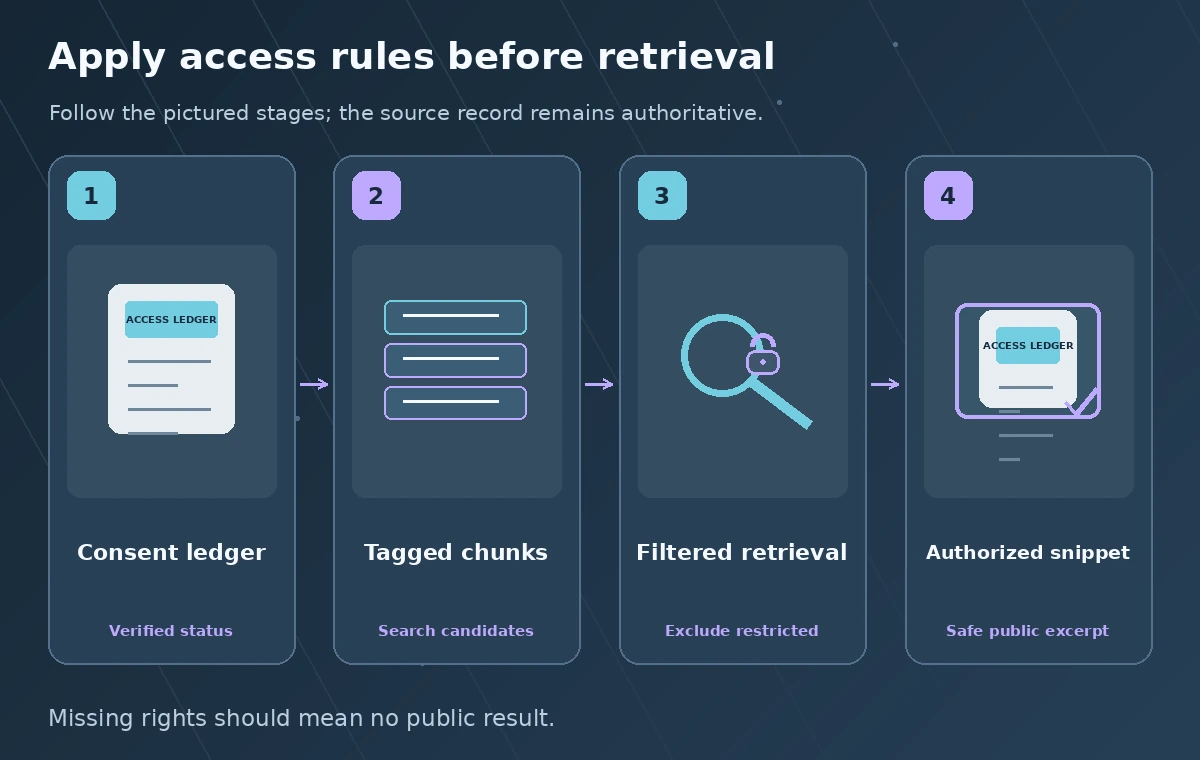
Treat missing or malformed flags as restricted. Test values with uppercase, unexpected booleans, archived revisions, and missing dates. If an archive calculates public eligibility from an embargo date, evaluate that policy in trusted application code and confirm date interpretation and timezone rather than expecting arbitrary string comparisons to enforce it. Keep a separate document-level access check after the search returns candidates; the index filter is one defense layer, not the only authorization decision.
Keep public and restricted searches separate
Pinecone namespaces provide logical partitions within an index, and the SDK documentation explains that operations in one namespace do not search another. An archive can use named namespaces for public and internal search or use separate indexes where stronger administrative separation is needed. Do not confuse a namespace partition with a complete authentication or encryption system. Credentials, API gateways, staff roles, and data routing still require independent design and security review.
The public endpoint should select its authorized search scope on the server, not trust a browser parameter that requests an internal namespace. Staff users may need access to both public and restricted records, but that must be based on verified identity and role. Test for accidental fallback to the default namespace when none is named. If a query finds nothing, the interface should say no accessible matches were found, not reveal that a hidden interview exists elsewhere.
Compare three retrieval outcomes
The illustration shows three invented oral-history cards that share the words ‘harbor festival.’ One is public and may appear; one has an active embargo and must be omitted; the third has no verified permission record and must also be omitted. The ranking numbers and document labels are editorial examples, not Pinecone query output. A high similarity candidate can be inaccessible. A lower similarity candidate can be both relevant and fully cleared for display.
Return only enough information for the public result card: an authorized title, short approved excerpt, curator-approved citation, and link to the original public catalog page. Avoid leaking the private record’s title, narrator identity, vector ID, or number of suppressed matches through the interface. Confirm that linked pages and search-preview snippets reflect the same permission check. Cached search results can be just as revealing as a live query if permission changes are not propagated promptly.

Handle embargo expiry and consent withdrawal
Make permission changes an explicit lifecycle event. An embargo expiring does not necessarily authorize publishing every line; there may be additional restrictions or unreviewed segments. The collection manager should approve the transition, then the indexing pipeline can update metadata or move the allowed records into a public partition. Consent withdrawal should instead initiate immediate public suppression and a review of caches, saved excerpts, CDN pages, search engine indexing, and previously distributed exports.
Use a revocation test with a fictional record. After it changes from public to restricted, run both exact identifier search and broad semantic queries, and verify that no text or citation remains accessible through the public endpoint. Record whether the application continues to serve old cached answers. An index update succeeding is not the same as a completed takedown; the publication system and downstream copies need their own checks.
Evaluate relevance without sacrificing access
Prepare separate positive and negative search cases: a public interview about a harbor festival, an embargoed interview using nearly identical language, an unrelated public interview, and a formerly public record now withdrawn. A useful evaluation checks both whether accessible relevant records are found and whether restricted records are never exposed. Keep false-positive access leaks as a distinct failure category rather than averaging them into a generic retrieval score. No measured retrieval or leakage rate is asserted in this guide.
Check synonyms, misspellings, multilingual query variants, and accession-code searches against a curated ground-truth set. Exact codes may need ordinary lexical lookup alongside vector search. Evaluate the complete application: identity check, metadata filter, source join, final authorization, and snippet rendering. A perfect index filter cannot compensate for a public API that accepts arbitrary record IDs and returns full documents without checking permission again.
Release a searchable portal with auditable decisions
Before launch, require sign-off on the consent-state mapping, namespace routing, metadata schema, index-update procedure, and export permissions. Public pages should explain why some records may not appear without exposing private details. The interface should offer a staff contact for access questions rather than guessing when an embargo might end. Preserve internal audit references to the actual consent decision so librarians can explain why a record was shown or withheld.
Monitor changes in the source ledger, failed indexing jobs, unexpected namespace usage, and public search tests. If the permission store cannot be consulted, the safer public behavior is to return an unavailable result rather than bypass the filter. When staff revise a transcript, revalidate the excerpt citation and permission before replacing public chunks. Search quality matters, but the promise to narrators matters more than surfacing every semantically related passage.

How We Research
For this November 2026 editorial review, we consulted official vendor materials: Pinecone: Filter by metadata; Pinecone: Implement multitenancy; Pinecone Python SDK: Working with namespaces. We checked the named feature, input/output scope, documented limitations, and the points where software results must be reviewed against an authoritative record. The project is a hypothetical instructional design; the graphics, source cards, time marks, sample identifiers, and decision states are original explanatory illustrations, not captured screenshots or measured service results. We did not upload real archival data, conduct a production API evaluation, obtain permissions on behalf of an institution, or measure an accuracy or latency result. Before deployment, verify current feature availability, regions, quotas, prices, data protection terms, licensing, and the latest developer documentation. A qualified human must review permissions, factual accuracy, accessibility, and any publication or high-impact changes.
Frequently Asked Questions
No. Filters narrow search results; the application must authenticate the user and authorize access to each source before returning private material.
Its public retrieval path should exclude it, and the linked source, cache, snippets, and exports must honor the same restriction.
No. Namespaces logically isolate search operations, but credential scope, application routing, and storage security still matter.
No. A fail-closed rule is more appropriate for sensitive oral-history permissions until an authorized reviewer resolves the record.
Change a synthetic record from public to restricted, then verify exact and semantic searches, direct fetches, caches, and result pages do not expose it.