
A Missing Answer Cannot Become a Yes
A library offers an equipment-loan request form. The assistant returns structured fields for requested item, pickup window, eligibility notes and status. When a user asks it to certify a restricted request without required documents, the model may refuse or stop before finishing. A poorly designed importer assumes every response is parseable JSON and inserts a default approved status to keep the pipeline running.
That is a workflow error, not a harmless formatting issue. A refusal is not an approval, an incomplete output is not a decision, and even perfectly formed JSON is not evidence that the library has checked inventory or eligibility. The illustrated request is fictional. The article explains safe application handling rather than claiming live tests of an OpenAI model.
Build a Schema for Information, Not Authority
OpenAI Structured Outputs supports JSON Schema-based formats for supported models. Define the smallest data structure the application actually needs, such as request ID, item code, proposed pickup date, missing evidence and review state. Avoid asking the model to invent a final administrative decision. The API’s strict format is designed to constrain structure, not to grant the model authority to issue equipment or override staff policy.
Structured Outputs documentation requires schema design rules, including required fields and additionalProperties set to false for objects under strict adherence. If an input field may genuinely be unknown, represent that explicitly with a nullable schema where supported. A field that is always present in JSON can still contain an unknown value; required keys and verified facts are not the same thing. Validate the values against business rules after parsing.
Handle Refusal as Its Own Response Branch
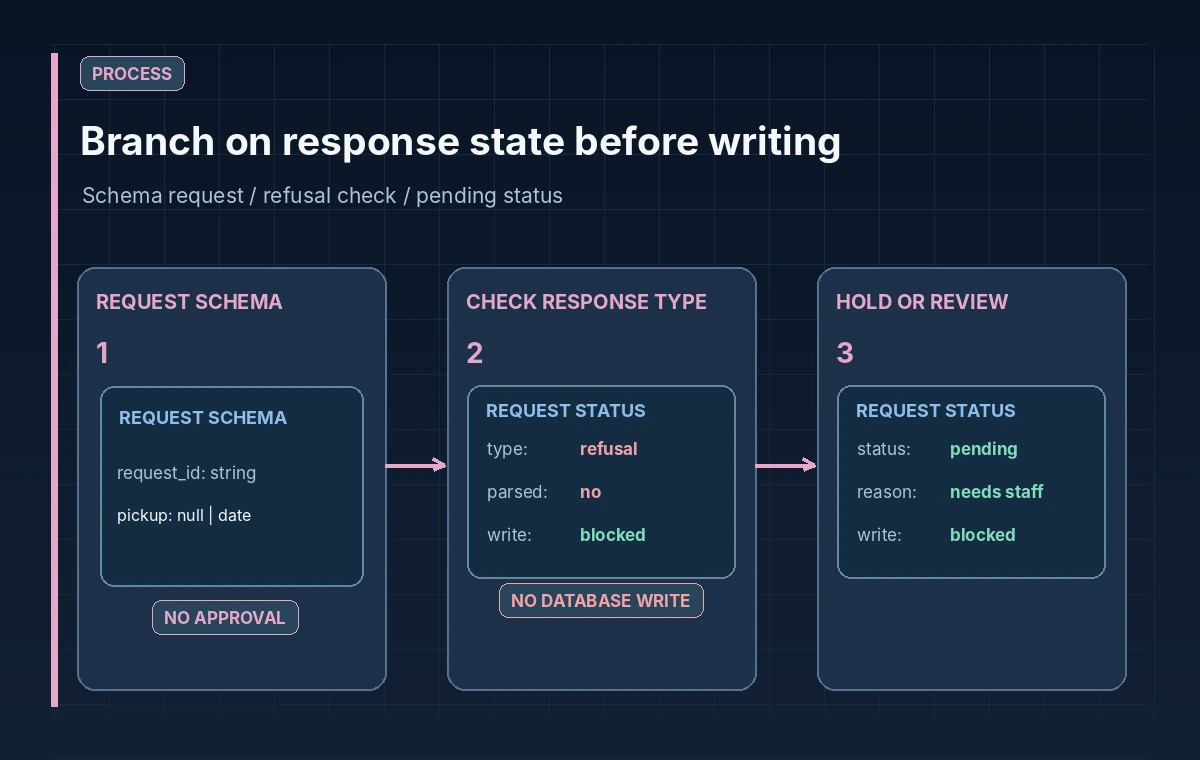
OpenAI documents that a safety refusal may not follow the requested JSON Schema. A refusal indicator can appear in the response output, and client code should branch on it rather than forcing the refusal through a parser for ordinary application data. The user-facing result should explain that the assistant did not complete the requested action and offer a staff review path when appropriate.
Do not replace an absent structured object with a fabricated item code, consent flag or approved status. Distinguish expected “needs more information” values inside a successful structured response from refusal as a separate response type. Keep this state visible in the application and audit log; a downstream WordPress or database importer should never treat a refusal as an empty but valid application.
Distinguish Completed From Incomplete Responses
The Responses API exposes status and incomplete details for response processing. A maximum output limit, filtering or another interruption can mean the output is incomplete. A chunk of streaming JSON may look plausible before it closes the object, yet should not be used to create or update an official request. Commit only after a response reaches an acceptable terminal state and your validation passes.
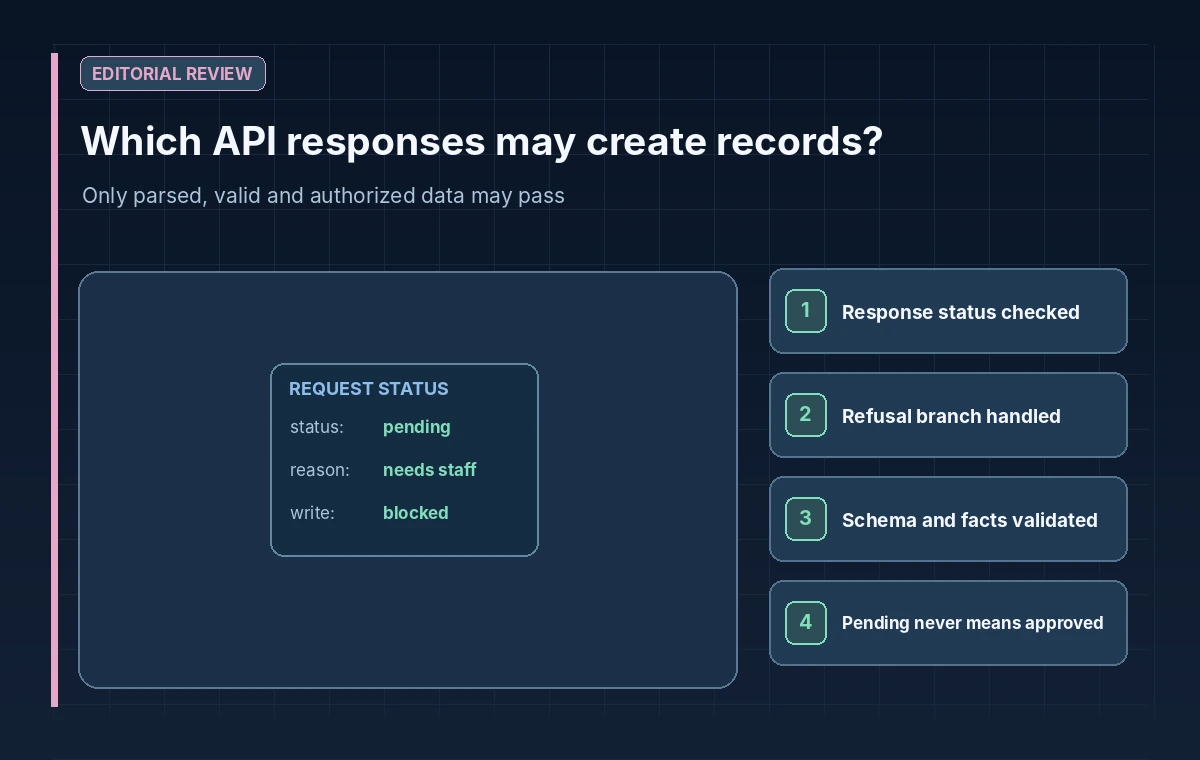
The decision tree should check for transport errors, response status, refusal content, schema parsing and domain-specific facts in that order. Make retries idempotent: retain the application submission ID and reconcile existing records before attempting a second write after a timeout. It is safer to show a pending state than to create duplicate approvals or infer a result from partial output.
Compare Three Distinct Application Outcomes
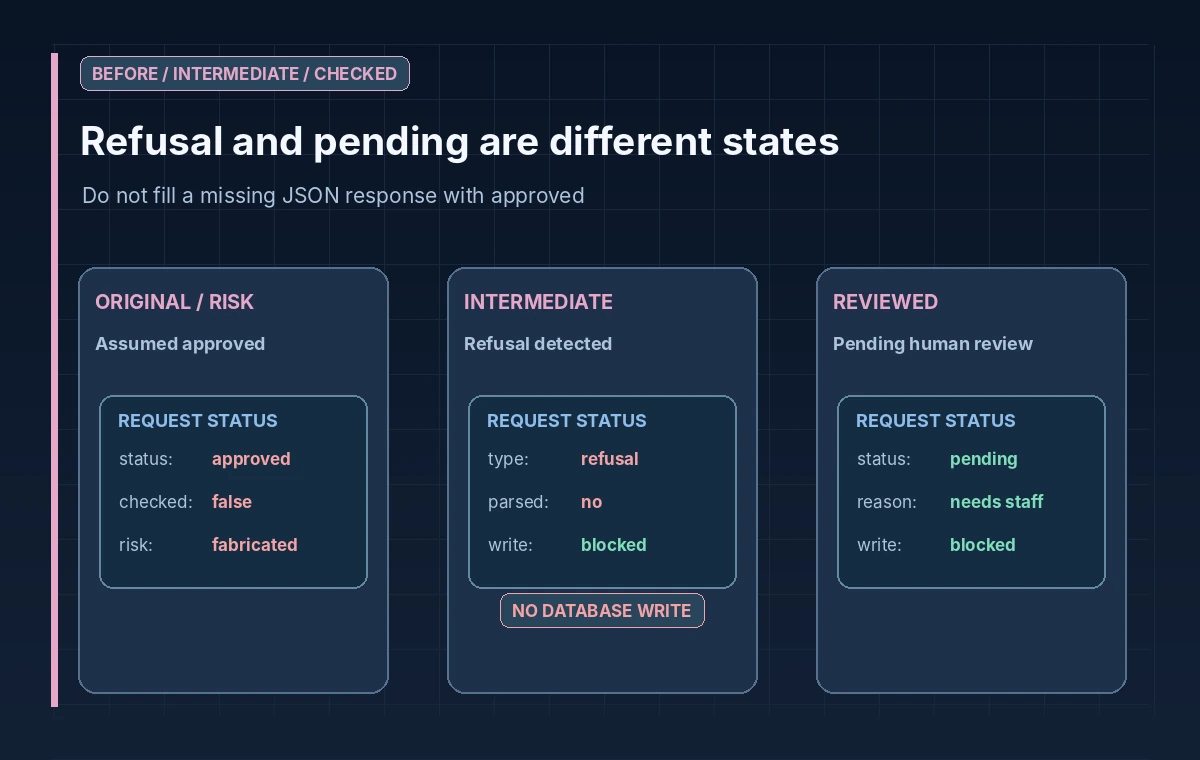
In the visual example, the unsafe panel inserts “approved” when no validated response exists. The middle panel shows a refusal or incomplete JSON, and the reviewed panel stores a pending request with a clear reason and a path to staff assistance. The key difference is the database decision, not merely the color of a confirmation icon. No diagram represents a real API session or production user.
A second example could involve a date field: the model returns null because the applicant has not chosen a pickup day. That is different from the API refusing to answer or truncating its output. The application must preserve all three meanings. Null belongs to a successfully parsed field; refusal belongs to response handling; an incomplete stream belongs to an unfinished generation.
Put Business Validation Outside the Model
After receiving schema-conforming data, check the request against the real lending catalog, staff-reviewed policies and available pickup slots. A status such as “ready for human review” is not the same as “item reserved.” Require a system-of-record confirmation before showing a loan as approved. If the user requests something prohibited, handle the policy boundary explicitly instead of asking the model to fill in a comforting status.
Keep sensitive patron information out of incidental logs and test fixtures. Develop with invented names and item codes. Use a small set of acceptance cases: clean structured response, nullable field, safety refusal, incomplete generation, schema mismatch, duplicate request and service outage. The tests should define expected behavior without pretending the API has been executed or that empirical refusal rates were measured.
Release With Clear Pending and Error States
A safe production release requires typed handling for each response category, strict schema validation, separate business validation and a single authorized write path. Document who can resolve a pending request and how the application lets a user correct missing information. Logging should capture non-sensitive correlation IDs and error classes without retaining full private application content unnecessarily.
Structured Outputs can make downstream processing more predictable, but cannot guarantee the truth of fields or remove the need for refusal and incomplete-response handling. The operational goal is to ensure every absence of evidence stays visible as unresolved. The system should prefer an honest pending message to a confident-looking but unauthorized approval.
How We Research
We consulted the following official developer documentation on November 8, 2026: OpenAI API: Structured Outputs guide; OpenAI API: Create model response; OpenAI API: Retrieve model response. We compared the documented parameters, data flow and stated limitations with this hypothetical editorial scenario. The diagrams are original instructional illustrations, not real vendor screenshots or outputs. We did not submit private archive material, run a production API evaluation, measure tool accuracy, obtain legal consent, or test a live service configuration. Product behavior, access rules, quotas and supported settings may change; confirm the latest documentation and your organization’s policies before deployment.
Frequently Asked Questions
Yes. OpenAI documents refusal behavior as an edge case outside the ordinary structured payload; handle that response separately.
No. Schema adherence constrains structure, while inventory, eligibility and policy decisions require application and staff checks.
Do not write a final status from partial output. Inspect the response status and incomplete details, then use a safe retry or human-review path.
Use an explicit nullable field where supported and treat it as missing information, not as a refusal or an approval.
No. They illustrate hypothetical error branches and proposed release safeguards.