
A Streaming Draft Is Not a Published Library Notice
A public library uses an AI assistant to draft short service notices from verified operational updates. The interface feels more responsive when text appears gradually, so the development team considers streaming the OpenAI Responses API output over server-sent events. That convenience creates a publication risk: an incomplete sentence can look final, particularly when it refers to a temporary closure, emergency access route, or a deadline. A visible first token is not confirmation that the response has finished.
OpenAI’s Responses API supports streaming with stream=true and emits typed events such as response.output_text.delta, response.completed, and error. A robust application can render provisional text in a private preview while refusing to expose it as an official notice until a terminal success signal and independent source checks pass. This article uses a fictional branch-hours announcement to explain the architecture. It does not report a live API benchmark, an observed outage, or a measured error rate.
Separate Stream Transport From Notice Approval
A typical workflow has three boundaries: source verification, draft generation, and editorial publication. The library’s official schedule or closure notice is the source of truth. Streaming changes how the draft reaches the screen, not whether the content is correct. The frontend may accumulate text deltas for a staff member to review, but the publishing service should never treat a partial buffer as a complete, approved announcement.
Represent the buffer with an explicit state such as ‘draft in progress’. Do not attach a public permalink or send a notification just because the UI has received enough words to form a sentence. If the user’s connection drops, the buffer may be missing a condition at the end, for example ‘except during an accessibility upgrade’. A downstream observer must not mistake network delivery for a complete, policy-checked result.
Handle Typed Events, Not Just Text Chunks
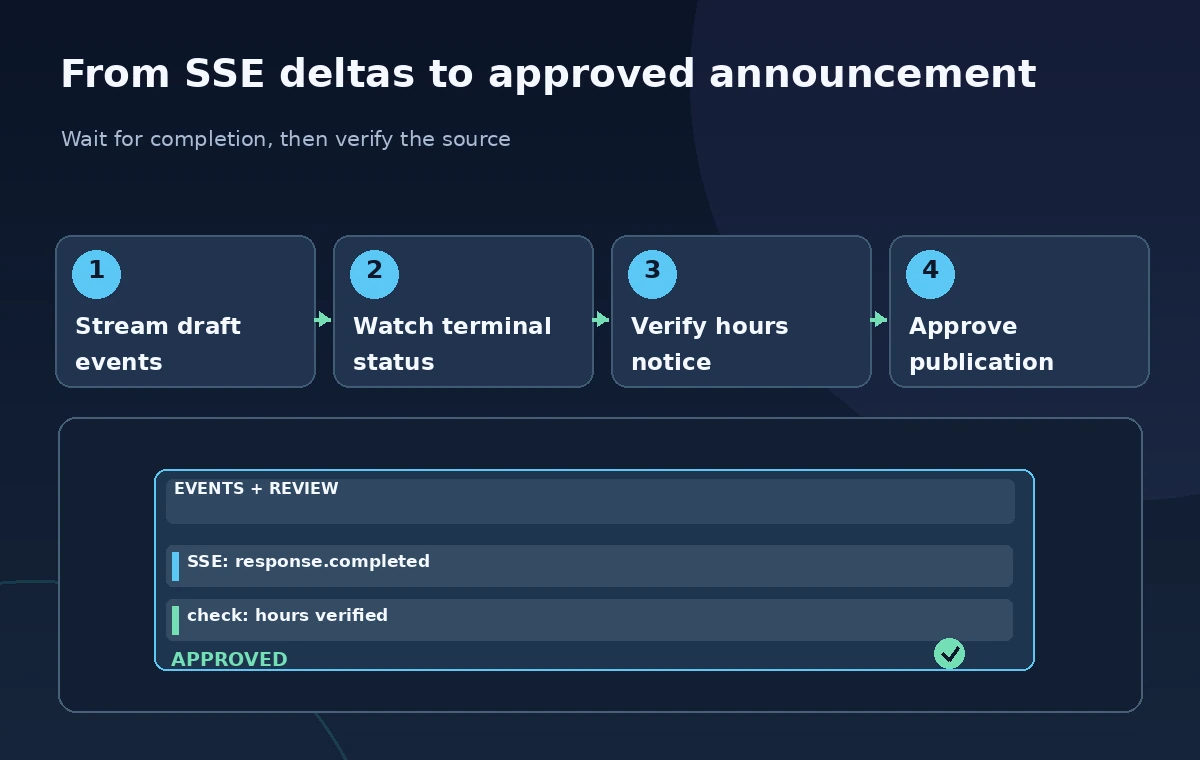
The Responses API streams semantic events, and the application should branch on each event’s type. response.output_text.delta contains incremental text; response.completed marks a successful completed response. Other lifecycle events can represent failure, incompleteness, or a processing transition. The streaming event reference specifies the event shapes, including sequence numbers and content identifiers. Avoid reducing every event to an anonymous string because that discards the difference between progress and success.
For a single notice, keep a response ID, content buffer, terminal status, and source revision reference together. Log lifecycle state changes without storing private patron messages in broad analytics. An error event should move the draft into a failed state with a clear retry decision; it must not silently become a successful publication. Where a response includes tool calls or other output items, the application should process each item according to its type rather than assuming the text stream is the only relevant channel.
Avoid Acting on Partial Tool Arguments
A streaming model may emit partial function-call arguments before they are finalized. OpenAI’s documentation distinguishes argument-delta events from argument-done events. Even a syntactically plausible partial JSON fragment can be incomplete or change as later chunks arrive. Do not execute an external tool based on an intermediate fragment, and do not allow a model to update the library schedule merely because it mentioned an operation in text.
Treat tool execution as a separate authorization decision. Wait for the complete tool-call representation, validate it against the allowed schema and exact permissions, and prefer read-only tools for information requests. For a branch-hours lookup, the authoritative schedule should be fetched from an approved service and matched to an effective date. The streaming draft can then explain that verified value, but it cannot create, change, or approve the source record by itself.
Compare Draft, Truncated and Approved States
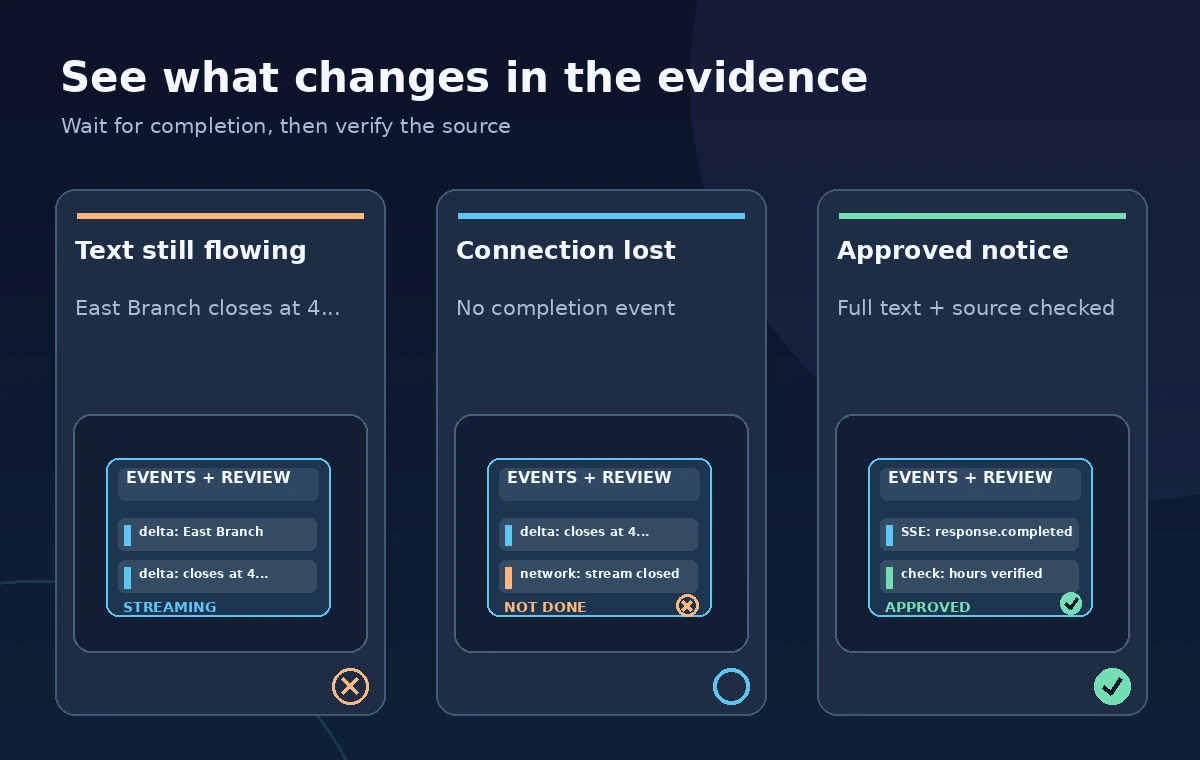
Imagine the source notice says: ‘East Branch closes at 4 PM Friday; the accessible entrance remains open until 6 PM.’ The first streamed fragment might read ‘East Branch closes at 4 PM’. If the frontend exposes it immediately as a finished alert, important context disappears. A second state represents a network interruption after that fragment, with no terminal completion event. The application must show an incomplete draft, not a public-facing confirmation.
In the approved state, the system has received response.completed, checked the source revision and both times, and obtained the required editor approval. These three states should look different on an instructional diagram: flowing text, interrupted buffer, and a locked release card. They are conceptual examples, not production screenshots or measured model output. Importantly, terminal success alone does not establish that the generated text is factually correct; it only establishes the response lifecycle outcome.
Design Recovery Without Duplicate Publication
When a connection fails, first determine whether the server-side response reached a terminal state using whatever retrieval and state tracking the application’s retention settings allow. Do not blindly start a second publication workflow. If the model request must be retried, use a durable local draft identifier and require a new approval before any public side effect. The point is to prevent the same notice from being posted twice with slightly different wording.
Keep retries and release actions separate. A request to produce text is not the same as a request to email readers, update a homepage banner, or change branch hours. Those actions need their own idempotency and authorization controls. Maintain a clear log of draft version, effective date, editor decision, and publication outcome. If the authoritative notice has changed while generation was in progress, discard or refresh the draft rather than approving words grounded in an old schedule.

Review Moderation, Privacy and Retention
OpenAI notes that streaming can complicate moderation because partial outputs are harder to assess than completed content. Therefore, a UI that shows live deltas publicly needs additional safeguards. For sensitive library questions, favor a restricted staff preview until the full content has been checked. Do not include patrons’ personal contact information in prompts unless the workflow truly requires it and the organization has approved the use. Keep logs minimal and restrict who can inspect failed drafts.
Understand response storage as a separate question from streaming transport. The application’s project settings and the API’s store behavior affect retrievability and retention. A resilient architecture must neither assume that all drafts are permanently available nor claim that they are never retained. Verify the current data controls documentation and create a documented deletion policy for local buffers, operational logs, and any saved response objects. Do not make privacy promises based solely on stream=true.
Publish Only After Completion and Source Review
Use a release gate with explicit inputs: a recognized completed event, full buffer, source ID and revision, date verification, content review, and a staff approval. If any item is absent, leave the item unpublished with a reason. Test this gate using fabricated event sequences that include a dropped connection, an error event, and an outdated source notice. Validate the frontend and backend against the same state machine so a UI bug cannot turn a partial buffer into a release action.
The best outcome is a fast staff preview paired with a deliberately slow publication boundary. Streaming helps people see progress, but responsible public notices require authoritative facts, complete output, and accountable approval. Keep all three visible in the workflow diagram and help text. Readers should understand that response.completed means the model finished its response, not that a library closure, grant award, or inventory change has been officially confirmed.
How We Research
For this November 2026 guide, we reviewed named primary documentation: OpenAI: Streaming API responses; OpenAI: Responses streaming event reference; OpenAI: API data controls. We checked documented settings, limits, and failure conditions against a fictional institutional use case. We did not run live vendor API tests, process actual private records, verify real-world speech or translations, measure latency, or collect permissions. All images are original conceptual instructional drawings rather than screenshots or observations. Claims about source revisions, speaker wording, ownership, and access must be checked against the authoritative records by qualified staff. Vendor capabilities, eligible plans, regions and logging behavior can change; check current documentation and institutional policy before deploying any workflow.
Frequently Asked Questions
No. It carries an incremental text fragment and must not trigger publication or another irreversible action.
The typed response.completed event indicates a completed model response; factual and editorial approval are still separate.
Keep the item in an incomplete or failed draft state and verify server-side status when possible before deciding whether to retry.
No. Wait for the full tool-call representation, validate the arguments, and enforce application-side authorization.
No. Streaming partial text creates additional review challenges; retention and logging are governed by separate data controls.