
An archive receives a scanned gift agreement whose main paragraph grants permission to reproduce photographs but a handwritten margin note restricts one collection. Converting every detected word to a single paragraph could make that exception disappear. Amazon Textract’s LAYOUT feature identifies document structures and their positions, helping staff build a review interface that keeps clauses near the source page. It does not interpret the legal meaning of those clauses. This guide uses a fictitious two-page donation deed to show which evidence must remain visible.
Register the deed and its page images before OCR
Start with an approved, legible scan of the entire deed, including page edges, stamps, backs of pages and any attached schedules. Give the scan a stable archival identifier and checksum. Record the page sequence, whether a side note is handwritten, and any known scanning defect. The sample document here has a heading, a printed grant clause, a marginal restriction and a signature block; it is fictional and has no legal authority.
Keep the original files in access-controlled storage, separate from AI-generated text. Document who may submit the agreement to a cloud service and whether retention rules permit processing. If a page is skewed or partly hidden, rescan it instead of expecting OCR to invent the missing language. Label all derived extraction as provisional so a reader never mistakes the structured blocks for an approved transcription of a legal document.
Request the LAYOUT feature explicitly
Amazon Textract AnalyzeDocument accepts a FeatureTypes list. Adding LAYOUT asks for layout information alongside detected lines and words; the API also supports features such as TABLES and FORMS when appropriate. A typical analysis response consists of Block objects with types, geometry and relationships. A multipage process can instead use StartDocumentAnalysis and paginate GetDocumentAnalysis responses, while preserving the page number of every block.
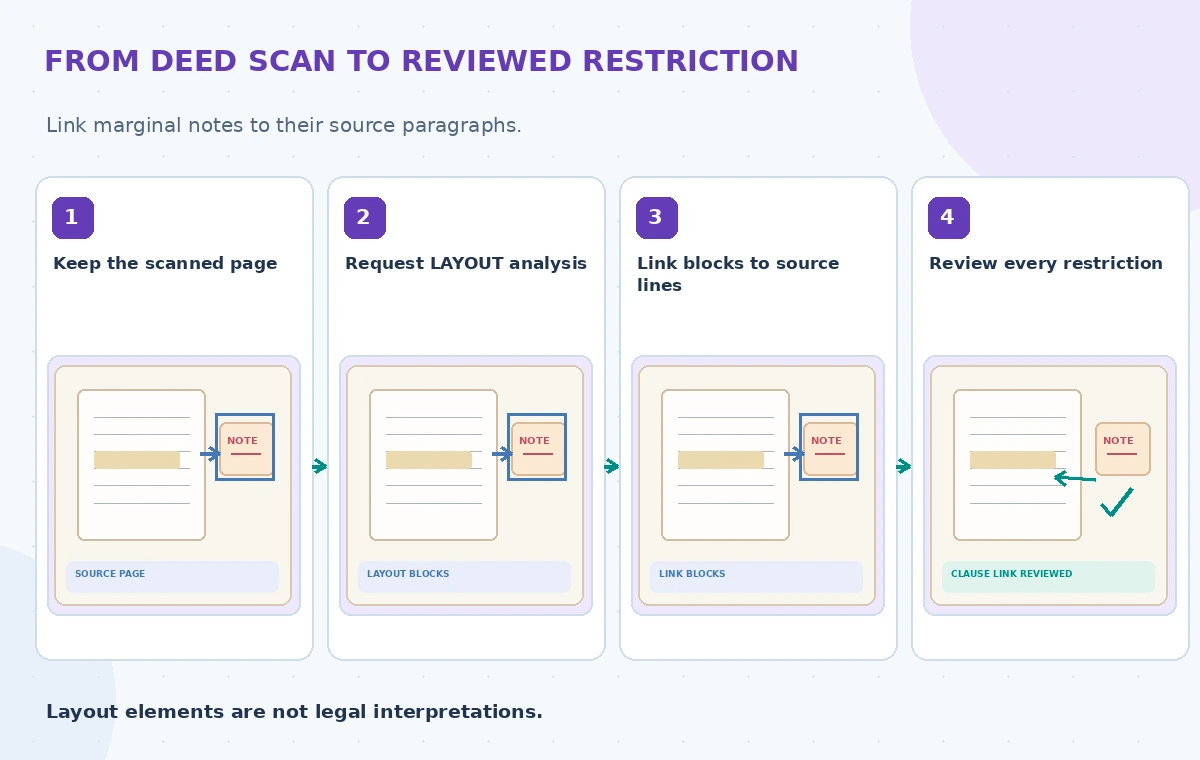
Do not assume that LAYOUT reconstructs arbitrary spatial meaning. AWS describes its layout ordering as implied reading order, generally top to bottom and left to right. That is useful for conventional pages but fragile for irregular notes, columns and stamped amendments. Keep the line and word IDs and geometry rather than concatenating layout text and discarding the positions; downstream reviewers will need to trace an alleged exception back to pixels.
Distinguish layout objects from approved clauses
Expected layout categories include elements such as titles, headers, paragraph text, lists, tables, figures, page numbers and section headers. Their presence helps segment a scan, not decide which text legally modifies another. For the fictional deed, the margin note may fall near the reproduction permission but the model’s block sequence may not encode the logical relation. An archivist must link that note to the correct provision using the image and other evidence.
Save a structured record containing page index, block ID, type, bounding box, extracted text and human-reviewed association. The source coordinates enable a split-pane interface that highlights an element on the scan when the reader clicks its text. A block with a high confidence value still may be on the wrong reading path. Never insert the model’s guessed association into the deed as though the parties wrote it.
Reconstruct a navigable page, not a false linear transcript
Render the page thumbnail beside a provisional list of block groups. Let staff change the ordering and attach a marginal condition to its parent paragraph without destroying the raw extraction. For a two-column schedule, compare each column against the original layout. Tables may need their own TABLES extraction and cell-level review if the relationship between donor names and restrictions matters.
Keep visible markers for line breaks, page transitions and uncertain handwriting. A field labeled ‘permission granted’ is particularly risky if a nearby note says ‘except unpublished photographs’. Treat the first phrase as incomplete until the whole page and attachments are reviewed. Do not use the simplified reading order to generate public permission metadata automatically; require a human to approve the specific rights statement.
Compare flattened, detected and verified states
In the first conceptual state, a naive export strings together the printed grant while a margin restriction sits outside the text column. The intermediate state has visible layout rectangles, but no verified link between the restriction and its paragraph. In the reviewed state, a connector points from the side note to the appropriate clause, with a source-page anchor and an unresolved flag if its wording cannot be read.
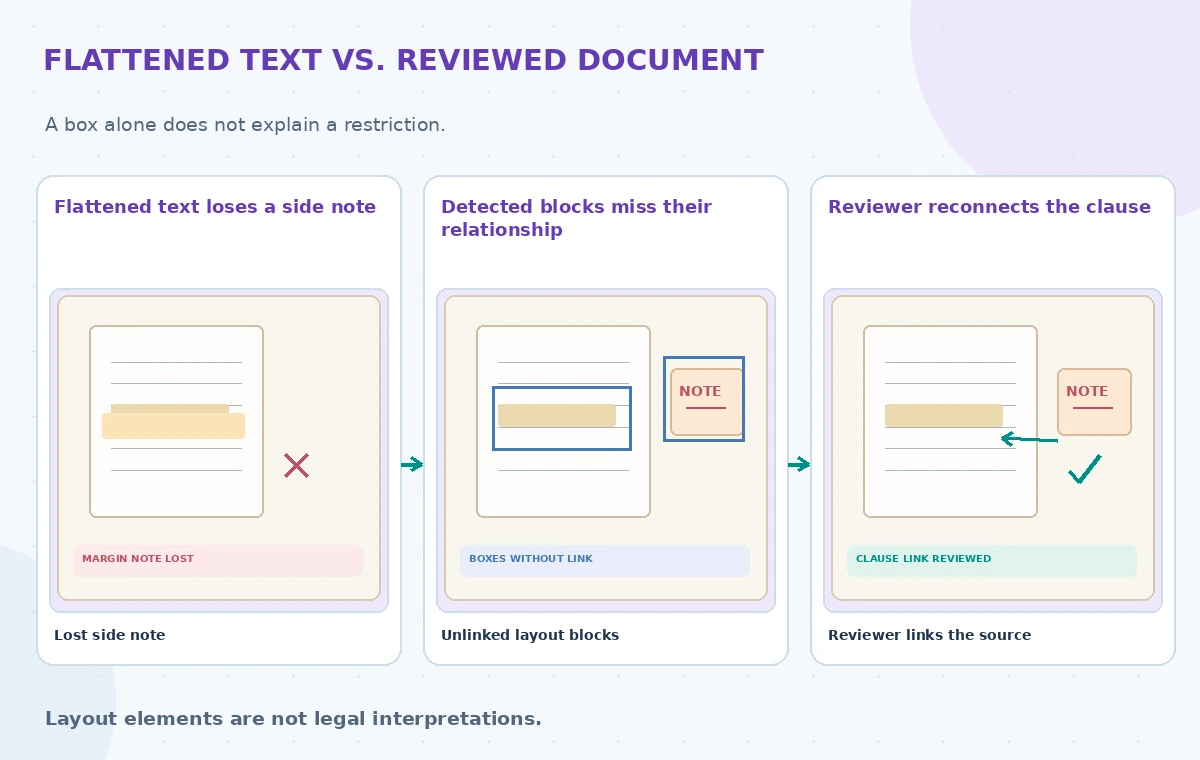
These pictures are explanatory drawings, not real Textract output or measured extraction accuracy. A pipeline can have technically successful OCR and still fail the archive’s purpose. Evaluate whether each rights-changing clause is located, transcribed correctly and logically associated with its source. The number of extracted boxes alone says little about whether a future researcher can safely reuse the photographs.
Protect legal and personal information in annotations
Donation deeds can contain addresses, signatures, private valuations and nonpublic agreements. Limit access to raw scans, derived OCR and review notes according to the archive’s policy. Layout extraction does not redact sensitive fields; even the page-image preview can reveal information that should not be on a public catalog screen. Keep restricted pages out of search indexes and diagnostic logs unless there is a documented basis for inclusion.
A public discovery description may summarize a reviewed restriction without publishing the deed itself. Separate internal review status from public rights metadata and keep an approval trail. Do not present this workflow as legal advice; when language affects licensing or donor obligations, consult the organization’s authorized records and qualified legal reviewer rather than relying on classification or visual proximity alone.
Build a review fixture around difficult layouts
Construct synthetic examples with a page header repeated as body text, a footnote, a two-column schedule, a crossed-out sentence and a margin condition. For each one, label the exact source location and the link a reviewer expects to see. Test both correct and intentionally incorrect associations. Include multi-page pagination so a line from page two cannot silently attach to a paragraph on page one.
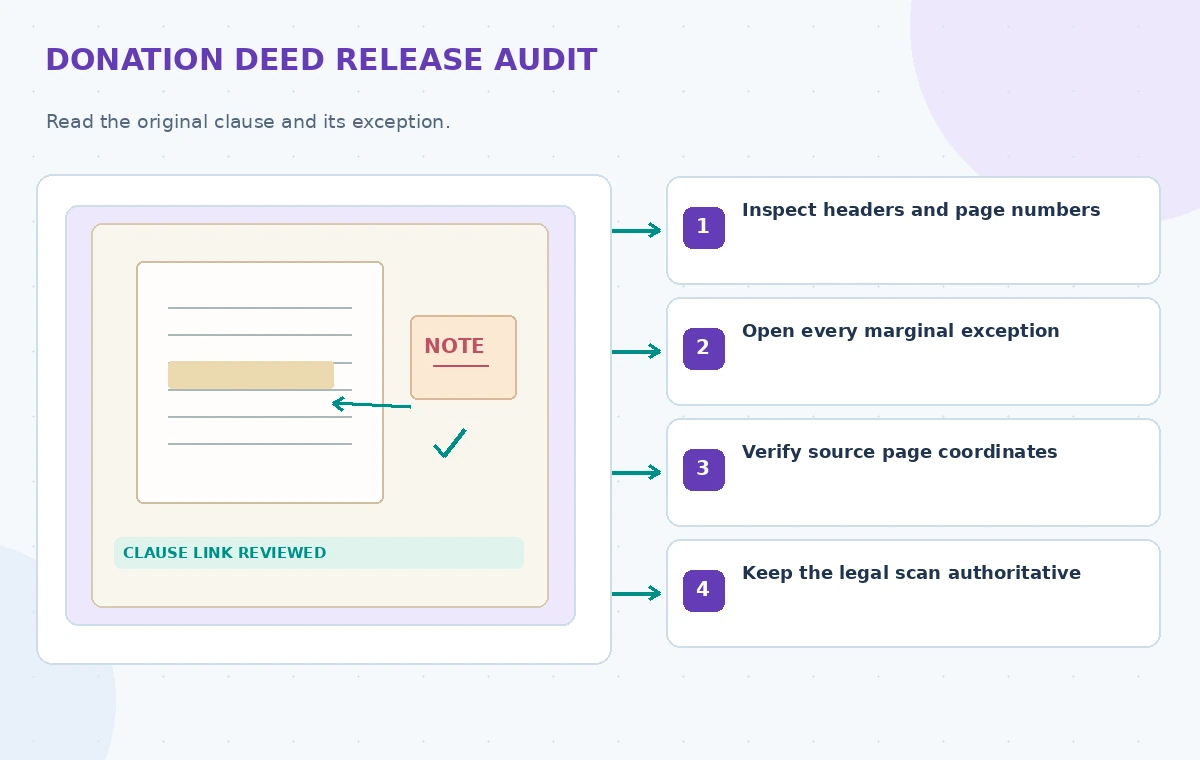
Record which blocks were extracted, which relationships staff changed and which areas remained illegible. Compare review workload and missed restrictions only after testing with authorized representative documents. There is no measured recall figure in this article. If an API upgrade or rescan shifts block IDs, keep versioned mappings and force reapproval for material whose coordinates or words have changed.
Release a traceable rights record after human approval
Before attaching a rights statement to a catalog record, the reviewer should see the full clause, the side note, page number, document edition and approval state. A permission field without its exception must be blocked from publication. Export a clear citation to the original deed and a link to the restricted staff-only scan where permissible; a public visitor should not receive credentials or unrestricted document URLs.
Recheck AWS’s current supported input formats, document limits, regions and processing costs before any deployment. Preserve the scan, original OCR response and reviewer changes according to retention policy. The meaningful result is an auditable rights interpretation backed by source evidence, not a claim that OCR recognized a legal agreement with certainty.
How We Research
We researched this November 2026 article from named official documentation: AWS: Analyzing documents with Textract; AWS: AnalyzeDocument API; AWS: Textract block and layout objects. We compared documented request parameters and operational limitations with a hypothetical community organization use case, then designed independent human review and regression checks. Images are original fictional educational diagrams, not product screenshots, actual measured benchmark charts or verified customer cases. We did not submit live API requests, upload personal files, process museum assets or measure vendor accuracy. Implementers must verify current endpoint versions, access controls, region support, pricing and retention before deployment. Factual and rights-sensitive results require review of primary sources.
Frequently Asked Questions
No. It identifies document elements and implied order; a reviewer must interpret and link the clauses.
Not necessarily. Request and review TABLES where cell relationships matter.
No. Inspect the source image and independently verify unreadable wording.
Not for rights-sensitive deeds. Approve the linked clauses and disclosure permissions first.
Yes. Preserve page numbers, source checksums and extraction revisions for traceability.