
A library patron asks whether a projector and its matching adapter are available. An AI assistant may need two inventory lookups before giving a useful answer. The OpenAI Responses API supports function calling and, on supported models, can return multiple function calls in a turn. Parallel tool calls may improve a workflow but also create ordering, permission and duplicate-action hazards if an application blindly executes every suggested operation. This article designs a hypothetical read-only lookup with separate call identifiers and human-controlled inventory updates. No live library or API request was tested.
Choose a question that requires independent reads
For a projector-and-adapter question, treat the projector record and accessory record as separate data sources. The patron wants availability, not a reservation or a permanent change to inventory. Define two read-only functions such as get_item_status and get_accessory_status and mark the supplied inventory IDs as user input, not trusted database keys. The application should authenticate the patron only for the information they are entitled to view.
Plan for mismatched results: a projector might be available while the adapter is checked out, or an item might be under maintenance. The assistant should report both statuses and not declare a complete equipment kit available based on one successful lookup. Preserve the authoritative inventory source and last-updated timestamp. If a source is stale or missing, an explicit unknown is safer than a fabricated combined answer.
Understand multiple function calls in a response
OpenAI’s function-calling guide describes a flow in which the model proposes tool calls, the application executes code, and tool outputs are sent back for a final response. The model may choose more than one function call in a turn. The parallel_tool_calls setting can be set to false to ensure zero or one call rather than several. Parallel execution is a scheduling choice; it does not grant any authorization to the requested actions.
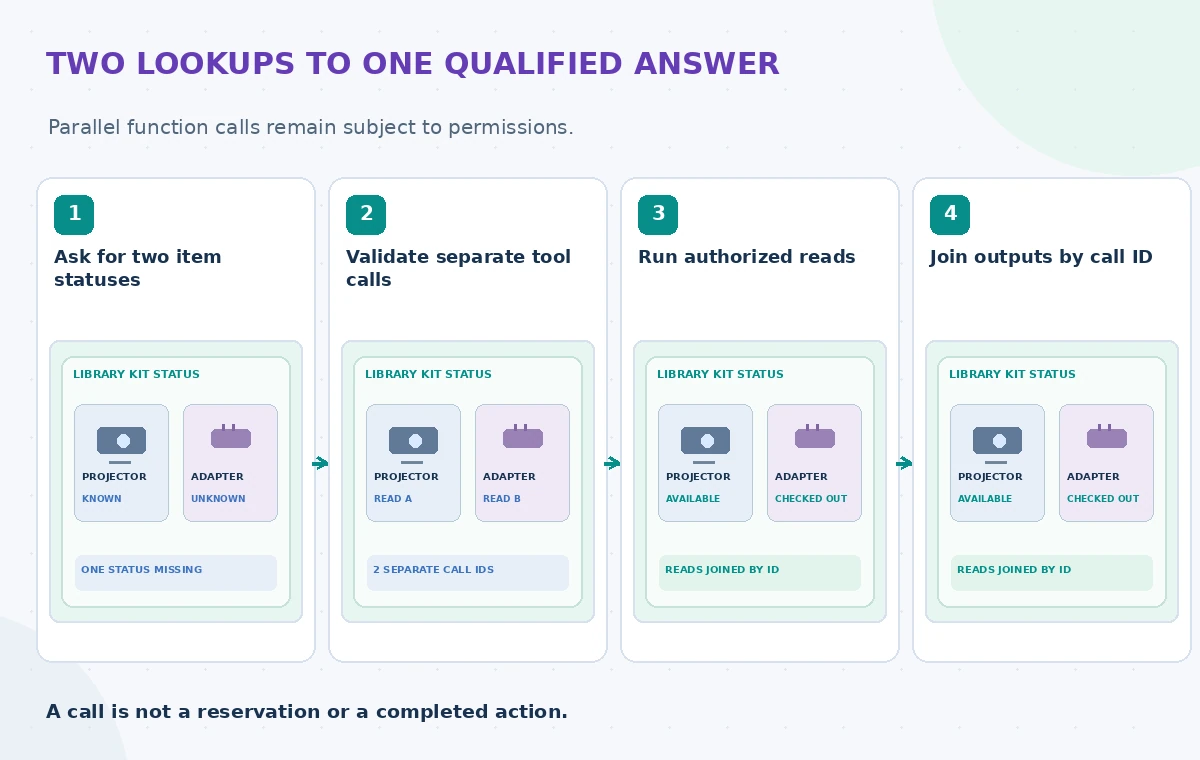
Do not assume that parallel calls are always supported with every model and tool combination. OpenAI documents restrictions involving built-in tools and special considerations for fine-tuned models and strict schemas. Check the current model documentation and the response output structure used in your integration. A robust implementation can work serially when parallel behavior is unavailable, without changing the public answer’s correctness requirements.
Validate arguments and call identities separately
For each returned function call, inspect the function name, JSON arguments and unique call_id. Validate the requested item ID against the authenticated user’s permitted scope and the expected schema. Never infer that two calls with similar parameters are automatically safe to merge. Store a pending-call table keyed by call_id so the next request can attach the right tool output to each invocation.
If two calls target the same item unexpectedly, do not turn that into a duplicated reservation. Read functions may tolerate retries better than writes, but they can still generate cost and sensitive logs. Enforce server-side allowlists, rate limits and bounded timeouts. When tool arguments contain natural-language text from the patron, treat it as data, not as instructions from the system or as permission to invoke another function.
Compare a partial answer with reconciled evidence
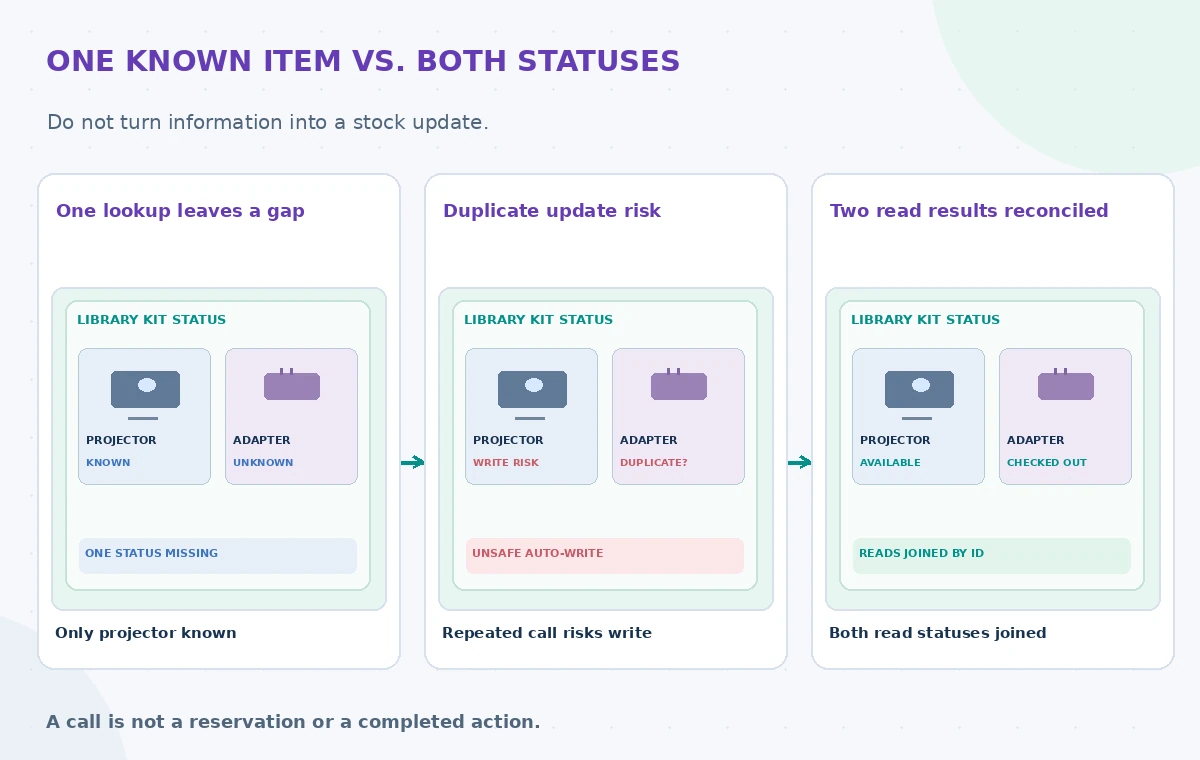
A useful comparison shows a single projector lookup returning ‘available’ while the adapter status is still unknown; this is incomplete, not proof that the full kit is available. A second panel shows the failure mode where repeated model calls are mistaken for two approvals or a write action is invoked. The final panel shows two separate read responses, each matched to its call_id, combined into a qualified answer. These are original teaching examples, not actual responses from OpenAI.
Do not label the final panel ‘reserved’ unless a separate authorized booking service confirms a transaction. The library may have a different public availability cache from the staff system, so note retrieval times and conflict conditions. When one function fails, return ‘projector status known; adapter status unavailable’ rather than manufacturing a green overall result. Keep the user-facing distinction between information and action clear.
Use read-only functions as a hard boundary
Separate tool definitions for query operations from write operations such as check_out_item, reserve_kit or adjust_quantity. For this task, expose only the read functions and enforce read-only behavior in the backend credentials. OpenAI’s tool choice controls can restrict eligible calls, but application enforcement is still necessary because tool arguments and execution happen in your environment. Never treat a model-generated function call as a completed transaction.
A future booking request should be handled as a new authorized workflow with a clearly identified patron, resource and explicit confirmation. The presence of a successful inventory lookup must not become implicit consent to reserve. If an application performs writes, require idempotency keys and post-write reconciliation. Parallel invocation must not change who has the authority to authorize the action.
Bring tool outputs back with exact correspondence
After running reads, return each output as a function-call result associated with the original call_id. Treat a timeout, malformed result or missing record as an error state for that specific call rather than borrowing data from a neighboring result. Keep a bounded map of pending calls, expiration rules and a test for duplicate or orphaned identifiers. Only after all required evidence is in should the application ask for a combined response.
Do not rely on completion order to match results. Network calls can finish in reverse order and IDs such as ‘adapter’ and ‘projector’ may resemble one another. A deliberately reordered mock test should still yield the same status mapping. If a result is from a stale inventory snapshot, show that limitation rather than silently normalizing it to a more recent status.
Test failure, retry and model behavior
Prepare synthetic tests for a simultaneous success, one missing adapter, a duplicated function call, malformed IDs, a timeout, and a canceled patron question. Check that errors are not swallowed and that no write-capable endpoint is reachable. Measure local correctness against expected records if conducting a real implementation evaluation; do not claim speed gains based on a diagram. The integration should remain correct when parallel calls are disabled.
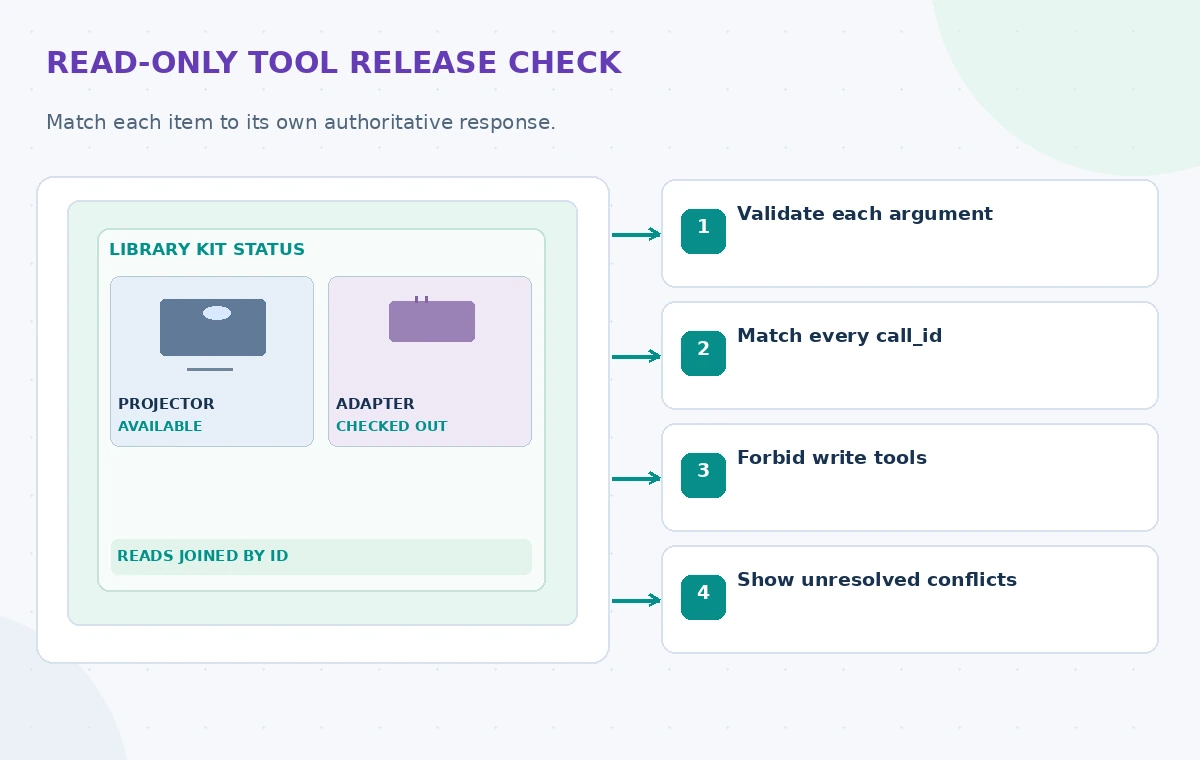
Review the strict schema guidance for function definitions and any model-specific limitations, particularly when other tools are present. A model may propose calls that do not suit a given user’s permission context; the backend must reject them. Keep logs focused on call identifiers, sanitized function names and outcomes, not private patron history. Do not include raw access tokens in prompts or tool outputs.
Answer with provenance and no implied reservation
The final response should say which item is currently available, which item is not, and when the inventory records were checked. If either status remains unknown, communicate that gap. Include the authoritative catalog link or staff contact route instead of inventing a pickup time or a successful reservation. A person should be able to trace each factual clause to the correct read output and call identifier.
All examples in this article are fictional and no API calls, latency measurements or inventory updates were performed. The success criterion is that the assistant faithfully combines authorized read results without silently changing stock or interpreting parallelism as permission. For critical or restricted equipment, a human confirmation step may be needed even after the information is correct.
How We Research
For this November 2026 article, we examined three named official references: OpenAI: Function calling guide; OpenAI: Responses API reference; OpenAI: Tool calling in Responses. We compared documented configuration, request behavior and limitations with a fictional nonprofit use case. The resulting narrative and diagrams are an editorial design exercise. We did not use real records, invoke vendor services, test accuracy, time API responses, conduct a security audit, or obtain actual publication rights. An implementation should recheck model, region, account, IAM, costs, privacy law, source status and the organization’s approval policy before processing any real material.
Frequently Asked Questions
It restricts a turn to zero or one function call rather than multiple parallel calls.
No. Your application validates arguments, runs the function and returns a matching result.
Use each function call’s call_id, not arrival order or a guessed item name.
No. Any write or booking requires a separate authorized, confirmed operation.
Preserve the uncertainty for that item and do not claim the full kit is available.