
A Long Archive Request Needs a Budget Before Generation
Imagine a curator preparing forty scanned correspondence pages for an AI-assisted subject index. A plain word count does not account for image inputs, system instructions, prior conversation items or the structure of a tool-enabled request. OpenAI documents a dedicated Responses token-counting endpoint, POST /v1/responses/input_tokens. It returns an input token count for the request, without being the same as generating the index. That distinction matters when access to scans is expensive, and when a draft cannot afford to lose its final pages. The sample project here is hypothetical: we have not sent those scans or billed an API account. First define the exact batch, permitted data and intended output before choosing a model or token limit.
Count the Actual Request Shape, Not Just OCR Characters
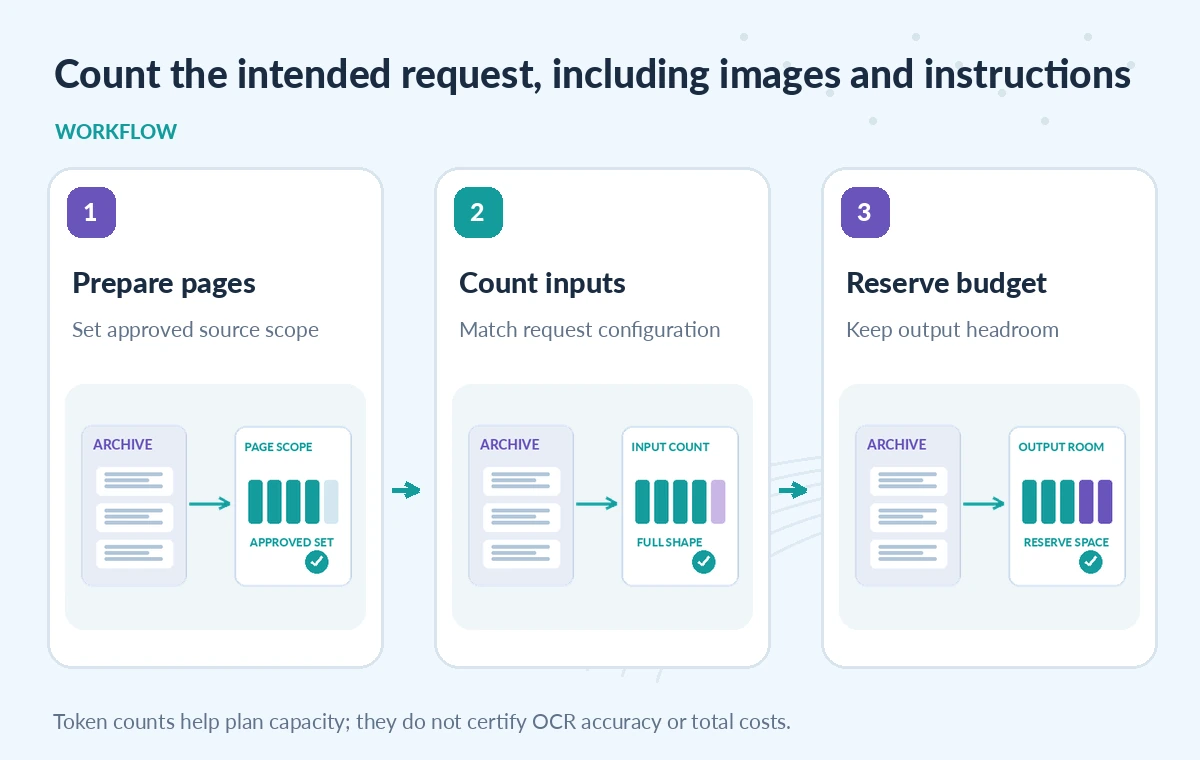
The input-token endpoint accepts fields relevant to the proposed Responses request, including model, input, instructions and conversation context. Use the same material and settings you plan to send rather than counting a shorter sample and multiplying by page count. For a document workflow, the initial input might contain the transcription of a handwritten page, separate image content and a fixed instruction to preserve uncertainty. If the final request includes many earlier messages or tools, the tally may differ from a count of the current user text alone. Treat this preflight as a sizing step, not an exact prediction of the model’s final cost. Generated output and any subsequent tool operations remain separate considerations.
Separate Image Pages, OCR Text and Supporting Instructions
Build three named bundles for an imaginary archival request: approved OCR text, page images that require visual inspection, and the editorial rules. The OCR is searchable but may drop marginalia; the image can show structure but has its own processing and privacy concerns. Include only the pages needed for the task, and avoid duplicating all text in both a transcription and an instruction attachment unless the comparison requires it. Keep the source filename and page index outside the prompt as controlled metadata. A token estimate does not establish whether the page is legible, rights-cleared or factually reliable. A visual comparison in this article illustrates relative request components, not measured token values or throughput from an OpenAI account.
Preflight the Full Conversation and Output Headroom
A request linked to a conversation can carry older items into the model’s effective input. Count with the intended conversation parameters and understand the difference between an isolated test request and the true history. Next reserve room for the output. The OpenAI counting guide explains that reported output usage can include tokens used for model operations and formatting that are not visible as prose. A request budget that allocates every available unit to input text may leave the summary truncated or unable to supply page references. Use model-specific limits from current documentation and keep a practical buffer for instructions, generation and error handling. Do not hard-code a universal page limit across models or OCR formats.
Compare a Guess, a Text-Only Count and an Actual Preflight
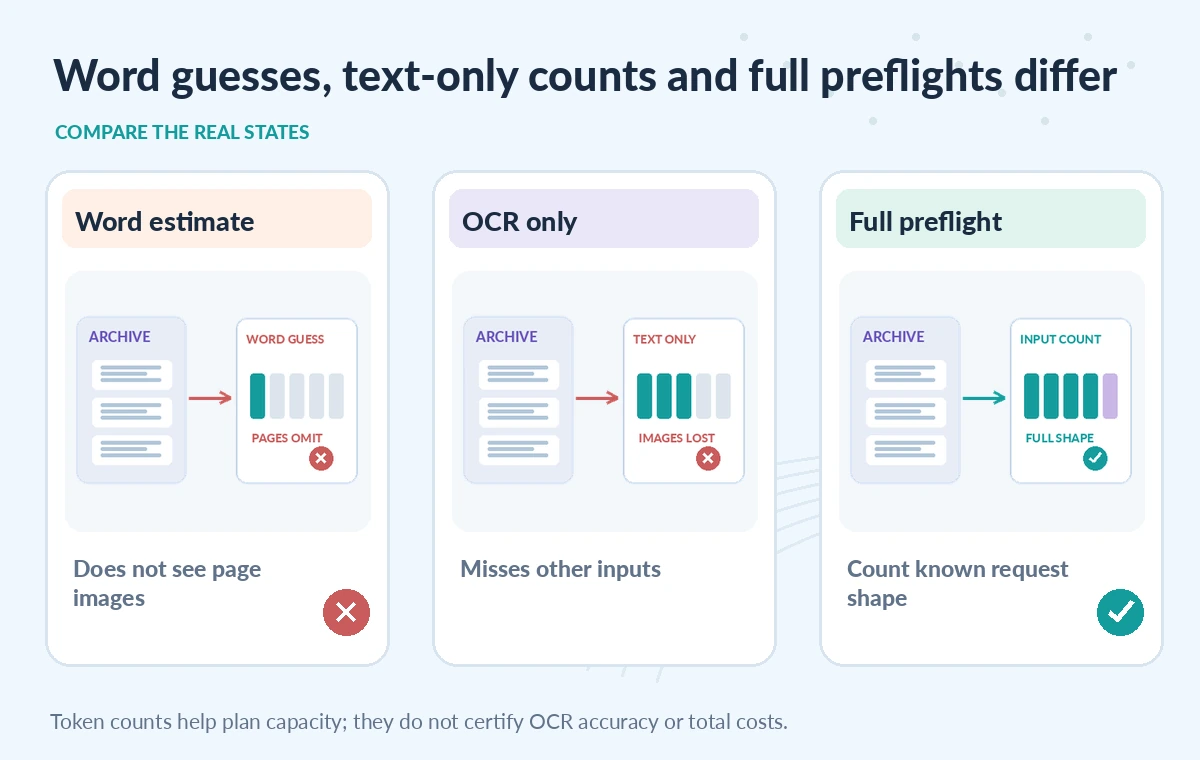
Consider three illustrated alternatives. The first operator estimates the archive by multiplying a word count by a fixed ratio, overlooking a folder of page images. The second counts OCR text but excludes conversation history and tool configuration. The third submits a representative planned request to the counting endpoint and logs the resulting integer alongside the model and input revision. Only the third follows the documented route for sizing that request shape, though it still does not guarantee later response quality. For internal evaluation, repeat the comparison after changing image detail settings, attachment types or the number of pages. Record real results only if your own tests produced them; our figures are deliberately schematic.
Put a Clear Failure Branch Before the Model Call
Establish a maximum allowed input budget for the archival task, considering the chosen model’s context window, expected answer length and the team’s cost ceiling. When the count is too large, stop and divide pages by source, document or year; do not silently discard the oldest pages. Return a message explaining which content was omitted and which batches remain unprocessed. A compressed OCR excerpt can drop negations, cross-references and dates, so the user should decide whether chunking preserves the question. A cost threshold should similarly be a project policy, not a model judgment about whether the historical evidence is important. Keep the unmodified source available to authorized reviewers outside the AI request.
Review Privacy and Output Quality Independently
Token counting still involves preparing request data for an external API. Check whether each scanned page may be processed by the service and keep private addresses, account numbers and unapproved donor notes out of a public workflow. Use minimal identifiers in logs, and avoid storing full token-count payloads as debugging artifacts. After generation, a reviewer must verify every claimed date or quotation against page images and original catalog references. A response that fits the token budget can still misread handwriting or merge speakers. Mark unsupported assertions for review, and never let a successful budget preflight become an automatic approval to publish a summary or new subject heading.
Keep Evidence for Changes in the Batch Design
When a collection team revises its prompt, model choice, OCR software or page selection, rerun the count. A single stored integer loses meaning without the associated model, input composition and document revision. An audit record can keep a pseudonymous batch ID, original document version, page count, request-type digest, count value and later observed usage if a real response was created. Avoid inserting raw page contents into the budget report. For regression checks, use a rights-cleared test set with a few known difficult pages; compare budgets and human review findings separately. A smaller input is not automatically better if it hides a disclaimer or critical footnote.
Define a Reviewable Handoff for the Archive Team
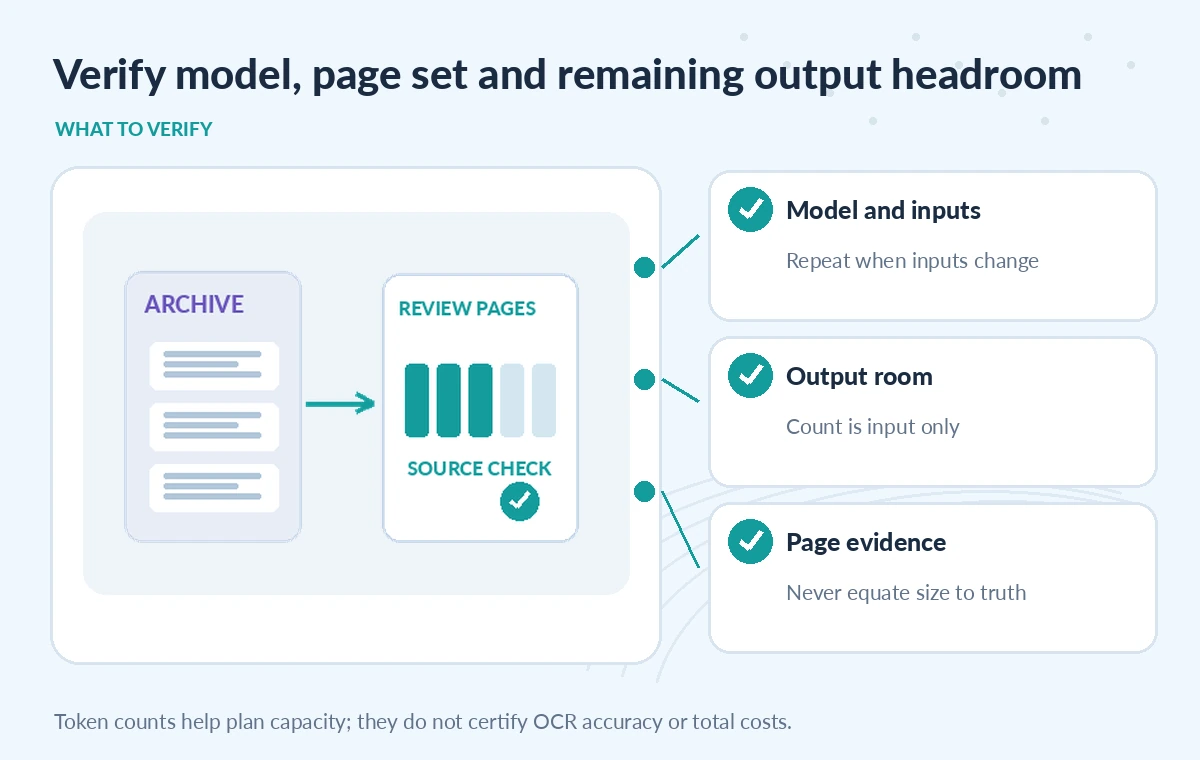
The practical handoff should identify which pages are in scope, what the token counting endpoint returned, which model will handle the request and where the generated answer will be checked. Include a fallback for pages that exceed the budget and a visible status for unfinished batches. The documentation supports counting request input; it does not certify historical facts, privacy permission or a total financial quote for the entire workflow. Keep those as distinct decisions with named owners. A reliable process turns the preflight into a useful capacity signal while leaving final interpretation, citation quality and release authority with the editors of the archive.
How We Research
For this guide, we reviewed the official product documentation on November 8, 2026: OpenAI Get Input Token Counts API, OpenAI Counting Tokens Guide, OpenAI Create a Model Response Reference. We checked the named setting or feature against its published behavior, mapped the documented constraints to the specific hypothetical scenario, and reviewed whether the topic duplicated titles in the supplied LabFin WordPress inventory or prior B0267–B0281 ZIPs. No authenticated vendor service was run; we did not perform a benchmark, observe real customer data, verify third-party rights or claim operational outcomes. All illustrated records and comparisons are teaching examples. Confirm product documentation and security requirements again before implementing a workflow in a real organization.
Frequently Asked Questions
OpenAI documents POST /v1/responses/input_tokens, which returns an input_tokens count for the specified request.
No. It counts the request input; generated output usage is a separate consideration.
No. Match the intended request, including images, instructions, conversation and any other relevant inputs.
No. Image recognition accuracy and historical interpretation need independent review.
No. It helps size input, but actual requests, model prices and output or tool usage affect total costs.