
The best n8n alternative is not simply the tool with the most connectors. A team leaving n8n usually wants one of three changes: fewer servers to manage, a different developer experience, or better alignment between workflow complexity and ongoing charges. Those reasons lead to different choices. This guide compares the decision boundaries for Activepieces, Windmill, Make, and Zapier, then gives you a migration scorecard you can run with a representative workflow. It does not claim hands-on performance measurements or treat unlike billing units as comparable.
Identify the actual reason to replace n8n
Write down the trigger for your search before trying another interface. If a small team keeps missing upgrades, managed hosting may matter more than advanced branching. If developers dislike graphical debugging, a script-oriented engine may be the better fit. If legal review is about third-party access, the deployment and licensing model matters more than a free trial. Record the owner of every current workflow and the business consequence if it stops for an hour.
Use a concrete comparison case: a form arrives, the system enriches a company record, asks for an approval, and writes one CRM update. Include the failure path and retry policy, not only the happy path. If you cannot reproduce that scenario in the replacement, a slick demonstration has no practical value. Keep the original workflow running during evaluation with the new integration in read-only or sandbox mode.
Activepieces: visual workflows with a self-hosted option
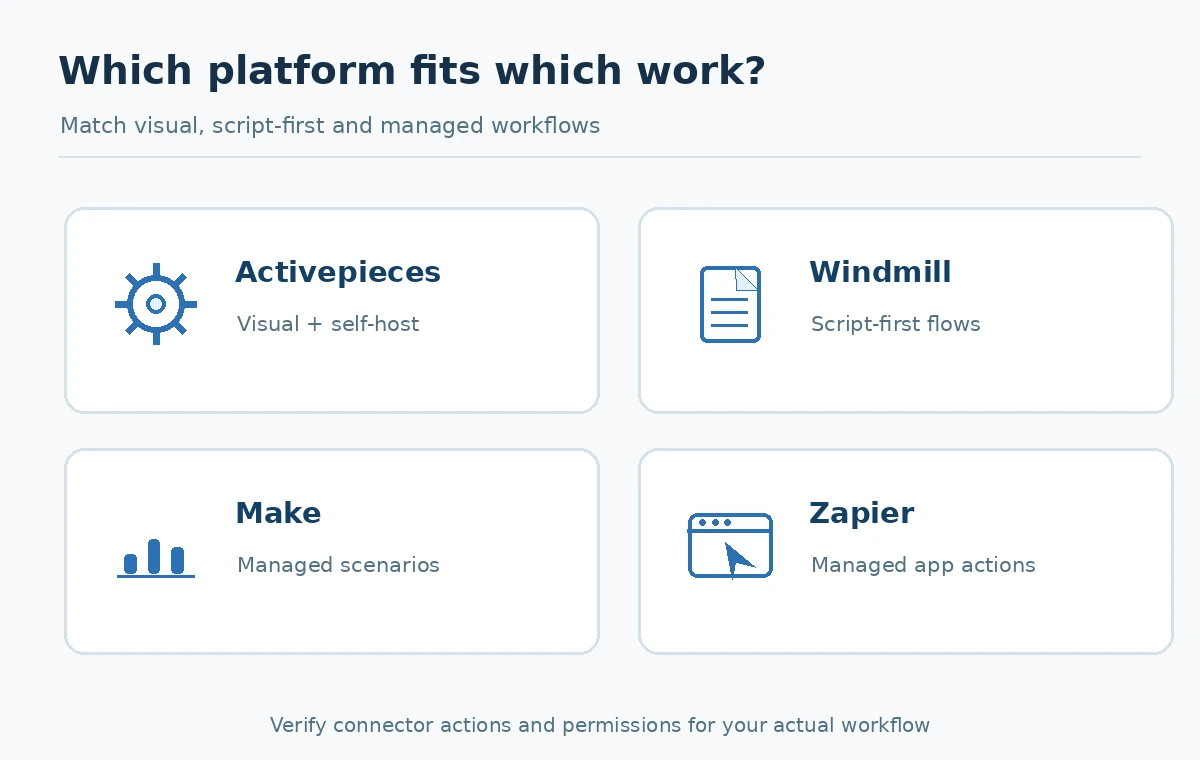
Activepieces is the closest option on this shortlist for a team that wants an approachable visual flow while retaining an option to run the software. Its official installation guide recommends Docker Compose with PostgreSQL and Redis for self-hosting; its cloud edition offers a managed route. Do not assume a simple local Docker example represents a production installation with backups, durable queues, monitoring, and upgrade controls.
The license documentation distinguishes MIT-licensed core code from commercially licensed enterprise features. Check required SSO, audit and organization controls against the exact edition, rather than declaring every feature open source. Test your three most important app actions and authentication refresh before migrating. A missing connector, or a connector that lacks one critical action, is more consequential than an attractive feature matrix.

Windmill: choose scripts and controlled execution
Windmill suits teams that already manage code and want scripts to become schedules, endpoints, flows, and internal tools. The official feature guide documents triggers, error handlers, retries, branches, loops, concurrency controls, and step-level approvals. That is useful when the business logic is easier to maintain as a reviewed function than as nested visual conditions. This does not make it a no-code swap for every n8n deployment.
In your pilot, implement a small typed function that returns a defined JSON object, then place it inside a flow with an explicit error branch. Check secrets handling, deployment permissions, source control and who can change production logic. If your operations manager needs to modify a CRM mapping without a developer, script-first architecture may create a new bottleneck. Include training and support ownership in the final decision.
Make: managed visual scenarios with credit accounting
Make removes most infrastructure administration and offers graphical routing for multi-step business automation. Its official credits explanation matters because it separates operations from billing credits: many standard actions consume one credit, while selected AI and advanced features can use dynamic credits. Treat a scenario with five ordinary modules differently from an AI module consuming variable tokens. Work with actual usage history where possible, not a guess based on a trigger count.
For the pilot, keep the same input schema, the same validation rules, and the same number of downstream writes as the n8n original. Record every module run, retries, polling behavior, and the credits consumed. If a migration requires twice as many operations, an apparently low starting subscription may not be cheaper. This option is strongest when business users need a sophisticated managed canvas and do not require self-hosting.
Zapier: broad managed connectivity and task simplicity
Zapier is often a reasonable choice when setup speed, common business app connections, and support by non-developers outrank hosting control. Its task guide says successful action steps count as tasks while triggers, filters, and paths generally do not. AI by Zapier and other features can have special task rates. You therefore need a step-by-step estimate instead of translating an n8n execution into one Zapier task.
Try your actual CRM create-or-update action and check whether a search action is billable in the chosen configuration. Then deliberately submit a duplicate source event: does the workflow create another record, stop, or update the first one? Do not migrate a sensitive workflow until the destination record ID, permissions, and error recovery are observable. Zapier may reduce server chores while increasing variable task costs at volume.
Use a comparison matrix based on constraints
Rate each candidate on five categories rather than giving a universal winner: deployment control, developer involvement, connector completeness, governance, and cost predictability. An example four-point scale is 0 = blocker, 1 = workaround, 2 = adequate, and 3 = strong fit. Give deployment and access control twice the weight if customer data is sensitive. Scores are your own evaluation judgments, not independent product ratings from LabFin.
For a self-host-first organization, test Activepieces and Windmill before managed-only systems. For an operations team seeking no server responsibilities, Make and Zapier deserve the first trials. For code-heavy queues and internal services, Windmill may be a closer conceptual fit. If your n8n setup already meets the important requirements, include staying on n8n as a fifth candidate: a migration with no concrete gain is usually difficult to justify.
Run the same migration acceptance test
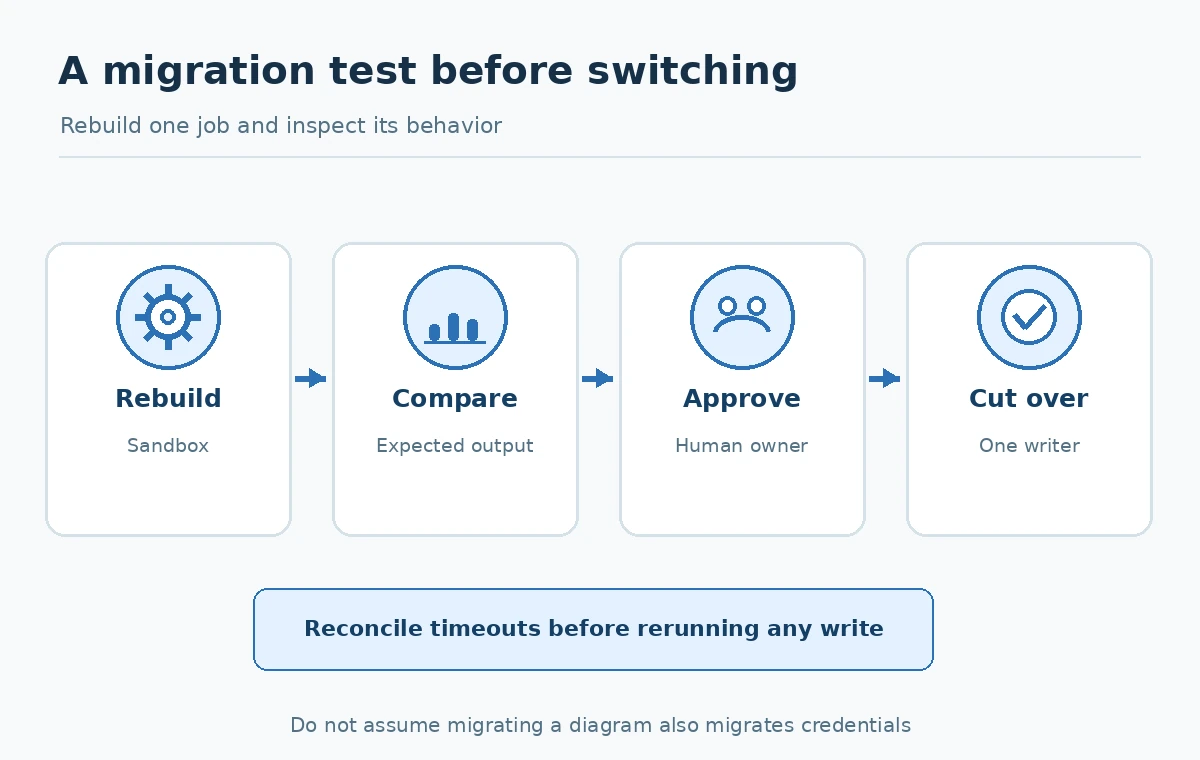
Create a worksheet with ten columns: input event ID, expected transformation, output schema, approval state, destination record, error behavior, duplicate behavior, permissions, elapsed execution, and recorded billing units. Use ten synthetic inputs including missing fields, invalid contact data, a second identical webhook, an unapproved write, and a timeout after an external action. Run the tests in sandbox accounts without real customer records or outbound messages.
A successful migration is not merely a green completion indicator. Check whether a human could explain an unexpected result and recover from it without corrupting customer data. Assign an owner to the new workflow, a rollback trigger, and a date to retire the original only after parallel results agree. Save the original workflow export and credential inventory separately; importing visual logic does not safely transfer secrets or grant equivalent connector permissions.
Estimate the whole monthly ownership cost
Build a cost sheet that includes subscription, usage units, cloud or server charges, paid connector/API tokens, engineering maintenance, failure review, and security oversight. Do not compare Make credits, Zapier tasks, and n8n executions as if they are identical units. Instead estimate each vendor separately from the pilot logs. An illustrative workload of 2,000 forms per month with two external writes still requires measuring how each platform handles searches, retries, and AI enrichments.
Finally, model a busy month and a failure month. Some runs will be retried, some will require manual review, and some API providers bill independently. Demand a cost explanation that another employee can reproduce from the run history. If one platform is cheaper in license fees but costs several extra hours of skilled maintenance each month, the apparent saving may disappear. Confirm current commercial terms on the vendor checkout pages before signing.
How We Research
We reviewed the linked vendor documentation on October 27, 2026: Activepieces installation, Activepieces license, Windmill architecture, Make credits, Zapier task accounting. This is source-based evaluation and an editorial decision framework, not a claim of paid hands-on testing, measured rankings, or real customer-account access. Proposed pilot worksheets and synthetic examples are instructions readers can execute; their outcomes have not been observed by LabFin. Editions, permissions, billing policies, availability and product interfaces can change, so recheck original product pages and account-level settings before deployment.
Frequently Asked Questions
No. It can replace many visual workflows, but connectors, triggers, feature entitlements, and recovery behavior must be checked for the actual flow.
Activepieces and Windmill document self-hosted routes. Review their licenses and production operating requirements before assuming the Community edition meets governance needs.
No universal answer is possible because Make credits and Zapier tasks measure different activities. Price your specific workflow with real run logs.
A safe strategy is to rebuild in sandbox, compare outputs in parallel, then cut over with one active writer and a rollback plan.
Keep it when the team can operate it reliably and there is no documented, material improvement in costs, capabilities, or maintainability.