
Ideogram pricing is more than a monthly subscription sticker. The practical cost depends on priority-credit use, access to slower generation, the need for private outputs, batch jobs and whether the work sits in a single creator account or a managed team. A price that looks inexpensive for occasional posters can become a poor fit if many iterations must finish on a deadline.
As checked against the official US pricing page on October 27, 2026, Ideogram lists Plus at $20 month-to-month or $15 per month when billed annually, and Pro at $60 month-to-month or $42 per month when billed annually. Verify the live checkout before paying; listed credits and some entitlement tables can differ across pricing-page views.
Compare Plus and Pro on the same billing basis
Plus is the lower-cost paid creator tier; Pro is the higher-volume tier. On the public pricing page reviewed, annual equivalents are $15 for Plus ($180 charged for the year) and $42 for Pro ($504 charged for the year). The monthly checkout alternative lists $20 and $60 respectively. Writing “$15 a month” without mentioning annual prepayment is misleading for a buyer who needs a one-month commitment.
To compare accurately, calculate total outlay over your expected term, including months you might not work. A short campaign may justify the higher month-to-month rate; a stable weekly design practice may benefit from the annual price. Cancellation, taxes and promotional offers should be checked on the account checkout.
Understand priority credits versus slow generation
Ideogram distinguishes priority credits from unlimited slower generations on qualifying paid tiers. Priority credits govern the speed of certain generations and can be more valuable than the raw image count when a client waits for several variations. The live pricing comparison currently advertises 2,400 monthly priority credits for Plus and 7,500 for Pro, but the exact credit-to-output conversion depends on the model and operation.
Do not divide an allocation by an invented universal cost per image. Keep separate columns for model, resolution, speed mode and task, then review the account’s current deduction before a batch. Slower access may be suitable for exploratory work, not a guaranteed substitute for priority capacity on deadline.
Decide whether privacy changes the purchase
If client concepts, unreleased branding or confidential campaign material are involved, verify whether generations are private on the plan you choose. The official Plus and Pro descriptions include private generation; free or pay-as-you-go access can carry different sharing or account behavior. Privacy in a user interface is not the same as a legal confidentiality agreement or a guarantee about every possible data use.
Use generic prompts when testing public tools. For client work, review the vendor’s current terms, retention and collaboration controls and make sure the team does not accidentally publish drafts through a community gallery. Store original brand assets only in approved locations.

Check what Team and Enterprise actually add
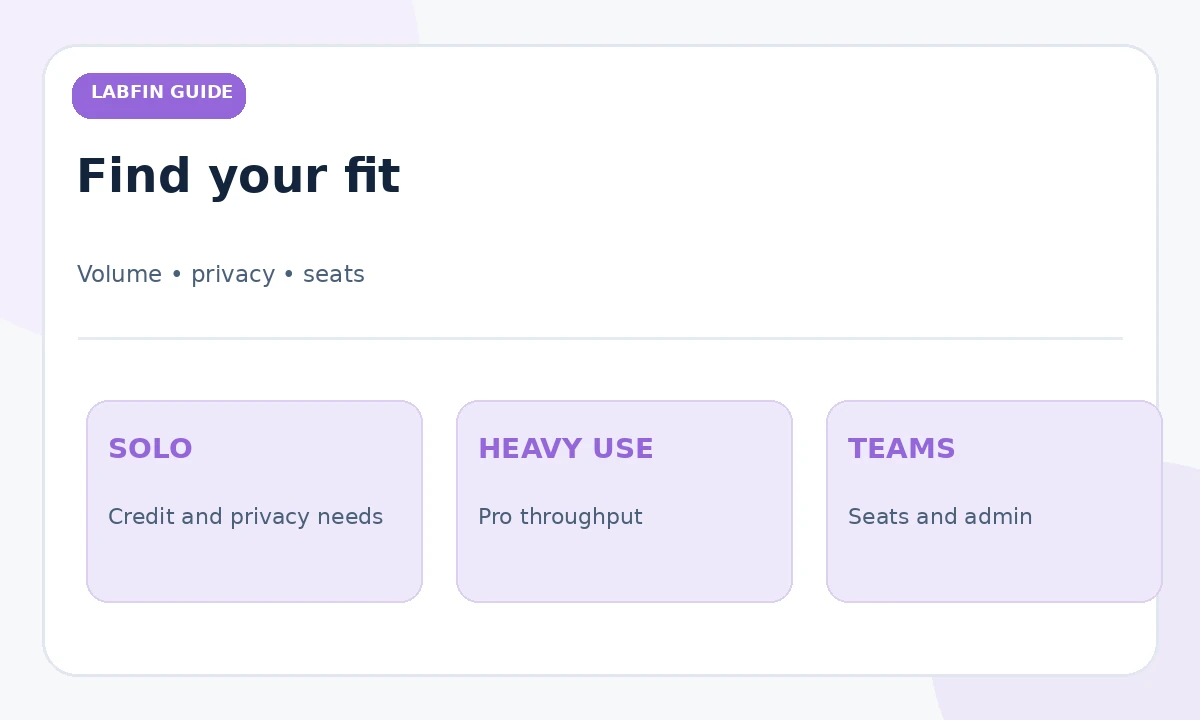
Team and Enterprise answer administrative needs rather than merely increasing the number of prompts. The public comparison lists a Team offering with seat-based billing and central administration, while Enterprise is quoted according to contract. A team that only needs an occasional graphic may not benefit from management features; a creative department with multiple people and billing owners might.
Ask who can buy credits, who owns generated assets, whether access persists after a teammate leaves, and whether separate personal accounts would become an operational liability. Verify license count, billing period and any admin controls on the specific team checkout, not from an individual Plus screenshot.
Separate application subscriptions from API use
Ideogram publishes API pricing independently of application plans. The official table shows model-dependent per-image charges and additional choices for edits, reframes and resolution. Purchasing a web subscription should not be treated as proof that external API calls are covered by the same monthly credits or that commercial automation carries no additional charges.
For an integration, model an expected monthly run as requests multiplied by the published rate for each endpoint. Add retries, rejected drafts and data-transfer or hosting costs from your own stack. Put the model version and the date of the price check in the estimate, because the API catalogue changes.
Budget a poster workflow before choosing a tier
Imagine a small business planning one event poster with six headline variants, three aspect ratios and manual cleanup. Those numbers define an editorial scenario, not a tested Ideogram consumption rate. Create a row for each distinct generation and edit operation, record its actual credit debit in your account, then see whether slow generations could absorb nonurgent exploration.
The cost of a design is not simply a subscription divided by the number of finished posters. Account for the review of spelling, legal claims, brand colors and print bleed. If a poster requires frequent typography corrections, saving time on retries can be more important than the cheapest nominal plan.

Know when to upgrade, downgrade or wait
Upgrade when consistent queues or privacy requirements, rather than curiosity about a higher label, are holding up projects. If most of your work consists of nonurgent drafts and you have unused priority credits, first tighten prompts and the review process. A higher tier can increase throughput without increasing accuracy of the headline or guaranteeing a better client-approved image.
Review usage in a typical four-week window: priority credits spent, slow generations completed, batch operations needed, private jobs, and seats actually used. If that evidence is missing, choose a reversible monthly experiment rather than committing to a yearly plan based on an assumed perfect-output rate.
Compare total ownership cost against alternatives
Ideogram is especially relevant when rendered text is a central part of an image. Compare it with Firefly or Canva by asking how many manual typography fixes, exports and revisions each workflow requires. The tools have different strengths, controls and bundled features; a direct dollar-per-image table without comparable deliverables is not a fair decision aid.
Run the same approved mock brief through trial access where permitted, then manually inspect the exact lettering, margins, cropping and file usability. LabFin has not performed a head-to-head generation benchmark here, so this is an evaluation checklist rather than an asserted quality ranking.
Watch pricing-page and renewal differences
Subscription screens may show yearly equivalents, monthly charges, model credits and team costs in different tabs. The official Ideogram site has shown differing priority-credit counts across page variants, so an archived screenshot should not be your final procurement document. For an expense request, preserve the current checkout summary that identifies region, tax, renewal term and credits.
Prices in this article are dated to the October 27, 2026 research check. Before authorizing an annual commitment, confirm whether credits renew, how top-ups are billed, whether unused allocations carry over, and which operations consume them. Treat all figures as current vendor offers, not permanent promises.
How We Research
We checked Ideogram’s published US subscription and API page and its Canvas documentation on October 27, 2026. We compared annual and monthly wording separately and note inconsistent credit figures visible on different official pricing views. We did not purchase plans or benchmark credits spent per completed poster. Consult the live account checkout for binding totals. Primary sources: Ideogram official plans and API table; Ideogram Canvas documentation.
Frequently Asked Questions
The official US pricing page lists Plus at $20 month-to-month, or an annual equivalent of $15 per month with $180 charged annually.
Pro is listed at an annual equivalent of $42 per month, billed $504 for the year; the monthly alternative is shown as $60.
No. Credits are consumed at rates that vary with the model, resolution, speed and operation. Check the current deduction for your chosen workflow.
Do not assume so. The public site separately lists application subscription benefits and API per-image or endpoint pricing.
Choose based on private generation, usage volume, shared billing and controls. Verify Team or Enterprise entitlements and actual seat costs at checkout.