
A community archive is digitizing a 1980s neighborhood film. The end credits contain names, a sponsor acknowledgment, and a handwritten-looking rights notice that does not appear in the catalog. Google Cloud Video Intelligence Text Detection can locate visible words in frames and return time and location information. That makes it a useful review aid, not a catalog authority. This hypothetical workflow shows how an archivist could retrieve candidate text, inspect the underlying frames, and record only credits that can actually be corroborated.
Start with a specific catalog question
Decide whether the task is finding the credit sequence, matching an existing donor index, or identifying possible reproduction restrictions. Those questions should not be collapsed into a single OCR accuracy score. If an end card says ‘Filmed by L. Green’ and a separate paper ledger says ‘L. Greene,’ the archive should preserve the disagreement rather than silently choosing the spelling most convenient for search.
Set a narrow intake boundary: use a film that the organization is authorized to process, store a stable source identifier, and note its scan version, duration, frame rate, and any editorial cuts. A newly encoded copy may contain different timestamps from an earlier transfer. Keep the timebase and the file hash attached to every later OCR finding so a reviewer can reopen the right master rather than a deceptively similar web preview.
Know what Video Intelligence actually detects
Google describes Text Detection as optical character recognition for visible text in a video or its segments. The service returns recognized text with spatial and time information; it is designed for screen content such as titles, credits, and burnt-in subtitles. For API annotation, request the TEXT_DETECTION feature. It does not listen to spoken credits, infer a producer’s identity, or determine ownership from a title card.
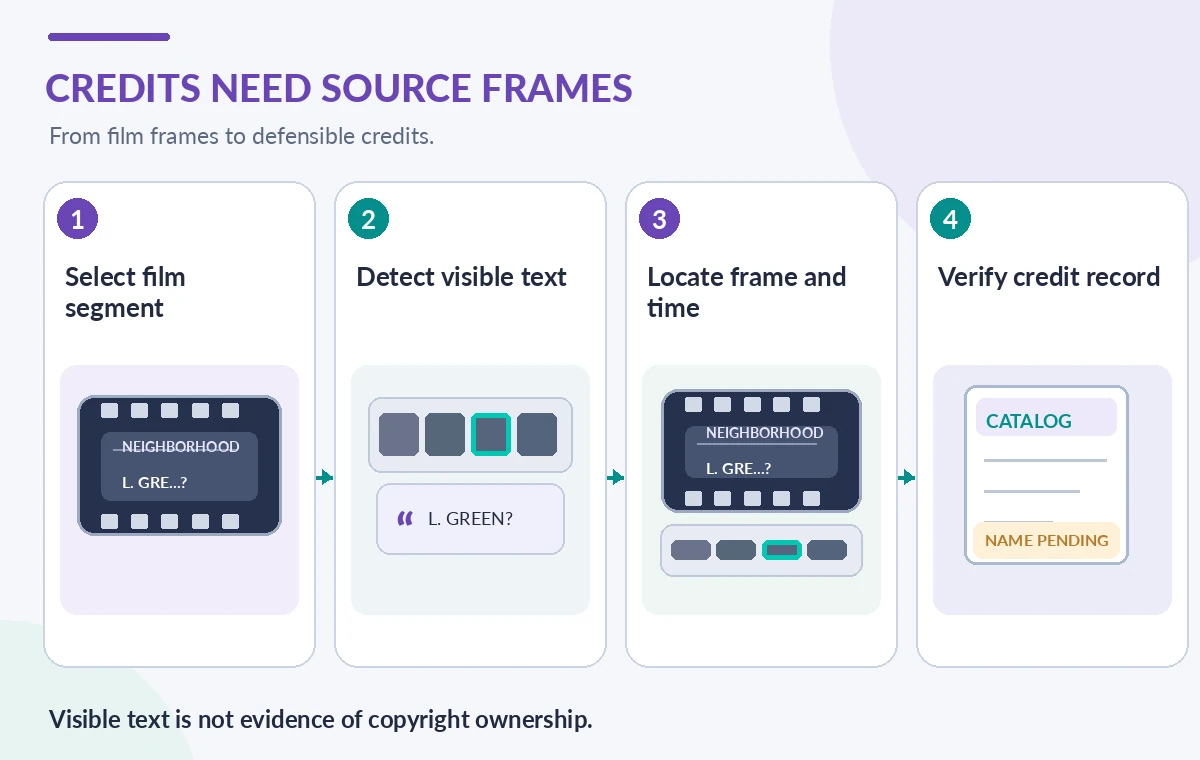
An OCR candidate can be wrong because lettering is small, a frame is blurred, a logo resembles a word, or a fade spans several frames. Treat the returned text and its associated locations as navigation hints. The response does not state that a copyright notice is authentic or that every occurrence of a phrase is present. The same words may be shown multiple times and on different shots, so retain the associated segment and timing details.
Prepare a reproducible test clip
Begin with a short copy of a legitimately held film containing an opening title, a scrolling credit, and at least one frame without text. A Cloud Storage input can be supplied using the documented video annotation workflow. Record the Cloud Storage object generation, the requested features, and how segments were selected. Protect source files with the same access rules used for archival media, including an approved retention plan for service outputs.
Add an intentionally difficult sample such as white credits over a moving background and an intertitle with faded handwriting. Before using a service, make a small manual reference sheet with expected words and frame positions. Do not treat that sheet as a live benchmark or imply LabFin ran this workflow. Its purpose is to show what a curator would need to compare after the actual service response becomes available in an institutional test.
Turn detected text into a time-coded review queue
For each candidate, display the recognized string, associated interval, thumbnail reference, and file version in one row. Combine overlapping detections only after checking that they belong to the same visible card; otherwise an opening title and an ending credit may accidentally become one catalog field. Preserve original capitalization when it affects names, acronyms, or historical spelling, and store any editorial correction in a separate field.
Make the review interface jump to a little context before and after the reported text. A single cropped frame can hide a fade, a second line of credit, or a disclaimer that changes meaning. The archivist should be able to compare a candidate against adjacent frames at normal size and confirm whether the words are still legible in the source. No invented confidence threshold should substitute for this inspection.
Compare the frame, OCR, and catalog record
An illustrative three-state diagram is useful: original film frame containing a partly obscured credit; a machine-suggested text segment on a timeline; and a staff-reviewed catalog entry with the original frame reference. The reviewed entry is not simply a cleaned-up transcription. It should say what was directly visible, what was found in a second source, and what remains uncertain. A cropped image labeled ‘Green’ must not silently become ‘Greene’ without evidence.
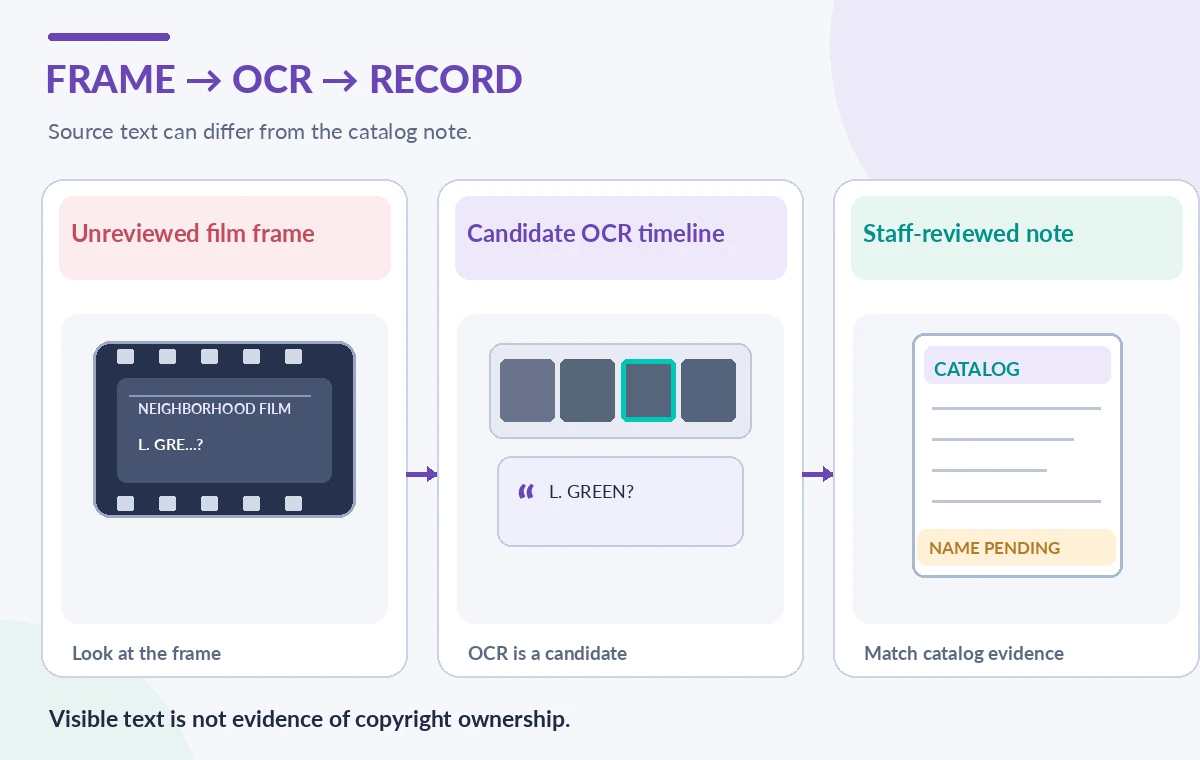
Distinguish visible captions from voice narration and from metadata entered by a distributor. OCR cannot establish whether an actor was the copyright holder, whether the credit is complete, or whether modern digitization requires additional consent. A visually correct transcription can coexist with a disputed rights statement. Keep a separate ‘rights review pending’ state even when the OCR candidate is accepted as accurately read.
Keep the rights and privacy questions separate
A film may show addresses, full names of minors, or other personal details that are legible in a frame. The fact that a name appears in credits does not establish permission to index it publicly. In a controlled archive, restrict the OCR output to the same authorized staff who can see the underlying film until retention and privacy policies are reviewed. Avoid feeding unlicensed or private collections to an external service without institutional authorization.
For a possible rights notice, document the frame wording as a quotation with its precise location and flag it for a person trained in collection permissions. Do not turn ‘Copyright 1984’ into a claim that the named organization still owns the work. Ownership chains, agreements, deposit conditions, and applicable law need their own evidence. OCR is a finding mechanism, not legal clearance or public-release approval.
Evaluate the failure cases that matter
Use a small human-labeled reference covering rolling credits, superimposed text, all-caps names, punctuation, multilingual signs, and deliberately blank intervals. Inspect missed credit lines, false words invented from background texture, incorrect timestamps, and merged names. Track errors by type rather than advertising a single recognition percentage. The most damaging failure may be omitting a rights notice, even if nearly every other title was read correctly.
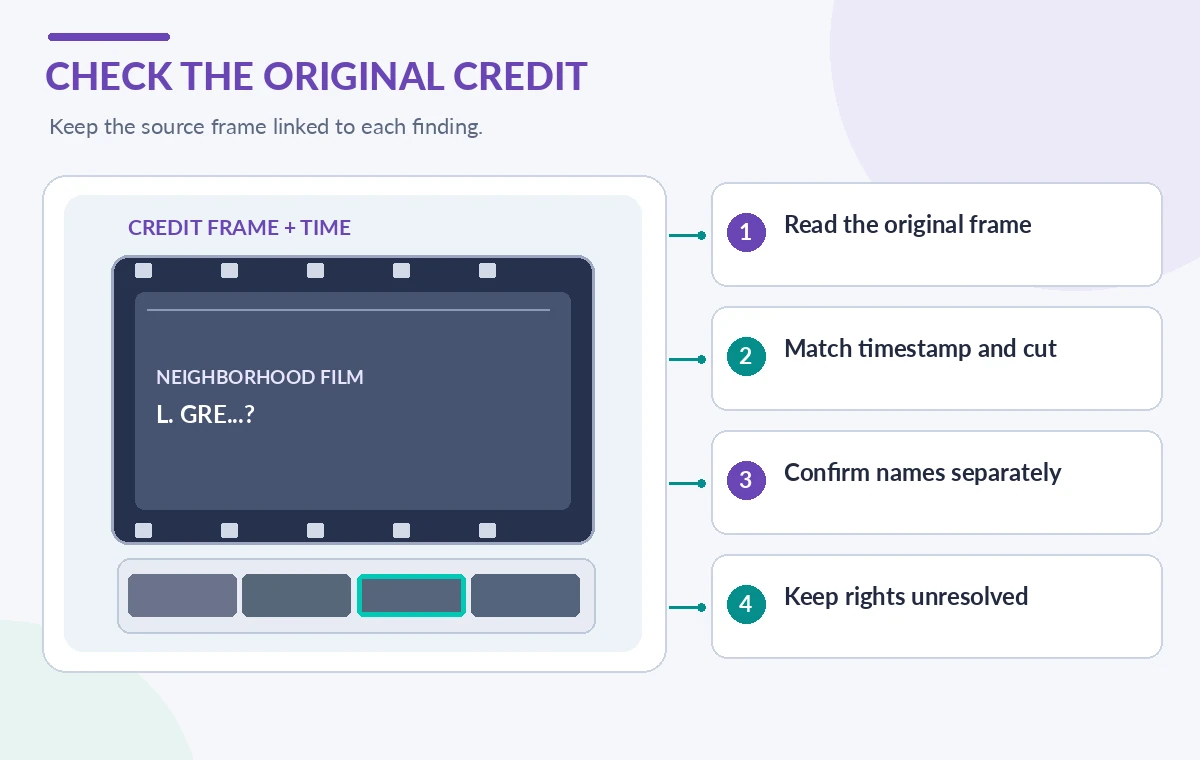
Ask two reviewers to reconcile disagreements using the exact archived source frames. A source-frame link should remain valid if the film is recut or re-encoded; version the time map when a new derivative replaces the current one. If a needed frame is not available or legible, retain ‘unverified’ rather than inferring a name from nearby cards. The archive’s credibility depends on preserving uncertainty as evidence.
Publish a traceable finding, not a guessed credit
A usable catalog note contains the transcription status, a stable film identifier, a cited interval, a reviewer, and an explanation for any spelling correction. Search indexes can include both the observed text and an authorized normalized form if they are clearly distinguished. Avoid exposing private note fields through public metadata feeds. Build a staff correction path for film owners or contributors who provide additional documentary evidence.
Before publishing or licensing any segment, recheck the actual frame and independent rights records. Text Detection helps staff locate and organize visible material; it cannot decide historical identity, provenance, accuracy, or permission. A good outcome is a shorter, reproducible review trail with more explicit human decisions, not a guarantee that an archive film is safe to distribute.
How We Research
For our November 2026 editorial review, we consulted the named official developer sources: Google Video Intelligence text detection overview; Google Video Intelligence text detection examples. We compared documented feature scope, parameters, supported inputs, workflow boundaries and important failure cases with a hypothetical, nonproduction museum or library scenario. We did not run paid API calls, access personal visitor records, independently benchmark model quality, conduct a real deployment, capture vendor interface screenshots or verify a particular institution’s permissions. All figures are original conceptual instructional drawings, not live results. Readers should verify current documentation, plan limits, regional availability, prices and applicable data policies before a trial.
Frequently Asked Questions
No. It identifies text visible in video frames, not spoken audio. Speech transcription is a separate task.
Google documents location and timing information associated with visible text, which reviewers can use to inspect source frames.
No. Names, punctuation and faint lettering require checking against frames and independent catalog evidence.
No. The existence or wording of a notice is distinct from current rights ownership and permissions.
Keep an unresolved transcription status and avoid inventing or silently normalizing a credit.