
Why a retry policy is more than a delay
A museum uses Cloud Tasks to pass event registrations into a membership system. During a brief outage, the receiver returns a failure code; a repeated delivery can be valuable because it avoids losing a registration. But an aggressive queue can also flood the receiver, cause duplicate welcome emails, or extend an outage. RetryConfig defines when a failed task may be attempted again. It cannot prove whether an earlier attempt already wrote the registration before a network connection broke. Design two layers together: bounded delivery retries at the task queue and an idempotent write in the RSVP database. The goal is a reconciled event record with a visible failure path, not the highest possible number of attempts.
Read all five RetryConfig controls together
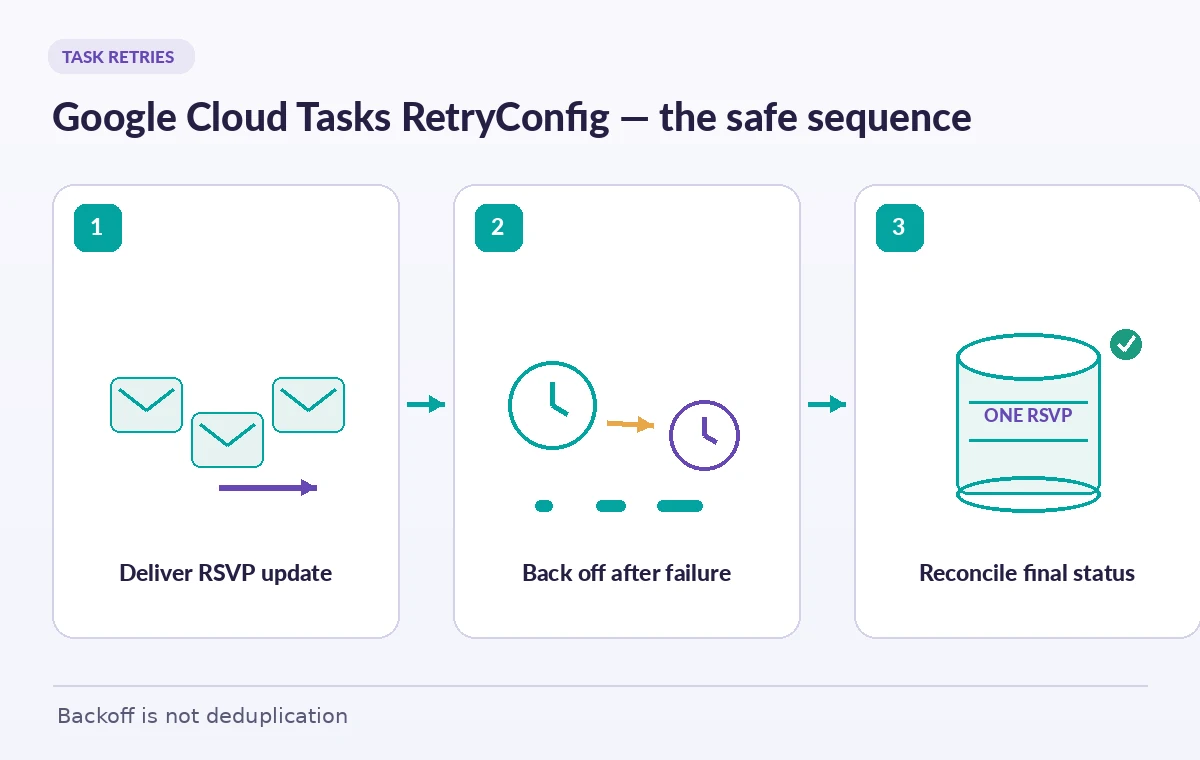
Cloud Tasks documents maxAttempts, maxRetryDuration, minBackoff, maxBackoff and maxDoublings. maxAttempts includes the initial attempt; maxRetryDuration measures retry time from the first attempt. Backoff intervals begin near minBackoff, double a configured number of times, then grow linearly until capped by maxBackoff. For example, the documentation illustrates 10, 20, 40, 80 and later bounded intervals under a particular configuration. Those numbers explain a mechanism, not a recommended museum setting. The retry policy interacts with task retention and delivery deadlines, and the receiver’s response code determines whether Cloud Tasks considers an attempt successful. Review queue-level defaults before assuming every task follows a local sample.
Set an operational budget for the RSVP window
Classify errors by whether they are transient. A short network interruption, temporary rate limit or receiver outage can justify retrying. A malformed event, an invalid registration identifier or a revoked credential needs intervention instead of more identical attempts. Choose the attempt and time boundaries in light of ticket deadlines, member expectations, backend capacity and how quickly a supervisor can reconcile a failed task. A hypothetical policy could allow a handful of retries across a limited window, but the organization must test how these settings interact with its actual traffic. Document the owner who can change the queue policy and how a pause, emergency rate reduction or configuration rollback will be handled.
Avoid the trap of counting two independent caps
A subtle detail matters when reasoning about maxAttempts and maxRetryDuration. Google documents that retries cease when the configured attempt and duration conditions are both satisfied, or the task succeeds; a task also remains subject to maximum retention. Do not paraphrase this as an unconditional stop at whichever limit is reached first. Confirm your exact API surface and effective queue configuration, including whether any task-level retry settings are present. Record the delivery attempt number and timestamps in a test log to see the actual schedule rather than trusting a diagrammatic stopwatch. Even an unlimited setting remains bounded by the service’s retention rules, and unlimited attempts plus unlimited duration is inappropriate for an unresolved consent or payment problem.
Make the receiving endpoint idempotent
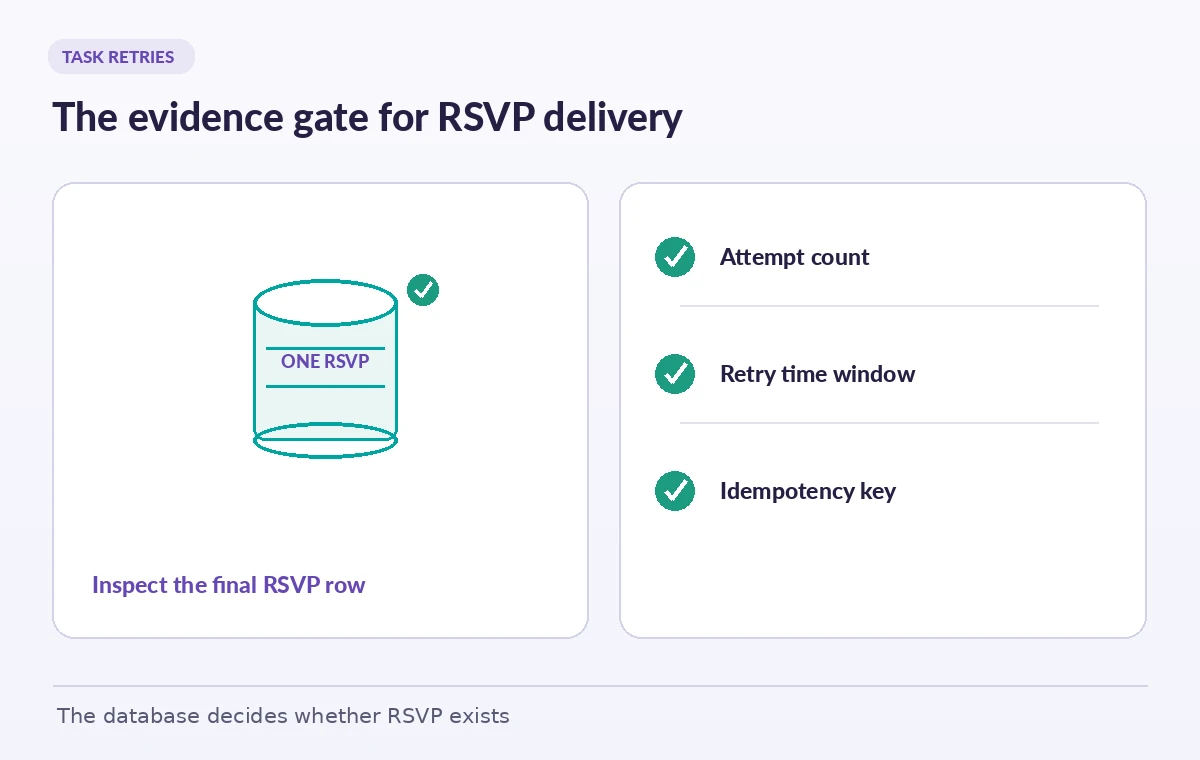
Give each registration event a stable identifier issued upstream. The receiver should check whether that event has already been committed before sending another email, reserving another seat or charging a donor. Use a database uniqueness constraint or conditional transaction so two concurrent attempts cannot both create the side effect. Record the original result and return a suitable success response when a duplicate represents a previously completed operation. Do not use a fresh timestamp as the idempotency key, because that makes every attempt appear unique. Keep event identifiers separate from names and other sensitive registration details, and guard the reconciliation endpoint with authentication. Delivery retries are at-least-once behavior from the application’s perspective.
Separate retry backoff from dispatch capacity
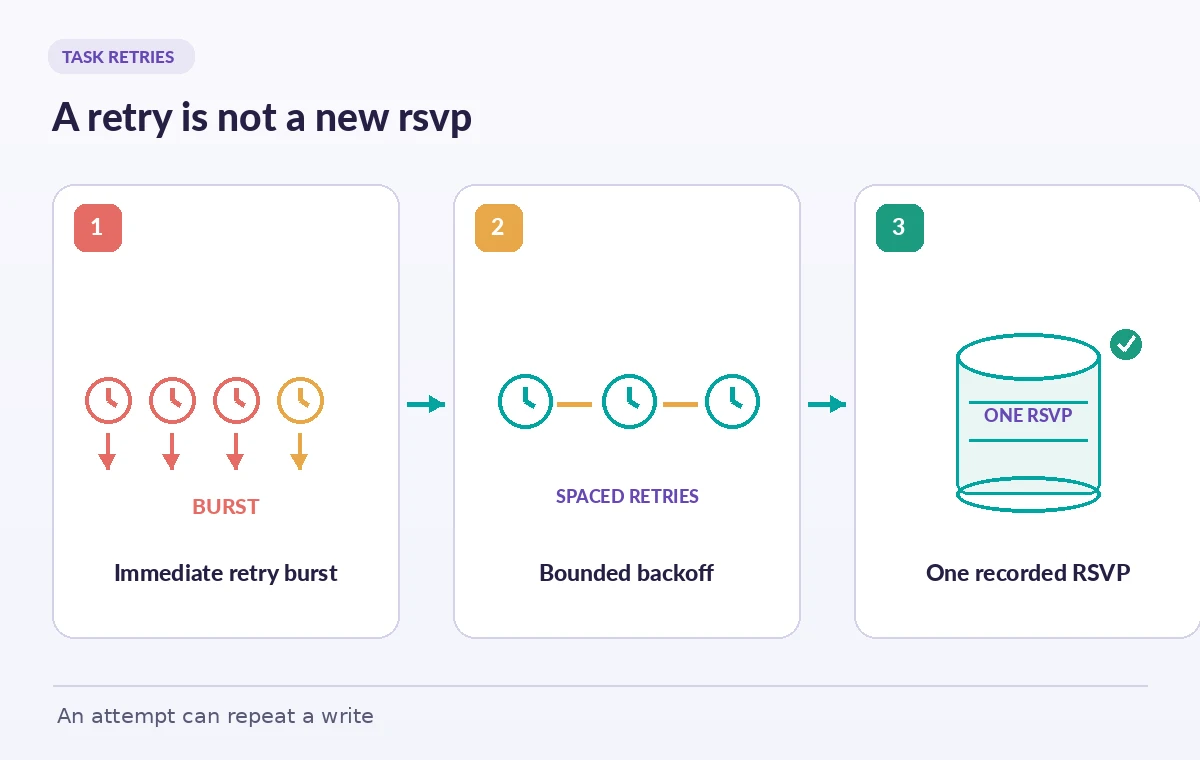
Queue rate limits control the overall pace of task delivery, while RetryConfig controls reattempt scheduling for failed tasks. A queue may respect its backoff policy yet still overload a downstream service when many tasks become eligible together, particularly after an incident. Observe concurrent dispatches, timeouts and the proportion of tasks whose receiver completed work before returning an error. The earlier LabFin topics on queue rate limits and dispatchDeadline address different controls; neither substitutes for the retry budget. Treat an HTTP timeout as an ambiguous result until the destination database is checked. A worker that completes a write but loses its response creates the most important duplicate case for testing.
Test ordinary errors and ambiguous completion
Create a synthetic registration, never a real attendee record, and simulate four outcomes: a clean success, an explicit temporary failure, a permanent schema rejection and a write followed by a lost acknowledgment. For each, inspect the attempts, the receiver’s stable event ID and the final RSVP row. The lost-acknowledgment case should produce another delivery attempt but not another registered guest. Check that permanent failures enter a visible operations queue instead of disappearing silently after the final retry. The diagram depicts three deliberately different stages: failed delivery, scheduled delay, and database reconciliation. It is a workflow illustration, not evidence of measured Google Cloud timing in a live account.
Keep an audit trail when retries stop
A task that is no longer retried is not automatically a resolved RSVP. Record the failure class, last attempted time, stable registration ID and the person assigned to reconcile it. Avoid placing full attendee data in unrestricted logs. Where the platform eventually removes a task, the application needs its own durable failure ledger if the museum has recordkeeping obligations. Reconciliation should compare the incoming event, RSVP database, outbound email record and any capacity reservation as separate facts. If the guest was registered but the confirmation failed, send a verified replacement message rather than replaying the entire registration operation. If the guest was never registered, resolve the input problem before creating a new task.
Publish a clear retry ownership rule
A reliable acceptance checklist names who can edit RetryConfig, what monitoring should alert them, how long the team tolerates missed confirmations and which errors require manual handling. Record effective config values at rollout and during an incident so the postmortem does not depend on a remembered default. Re-test after the ticketing schema, receiver service or event schedule changes. Most importantly, do not promise exactly-once delivery from Cloud Tasks itself. Promise the controllable part: unique database writes, bounded retries, understandable exception reports and a confirmed guest-facing outcome. When the receiver is unhealthy, a transparent delayed-status message is better than repeated emails that imply contradictory registration states.
How We Research
For this guide, we consulted the original provider documentation: Cloud Tasks RetryConfig reference; Google Cloud queue configuration guide; Cloud Tasks retry parameters guide. We compared the formal RetryConfig field definitions, documented delay sequence and queue configuration behavior, paying attention to the combined duration and attempt conditions. We separated service retry scheduling from the application database guarantees needed to prevent duplicate RSVP writes. No live attendee data or measured outage behavior was used; readers must rehearse the policy with synthetic events. We verified the terminology as documented rather than inventing product tests or production measurements. Recheck the effective API, organization policy and workflow settings before deploying this design.
Frequently Asked Questions
Yes. It counts the initial attempt as well as later retries, so maxAttempts is not the number of extra retries alone.
Google documents that the attempts and duration conditions both matter to retry termination, subject to retention and success. Check the active configuration rather than assuming a first-limit-wins rule.
No. Use a stable event ID and an idempotent database operation because a receiver may commit the update before its acknowledgment is lost.
No. Backoff schedules failed attempts; rate and concurrency limits constrain broader queue dispatch. Configure and observe both.
The application needs a durable reconciliation record and an assigned operator. A task disappearing from the queue is not evidence that the guest was registered.