
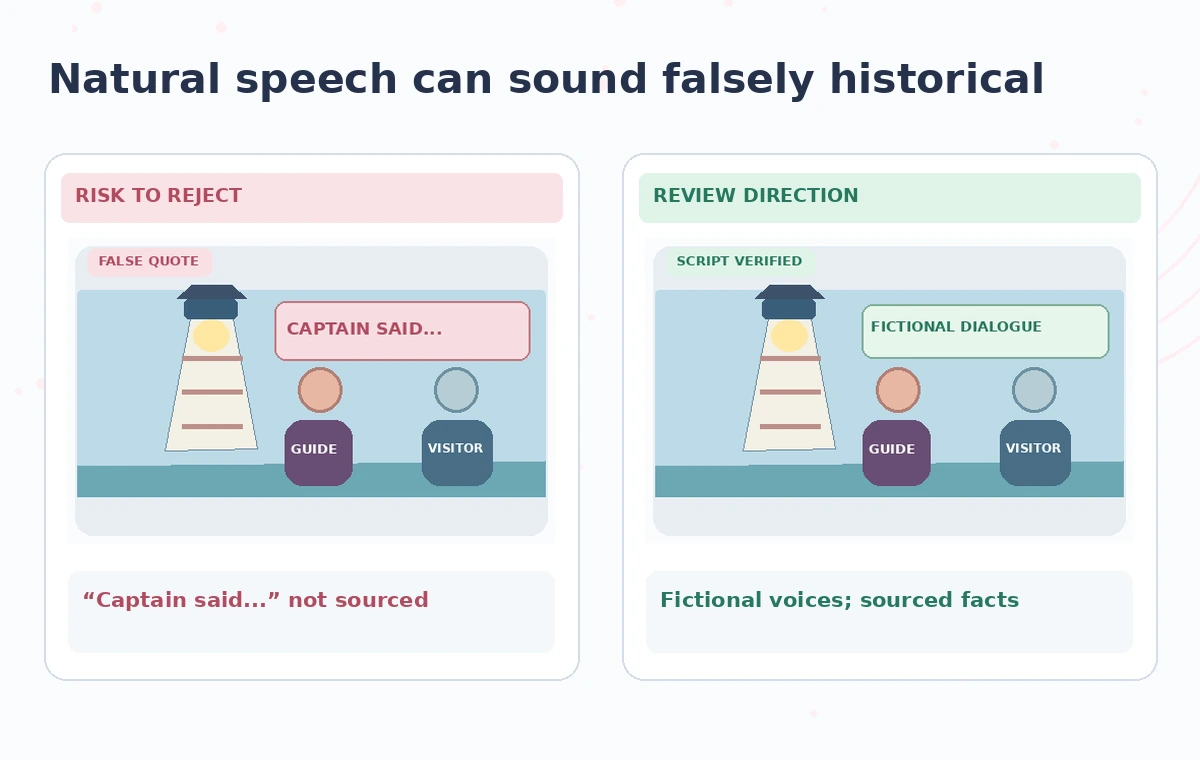
A small coastal museum wants a lively audio station in which a fictional visitor asks a fictional lighthouse guide about a beacon. Synthetic dialogue could turn a dry explanation into a scene, but a line introduced as a genuine captain’s quote would create false historical evidence. The names, imagined voices, and timing below are script examples; they are not recovered voices or quotations from the lighthouse archive.
ElevenLabs documents Text to Dialogue as a multi-speaker generation capability and Dialogue mode as a way to handle changing tone and interruptions. The service can render dialogue from text and selected voices. It cannot determine whether a historical line is authentic. This guide puts provenance, rights, and a museum historian’s approval ahead of expressiveness, and it does not claim to have generated or listened to audio in a live account.
Draw a line between facts and dramatic invention
Create two lists before writing: verified facts from the exhibit archive and fictional connective dialogue that helps visitors follow them. Use generic speaker labels such as Guide and Visitor rather than inventing a historical person’s voice.
A safe scene might have the Visitor ask what a beacon does, followed by the Guide explaining the documented purpose in original language. Avoid a quotation such as “The captain declared…” unless that statement is actually in a cited source. If the museum wants archival quotations, show the reference on the exhibit page and keep invented dramatization distinct in narration and captions.
Write short turns that survive spoken playback
Prepare a script with one fact or question per turn. ElevenLabs documents that Text to Dialogue assigns text and a voice to each dialogue turn and can interpret contextual cues such as punctuation, emotion, and delivery tags. A scripted interruption can sound natural but may hide an essential caveat if the following character speaks too soon.
Read the full script aloud before generation and check ambiguous pronouns, dates, measurements, and place names. Shorter, clearly attributed turns are simpler to review than a single energetic exchange packed with historical details. Use a source note for each factual sentence.

Select authorized fictional voices and boundaries
Choose synthetic voices you are permitted to use, not an imitation of a real guide, actor, or recorded maritime worker. A fictional narrator and visitor can sound distinctive without relying on a recognizable person. The official documentation describes voice libraries, design, and cloning options, but permission to create a voice is not permission to impersonate someone.
Keep an approval record for voice choice, intended audience, script rights, and distribution. If a local community member will narrate instead, obtain their informed permission and keep their recording separate from the AI demo. Avoid suggestive titles like “authentic survivor recording” for entirely fabricated audio.
Generate one approved scene at a time
ElevenLabs describes Text to Dialogue through its supported models and its API, where dialogue requests contain text and voice identifiers. The product documentation advises keeping reliable request lengths manageable, and generation is not perfectly deterministic. For a museum station, create short scenes from signed-off paragraphs instead of regenerating the entire tour whenever one line changes.
Use a clear naming scheme for script revisions, and save the exact text submitted for each candidate. The illustrated process compares approved turns, a candidate containing a fabricated quotation, and the reviewed scene with fictional attribution. It does not represent a real audio export.
Review speaker attribution and invented quotations
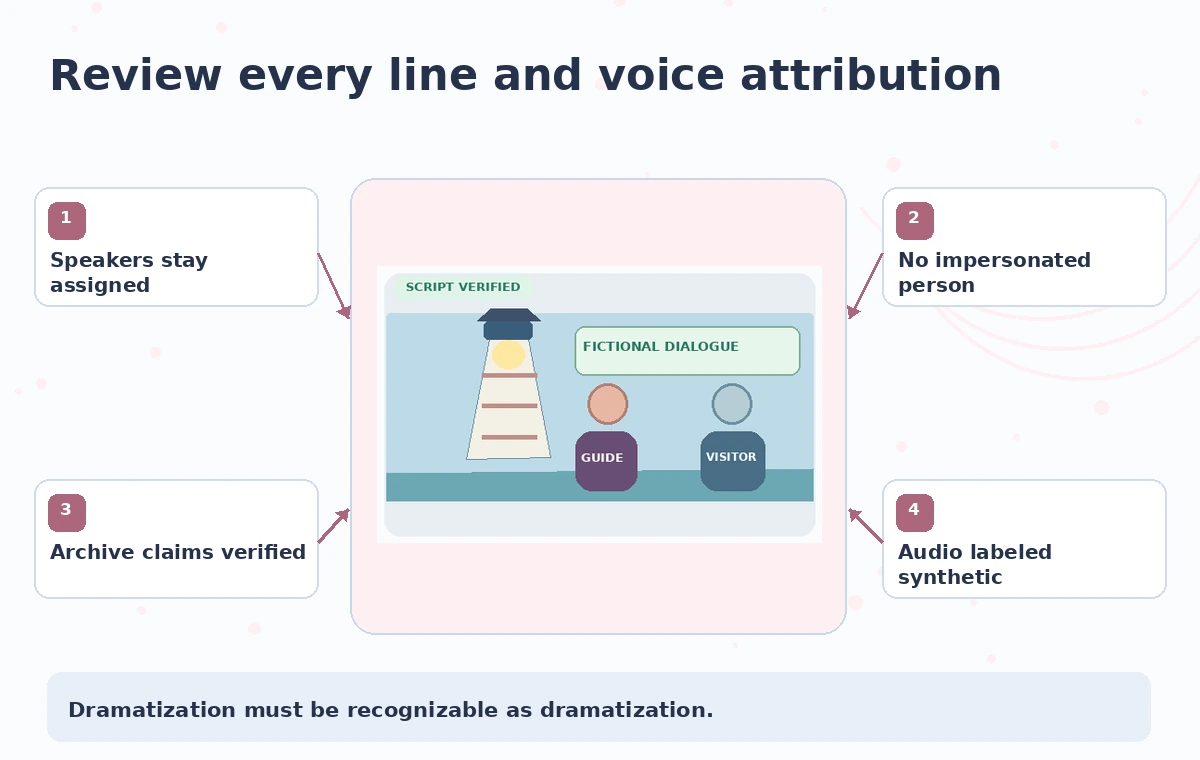
Listen to every candidate against the printed script with the exhibit specialist. Check that the Guide and Visitor never swap the facts, that a question is not rendered as a confident statement, and that no rhetorical line sounds like a primary-source quote. Emotional cues can shift emphasis; a surprised delivery may turn an uncertain date into a dramatic claim.
For the cautionary example, “Captain’s final words…” is prohibited because the script has no archival support. The safer version labels the exchange as fictional and states only a verified general explanation. Replace the sentence or regenerate the turn, not just its subtitle.
Treat ambience and audio tags as sound design
ElevenLabs documents optional audio effects and per-turn audio tags for expressive delivery, including laughter or whispers; these effects do not make the scene an authentic field recording. A lighthouse bell, wind bed, or echo may be atmospheric, but should never be presented as a recovered sound from a dated voyage.
Check that effects do not obscure a quiet fact, and mix for the actual speaker system or headphones. Include a text transcript and make it clear which sound effects are synthetic. Audio effect options and model behaviors can change, so check the current interface and documentation before committing to a design.
Review accessibility, licensing, and public labels
Provide an accessible transcript with Guide and Visitor names and flag the dramatization in the exhibit description. Use punctuation and line breaks that work for captions and translation. Verify the current service plan’s commercial-use permissions: ElevenLabs states that commercial rights depend on a paid plan and rights to the input material.
Do not assume generated voice output licenses historical text or third-party recordings. Make sure the station can be paused or replayed and that the surrounding display offers a source list for actual dates and equipment. A visitor should be able to enjoy the dramatization without mistaking it for original archival testimony.
Archive the script and audition the final installation
Keep the source references, approved script, voice permissions, generation date, final audio, captions, and reviewer notes. After the sound is placed in the gallery, listen to the whole presentation at realistic volume while reading the display.
Confirm that a caption does not attribute the Visitor’s invented question to a historic figure, and that sound design does not create a false provenance claim. If the museum later discovers a conflicting record, update the factual line and regenerate only the affected turn. The ethical success criterion is a clearly fictional exchange that accurately guides visitors to verifiable history.
How We Research
We prepared this guide on November 4, 2026 using named official documentation: ElevenLabs: Text to Dialogue; ElevenLabs: What is Dialogue mode?; ElevenLabs: Create dialogue API. We checked the feature description, documented controls and edition requirements, and how the tool may be misunderstood in the specific scenario. We did not run a live account, upload real customer assets, measure outputs, or produce service screenshots. The images are original instructional art; each failure is a hypothetical risk, not a claim that the developer produced that result. Access, labels, model behavior, licensing and billing may change. A human reviewer must confirm any factual claim, rights, and the final result against independent source material before publication.
Frequently Asked Questions
Yes. The documented feature accepts turns with text and voice identifiers and supports multi-speaker dialogue.
No. Authenticity depends on independent archives, not the naturalness of synthetic delivery.
Do not recreate a real person’s voice without appropriate rights and explicit permission; use authorized fictional voices.
The documentation describes delivery and event tags, with model-dependent results that need listening review.
No. They are instructional figures and hypothetical lines, not outputs measured or heard from ElevenLabs.