
A library information kiosk answers questions about opening hours and accessible entrances. If its primary language model times out, using a fallback model can keep the interface responsive. But a backup model cannot make outdated hours current, and a successful API response is not proof that the library is open. Cloudflare AI Gateway dynamic routing supports versioned flows, conditions, models, and fallbacks. This guide sketches a fictional kiosk design using documented features rather than a tested Cloudflare configuration.
Separate verified facts from the response model
Make two components explicit. A trusted library data service holds reviewed hours, closure notices, accessibility instructions, and the last verified update time. The language model presents those facts in understandable wording. When a provider fails, the kiosk may change the model that formats an answer; it must not replace the source of truth with improvised details. If the trusted record is missing, the correct response is uncertainty.
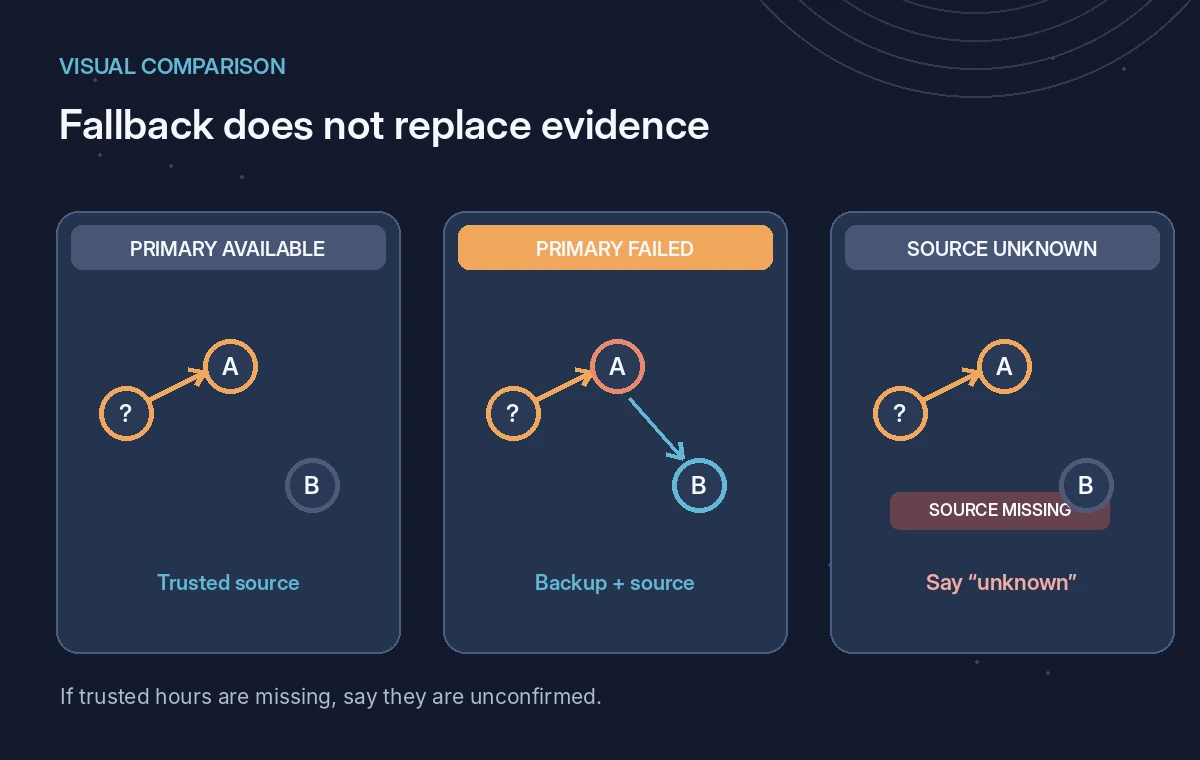
Use a scenario such as “Is the east entrance open Saturday?” The kiosk should require a current approved notice before answering yes. If that notice is absent, both the primary and fallback models should say they cannot confirm. A helpful system can point to the official library page or staffed contact, but it should never infer building access from past conversation alone.
Understand dynamic route components and scope
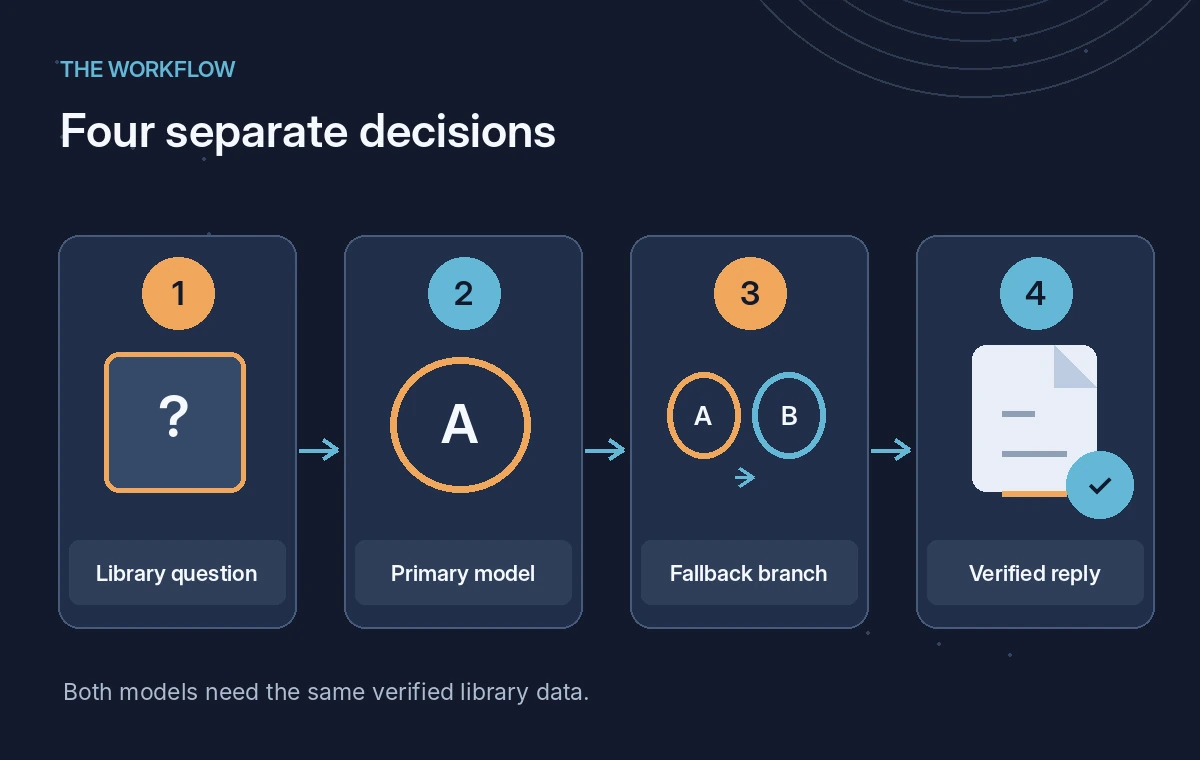
Cloudflare documents dynamic routing as named, versioned flows configured in a visual editor or JSON. Flows can contain start, conditional, percentage-split, model, rate-limit, budget-limit, and end elements. A model node invokes a configured provider; fallback paths can handle a problem or a quota boundary. Treat a route change as a deployed configuration revision, not an invisible prompt edit.
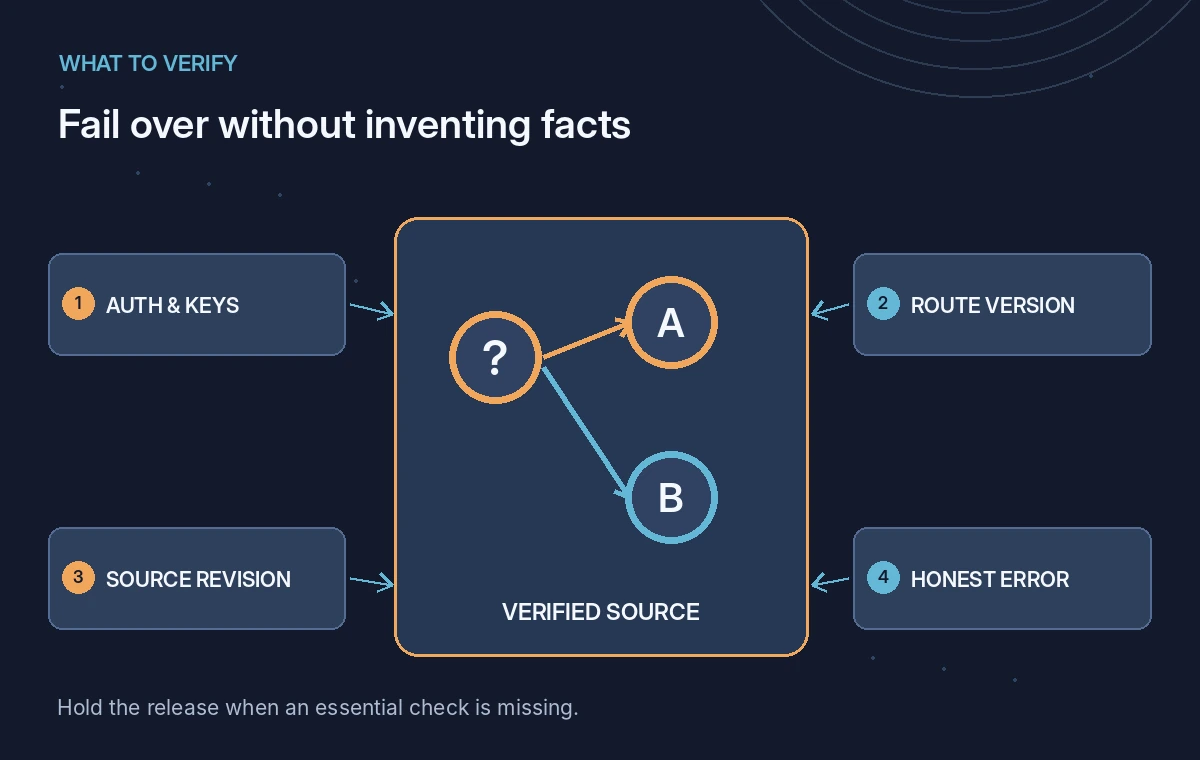
The current dynamic-route documentation specifies OpenAI chat-completions request shape rather than arbitrary provider-native payloads. Verify the supported endpoint before wiring a library kiosk that previously used a different API. The gateway must have authentication enabled and supported upstream provider credentials stored under the appropriate BYOK setup. Do not expose provider credentials in a public kiosk client.
Design the first branch around service eligibility
An example flow can check request metadata for a permitted kiosk environment, apply a rate limit, and send routine informational questions to a primary model. Keep conditions minimal and recorded, with a deny or bounded-error path for unknown clients. Do not put patron names, library card numbers, or unneeded conversation histories into routing metadata. Use pseudonymous request IDs where appropriate.
A fallback path should be explicit, not a quiet switch to whichever model accepts the request. Define when to retry, when to use the second model, and when to stop. A fallback may have different latency, context limits, content behavior, and costs. It still needs the same approved source snippets, response instructions, and access boundaries.
Verify the edge cases in fallback behavior
Cloudflare troubleshooting describes upstream provider errors and suggests dynamic routes with fallbacks for some transient failures. A library implementation should test provider timeouts, authentication failures, rate-limit responses, exhausted budgets, and malformed requests as distinct cases. A retry is inappropriate if it repeats an action that can send notifications or modify records, unless the downstream system has idempotency safeguards.
Our route diagram shows a conceptual primary-model failure leading to a backup and a final honesty check. It does not demonstrate a real incident or Cloudflare log. Model failover is useful for read-only explanations, but it should never turn “unknown closure status” into an authoritative “open now.” Keep hard limits and an error message when neither route can satisfy the information contract.
Use published versions and rollback instead of ad hoc edits
Cloudflare documents saving route versions and deploying or rolling back revisions. Before deploying, record the route name, current version, fallback model, provider access, and critical tests. Stage the change in a separate environment when possible. A rollout should include a human-reviewed sample of the kiosk’s exact high-risk questions, including accessibility, emergency contacts, and unexpected closure notices.
If a change breaks accurate responses, restore the known-good route configuration and document the incident. Rollback cannot undo a false statement already shown to a visitor, so publish corrective notices when warranted. Retain enough route metadata for support staff to identify which version answered an inquiry without storing unnecessary personal conversation content.
Make a model switch visible to the QA process
In a test matrix, separate three outcomes: primary answer with verified source, fallback answer with the same verified source, and unavailable answer when verification cannot be obtained. Grade the content against the library’s approved data, not against another model’s confident wording. Check citations or source identifiers and confirm dates were not reformatted in a misleading way.
Some fallback responses may be shorter or use different phrasing. That is acceptable if facts remain correct and accessibility requirements hold. The nonnegotiable part is that neither model may claim an appointment, reservation, closure, or accessible entrance is confirmed unless the system actually has such confirmation from the responsible data source.
Control spend, logs, and patron privacy separately
Dynamic routes can express rate and budget constraints, but operational governance should also define API cost alerts, log retention, access rules, and incident ownership. Keep privileged keys off the client. Restrict any data passed to provider models to the minimum necessary to answer the question. Do not assume routing metadata or error logs are safe to collect simply because they are useful for debugging.
Document who is permitted to deploy a new route and how the cost of a fallback differs from the primary model. A user-facing library kiosk should have a stable non-AI help option. If neither model can be reached, the interface still needs accessible text with verified contact details rather than a spinner that never ends.
Ship a verifiable service, not just a resilient graph
The final acceptance checklist covers live documentation of the route, provider availability, authentication, version pinning, rollback, primary and fallback test cases, verified knowledge source revision, and explicit unknown handling. Test with a fabricated holiday closure and an empty source record. The kiosk must decline to confirm hours when its trusted service has no current answer, even if the provider successfully generates fluent text.
No route was deployed or performance measured for this guide. Cloudflare documentation and release status can change, including feature availability and request formats. Before production, verify the current supported routing APIs, storage and logging behavior, provider terms, and the library’s real publishing controls. A fallback can restore model service; only trusted records can support factual claims.
How We Research
For this November 2026 guide, we reviewed named vendor-maintained documentation: Cloudflare: Dynamic routes, Cloudflare: Dynamic route JSON configuration, Cloudflare: AI Gateway troubleshooting. We extracted the documented feature controls, compatibility boundaries, and relevant limitations, then designed a narrowly scoped fictional workflow and evidence-based failure checks for the specific scenario above. This was a source review, not hands-on testing: no account or API credentials were used, no live data was sent, no outcomes or quality measurements were observed, and no vendor-generated screenshots were taken. The diagrams are conceptual. Before deploying, recheck current availability, privacy terms, region and plan access, prices, and the latest official documentation. An authorized human, not an extraction or language model, remains responsible for any legal, safety, access-control, or release decision.
Frequently Asked Questions
It routes eligible chat-completions requests through a configured flow of conditions, models and fallback paths.
No. It can reformat an answer but still needs a current approved data source for hours and closure claims.
No. Cloudflare documents a specific chat-completions shape for dynamic routes; check current support before integration.
Show an accessible, non-AI message with verified contact guidance, and do not invent service status.
Cloudflare documents deployed versions and rollback, but teams must test and log the route revision before release.