
A museum writes dozens of visitor labels and wants consistent tone without resending the same lengthy style guide at full processing cost on every API request. The complication is a policy update: yesterday’s guide permits an estimated acquisition date, but today’s policy requires unknown dates to remain explicitly unknown. Claude prompt caching can reuse an identical request prefix; it does not decide whether that prefix represents current policy. This hypothetical workflow demonstrates how to separate stable text from changing rules, and how to inspect usage rather than guessing that caching occurred.
Define the stable material before adding a cache
Start with the material that truly remains identical between requests: capitalization standards, word-length targets, inclusive-language guidance, and the format of the approved label. Store it in a versioned source file, not a collection of slightly different pasted prompts. A cached prefix only helps when its content and ordering match the earlier call; accidental changes may defeat reuse.
Do not put the museum’s current exhibition dates or changing legal notices inside that stable block. Make a simple dependency list showing which instructions staff may revise and who has authority to approve each revision. This matters more than a claimed savings estimate: an efficiently reused error is still an editorial error.
Choose automatic caching or an explicit breakpoint
Anthropic documents automatic prompt caching through a top-level cache_control setting and explicit breakpoints on content blocks. Automatic caching is convenient for an expanding conversation. For a repeated label-writing job with a clearly defined house style, an explicit breakpoint can make it easier to see exactly which text is intended to be stable.
Place an explicit cache marker after the last genuinely shared block, before the label-specific facts and newly revised policies. Do not create one breakpoint per request just because that is technically possible. Sketch the prefix boundary in an internal design note and record whether the application uses an automatic or explicit strategy.
Separate policy version from the reusable prefix

Use an approved policy ID, revision date and human owner in the variable portion when the policy changes frequently. If an instruction changes the meaning of previous guidance, update or replace any dependent cached prefix as well. Do not simply tell the assistant to ignore a contradictory earlier rule and assume the conflict has disappeared.
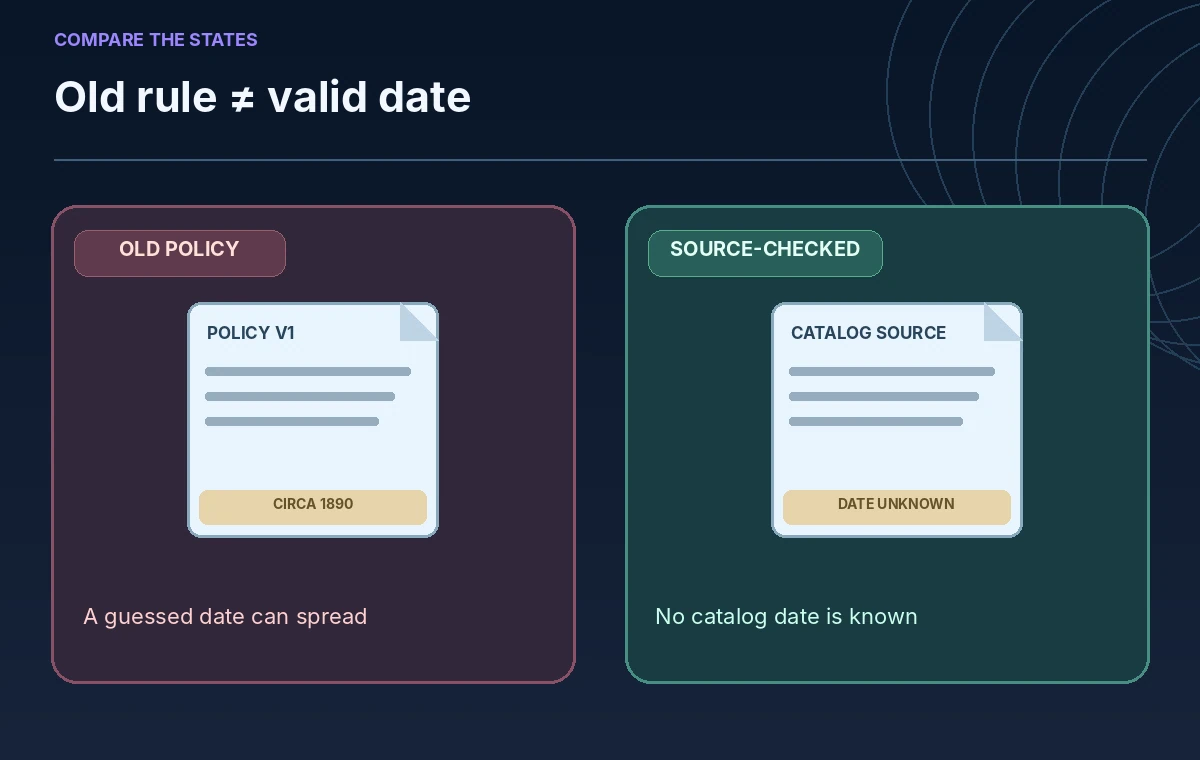
In the fictional example, the older rule suggests writing ‘circa 1890’ whenever a photograph looks Victorian. The approved replacement says to use ‘date unknown’ unless a source supports the year. The corrected request must explicitly exclude unsupported visual dating and be checked against a source record. The cache cannot certify provenance.
Understand duration and first-request behavior
The Claude documentation describes a five-minute default cache lifetime and an optional one-hour lifetime. A cache write only becomes reusable when the first response begins; near-simultaneous requests may not enjoy the intended reuse. The lifetime and eligibility thresholds depend on the selected model and platform, so do not hard-code an assumed hit rate.
If the museum runs a small batch once each morning, a short-lived cache may not help as much as it does for a burst of consecutive calls. Write down the actual job cadence and applicable model requirements. Avoid quoting universal savings percentages: cost depends on input composition, write/read pricing, traffic patterns and the number of successful hits.
Inspect usage rather than assuming a cache hit
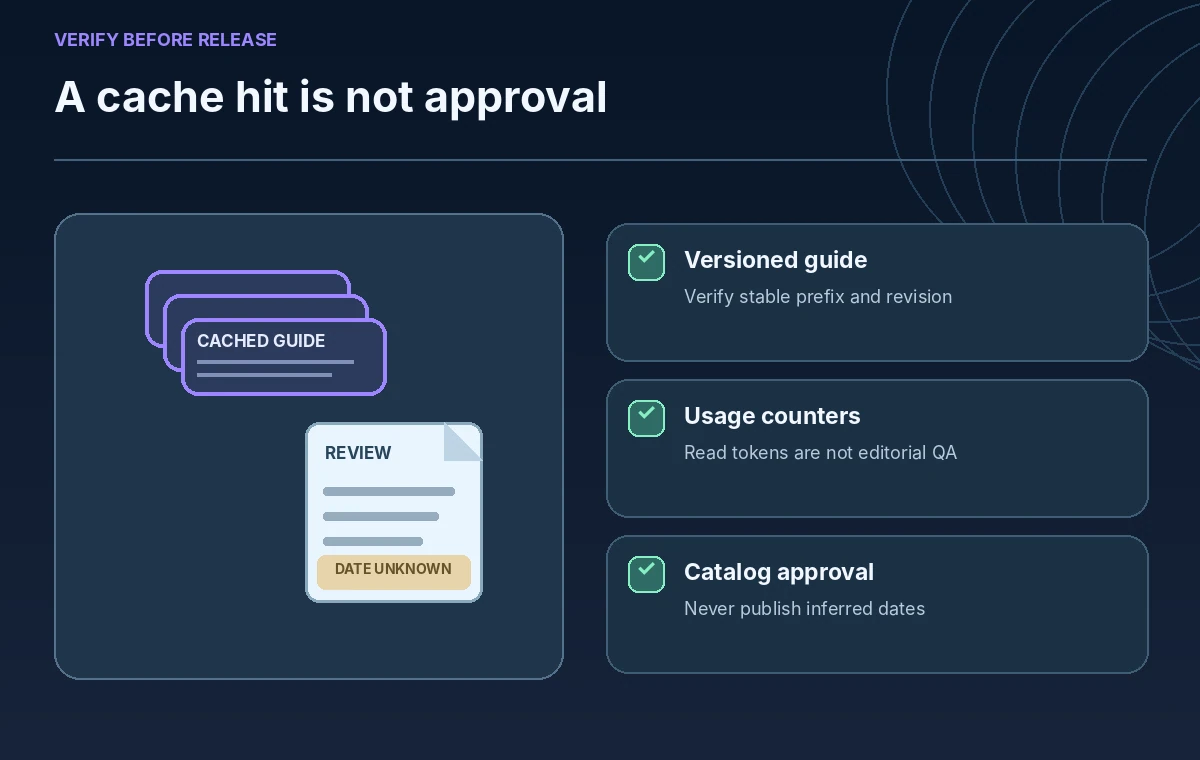
Anthropic exposes fields including cache_creation_input_tokens and cache_read_input_tokens. Log these along with request version, model, timestamp and the count of output records. If both creation and read counters are zero, the content may not have met the caching threshold or the intended marker may not have been eligible.
Compare a cold request with a later identical-prefix request in a controlled environment. Do not treat two differently worded museum labels as a valid cache comparison unless the shared prefix is actually identical. The diagrams here show possible hit and miss paths conceptually; they are not measurements from Claude.
Build a version-control acceptance case
Create two test records: a catalog card whose date is supported by a signed intake sheet and another whose date is missing. The expected outputs differ: the first can state its documented date while the second must say ‘date unknown.’ Repeat the tests after updating the policy and confirm that neither label inherits the older speculative convention.
Capture the policy hash or repository commit as part of every evaluation record. A successful cache hit should be recorded separately from the editorial pass/fail result. If caching reduces processing cost while the second record becomes falsely dated, the change is a release blocker, not a performance win.
Account for privacy and retention claims carefully
Prompt caching is an API processing feature, not a general-purpose document archive or a permission system. Read Anthropic’s current data-handling explanation and the organization’s contract before supplying donor correspondence, unpublished catalog files or personal information. A cached representation should not be treated as a substitute for secure file handling.
Use fabricated catalog snippets in development and minimize any sensitive text in diagnostics. Access to the underlying source file, request logs and staff review history should be controlled independently. If the organization has special retention requirements, confirm that the selected product and workspace arrangement meet them before uploading records.
Design rollback for a bad style-rule change
Maintain a known-good guide and a release checklist. If a new rule causes names to be normalized incorrectly, roll back the application instruction version and re-run a representative test set. Verify which prompts are identical to the earlier version before expecting cache reuse; a rollback of text and a rollback of cached behavior are not the same operation.
For high-impact labels, require an editor to compare the final wording to the authoritative catalog source. Store a record of what the model proposed and what the editor approved. The system should report ‘draft pending review’ rather than automatically marking a label approved when the API call completes.
Publish only independently verified labels
Treat caching metrics as an operational dashboard and source accuracy as a separate editorial dashboard. The final publishing checklist should ask whether a catalog fact has evidence, whether the style and policy versions agree, and whether the label has an accountable approver. No acceptable cache rate can compensate for invented provenance.
This workflow is intentionally a design exercise. We did not send requests to Claude, profile latency, reproduce the billing totals or test a museum dataset. A real team should validate exact model support, usage response shapes and current prices against the vendor documentation at implementation time.
How We Research
For this November 2026 guide, we reviewed primary vendor documentation: Claude Platform: Prompt Caching, Anthropic: API Usage and Cost. We checked terminology, supported inputs, operational limitations and the distinction between documented functionality and this hypothetical scenario. We did not access a paid account, run an API call or a performance benchmark, process real visitor information, or create real vendor screenshots. The original diagrams illustrate principles rather than observed outputs. Verify current eligibility, plans, regional availability and prices with the vendor before implementing this workflow; independently review any facts that will be published.
Frequently Asked Questions
No. It reuses eligible prompt prefixes; a cached instruction can still be outdated, incomplete or contradicted by newer evidence.
Anthropic documents a five-minute default with a separate optional one-hour setting. Check model and platform eligibility.
Inspect response usage, especially cache_read_input_tokens and cache_creation_input_tokens, rather than inferring a hit from response speed.
Generally keep frequently changing rules outside a stable reusable prefix, or explicitly version and replace the prefix when dependent instructions change.
No. Labels still need source verification and human editorial approval.