
Turn a Repeating Help-Line Question Into a Reviewable Case
A small public library may receive dozens of calls about inaccessible entrances, delayed book transfers, and temporary desk closures. Searching every recording by hand can be exhausting, but publishing a model-generated conclusion that a caller was satisfied would be much worse. Amazon Transcribe Call Analytics provides a narrower way to triage consented, appropriately retained call recordings. Its category rules can flag conversations that match specified phrases or interaction patterns, leaving the final interpretation to a person who can listen to the call.
Imagine a hypothetical archive of two-person help-line calls. One caller asks whether the side entrance is open; another says the wheelchair ramp is blocked. A useful review queue might isolate mentions of an access problem. It should not classify the first caller as distressed just because the word “blocked” appears in a staff explanation, or count every flagged call as an unresolved accessibility incident. The working unit is a matched recording plus a reviewer decision.
Choose a Category Rule That Actually Matches the Need
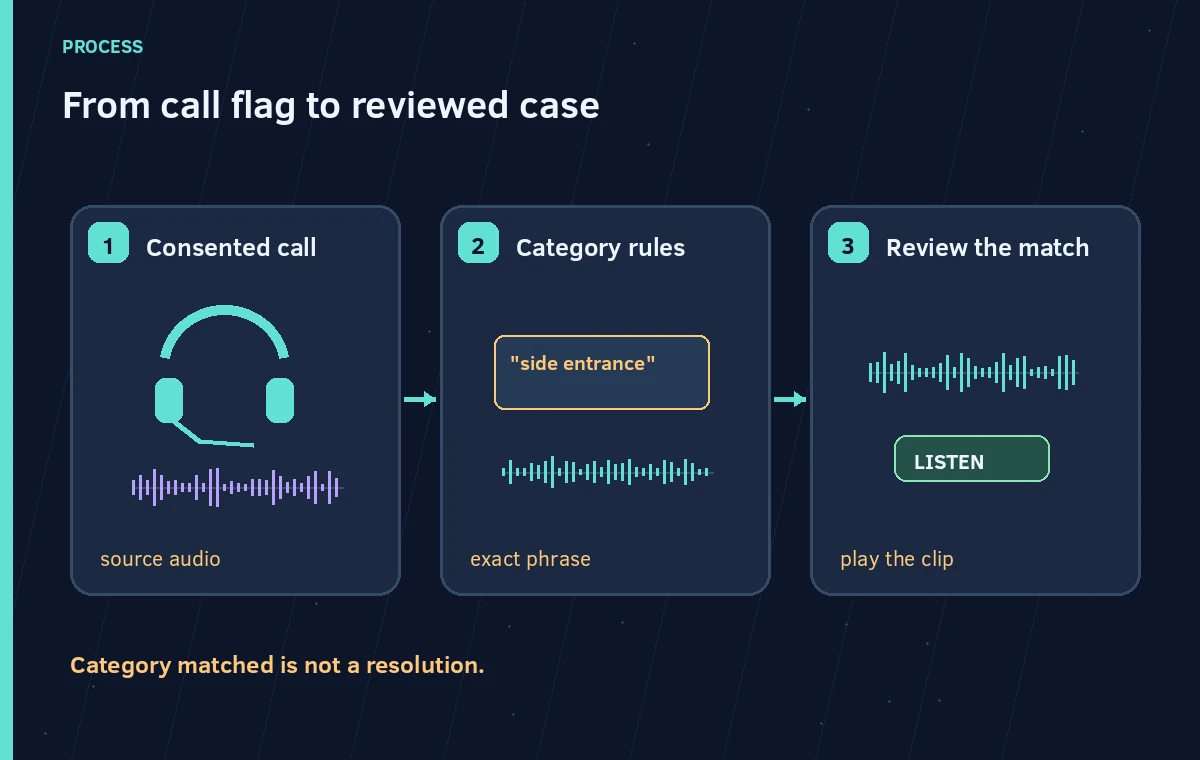
AWS documents post-call category criteria including transcript keywords, interruptions, non-talk time, and sentiment. A category can contain multiple rules; a match requires the configured rules to be satisfied. For exact phrase review, start with an ordinary expression a caller might use, such as “side entrance,” and verify that the recording actually contains it. If variants matter, model those variants deliberately instead of expecting a single phrase to cover every paraphrase or language.
Post-call categories are not interchangeable with real-time categories. An analytics category must be created before the call analytics job if it is to apply to that job; adding a rule tomorrow does not retroactively label yesterday’s completed recordings. Keep a dated rule register and record its input type. A change in category definition changes the meaning of any week-over-week count, even if the dashboard still uses the same category name.
Prepare the Audio and Permission Record Before Analysis
Confirm the organization may process each recording, including the required notice and retention basis. Limit access to originals, transcripts, and derived analytics. For the hypothetical library, save an internal call ID, recording date, consent record, language, and the staff queue responsible for follow-up. Exclude recordings that fail the permission or audio-quality check; do not quietly treat them as negative cases.
Where possible, preserve separate participant channels so reviewers can distinguish a caller’s words from an operator’s explanation. Record original media identifiers rather than depending only on friendly filenames. Consider dialect, background noise, technical terms, and the service’s documented language support before making category frequency claims. A call that cannot be transcribed reliably should remain an explicit manual-review item.
Read a Match as a Lead, Not as a Resolved Complaint
The output can identify a matched category alongside conversation characteristics and transcription segments. Use the category flag to open the relevant passage in a restricted review interface. If it matched “opening hours,” the reviewer should establish whether the caller asked about a closure, repeated posted information, or discussed an event at another branch. The same phrase can describe radically different circumstances; a category is not a verdict.
When sentiment or interruption criteria are involved, do not infer a participant’s motive from a single aggregate. Interruptions can result from latency, accessibility needs, or normal overlap in a lively conversation. A high count may prioritize a careful listen, but it cannot establish disrespect or service quality. Preserve a field for “uncertain” and record the actual reason for an escalation.
Compare Three Outcomes on the Same Review Path
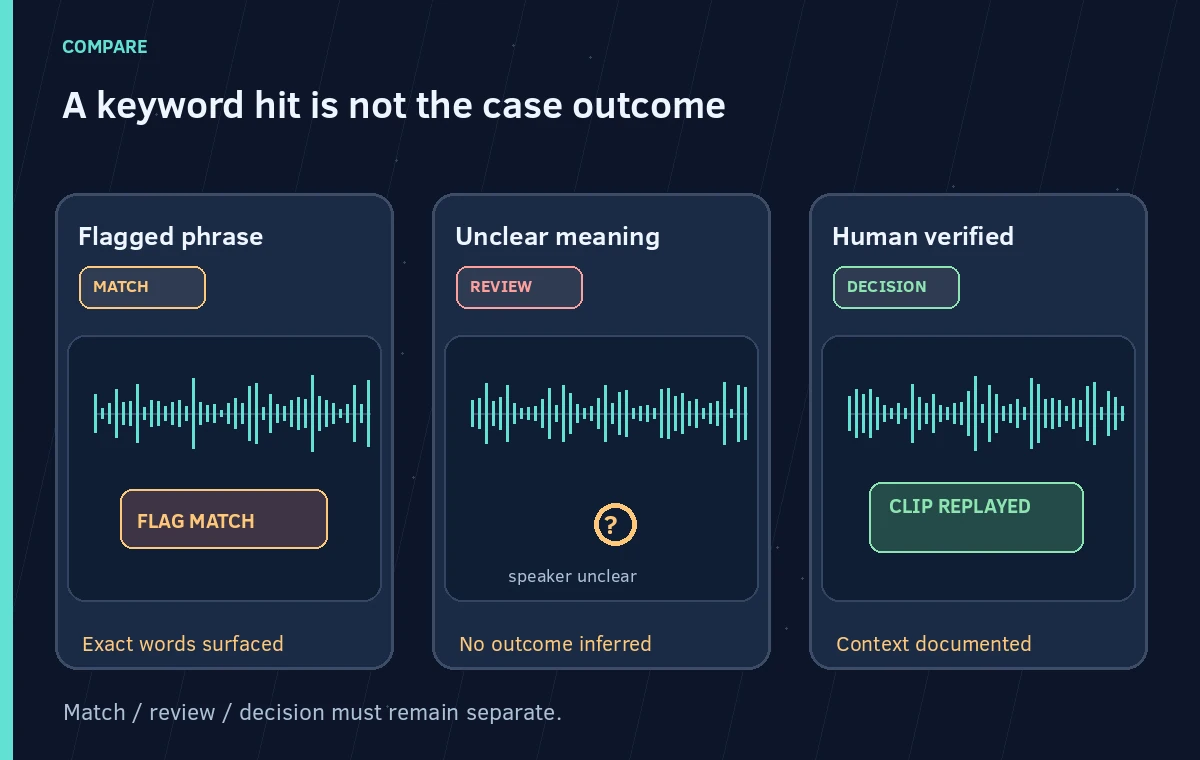
In a hypothetical training set, call A mentions a closed entrance but later confirms an accessible alternative; the keyword flag is expected, while the issue outcome is resolved. Call B contains a direct description of a blocked ramp without a recorded resolution; the same flag now prompts a follow-up. Call C has noisy speech and uncertain attribution; no decision is justified until the audio has been checked manually.
Those three outcomes must not be flattened into one count called “confirmed access complaints.” Separate raw category matches, reviewed true cases, resolved cases, and uncertain cases. For reporting, use consistent denominators and disclose missing or excluded calls. The category list can improve routing, but it should not become the authoritative record of what happened to patrons.
Detect Category Drift and False Alarms Before Deployment
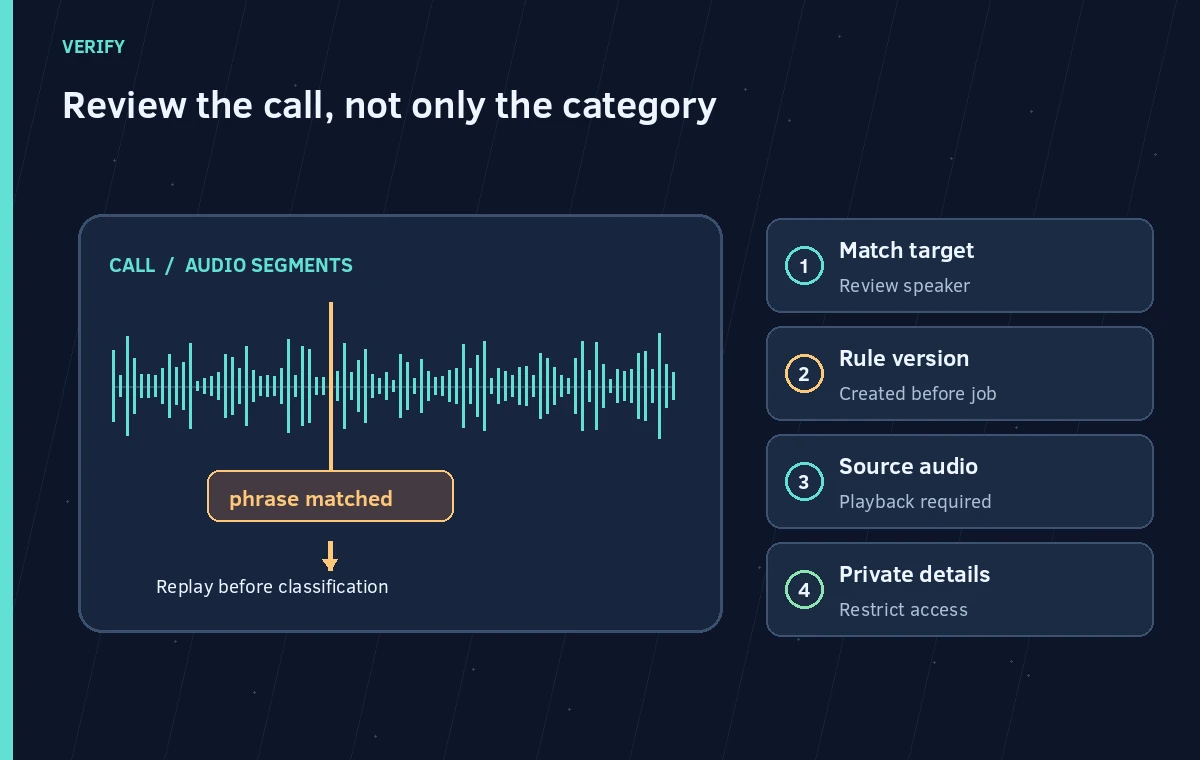
Test the rule definition on a small collection of recordings that the team is entitled to use. Include literal matches, paraphrases, near misses, and calls in which a staff member—not a patron—says the target phrase. Review the recording alongside the transcript and keep annotations about who spoke. If a new phrasing is missed repeatedly, consider adding a documented rule variant rather than broadening a category silently.
A separate failure mode is treating the category rule as permanent. Library policies, route names, and announcement language change. A rule for “east door” may stop representing the same entrance after a renovation. Version rule definitions with effective dates and do not blend older and newer categories in a historical trend chart without a clear note. Re-evaluate after any upstream transcription-model or vocabulary change.
Keep Sensitive Calls Out of the Public Dashboard
Only a narrow set of staff should hear recordings or see verbatim transcripts. Restrict public reports to aggregates that cannot reveal individual callers. Remove names, phone numbers, and detailed accessibility circumstances where they are not necessary to a documented review purpose. AWS supports PII redaction in certain Call Analytics workflows, but a redaction setting is not proof that every private fact was removed.
For a training illustration, show fabricated call IDs and schematic waveforms rather than a real patron’s speech or personal details. Keep reviewer comments factual: “caller described a blocked route; facilities team notified” is more defensible than “negative person complained.” Do not label someone with an emotion or intent that the audio and permitted records do not establish.
Create a Release Checklist for the Help-Line Team
Before using the workflow, confirm category rules are recorded, the corresponding jobs were created after those rules, recordings have appropriate permission, and each alert opens a verifiable source segment. Make sure staff can mark a match as false, uncertain, resolved, or requiring action. Test what happens when a source audio file is missing or permissions change.
The final internal report should distinguish automated triage from verified service outcomes and list the responsible human reviewer. If the organization cannot adequately secure the call recordings or document permission, the right decision is to avoid automated analysis altogether. A smaller, defensible manual sample is preferable to a dashboard of confidently mislabeled calls.
How We Research
We reviewed official documentation current at the time of writing: AWS: Post-call analytics categories; AWS: Post-call analytics output; AWS: CreateCallAnalyticsCategory API. We compared the published configuration terms, response behavior, and operational caveats against the hypothetical workflow described above. The examples and diagrams are original teaching illustrations, not screenshots or results of a live product test. We did not upload a patron recording, inspect a real institution’s documents, benchmark model accuracy, or verify any individual consent. Product availability, limits, and policies can change; confirm the current primary documentation before deployment.
Frequently Asked Questions
No. It indicates configured conditions matched the call analytics output. Listen to the source and review the case before recording sentiment or resolution.
No. AWS states category definitions must exist before the applicable job. Treat historical re-analysis as a separately governed task.
Yes. Post-call categories support multiple rules, which must be met for a category match. Keep each rule version documented.
No. Private details may remain in speech, context, and metadata. Review sensitive output and apply access controls.
Mark it for human review or exclude it from automated counts rather than recording a confirmed complaint.