
A fictional community seed exchange receives permit forms from several partner nurseries. The forms all ask for an authorization date and distributing organization, but the labels appear in different places. Amazon Textract Adapters customize the Queries feature for recurring document layouts. They are useful for proposing field values, not for determining whether a permit is valid. The workflow below keeps the source image, exact question, adapter version, and a named reviewer together so an appealing answer never becomes an unexamined compliance decision.
Define the question before training
Create a field dictionary with the literal questions staff must answer: issuing authority, named holder, effective date, expiration date, and any restricted variety code. Define each field’s expected format and whether a blank is acceptable. A plausible date in a footer should not automatically fill the expiration column. Preserve the distinction between information printed on the form and a later staff interpretation. This reduces the risk of using AI to fill an administrative gap with a confident guess.
Use a hypothetical permit where ‘Issued 04/12’ appears in the upper corner and ‘Valid until 10/12’ appears beside a signature box. Write two separate queries rather than asking for ‘the date.’ Record the intended answer span and page number in a human-labeled reference sheet. If the form is actually a sample or expired revision, label that too. Document class and status cannot be inferred safely from extraction alone.
Build a representative and separated evaluation set
According to AWS, custom query adapters are created from example documents with query-and-answer annotations. Choose samples representing clean scans, fold marks, alternate layouts, blank fields, handwritten corrections, and multipage documents. Label the true text or mark the field absent; do not insert the answer a clerk hopes to see. A biased training collection can make a model fluent on one organization’s layout while failing on another’s rare but important form.
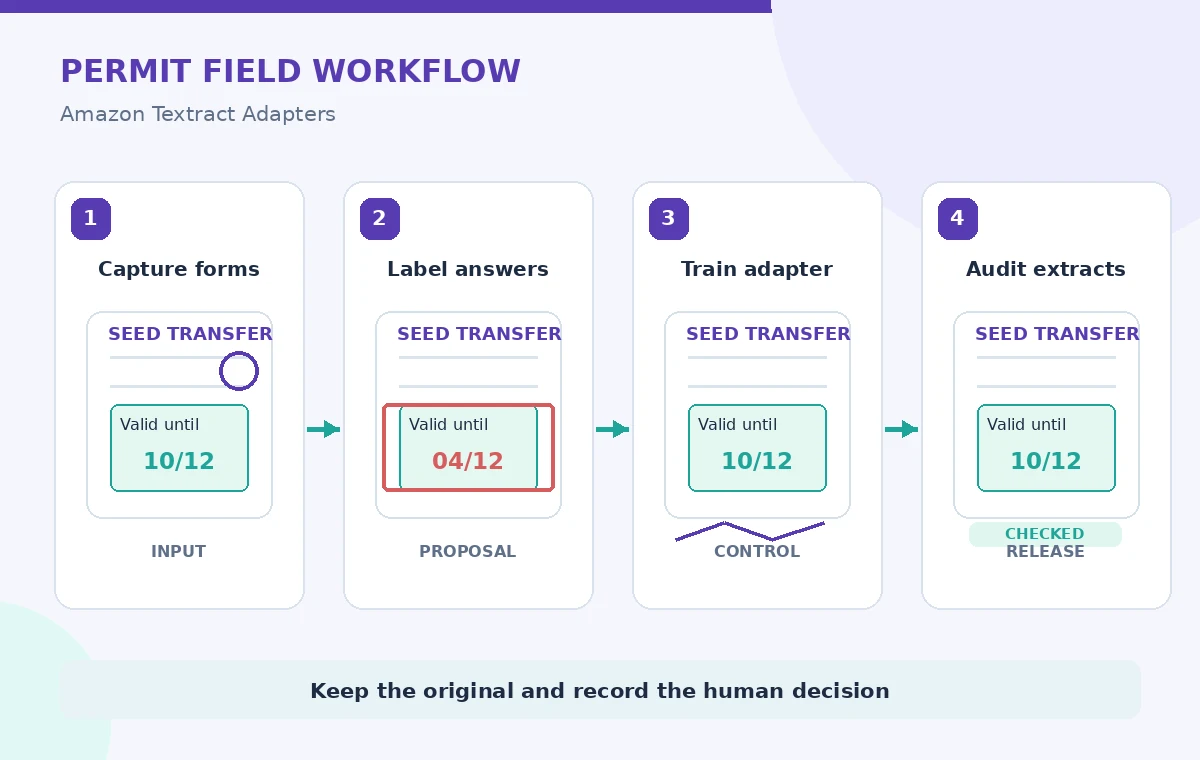
Keep a holdout group aside before annotating the training material. Evaluate exact-value extraction on that untouched group, and separately count omissions, wrong-field substitutions, and answers taken from the wrong page. Do not treat a vendor dashboard score as proof that a proposed permit decision is correct. A valuable error log includes a thumbnail of the original answer span and the reason a human did or did not accept it.
Connect the adapter with the correct page scope
After training, AWS provides an AdapterId and a version. Pass both in AdaptersConfig when calling AnalyzeDocument or StartDocumentAnalysis with the supported Queries workflow. For a multi-page packet, specify Pages deliberately. AWS documents first-page behavior when Pages is omitted, and page intervals for more complex requests. An adapter should not silently inspect only the cover sheet when the field actually lives on page four.
The service can apply different adapters to different page ranges, but a single page may not be assigned multiple adapters in the same configuration. Before processing a batch, map each known document type to its intended adapter version and pages. If the packet contains an unknown enclosure, route it for classification or manual handling rather than guessing an adapter. Keep configuration, access permissions, and test data separated from live permit documents.
Show the source and the suggested answer side by side
Make a reviewer screen with the original page, the precise query, the proposed response, and the page or region from which that response came. Distinguish a missing answer from an empty value printed on the page. If a name was detected on the wrong line, highlight the source rather than hiding the error behind a normalized field label. The operator should be able to reject a proposed field without editing the underlying document.
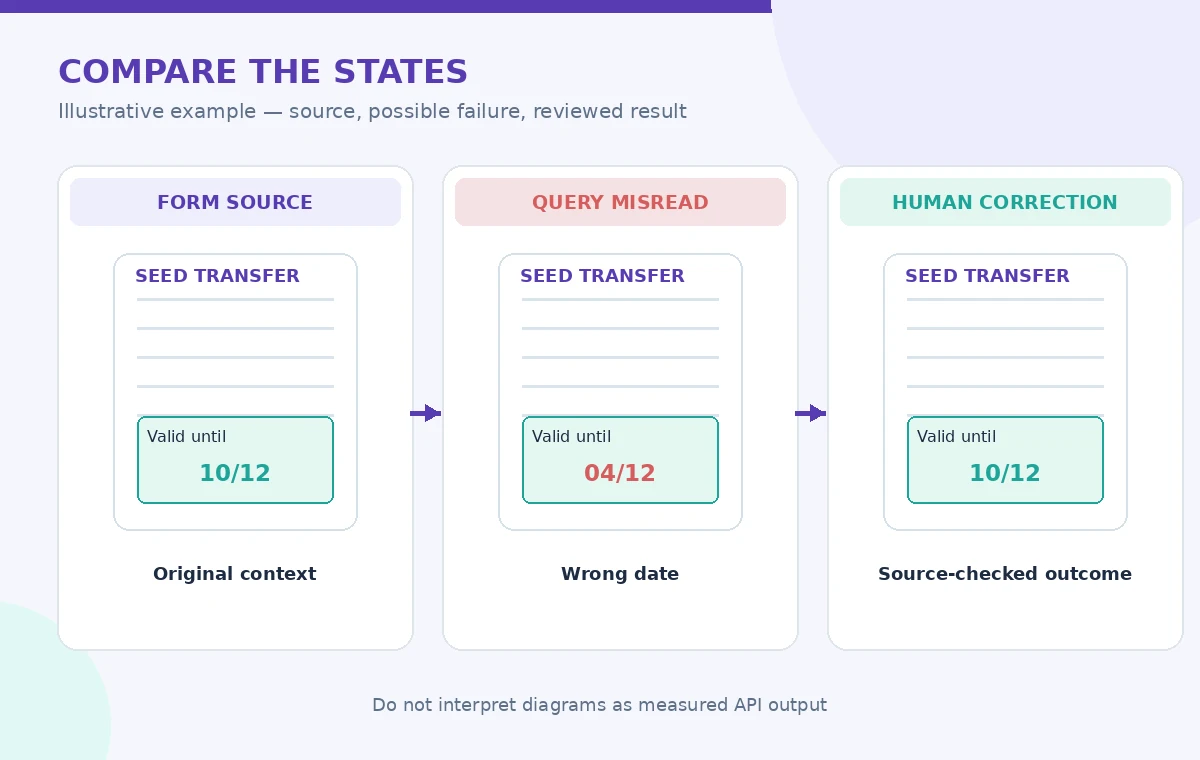
A useful comparison has three states: a form with a clear ‘Valid through 10/12′ label, an extraction that mistakenly chooses the issue date, and a corrected record referencing the actual expiration area. That is an illustrative review case, not a measured model outcome. Verify unusually short dates against the form’s year, locale, and instructions. Never automatically turn an ambiguous ’04/05’ into an ISO date without approved interpretation rules.
Keep version changes from shifting old records
Treat a new adapter version like a software release. Retain its identifier, training dataset revision, query list, evaluation notes, and deployment date. A newer version may fix one form family but change extraction for another. Run both versions against the same holdout examples before switching production, then document the differences. Historical approved field values should not be overwritten solely because a new model gives a different answer.
If an operator discovers an error after import, preserve the original machine proposal and add a traceable correction with reviewer name, timestamp, and reason. Reprocessing is valuable for quality audits, but it must not masquerade as the original administrative decision. Keep permission to retrain, deploy, and approve documents in separate roles. This makes it possible to explain how each official record was produced long after the model changes.
Set a release gate for missing or contradictory fields
Define a refusal-to-autofill rule for inconsistent holder names, a missing issuing authority, unreadable stamps, or dates that conflict between pages. The application can prepopulate a review queue, but not assert legal validity. Let the responsible coordinator inspect the physical or digitally authenticated source, applicable rules, and any special conditions. This is especially important for rare plant transfers whose restrictions may depend on an attachment not covered by the queries.
Count how often staff override the model and which classes of form generate the most corrections. Monitor these signals after deployment, not only during a pilot. If extraction quality deteriorates after a scan-vendor change, suspend auto-population and compare sample pages to the baseline. A good system makes uncertainty visible rather than forcing every document into a completed record.
Publish only reviewed administrative data
After approval, export only the minimum fields required for operations and link them to an internal evidence record. Do not place permit photos, personal signatures, or private contact details in a public catalog simply because they were used to train an adapter. Mark the review status separately from an extracted status field. Public-facing copy can say that an authorization was reviewed, but should not imply that Textract itself verified compliance.
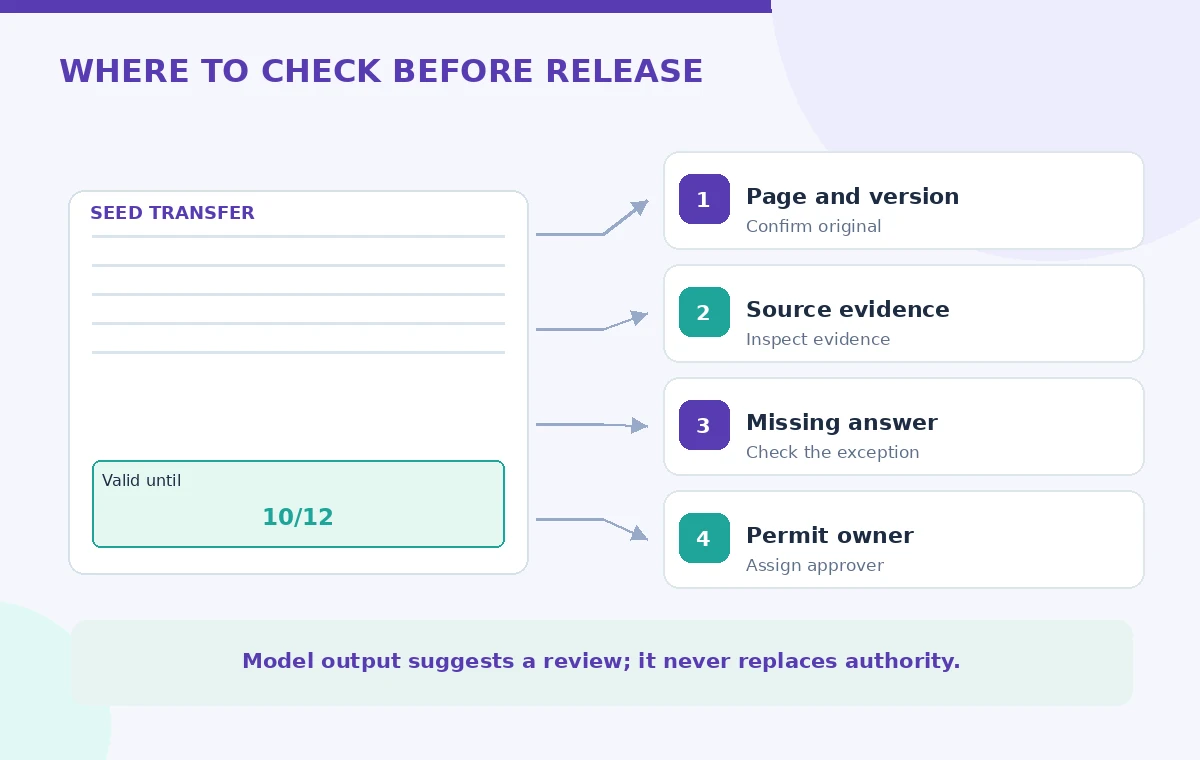
Before a bulk import, sample records from each document family and confirm that the source page, selected text, normalized value, and staff decision agree. Recheck after changes to the layout or query list. For a future audit, a compact chain of source, query, adapter version, extraction, correction, and human authorization is far more useful than a high average accuracy score without traceable evidence.
How We Research
For this November 2026 editorial review, we checked named official vendor and framework documentation: AWS Textract custom query adapters; AWS adapter inference; AWS Adapters API structure. We compared the documented inputs, output types, configuration options and stated limitations with a hypothetical, non-production workflow. We did not run paid API calls, upload actual patron or donor records, measure accuracy, certify legal compliance, or obtain sponsorship or staff consent on anyone’s behalf. All illustrated comparisons are synthetic examples designed to explain what a reviewer should inspect. Product availability, endpoint behavior, regional terms and pricing can change; consult the linked sources and your own organization’s policies before deployment.
Frequently Asked Questions
No. It customizes a document extraction model. A permit decision belongs to the authorized reviewer and the underlying legal or organizational rules.
Yes, adapters can be applied to separate page ranges in supported analysis operations; AWS specifies that only one adapter applies to a given page.
AWS documents a first-page default for adapter page selection. Specify the relevant pages explicitly for multi-page permits.
Yes. Capture the adapter ID, version, questions, source file identifier, page references and review result to make corrections reproducible.
Not for consequential fields. Compare the highlighted source text and surrounding labels, and send blanks or conflicts for manual review.