
A download permission is not a cost agreement
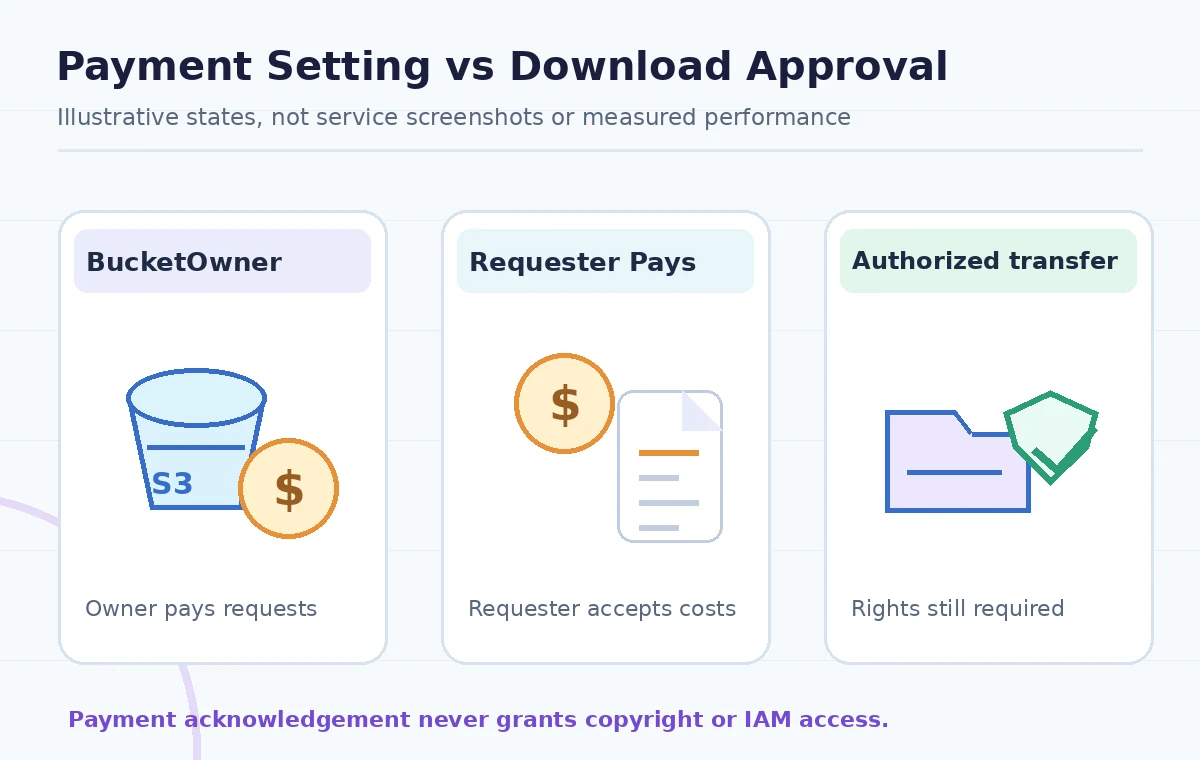
An oral-history archive wants partner universities to retrieve preservation-access copies from an Amazon S3 bucket. Staff see that a user has permission to get an object and assume the archive will pay every download bill. In a Requester Pays general purpose bucket, requests and data-transfer charges can instead be billed to the requester, subject to documented exceptions. The workflow therefore needs a billing preflight separate from permissions and copyright clearance. This fictional museum scenario illustrates a policy decision; it is not evidence that a specific bucket has Requester Pays enabled or that an individual was billed.
Read the bucket payment setting first
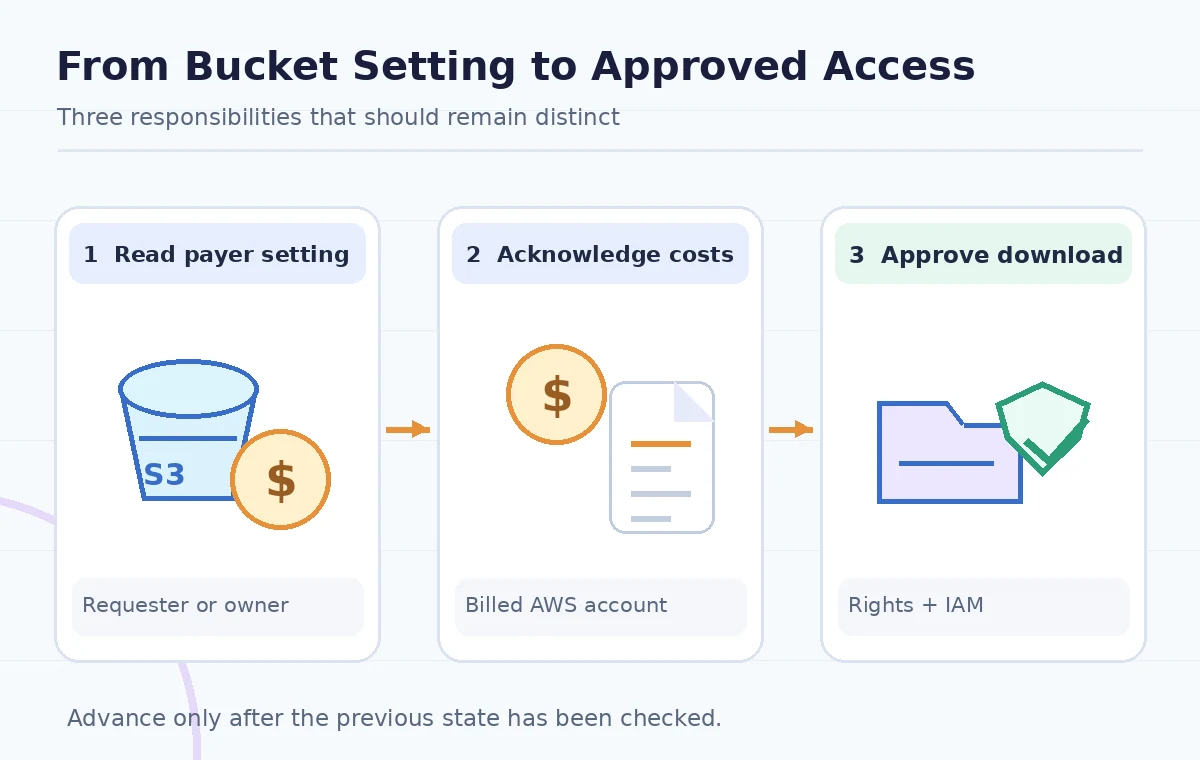
Use the authorized GetBucketRequestPayment operation or its SDK equivalent to check the RequestPaymentConfiguration Payer value. The documented values are Requester and BucketOwner. The response tells you the bucket’s request-payment configuration; it does not prove that a prospective downloader understands a charge or has sufficient account permissions. Record the bucket name, verified AWS account, relevant region, time of the check, and the approved audience. Do not copy a payer value from an old ticket, because a storage administrator may change the configuration. Avoid requesting any restricted object data merely to learn the payer setting.
Explain the acknowledgement requirement
When downloading from a Requester Pays bucket, a requester generally must explicitly acknowledge potential charges with x-amz-request-payer: requester, an SDK request-payer option, or the corresponding signed-URL parameter. AWS documents a 403 response for requests that omit the required acknowledgement, with specific billing behavior for the bucket owner. A permitted request can still fail for unrelated reasons such as IAM policy or object restrictions. Never interpret a 403 alone as proof that Requester Pays is enabled, and do not tell users that adding the header grants access to a private object.
Identify the account that could be charged
Explain which AWS principal makes the request and which account owns the role it assumes. AWS states that when a requester assumes a role, the account to which that role belongs is charged for the request. Clarify this point before giving a university a download script; people often assume their personal username is the billing entity. Storage charges remain with the bucket owner, while successful requester-pays requests and data transfer generally fall to the requester. The cost split has documented exceptions, and actual pricing varies by request type, storage class, geography, and transfer path.
Check object access and release approval independently
A correct payment acknowledgement does not grant copyright, consent, privacy, or IAM access. For an oral-history recording, verify the interview agreement, usage restrictions, and the particular access derivative selected for the partner. Check the requested object version and any retention or legal-hold restrictions when applicable. Avoid issuing an open-ended presigned link merely because a partner accepted possible network costs. The archive should keep a reviewed list of allowable files and a maximum planned distribution volume. If authorization changes, revisit existing distribution links and application controls rather than treating payment settings as revocation.
Budget for range requests, retries, and transfer
A single logical download may require multiple requests, including ranged reads, retries, and status checks. Build a forecast using the current AWS pricing documentation and the partner’s expected bytes, storage class, region, and retrieval path. Do not use a guessed per-gigabyte rate in a permanent article or claim that a small test predicts all future bills. If a partner uses an automated downloader, provide an explicit stop condition and ask them to verify AWS billing and request metrics. Payment acknowledgement signals consent to the AWS charging mechanism, not approval of an unlimited dataset.
Design a reproducible partner download procedure
Prepare a short, reviewed instruction sheet that identifies the approved bucket, object prefix or exact keys, payer setting at the time of review, required authentication, and acknowledgement option. Encourage the requester to validate a small approved file first and inspect the actual returned object metadata. Where supported, AWS documents x-amz-request-charged: requester on a successfully billed response. Save the partner’s acceptance in the appropriate administrative record, but do not store their cloud access keys. Provide a human contact for cost or rights disputes before enabling automated bulk retrieval.
Troubleshoot 403 without bypassing security
If a requester receives AccessDenied, inspect IAM, bucket policy, organization controls, object ownership, encryption-key permissions, region, and the required requester-payer acknowledgement. Test only the least-privileged path that an authorized partner is supposed to use. Do not turn off public-access blocks or broad access controls to make the request succeed. Requester Pays does not support anonymous requests, and signed URLs also need the payment parameter correctly included in the signature process. A failed download can be a healthy protection rather than an operational error to defeat.
Record the billing and evidence boundary
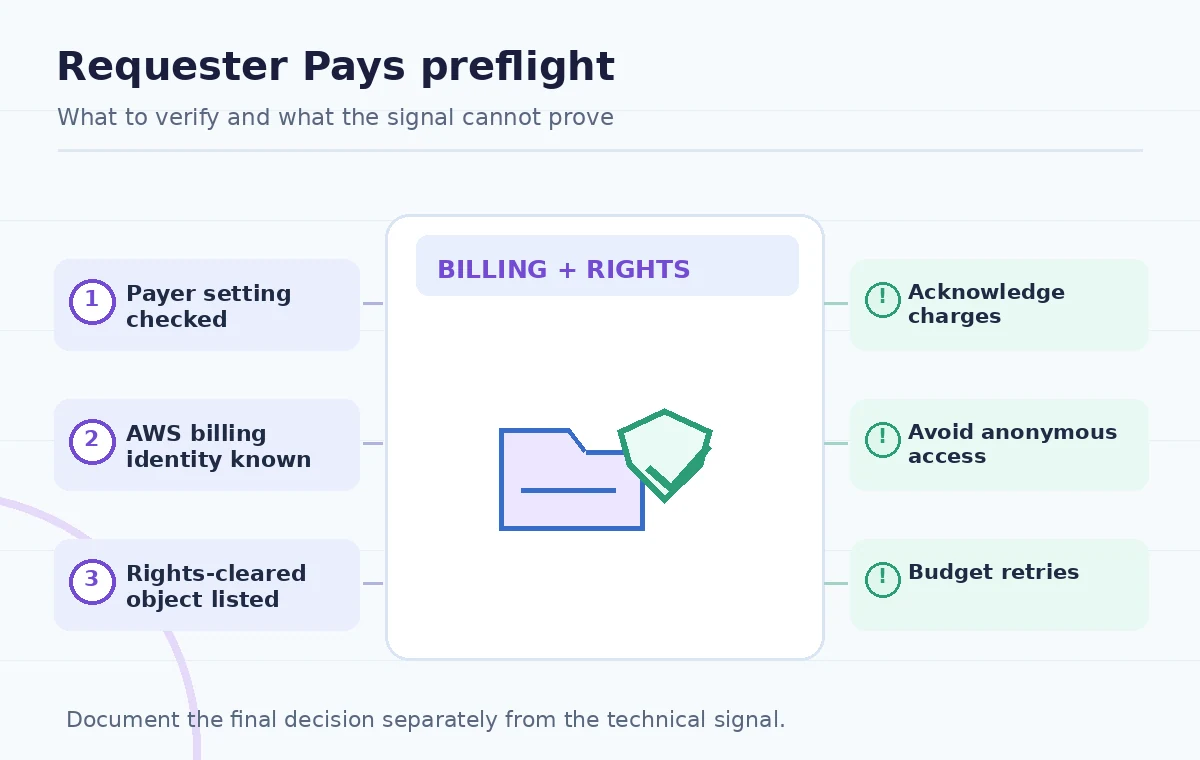
The release checklist should separately record the payer configuration, intended AWS billing identity, signed approval of permitted recordings, access policy, request-payer acknowledgement, and an estimated usage cap. After distribution, reconcile costs using billing records rather than assumptions from downloaded filenames. This makes the archive’s policy transparent without pretending that a cost flag changes the rights attached to an interview. Recheck the current AWS documentation before a new program starts, particularly if the team changes regions, uses roles from another organization, or adopts a different S3 bucket type.
How We Research
We reviewed the current official references: Amazon S3 GetBucketRequestPayment; AWS Requester Pays guide; AWS downloads from Requester Pays buckets. Our editorial method compared the documented API contract, configuration boundaries, and known limitations with the hypothetical museum use case described above. We distinguished software behavior from source accuracy, legal permissions, cost acceptance, and publication approval. We did not call a production API, measure a live system, inspect a customer account, or obtain the imagined collection records. Diagrams are original educational illustrations and show no measured provider output. Readers should confirm model or API-version support, live permission settings, and current organizational policy before using these instructions.
Frequently Asked Questions
The payment configuration identifies Requester or BucketOwner as the payer setting.
No. It acknowledges potential charges; IAM and other access controls still apply.
AWS states the account that owns the assumed role is charged for requester-pays requests.
No. AWS requires authenticated requests for Requester Pays buckets.
No. Missing acknowledgement is one cause; policy, encryption, and other restrictions can also deny access.