
Treat speed and recoverability as different questions
A museum digitization team uploads oral-history masters to an Amazon S3 source bucket and depends on an off-site destination bucket for disaster recovery. The staff wants timely copies but also needs a defensible record that every licensed master can be restored. Amazon S3 Replication Time Control, or S3 RTC, adds a bounded replication performance objective, metrics and event notifications to configured replication rules. It does not replace destination access tests, media file integrity checks or retention planning. A screenshot of a healthy replication dashboard cannot prove that a particular interview version is present and decryptable. Organize the workflow around the exact objects that the collection manifest says must survive.
Confirm the replication rule before adding RTC
An S3 replication configuration specifies source and destination, selection rules, permissions and what object versions qualify. Before enabling time control, verify the buckets, region pair, role permissions and encryption requirements for the collection. Inspect whether the rule covers all expected prefixes, object tags and future uploads. Existing objects might require a separate batch replication workflow; do not assume turning on RTC backfills decades of recordings. If the source uses SSE-KMS or complex object ownership controls, check the destination permissions and keys in advance. Document which data is excluded deliberately, because excluded masters are not late replicas and will not be rescued by adjusting a latency threshold.
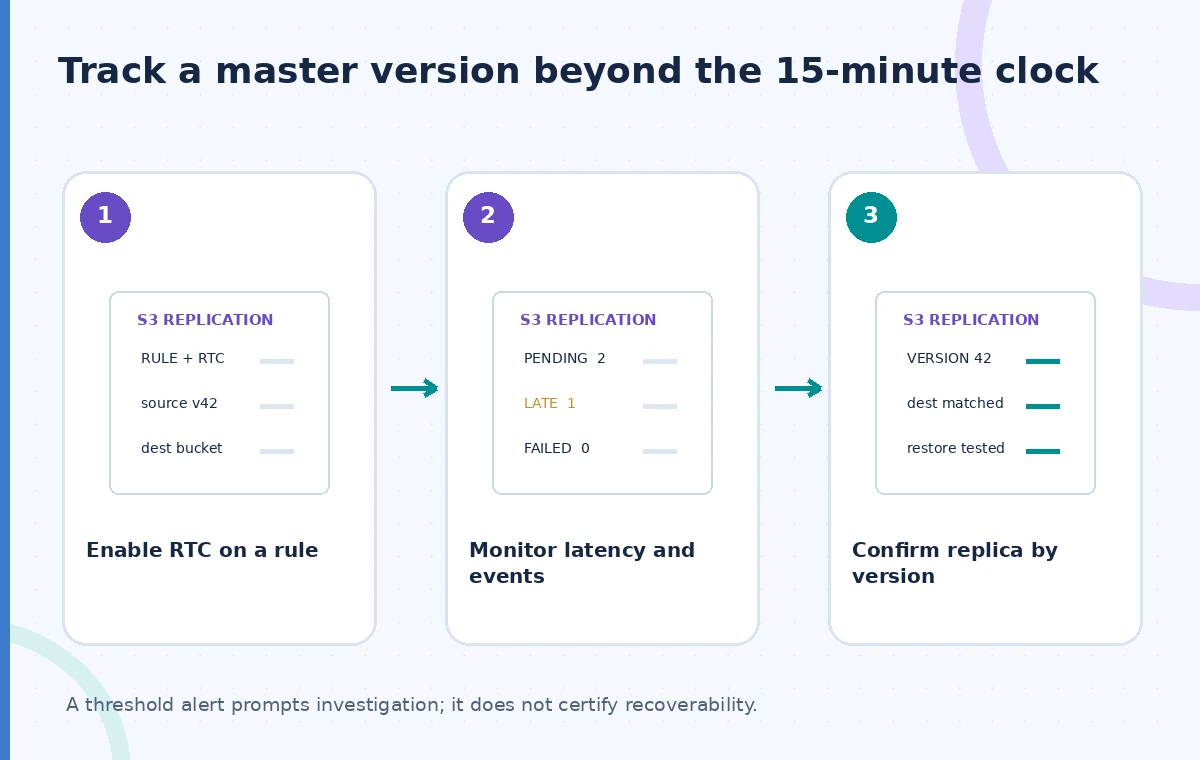
Understand what the 15-minute objective means
AWS describes S3 RTC as designed to replicate most eligible newly uploaded objects quickly, with a 15-minute performance target and service-level provisions. The percentage described in different overview and SLA contexts is not a promise that every individual object is copied within exactly fifteen minutes. Even after successful configuration, some objects may be delayed or fail replication for operational reasons. Use the time threshold as a monitoring and incident signal, not as an automatic authorization to delete the source after a quarter-hour. The collection custodian should still verify destination presence for specific versions and retain the original under the approved preservation policy.
Measure the queue and missed thresholds
With S3 RTC enabled, replication metrics include pending operations, pending bytes, replication latency and operations that failed replication. AWS also exposes event notifications for OperationMissedThreshold and OperationReplicatedAfterThreshold, showing when an object crosses the time boundary and when it eventually catches up. Set alerts that lead to an actionable reconciliation queue instead of treating every event as a simple pass-or-fail backup result. Metrics can require time before appearing after activation and can involve additional charges. Keep alert routing limited to authorized operators, especially if object keys contain sensitive accession names or interviewee references.
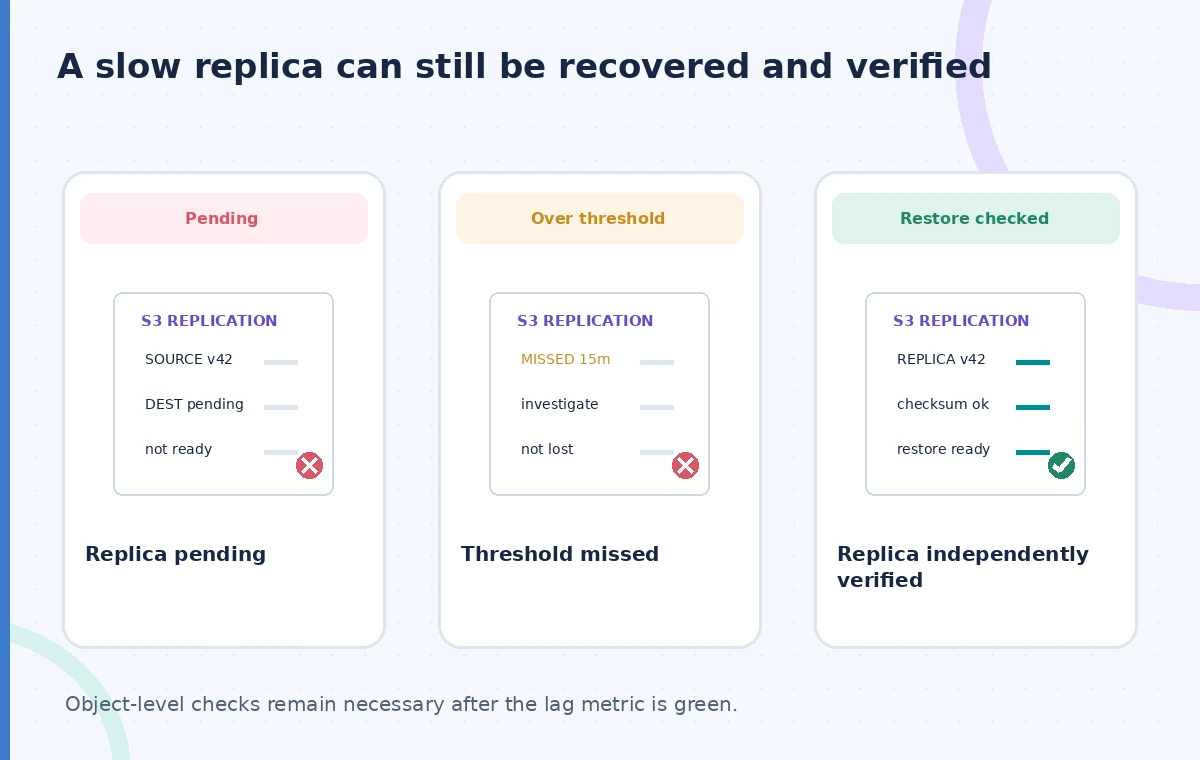
Compare pending, late and verified states
The figure shows three conceptual states for an oral-history master. First, the destination version is still pending and no independent copy is confirmed. Second, replication has crossed the monitoring threshold; operations must investigate rather than mark the file lost or assume it will never arrive. Third, the corresponding object version is identified in the destination, metadata is reconciled, and an authorized read or restore test supports recoverability. A late object may eventually become valid, and a copy recorded as completed can still be operationally unusable if keys, permissions or downstream restoration procedures are wrong. These are states in a suggested audit, not measured S3 telemetry.
Reconcile at object and version granularity
For each original recording, store its source bucket, key, version ID, expected checksum or inventory identifier, target location and archive rights status. Consult replication status information for the relevant version and confirm that the destination has the expected counterpart. A list of bucket names alone cannot distinguish a current approved recording from an old export with the same filename. If a source object is updated, treat that as a distinct version in the preservation ledger. Do not assume status COMPLETED automatically means editorially approved or fully recoverable. Test sample downloads or restoration using accounts and keys that would actually be available during a response to an outage.
Investigate failures before triggering recovery work
Failure can result from insufficient permissions, destination configuration, KMS key access, quota or request-rate constraints. First capture the failure reason, affected object identifier and relevant rule. Distinguish transient replication lag from a persistent failure that needs a configuration correction. When historical or failed objects need retry, use an authorized replication recovery workflow, potentially involving S3 Batch Replication; do not recursively copy entire buckets without a frozen manifest. Avoid re-encrypting or rewriting a master merely to force a green status, because that can create a new object version and undermine audit history. Escalate any interview subject’s restricted-access requirements before distributing restored copies.
Budget for monitoring and resilience trade-offs
S3 RTC, cross-Region transfer, replication metrics, notifications and storage can have separate costs. Account for monitoring cardinality, per-object alert volume and the legal need to retain older versions. A collection with many small derivative assets can generate a different operational burden than a few large archival WAV masters. Also confirm that replication configuration does not unintentionally multiply restricted recordings into a region or account that lacks the required controls. Test destination-account access and disaster recovery procedures independently of steady-state latency. An off-site replica that depends on an unavailable credential or undocumented runbook may satisfy a dashboard but fail the actual preservation objective.
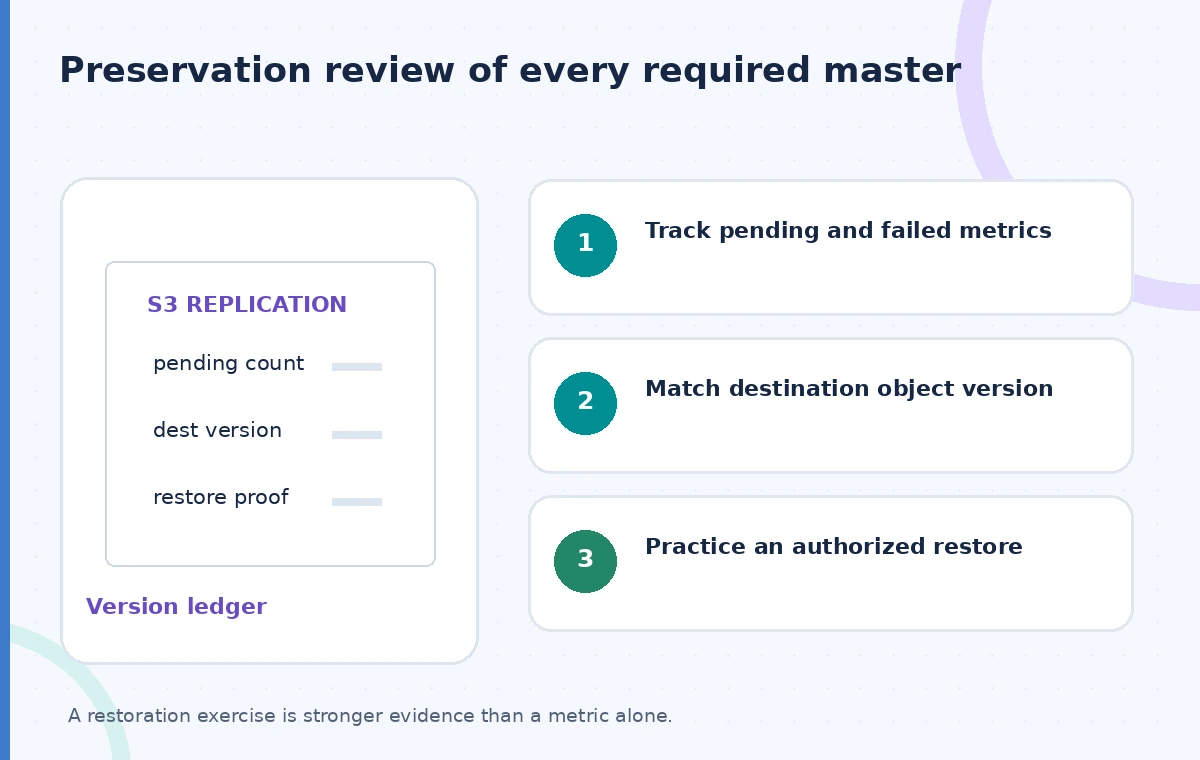
Make the archive release decision explicit
A preservation officer should sign off on a report containing expected object versions, replication statuses, late and failed event counts, destination evidence, integrity checks and the outcome of a controlled restoration exercise. Hold source deletion or cold-storage migration until that report reconciles every required master under the organization’s retention policy. If some copies remain unresolved, publish a limitation for staff rather than a false completed-backup banner. Retain the S3 RTC configuration and alert definitions with the report to explain which performance promise was in effect. The platform helps expose latency; the museum must still prove recoverability, permissions and long-term record integrity.
How We Research
Our research consulted these named official documents: AWS: Meeting compliance requirements with S3 RTC; AWS: S3 Replication metrics; AWS: Replication status information. We checked tool behavior, version-specific options, and stated limitations against an illustrative museum scenario. The examples are suggested implementation and editorial review procedures, not production tests. We did not call the services with live patron records, benchmark latency or accuracy, measure storage savings, or obtain third-party consent. All images are original explanatory drawings rather than screenshots or claimed measured results. Verify provider documentation, service availability, access policies and current organization rules before adoption; keep final publication approval with authorized staff.
Frequently Asked Questions
No. It provides a replication performance objective, SLA framework and monitoring events, not an individual-object absolute guarantee.
An OperationMissedThreshold event can be emitted. Investigate the object and watch for eventual replication or a failure condition.
No. Existing objects may require separate replication or backfill arrangements; verify rule scope.
Not by itself. Check the intended version, retention, encryption permissions, integrity and restoration procedure.
Pending operations, pending bytes, replication latency and failed replication operations are useful indicators.