
Short fiction is unforgiving: a single weak scene can consume a third of the story, and a sudden change in character motivation can break the ending. An AI fiction writer can brainstorm options or draft prose, but it needs boundaries. A useful process protects the author’s central choice before any sentence generation begins.
This guide is for writers producing a short story rather than a full-length manuscript. It compares the jobs supported by Sudowrite, NovelAI and general chat assistants, then offers a compact scene-card method that can be used in any tool. We did not independently run a blind prose-quality contest.
Select software for the kind of help you need
Sudowrite offers story-aware writing features such as Write, Rewrite, Feedback and Story Bible. NovelAI has an editor and Lorebook for remembering story details in the generated context. General assistants are flexible for character interviews, outlines and critique, but writers may need to resupply story context during a session.
Choose by the work you actually dislike: invention, continuation, consistency checks or line editing. A writer who drafts confidently but struggles with endings may benefit from critique prompts more than from a dedicated scene generator. Pricing and usage caps can change, so compare current official plans before committing.
Write the story promise in one sentence
Start with one person who wants something, an obstacle that forces a choice and a cost attached to that choice. For example: “A night-shift dispatcher must decide whether to report a misleading safety alert that could close the only road into town.” This provides dramatic stakes without giving a model a blank invitation to wander.
Specify the target reader, viewpoint, tense, setting and approximate word budget. Add a note about what the story should not do, such as introducing a last-minute mystery villain or explaining the twist before the climax. The goal is a testable creative direction, not a rigid fill-in-the-blank formula.
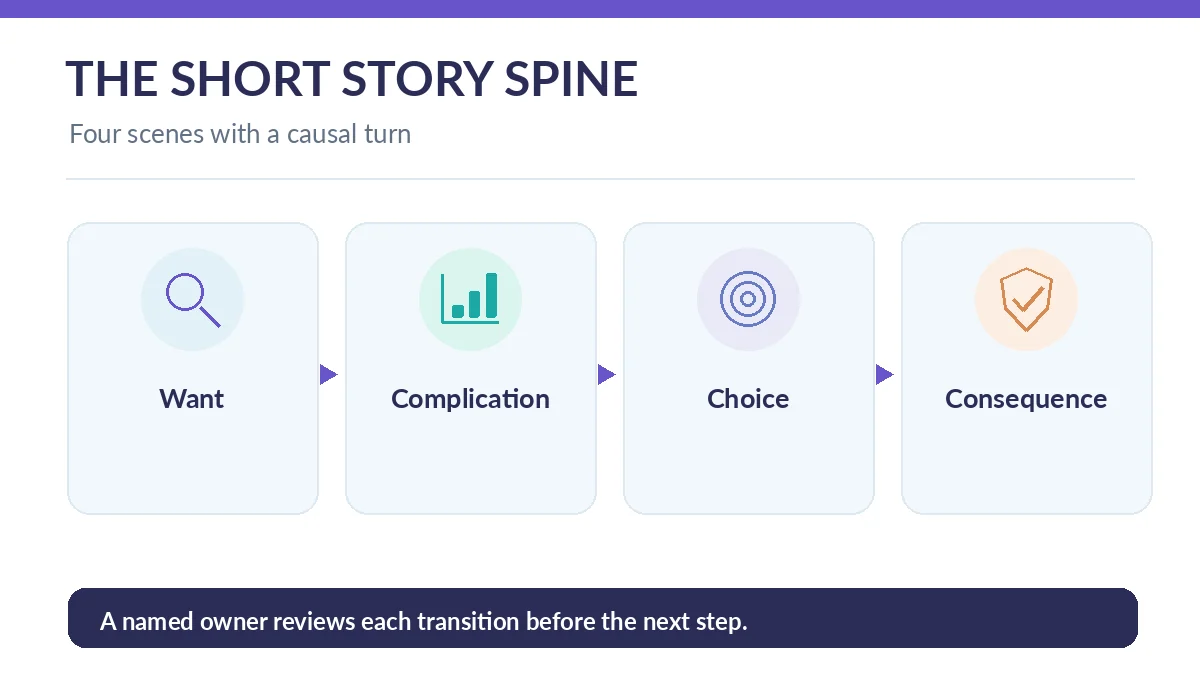
Use a four-card scene spine
Card one establishes the want and the small present-day problem. Card two introduces evidence that complicates the plan. Card three forces an irreversible choice. Card four shows the consequence in action. For a 2,400-word story, an illustrative allocation is 350, 650, 850 and 550 words, adjusted to pacing and genre.
Put a single change of state on each card: “Before this scene, Maya trusts the alert; afterward, she suspects it was staged.” A generator that repeats mood without changing the situation has not earned its space. The author can approve the cards before asking for paragraphs.
Give the model only relevant facts
Maintain a tiny continuity file: character names and motives, physical location, timeline, crucial objects, point-of-view rules and prohibited outcomes. Sudowrite Story Bible and NovelAI Lorebook can help organize that context, but context inclusion works differently across products. Check the appropriate vendor controls rather than assuming every note is always read.
Avoid uploading private journals, unpublished coauthor material or licensed work without permission merely to teach a style. Describe the craft characteristics you want—spare sentences, sensory detail, close third person—instead of requesting recognizable imitation of a living author.

Draft scenes one at a time with constrained prompts
Ask for a scene that begins at a specified moment, changes one relationship and ends with a concrete new problem. Include the scene card and only the required continuity facts. Reject a draft that reveals information the viewpoint character could not know or that lets the AI solve the conflict by inventing an unearned ability.
Compare two variants based on story mechanics: which has an active choice, sharper obstacle, clearer geography and less exposition? This is a human editorial comparison, not an assertion that one AI model has better prose in general. Keep the final authorial language you actually want.
Test the ending against the opening
An ending should pay off an earlier promise or deliberately subvert it with sufficient setup. Read the last paragraph next to the first: does the protagonist face a new understanding or meaningful consequence? An AI-generated surprise that relies on information never planted earlier usually needs revision, not more dramatic adjectives.
Ask the assistant to identify contradictions and omitted setup, then verify each suggestion yourself. Some findings will be invented or too literal. Track actual continuity faults separately from subjective recommendations about tone, so the final version is not flattened by indiscriminate acceptance.

Revise for voice, not just smooth sentences
Do an author pass removing repeated metaphors, generic emotional labels, improbable dialogue and unearned backstory. Read aloud to find stretches where every sentence has the same cadence. Short stories benefit from deliberate compression; a paragraph is valuable because it advances motive, tension, setting or consequence.
Use AI feedback as a list of questions: Where did the reader get lost? Which character choice lacked an antecedent? Which image repeats? Retain the right to disagree. AI output should remain raw material until the writer has actually made craft decisions in the final draft.
Plan disclosure and long-term manuscript control
Keep versioned originals outside the writing platform, and export the final story in an editable format. Check the submission rules of any magazine, competition or publisher before submitting work that involved generative AI; each venue can set different disclosure requirements. Do not promise yourself that one universal copyright or ownership rule applies worldwide.
The right tool is one you can leave without losing access to your work. Test export and deletion before uploading a large archive of unpublished fiction. For short stories, good backups and a clear scene card often matter more than an impressive feature list.
How We Research
We used the official Sudowrite Story Bible documentation, its feature catalogue, and the NovelAI Lorebook documentation checked October 26, 2026. Tool fit is reasoned from documented capabilities and the constraints of short-form writing; we did not perform a prose benchmark or claim to have submitted AI-assisted work to publishers.
Frequently Asked Questions
No. It offers fiction-specific planning and prose features, but writers who want only brainstorming or critique can also use general assistants.
Keep an approved continuity note and request one scene at a time. Check every generated scene against the note rather than assuming story-memory features are infallible.
Usually not when authorial control matters. Approve the premise, scene turns and ending logic first, then draft and revise in manageable sections.
It depends on the venue. Read the specific rules on AI-generated and AI-assisted work and disclose involvement when the venue requires it.
Read the opening, turning point and ending together. They should form one causal line of decisions, not a sequence of unrelated generated surprises.