
Legacy code is usually more dangerous to change than to read. Years of fixes may encode undocumented customer behavior, unusual deployment constraints or compatibility rules. A coding assistant can summarize unfamiliar files and propose a narrow patch, but it cannot promise that a change preserves an unknown contract.
Rather than repeating LabFin’s existing best-AI-for-coding shortlist, this guide gives maintainers a constrained procedure for one old-repository change. It applies whether the assistant is GitHub Copilot, Cursor, Claude Code or another tool with repository access.
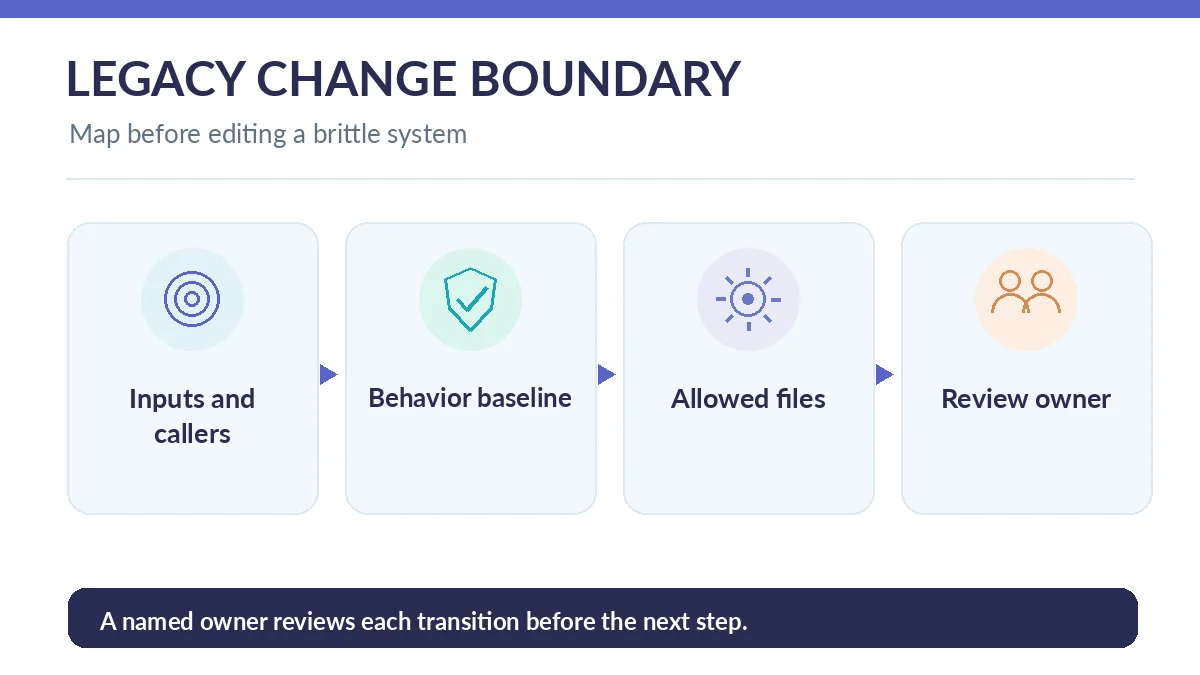
Inventory what must not change
Start with the runtime, language version, deployment process, database schema, integrations and known brittle behaviors. Confirm the main user journey by tracing an entry point to the output it produces. Write down which logs, fixtures and sample inputs are safe to share with a model. Do not paste production secrets or customer records into prompts.
A payment integration illustrates the stakes: changing a parser could alter how a harmless-looking field is rounded or rejected. List supported inputs, old edge cases and the required response format before asking for a rewrite. The goal is to make an invisible contract visible.
Create a reproducible baseline and backup
Record the current Git commit, dependency lockfile, build command, unit-test results and observable output for a few representative fixtures. If no test suite exists, preserve example input-output pairs before refactoring. If a build cannot run, document the blocker; a green-looking AI explanation is not a replacement for an actual baseline.
Make a small clean branch and record any environment assumptions. Version-control history is the durable rollback mechanism, not a conversational undo control. Some agents offer local checkpoints, but those can miss manual edits and are not a substitute for a reviewed Git commit.
Ask the agent for a read-only dependency map
Begin with a question: “Which files implement this validation route, what calls them, and which tests cover the affected branch? Cite paths and lines; make no edits.” A useful response lists likely functions and openly marks unknown behavior. Cross-check every file and dependency before promoting the map to an implementation plan.
GitHub documents repository-level custom instructions for project conventions, while Claude Code offers a plan mode with read-oriented behavior. Use the controls available in your tool to force an analysis step. Do not grant broad write or shell privileges just to ask where the logic lives.
Define a change with one narrow acceptance test
For example, “Correct date parsing for an explicit timezone offset without changing the accepted default input format.” Create tests for the new expected behavior and the old preserved cases. State the files the agent may modify, prohibited external calls, and the command you will run locally to validate the proposal.
Avoid a broad request such as “modernize the module.” It combines architecture, style, dependencies and behavior into one unreviewable patch. You can approve a future modernization roadmap, but first make the bug fix small enough to understand by inspecting one focused diff.

Review the patch as a behavior change, not prose
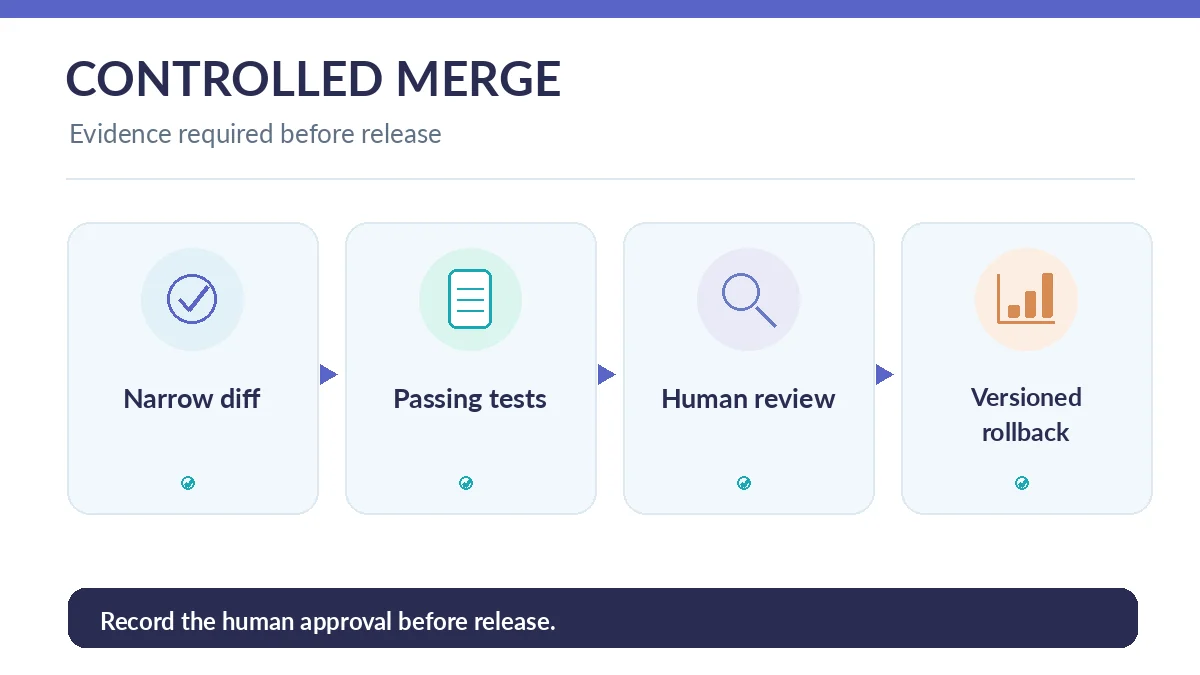
Require the assistant to show the edited files, new test coverage and assumptions. Check public interfaces, error handling, logging of sensitive data, locking, timeouts and failure behavior. Search for surprising package additions, changed environment variables and generated files. A successful build is necessary but not sufficient.
Keep the AI’s rationale adjacent to the actual diff. Ask a maintainer who knows the integration to review it, especially when tests cover only happy paths. A tiny patch that preserves compatibility may be preferable to an elegant rewrite that silently changes existing callers.
Exercise adverse inputs and dependency boundaries
Test null, empty, malformed, high-volume and duplicate inputs where they are relevant. Use sanitized fixtures from production incidents if permitted. Check which downstream integrations expect exact error codes or field names. These regression details are often absent from generic coding examples but crucial to an older service.
Consider a parser that now accepts an extra format. Does a serializer elsewhere assume the old result type? Does monitoring expect the original exception? Document those effects, not just the new passing test. When uncertainty remains, prefer a feature flag or a staged rollout with rollback instructions.
Control tool permissions and data exposure
Repository-reading agents may send prompts and selected code context to service providers. Review your organization’s data classification and each product’s privacy settings. Cursor documents Privacy Mode; it reduces specified training uses but does not mean no context leaves the machine. Restrict connected tools and keep credentials out of the repository.
Approve shell commands and edits using the least privilege suitable for the task. Do not let an agent run migrations, deploy releases or access production resources merely because it can write code. A separate operator should authorize effects outside the checked-out working tree.
Merge only after a transparent handoff
Close with a short pull request describing the original bug, the preserved behavior, new tests, side effects and rollback procedure. Add links to tickets or approved specifications, not an assertion that the agent “verified everything.” Reviewers need evidence they can reproduce without access to the model conversation.
If the patch fails or reveals an undocumented requirement, restore from the branch or commit and revise the acceptance test. Small validated changes compound into a safer modernization path; autonomous large-scale rewrite requests make uncertainty compound instead.
How We Research
We checked official GitHub Copilot repository instructions, agent-mode guidance, Cursor checkpoints and privacy explanation, plus Claude Code permission-mode documentation on October 26, 2026. Our workflow is a precautionary editorial synthesis; no legacy application was modified, measured or security-audited by us.
Frequently Asked Questions
It can map files and propose hypotheses, but unknown customer contracts and historical edge cases still require real maintainers, fixtures and verification.
Request a read-only path-and-dependency map, a narrow acceptance criterion, relevant tests and a list of allowed files or commands.
No. Cursor explains checkpoints are local undo snapshots for agent changes, not Git history or a complete record of manual edits.
Usually isolate unrelated failures first. Combining regression repairs with a feature change makes causality and rollback harder to establish.
Do not assume so. Database migrations need separate backups, schema review, staging validation, explicit authorization and an operational rollback plan.