
Why an empty log search can be misleading
A nonprofit museum sends RSVP reminders through Google Cloud Tasks. A volunteer searches Cloud Logging after a complaint and sees no entry for a particular reminder. It is tempting to conclude that the task never ran, but that inference is unsafe when queue-level logging is sampled. In a different failure, the team turns logging up to a high rate and discovers that diagnostic messages expose visitor identifiers in a broad workspace. The operational problem has two halves: collect useful evidence without collecting unnecessary personal data, and distinguish a sample of attempts from an authoritative record of what the application actually did. The diagrams use fictional events, not captured production logs.
What stackdriverLoggingConfig really configures
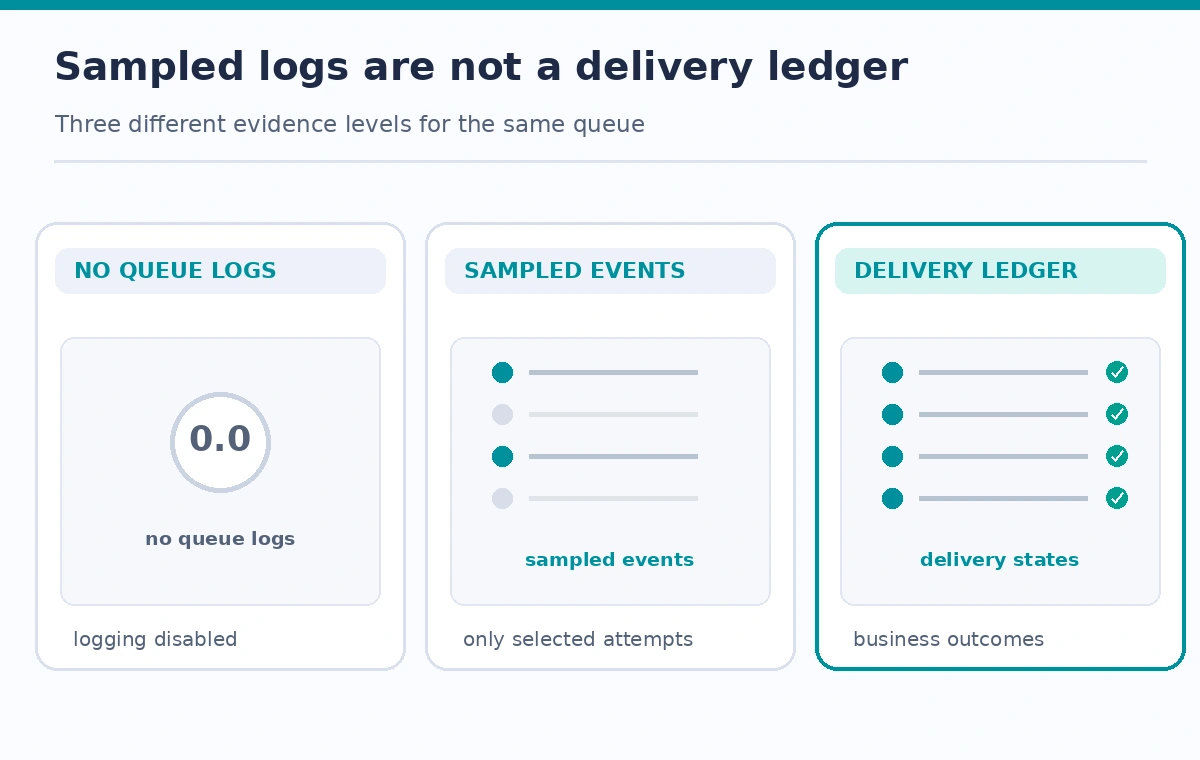
The Cloud Tasks v2 Queue resource includes `stackdriverLoggingConfig`, containing a `samplingRatio` number between 0.0 and 1.0 inclusive. The documentation describes 0.0 as the default, meaning no operations are logged when that configuration is absent or zero. Intermediate values select a fraction of operations for logging; 1.0 requests logging for all applicable operations. This is queue-level logging behavior, not an RSVP-delivery guarantee and not a setting that changes retry timing. Google uses the historical Stackdriver naming in the API field even though the product is now called Cloud Logging. Do not confuse the API field with an application logger that emits business events.
Inspect the existing queue and protect unrelated settings
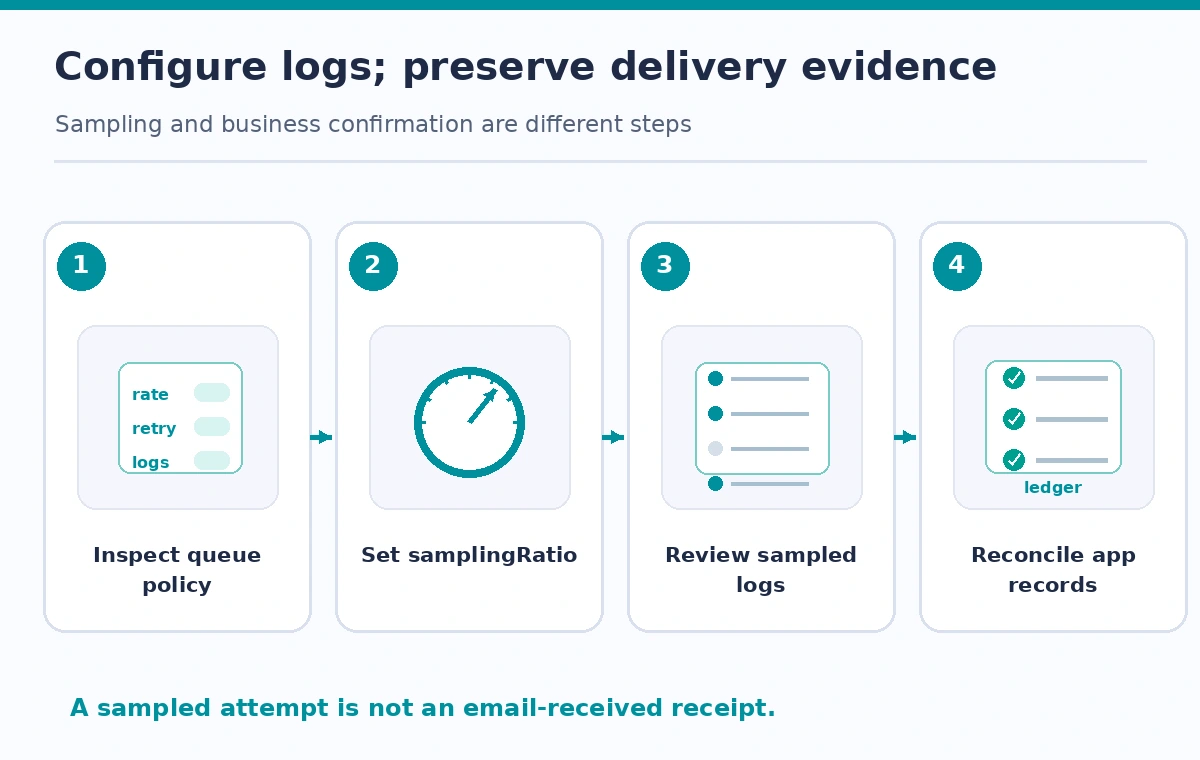
Before changing anything, read the queue configuration and retain its current name, state, rate limits, retry configuration, routing target, and logging settings. Agree on a diagnostic window and a proportionate sampling rate with the service owner. If you update a queue using `queues.patch`, specify an `updateMask` limited to `stackdriverLoggingConfig.samplingRatio` where supported by your client and API schema, and verify the resulting configuration. A broadly constructed patch can overwrite unrelated settings if implemented carelessly. Never adjust dispatch concurrency as a supposed fix for missing log entries; it may change actual service load and retry behavior instead of observability.
Start with a narrow, synthetic diagnostic case
Prepare an approved test reminder addressed to an internal sink or fake recipient, not to a real museum member. Attach a task ID that can be cross-referenced without exposing email addresses in log messages. Note creation time, scheduled time, webhook endpoint, and a test-case label. Run the test while keeping the logging configuration and application release fixed; otherwise a changed handler and a changed sampling rate make troubleshooting ambiguous. Confirm the team has access to the relevant Cloud Logging project and retention window. An empty viewer might reflect permissions, filters, timing, or sampling rather than a task delivery failure.
Interpret sampled attempts and the absence of a record
A sampled log can show a dispatch-related event that merits inspection, but it does not certify that the visitor received or opened an email. Conversely, the absence of one task in logs is consistent with sampling and cannot establish that it never dispatched. Retries also complicate interpretation: one logical task may correspond to more than one attempt when the handler times out or returns an error. Compare event times and stable task names with the worker’s own receipts. Avoid extrapolating a precise delivery success rate from an ad hoc handful of log entries. Sampling can support diagnosis while remaining unsuitable as the sole audit mechanism.
Create an application-side delivery ledger
For proof-oriented workflows, write a minimal, access-controlled record in the service that processes the task: stable task identifier, handler attempt, idempotency outcome, timestamp, and the provider acknowledgement when one exists. Keep separate states for queued, attempted, processed, and downstream confirmed. A 2xx HTTP response generally indicates the task handler completed successfully from Cloud Tasks’ perspective; it need not mean a human read an RSVP or a notification provider delivered a message. Correlate a sample of queue logs with this ledger to understand retries and gaps. Apply retention limits to both sources and avoid storing message bodies when a reference ID is sufficient.
Review cost, privacy, and retention before raising the ratio
Increasing a logging ratio may increase log volume, storage and analysis needs, but the exact financial effect depends on traffic and Cloud Logging billing. Keep sensitive payloads and credentials out of diagnostic fields and avoid expanding viewer access just because support staff need an answer. Restrict access by role and document the approved retention period. If you temporarily set the ratio to 1.0 during an incident, set an owner and a reversion checkpoint, then verify the later configuration rather than assuming someone will remember. Logging fewer events is a cost and privacy choice, not a declaration that omitted operations did not happen.
Run a reconciliation instead of publishing a green dashboard
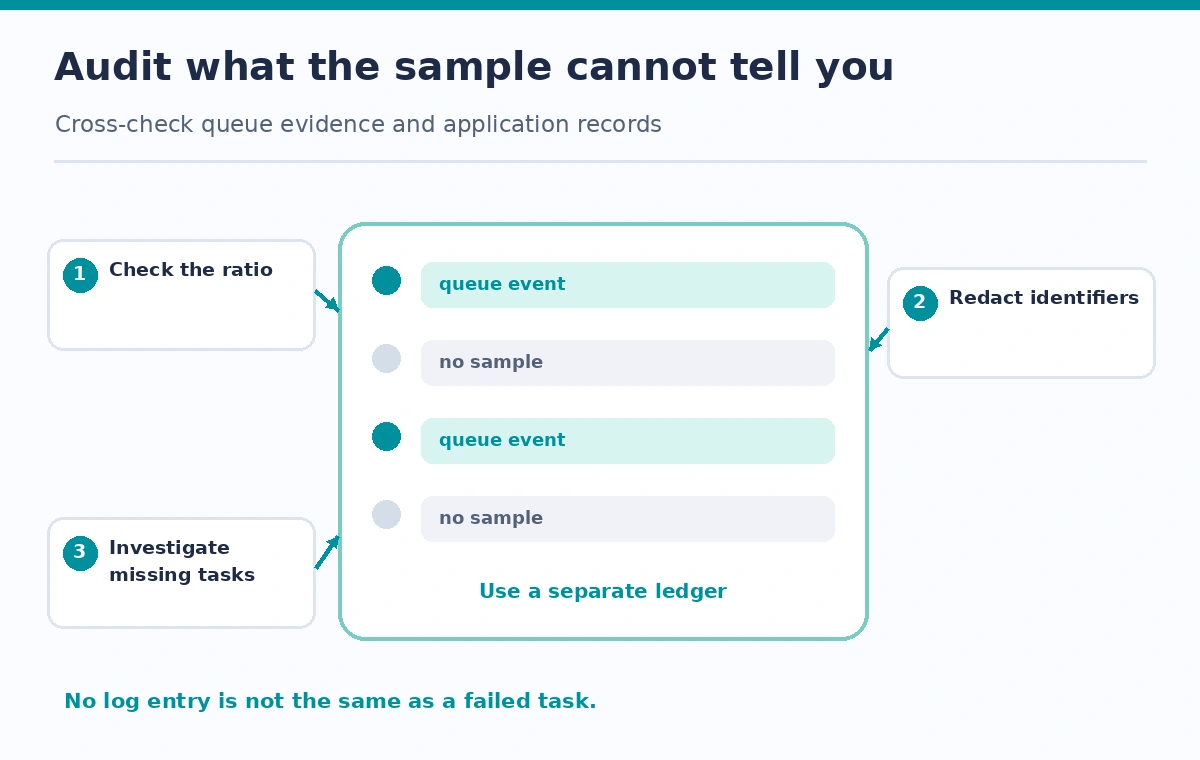
At the end of the diagnostic window, compare tasks created with handler ledger entries, idempotency outcomes, and downstream confirmations, where available. Split unknown tasks from failed and confirmed tasks rather than forcing every case into success or failure. Select specific unknown IDs for follow-up in the Cloud Tasks console or API, recognizing that completed tasks may no longer be listed. Record the configuration version and log filters used for the investigation. If the team cannot reconcile a task because its records were sampled out or expired, state that limitation plainly rather than turning a blank log query into an optimistic health signal.
Mistakes that turn sampling into false certainty
A dashboard can mistake log entry counts for unique task counts, or compare two periods with different sampling ratios as though their totals are directly comparable. Another mistake is to assume setting samplingRatio to one also produces authoritative business acknowledgements. Yet another is to include patron contact data in task names, then replicate those names throughout searchable logs. Prefer opaque identifiers, reviewed filters, and a small operational ledger. Queue logging helps engineers investigate the mechanism; business delivery evidence must come from the responsible application and, when relevant, its downstream provider. Keep those claims separate in incident reports.
How We Research
We read the official Cloud Tasks v2 Queue resource and the v2 RPC reference for the StackdriverLoggingConfig field and its allowable sampling ratio. The museum workflow, comparison, and example IDs are conceptual. We did not configure a Google Cloud project, inspect private logs, or collect delivery metrics. Specific logging entries and Cloud Logging charges can vary; verify current console behavior, permissions, and your own application semantics before relying on the procedure.
Frequently Asked Questions
No. It controls what portion of applicable operations is logged. A delivery success rate requires a separately defined denominator and authoritative processing evidence.
No. The logging setting does not pause or purge the queue; it determines whether queue operations are written to the logging service.
No. Sampling, filters, access rights, and retention can all explain missing entries. Cross-check task and handler records.
Avoid doing so by default. Prefer opaque task identifiers and redacted diagnostics under controlled retention and access policies.
No. Queue logging describes operations, not an external inbox or a person opening a message. Use downstream confirmation when available.