
A thumbnail request can lose the label that matters
A museum has a high-resolution photograph with a rights statement, a credit line, and an accession reference stored as object metadata. A web contractor needs an exhibit derivative and suggests copying the original to a public-preview prefix while changing Content-Type or cache behavior. The risk is that the operation treats metadata as replaceable decoration. Amazon S3 CopyObject supports a MetadataDirective that controls whether metadata is copied or replaced. In the wrong workflow, a derivative may exist with the correct pixels but without labels that a publication review depends on. This hypothetical case does not establish that S3 metadata is the museum’s canonical rights database; the authoritative rights record must remain independent of the cloud object.
Inventory user-defined and system-controlled fields
Before a copy, inspect the source object’s key, version where applicable, user-defined x-amz-meta fields, and user-configurable system metadata such as Content-Type or Cache-Control. Distinguish fields you can configure from system-controlled fields S3 generates. Amazon documents that copying an object resets certain system-controlled metadata, such as the object’s creation timestamp. Record a source hash or other integrity evidence using a suitable approved method; do not assume an ETag is always a simple content checksum for every upload method. If the derivative changes image content through a separate processing step, record that transformation as provenance too. The metadata inventory should include mandatory legal and attribution information, not only display preferences.
Understand the default COPY behavior
In CopyObject, x-amz-metadata-directive can be COPY or REPLACE; AWS documents COPY as the default when the header is not provided. Under COPY, source metadata is copied to the target as described by the service. For an unchanged object copy, this is a reasonable starting point when the goal is to preserve current user metadata. It does not mean destination bucket policy, encryption configuration, object ownership, access controls, replication configuration, or publication permission are automatically identical. A copy into a different bucket may have a new version ID and new security context. Verify those conditions separately. Most importantly, do not assume a rights label being present is proof that rights clearance exists.

Why REPLACE needs the entire selected metadata set
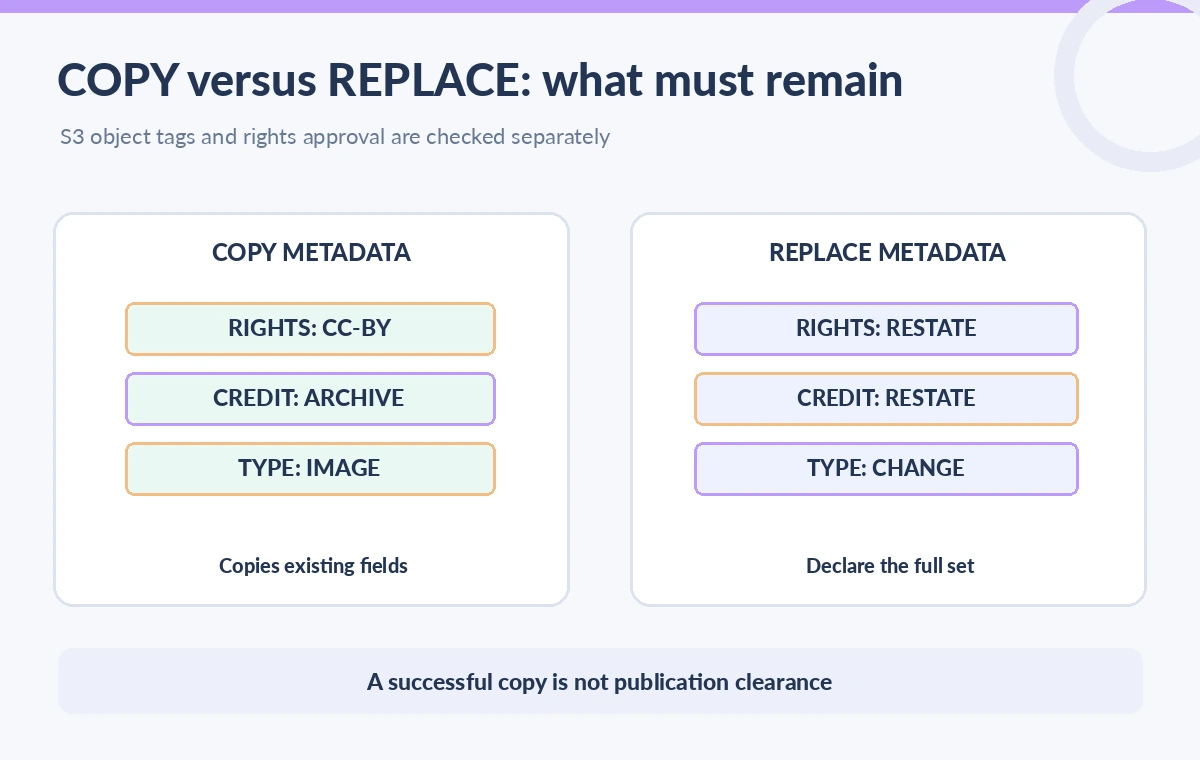
When staff want to change a user-configurable metadata field during a copy, AWS says they must explicitly specify all the user-configurable metadata values that should remain, even if they intend to change only one. Treat REPLACE as a full metadata declaration, not a one-field patch. If the source carries rights-holder, credit, permitted-use, source-accession, and display-restriction values, list and review each field before requesting the derivative. Then include the intended target values in the copy request. This is where a preflight checklist helps: confirm every required key has an approved target value and distinguish deliberate removal from accidental omission. The process drawing follows source inspection, directive choice, and target inspection.
Object tags and other controls are separate decisions
S3 object tags are distinct from user-defined object metadata, with separate copy behavior and controls. An application that uses tags for lifecycle or review holds must inspect those settings independently instead of assuming MetadataDirective alone determines every property of a copy. The same applies to server-side encryption, storage class, retention, and destination bucket permissions. A derived image might need a more restrictive access policy than the original if its preview contains an unreleased exhibit. Conversely, placing a copy in a public prefix should never be used as an implicit license approval. Map the intended distribution channel and enforce the authorization check before the copy reaches any public-facing service.
A side-by-side test exposes missing rights labels
The comparison diagram shows two conceptual paths. Under COPY, the illustrated derivative keeps the source’s rights and credit metadata when those fields are copied. Under REPLACE, a second illustration shows why changing one header while omitting required user metadata would leave an incomplete target. This is not a screenshot from the S3 console or a measured test. The lesson is not that REPLACE is inherently wrong; it is useful when metadata must be deliberately updated. The lesson is that the full approved metadata set needs to be declared and checked. Name the output version so reviewers can distinguish it from the preservation master and from earlier preview versions.
Apply version-aware, failure-aware copying
If versioning is enabled, identify the exact source version and record the destination version ID after the copy. Reusing only a filename can select a modified source after a rights team approved a previous one. Check copy completion and service errors rather than assuming the destination is complete because an HTTP request began. AWS documents special handling for copying large objects: a single CopyObject operation is limited, and larger objects use multipart copy patterns. An exhibit’s web-sized derivative may be small, but the original master can be much larger. Keep the source and destination paths, version identifiers, request configuration, and authorized reviewer in a private audit record.
Review preservation and security implications
Replacing metadata on the same key can create a new object version in a versioned bucket, but it should not be treated as the routine way to edit preservation records. Keep master provenance and approved rights details in a dedicated catalog system, with controlled synchronization to object metadata for operational use. Avoid updating hundreds of archival objects with an unreviewed bulk rule merely to fix a website cache header. Also examine whether object tags trigger retention or lifecycle policies in the target bucket. A correct derivative is one whose content, labels, access controls, and version identity all satisfy the publication workflow. None of those conditions can be inferred from a single success code.

A release checklist for the derivative
Use a synthetic test file carrying multiple metadata keys, a known Content-Type, and a test tag. Make an unchanged copy using default behavior, then make a separate controlled REPLACE copy that explicitly restates the full approved metadata set. Inspect both target objects with authorized tools and compare user metadata, configurable headers, tags, version identifiers, and access policy expectations. Record differences before a production copy. Finally, make the rights reviewer approve the intended audience and derivative, not simply the API command. Do not rely on a public image URL as a rights record. The safety illustration marks the rights label, content headers, and target version as three separate inspection points.
How We Research
Our primary named official sources were: Amazon S3 CopyObject API reference; Amazon S3 copying objects user guide; Amazon S3 edit object metadata user guide. We compared Amazon’s CopyObject API reference with its object-copy and metadata-editing guides. We did not copy an image, read a bucket, inspect rights records, or test multipart copies. All diagrams are explanatory and avoid asserting observed API responses. Readers should verify current deployment-specific documentation and their own permissions before adopting a workflow. Any figures are original instructional diagrams, not actual vendor screenshots or observed results.
Frequently Asked Questions
AWS documents COPY as the default when x-amz-metadata-directive is omitted from CopyObject.
No. The operation must explicitly supply the user-configurable metadata you want to retain when replacing a field; accidental omission can leave a target without needed labels.
No. Tags are a separate object property with their own copying and lifecycle considerations. Check tagging behavior independently.
Only with a deliberate versioning and preservation plan. Reusing a key can affect the current version and is not a substitute for a distinct derivative workflow.
No. Rights approval must come from authoritative collection records and an authorized reviewer, irrespective of object metadata or copy success.