
Why a stateless grant review needs an explicit history
Imagine a small nonprofit processing fictional grant eligibility questions. A caseworker submits a policy excerpt and asks for an initial summary, then follows up about an exception. In a stateless Responses API workflow, the application is responsible for supplying the prior conversation items on the next call. If it only sends the latest question, the model might lose which policy edition and applicant category were under review. Stateless processing is a storage and application-design choice, not a guarantee that one request will remember another. Keep a source register with the document version, effective date, approved access scope, and the relevant exception. This source register, rather than a model-generated explanation, is the evidence against which every later answer must be checked.
Understand what an encrypted reasoning item carries
The OpenAI reasoning documentation describes reasoning items that can be carried forward between Responses API requests. In stateless mode, including requests with store set to false, reasoning output items include encrypted_content by default in the current API documentation. This value is opaque to the application: it is not a readable chain of thought, a user-visible explanation, or an extract of the grant policy. The API still accepts the legacy include value reasoning.encrypted_content for compatibility, but the current guide says that explicit inclusion is no longer required for stateless responses. Record the model and API behavior you actually use, because older examples may show different switches. Never claim that decrypting or examining these items provides independent proof of eligibility.

Preserve complete input and output item ordering
For a controlled follow-up, retain the original input items and all output items from the preceding response, preserving their sequence. Append the next user message rather than editing earlier model or tool content to make the history shorter. The preserved-reasoning guidance explains that changing an earlier history prefix can cause related reasoning to be dropped in newer models. That behavior matters when a source excerpt is corrected: a new policy version should be introduced as a new, explicitly dated item, not silently substituted inside an old transcript. Keep the full source file in a separate protected store with an immutable reference. An encrypted reasoning item does not replace an application audit log, a signed decision, or a source document.
Choose a compatible model and reasoning context
Reasoning continuity depends on model support and the effective reasoning context mode. The documentation distinguishes current_turn and all_turns, and notes model-family compatibility requirements. In a staged integration, inspect the effective reasoning.context value returned for the model you selected rather than assuming a default will remain the same. A switch across incompatible model families can omit earlier reasoning from the model context. This does not necessarily mean the API request failed; it means the application must not rely on inaccessible prior reasoning to defend a decision. Plan a fallback that reintroduces the permitted visible source material and restates the review question from scratch when context cannot be reused.
Treat tool results as part of the source record
If a model calls a search or database lookup during the grant review, preserve the tool call and the actual tool result in the replayed sequence where required. A tool failure is not an empty successful lookup. Store a separate application event with the tool name, query scope, authorized collection, success or failure, and a durable reference to the source returned. Never expose a full private applicant record merely to simplify the model’s context. The next model message should distinguish verified source passages from generated commentary. If the grant policy changes while a review is open, query the current approved edition again and show the difference. Reasoning continuity helps preserve context, but source freshness and permission checks remain independent obligations.
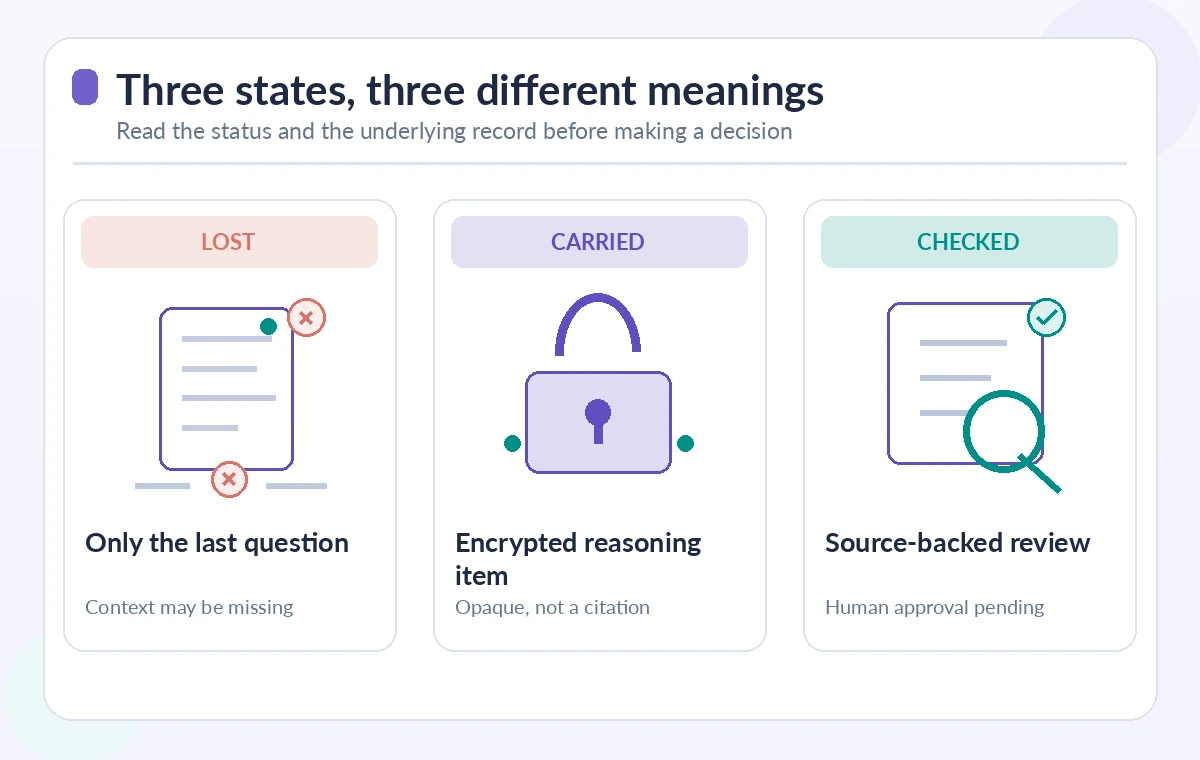
Compare three continuation outcomes honestly
A conceptual comparison can show a follow-up sent with only the latest question, a follow-up sent with the complete sequence including encrypted items, and a final staff-reviewed response connected to the actual policy section. These are workflow states, not measured accuracy improvements. The first may lack important context; the second may preserve compatible opaque reasoning; the third requires evidence review that neither earlier state guarantees. Do not present sample badges such as “verified” until a human has checked the applicable rules, source dates, and exception boundaries. An auditor should be able to recreate the visible conversation from retained records without needing to understand or decrypt the private reasoning token payload.
Protect the stored history outside the API
Setting store to false does not remove the need for a retention design inside your own application. If you preserve encrypted reasoning items and input history locally, those records become part of your institution’s information-security inventory. Limit access by staff role, encrypt data at rest and in transit, set deletion periods, and test removal. Do not put private case identifiers into publicly visible log lines or screenshot examples. The opaque item is not necessarily a safe substitute for a data classification review: it can still be sensitive workflow material and should be controlled accordingly. Confirm actual vendor data handling and your organization’s retention requirements rather than equating a single API flag with legal compliance.
Build a failure-safe review interface
Show a caseworker three distinct status values: model response completed, source evidence checked, and decision approved. In the fictional workflow, the model may produce a plausible summary while the source registry has an unresolved eligibility exception. The interface should leave the item pending, display the exact document section requiring inspection, and offer an option to restart with a clean visible context when preserved reasoning is unavailable. A blank or malformed encrypted reasoning field should not be filled with a guessed value. Likewise, if tool output was truncated or unavailable, the interface must say so before allowing a reviewer to accept a proposed summary.

Run a synthetic regression before release
Prepare synthetic policy cases covering an ordinary rule, an exception, a corrected source, a failed lookup, and a model-family switch. For each case, compare the actual submitted item order with the application log and verify that the new question is appended without silently rewriting history. Inspect the reported reasoning context and confirm whether supported items were carried, then independently review every factual claim against the policy PDF. Record the exact endpoint, model identifier, SDK, and test date in an internal report. These instructions describe a test plan; they do not claim that LabFin ran a live API evaluation or measured a performance benefit. Ship only after privacy and editorial reviewers approve the handling of retained histories and source links.
How We Research
We reviewed the following named first-party technical references for the documented behavior and constraints: OpenAI reasoning models guide, OpenAI preserved reasoning guide, OpenAI Responses migration guide. The article connects these documented mechanisms to a hypothetical museum or nonprofit workflow. We did not execute a live production service, inspect private customer accounts, measure API performance, verify a real archive or run an institutional penetration test. Diagrams show instructional states, not real screenshots or observed measurements. Before using this process, confirm current API and SDK versions, availability, pricing, data handling and identity permissions; reproduce the failure cases in an authorized staging environment and obtain human editorial or security approval.
Frequently Asked Questions
No. It is opaque reasoning context for the API, not a readable explanation, policy citation, or audit transcript.
Current OpenAI reasoning documentation says stateless responses include encrypted reasoning content by default; the legacy include option remains accepted for compatibility.
No. The application still controls how its input, output, source references, and encrypted items are stored, accessed, and deleted.
Not necessarily. Compatibility is model-family dependent; reintroduce visible source context and verify the effective reasoning mode.
No. A person must verify policy language, eligibility evidence, dates, and authorization before a grant decision is approved.