
One Interview Can Arrive as Several Objects
A community archive receives a licensed oral-history recording in sequential audio parts produced by a controlled export process. The archive wants to assemble a single file before transcribing and cataloging it. Google Cloud Storage Compose can concatenate existing objects into a composite object in the order specified. The word concatenate matters: Compose does not decode audio, repair headers, align speech or verify that the segments form a playable audio file. It joins object bytes. If a segmented format cannot be concatenated safely, assemble and validate it with an appropriate media tool before storage. An archive should treat a list of intended part names, byte sizes, checksums and source generations as part of its ingestion manifest rather than relying on a folder sort order.
Understand the 32-Source Compose Limit
Google documents that a single Compose request combines between one and 32 source objects. The operation creates a destination object while leaving source objects intact unless a separate cleanup later removes them. If an interview has more than 32 pieces, the application must plan a staged composition tree rather than quietly dropping later parts. That tree needs an explicit manifest recording which component outputs were combined and in what order. A component-count field exists on composite objects, but it is not a substitute for your complete source map or playback verification. Do not claim that a single API call supports an unlimited number of parts. Confirm object permissions and any storage-class charges before choosing a temporary assembly strategy.

Freeze the Source Generations Before Assembly
Two object paths can look identical while their generations differ. An editor might replace a damaged segment between the moment your list is built and the moment Compose runs. Google recommends generation-specific source names or protections against such races. Record the generation of every intended part and use the supported source-generation matching conditions or immutable staging names where practical. Protect the destination name with a generation precondition so an automated rerun cannot silently overwrite a previously reviewed master. If one segment changes, stop and generate a revised manifest. The correct response to a conflict is reconciliation, not forcing the composition to succeed with whatever happens to occupy the familiar path.
Validate CRC32C Instead of Trusting an MD5-Looking ETag
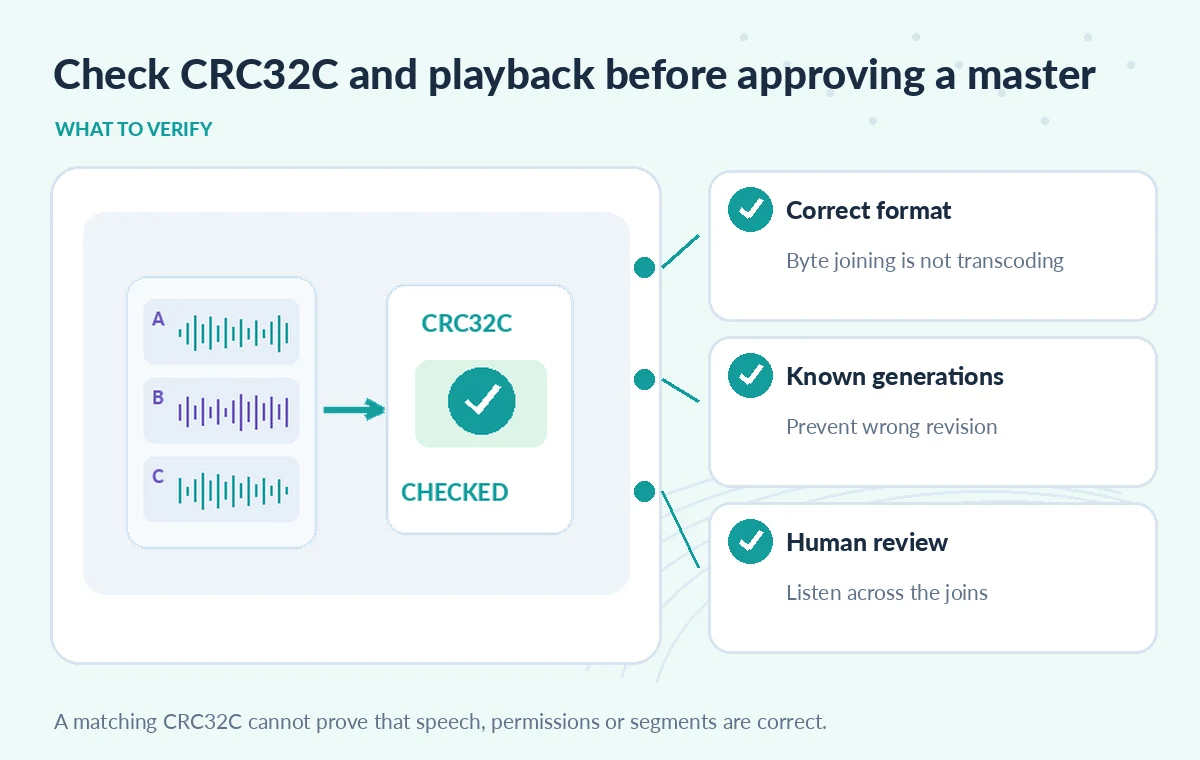
Composite objects have important checksum differences from ordinary uploads. Google Cloud Storage documents CRC32C as the integrity mechanism for both uploaded source objects and composite results. The ETag of a composite object is not guaranteed to be an MD5 of the object bytes; software that assumes an ETag is an MD5 can raise misleading corruption alarms. Compute the CRC32C of source uploads and compare it with the stored values. After composition, inspect the returned composite CRC32C and verify a downloaded copy using a compatible CRC32C implementation. A checksum detects some corruption and transfer errors but cannot confirm that the parts are in chronological order or that the speaker’s permission covers this recording.
Compare a Clean Assembly With Two Dangerous Shortcuts
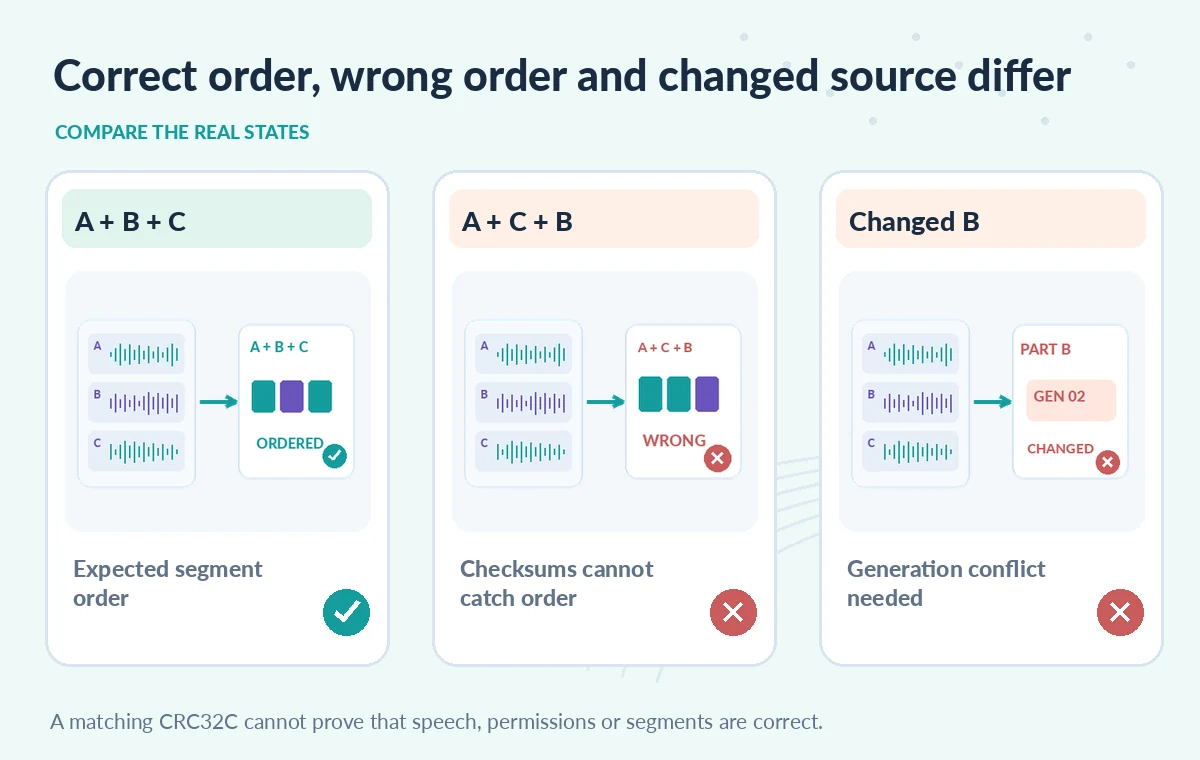
Imagine three teaching cases. In the first, a manifest specifies A, B and C in that order and the stored source generations match; Compose produces the expected byte sequence for a format designed to be concatenated. In the second, a lexicographic sort places part 10 before part 2. The bytes may be intact while the interview chronology is wrong. In the third, part B is overwritten after the manifest was prepared, so the output may contain a different revision. These are conceptual comparisons rather than measured outputs. A release checklist needs both machine-verifiable object integrity and human inspection of the content timeline, with known start and end points for each segment.
Plan Temporary Object Cleanup Without Losing Evidence
Source objects remain in the bucket after Compose, which is useful for rollback. Immediate cleanup is not automatically free or reversible: storage-class minimum durations, soft delete and versioning can affect cost and retention behavior. Identify a staging prefix and define when a source component can be removed after the composite is validated and the retention policy satisfied. Do not apply a broad lifecycle rule that also matches the approved master. Keep the ingestion manifest and relevant checksums in a controlled evidence store. If storage policy requires source preservation, the cleaner may do nothing. Data minimization and archival preservation are separate decisions that a project manager should make explicitly.
Remember That Byte Integrity Is Not Audio Correctness
Suppose the audio parts were encoded as self-contained files with independent headers. Plain concatenation may create a technically valid object that many players cannot interpret as one continuous recording. Before using Compose, establish that the source format and export procedure make byte concatenation appropriate. Where necessary, create a media-safe assembled file using a trusted audio pipeline and upload that validated result instead. Run a lightweight playback and duration inspection using tools the archive already trusts. Compare boundary samples and timestamps against the source manifest. Do not invent acoustic quality scores or claim the tutorial ran an actual speech-transcription benchmark.
Exercise a Generation Conflict and a Wrong-Order Test
In a sandbox bucket with synthetic audio bytes or simple test payloads, upload three numbered parts with known checksums. Compose them in the intended order, download the composite and compare its CRC32C with the recorded value. Now prepare a manifest, replace one source object and attempt the protected request. Verify your application detects and reports the generation conflict. Separately compose the same parts in the wrong order and demonstrate that integrity alone does not detect semantic order mistakes. Ensure the destination generation protection prevents accidental replacement. Keep logs of test object names, expected order, source generations and pass/fail conditions without putting real interview names into public diagnostics.
Publish Only a Reviewed Composite Revision
The archive’s acceptance record should identify every source component, generation, expected order, final object generation, CRC32C and the human signoff for content and permissions. A transcription system should read only that approved object revision. If the assembly fails, leave the existing approved master unchanged and mark the candidate as incomplete. When a new source arrives, create a new candidate rather than pretending the first approved file was always correct. Compose is an efficient storage-side byte operation; provenance, media format handling, licensing and editorial quality remain application responsibilities. A reliable handoff documents these boundaries plainly for the next archivist.
How We Research
For this guide, we reviewed the official product documentation on November 8, 2026: Google Cloud Storage compose objects, Google Cloud Storage composite objects and integrity, Google Cloud Storage object metadata, Google Cloud Storage request preconditions. We checked the named setting or feature against its published behavior, mapped the documented constraints to the specific hypothetical scenario, and reviewed whether the topic duplicated titles in the supplied LabFin WordPress inventory or prior B0267–B0277 ZIPs. No authenticated vendor service was run; we did not perform a benchmark, observe real customer data, verify third-party rights or claim operational outcomes. All illustrated records and comparisons are teaching examples. Confirm product documentation and security requirements again before implementing a workflow in a real organization.
Frequently Asked Questions
Google documents 1 to 32 source objects per Compose request; larger assemblies require a staged strategy.
No. It concatenates object bytes. Ensure the source format is suitable and validate playback separately.
No. Composite-object ETags should not be assumed to contain an MD5 digest. Use CRC32C as documented.
No. Compose leaves source objects in place unless a separate operation removes them.
Record and enforce intended source generations or use immutable staging names, and protect the destination generation.