
A Search Response Can Be Available but Incomplete
A public archive search may appear to work during an infrastructure problem. A visitor types an accession number and receives two plausible results, or none at all, even though the catalog contains more eligible records. The dangerous moment is when the interface treats that response as a definitive answer. Azure AI Search has a minimumCoverage request option that helps define whether a query covering only part of an index should count as successful. It is an availability control, not a statement about whether the retrieved facts are correct.
Imagine a hypothetical museum finding aid where some index partitions become temporarily unavailable. A volunteer asks whether a collection includes a safety notice. A partial response that omits the notice should not produce “no safety notice exists.” The application needs to distinguish a retrieved record, a complete search, and an incomplete search. This distinction applies even if the user entered a precise identifier and the text returned looks well formatted.
Understand the Documented Coverage Contract
Microsoft’s Search Documents API defines minimumCoverage as a number from 0 to 100: the portion of the index that must be covered before the query is reported as successful. The documented default is 100. A lower value can keep search available under degraded conditions, but it also explicitly accepts a risk that some results will be absent. Do not lower the threshold simply to avoid reporting incidents on a public dashboard.
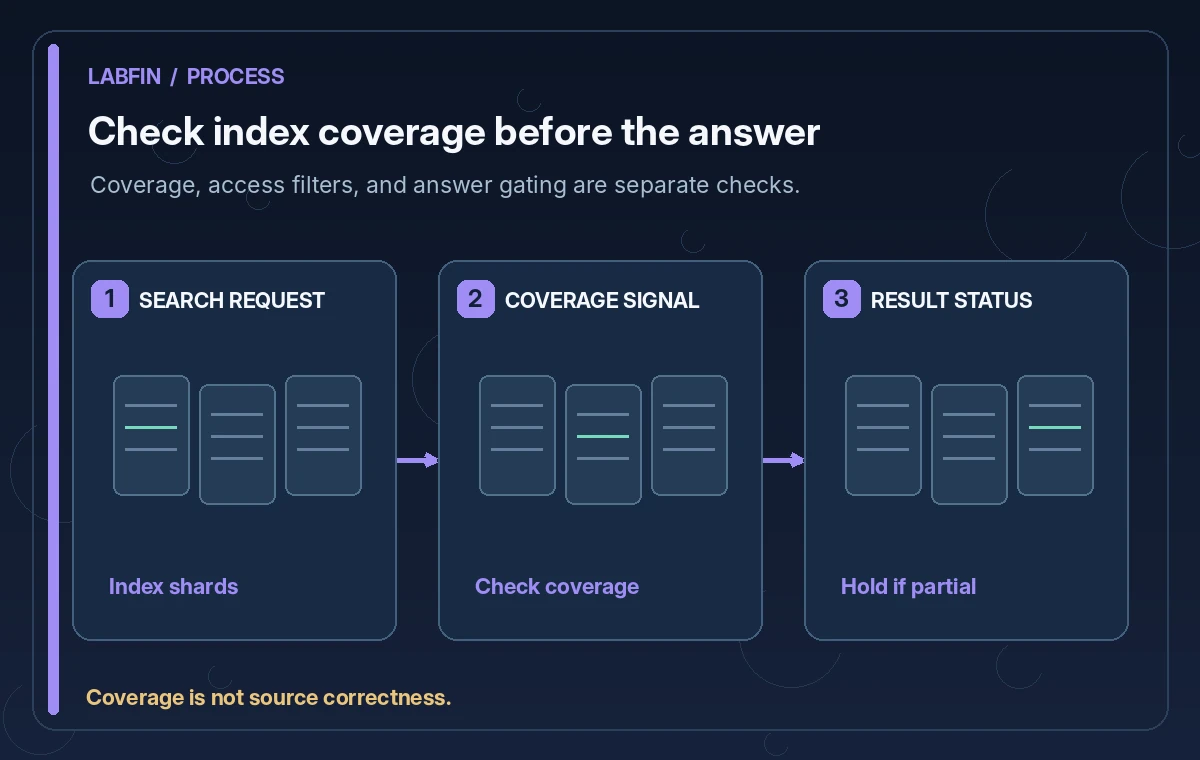
The response can contain an @search.coverage percentage when minimumCoverage was specified. The percentage is about index coverage, not the accuracy of the returned answer or the completeness of a particular legal document. A 100% coverage signal does not certify that every source record was indexed correctly, current, public or properly tagged. Treat it alongside the ingestion and permissions checks already required for the archive.
Design a Search Policy Before the Incident
Set a policy for which queries may tolerate partial results. A casual exploratory search for exhibition posters may be marked “results may be incomplete” during a service disruption. A query used to answer whether a donor license authorizes publication should require the stricter path or stop for staff review. The threshold should follow the consequences of an omitted record rather than the team’s desire for a green availability metric.
Record the request mode, timestamp, index alias or version, authorization filter, and expected response type. Use examples with invented document IDs, not a live collection identifier. A safe UI offers a degraded-search state distinct from “zero matches.” That difference should remain visible to staff even when the front end truncates results to a small first page.
Run a Query and Check the Response Envelope
When calling the API or a supported SDK, set minimumCoverage deliberately if the workflow needs a returned coverage signal. Evaluate the HTTP outcome and the structured response, including @search.coverage where present, before rendering a definitive answer. A response that lacks coverage data should be treated according to the integration’s documented configuration, not assumed to have been measured.
Do not confuse request coverage with the number of hits. A search that covers the entire index can legitimately return zero matches, while a partial search can return many seemingly persuasive matches. Also check filter correctness and result permissions. The existence of an authorized document in a returned list cannot justify revealing unrelated restricted documents or saying that unreturned records do not exist.
Compare Three Truthfully Labeled States
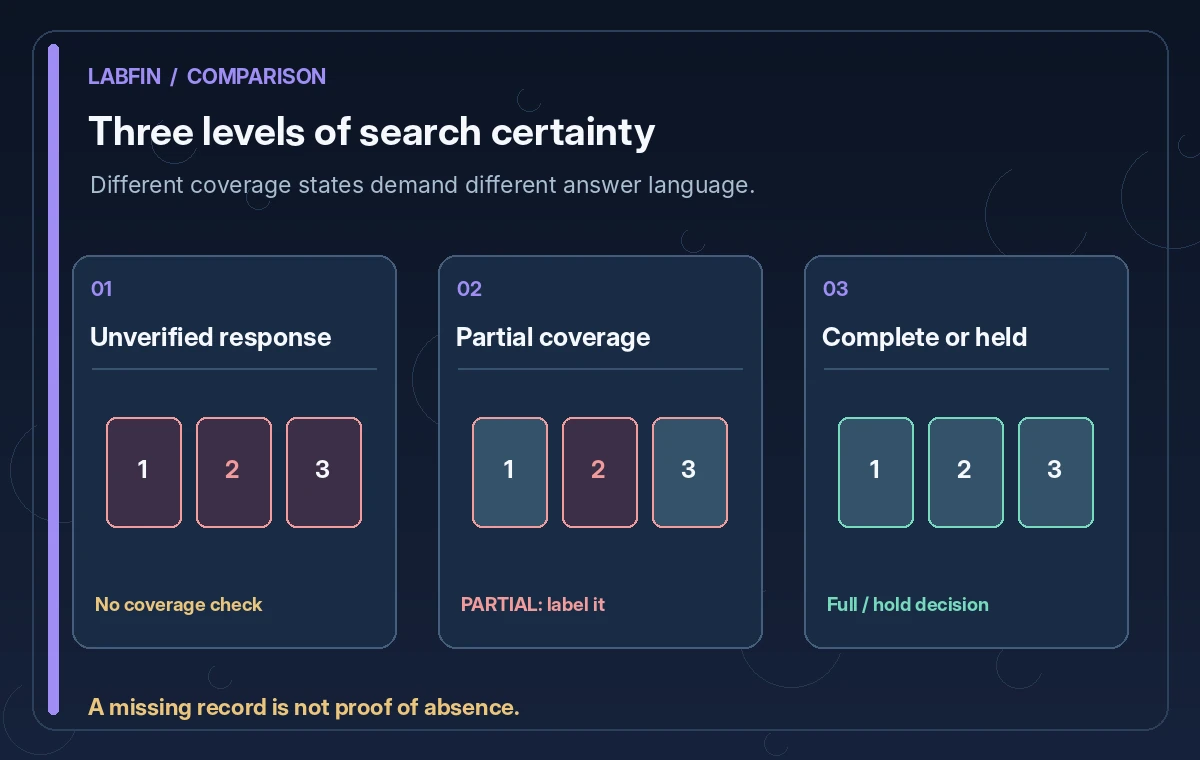
In a training diagram, show three conceptual paths: a response rendered without a coverage check, a degraded response explicitly labeled partial, and a review gate holding a high-stakes conclusion until the service returns an acceptable result. These states illustrate a possible workflow; they are not measurements from a test cluster. The visible difference is whether the user is allowed to infer absence from the search results.
For example, “We found two related guides” is defensible if those two authorized documents were retrieved. “These are the only related guides” requires a much stronger completeness claim. A low minimumCoverage can be useful to keep exploratory search functional, but it should not silently relax the completeness standard for requests about ownership, legal permissions, safety, or archival retention.
Prevent Partial Results From Becoming RAG Certainty
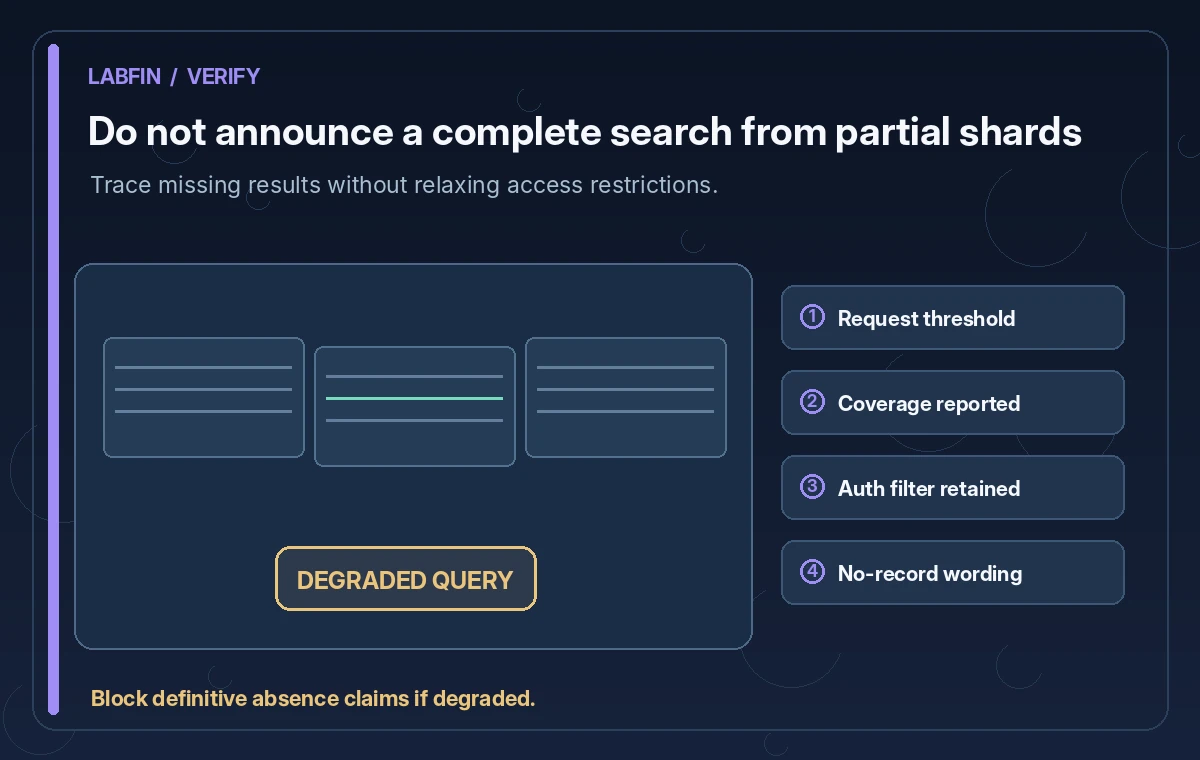
A retrieval-augmented assistant may answer with polished prose even when the search index returned only part of the available material. The model should not be given an unqualified “search complete” signal when coverage is insufficient. Pass an explicit degraded state to the application, restrict claims, and require source citations for any positive facts the system does return. Never let a model substitute its own guess for a missing record.
Use an application-controlled decision gate, not a prompt alone, to block definitive no-record statements in high-stakes workflows. Keep the underlying access filter enforced server-side. A completeness warning must not become a pretext for returning documents a patron cannot access. The model-facing summary may state that search coverage was limited, but it must not invent an outage percentage if the backend did not supply one.
Test Recovery, Monitoring and Editorial Language
Prepare test cases for a normal full-coverage response, an explicit partial response, a service failure and a zero-match query with acceptable coverage. Verify that each produces the right UI language and internal alert. Because a real outage is not required to teach this concept, diagrams should use hypothetical percentages, visibly identified as examples in alt text or surrounding prose rather than falsely attributed production metrics.
After recovery, rerun affected high-stakes searches and record the new source revision and outcome. Compare the results with the indexer execution record to rule out missing input files; search coverage alone is not an ingestion audit. If the system previously answered “no record,” treat that statement as potentially incomplete and correct it when needed. A good archive search communicates uncertainty instead of concealing degraded coverage.
How We Research
We reviewed the following official developer documentation on November 8, 2026: Microsoft: Search Documents POST REST reference; Microsoft: Search Documents GET REST reference; Microsoft: SearchOptions.MinimumCoverage SDK. We compared the documented parameters, data flow and stated limitations with this hypothetical editorial scenario. The diagrams are original instructional illustrations, not real vendor screenshots or outputs. We did not submit private archive material, run a production API evaluation, measure tool accuracy, obtain legal consent, or test a live service configuration. Product behavior, access rules, quotas and supported settings may change; confirm the latest documentation and your organization’s policies before deployment.
Frequently Asked Questions
Microsoft documents a default of 100, meaning the query needs full index coverage to be reported successful.
No. It reports index coverage for that query, not source authenticity, indexing quality, permission checks or the model’s interpretation.
Yes. Available partitions may return valid records even if other eligible records are missing. Label the search as potentially incomplete.
Not if coverage is insufficient or the index and filters have not been audited. Avoid an absolute no-record claim.
No. Set a policy based on the consequences of omitted evidence and apply an application-controlled gate for high-stakes claims.