
A volunteer-run museum kiosk uses Python packages and frontend dependencies. Routine update pull requests arrive faster than maintainers can review them, but delaying an urgent security fix could expose visitor data or destabilize accessibility controls. GitHub Dependabot’s cooldown configuration lets maintainers delay ordinary version-update pull requests by a defined period. Crucially, GitHub says cooldown does not apply to security updates. This guide creates an editorial maintenance policy rather than promising that any configuration automatically secures a repository.
Separate maintenance traffic from security work
Inventory the kiosk’s package ecosystems, supported runtime versions, deployment workflow and responsible reviewers. A standard version update can wait for an agreed review window, but a critical advisory needs a distinct escalation route. Record ownership of both channels. If security alerting is disabled or ignored, reducing routine pull requests offers little protection regardless of how elegant the dependabot.yml file looks.
Describe the risks in operational terms: a rushed dependency update could break captions, keyboard navigation or barcode scanning; a delayed security fix could leave a known vulnerability exploitable. These outcomes require different controls. The article’s fictional repository has no real CVEs or installed packages, so do not interpret its example as a vulnerability assessment of a production kiosk.
Configure supported cooldown fields
Dependabot’s options reference documents cooldown.default-days and, for supporting ecosystems, semver-major-days, semver-minor-days and semver-patch-days. A configuration may also include and exclude dependency patterns. GitHub’s docs state that the option affects version updates only, not security updates, and that version updates have a documented default cooldown of three days even when none is specified.
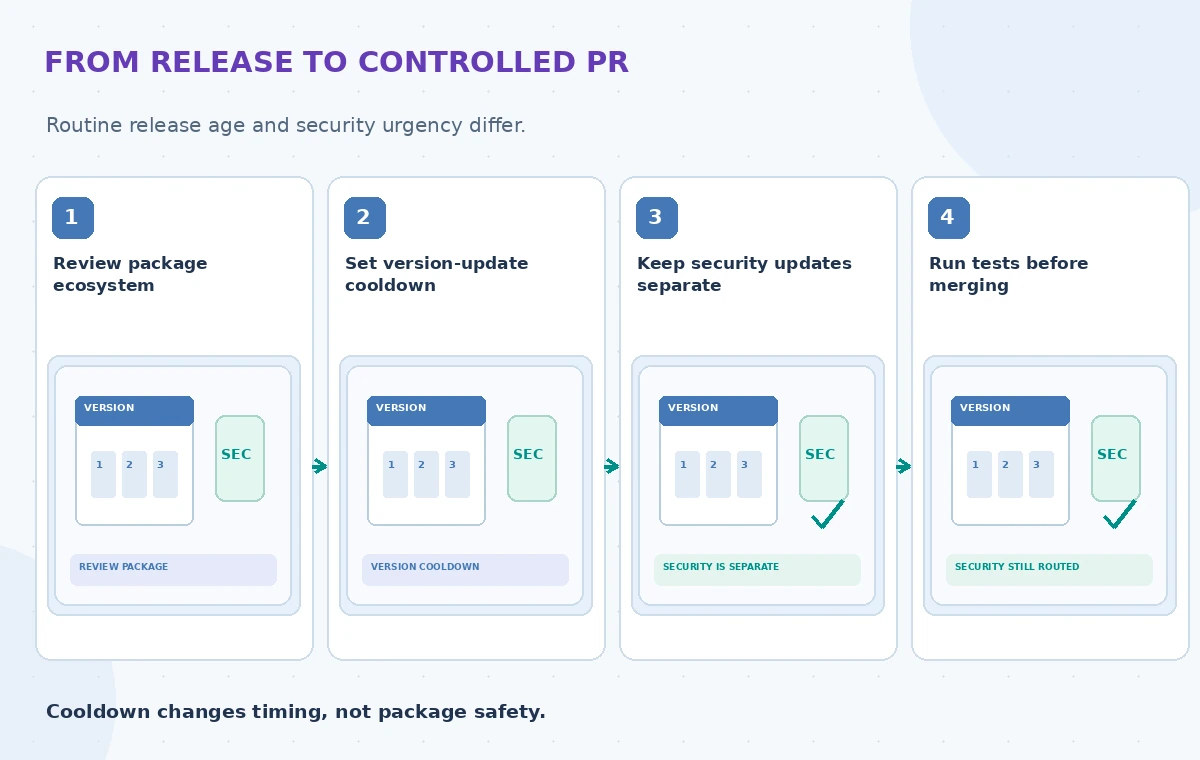
Avoid copying the same thresholds into every project. A small volunteer team might choose a longer delay for major changes but review patch releases more frequently. The final values should reflect changelog review capacity, risk appetite and vendor support windows. Confirm the selected package manager supports each field; GitHub’s support table distinguishes default-day support from SemVer-specific options.
Understand the difference between schedule and cooldown
The schedule controls when Dependabot checks for versions, while cooldown determines whether an eligible release is still too new to propose. A weekly check does not mean every package released that week will generate a pull request. Release age, the selected rule and the next scheduled scan all affect when a PR might be opened. Present dates as illustrative rather than actual GitHub run timestamps.
Set expectations with maintainers: cooldown is not a queue promising an exact future creation minute, and an outdated release might remain unproposed for other reasons. Review open PR limits, ignore rules and repository settings separately. When diagnosing a missing version PR, inspect configuration and logs rather than assuming the dependency was considered safe or automatically rejected.
Review wildcard and exclusion precedence
The current configuration supports include and exclude patterns for cooldown. GitHub documents that an excluded dependency takes precedence when the same dependency matches both lists. Test a small hypothetical manifest: requests may be delayed by a five-day rule while one explicitly excluded package follows the regular schedule. Show the decision tree in the diagram rather than presenting every package as delayed identically.
Avoid blanket exclusions that quietly make major infrastructure packages update too quickly. Conversely, do not include a package that has urgent operational patches in a slow channel without a separate security path. Maintain a review log listing which rules apply and why, and recheck your list after renaming or adding dependencies. The configuration is part of change governance, not a substitute for software testing.
Compare routine noise with an urgent alert
The visual comparison should show a new ordinary version arriving, a cooling period deferring that routine PR, and a separate security alert that still reaches a human reviewer. This distinction matters more than a dramatic reduction in PR counts. Never imply Dependabot cooldown suppresses or delays security remediation. Whether a security PR is opened also depends on repository settings, advisory data and supported package ecosystems.
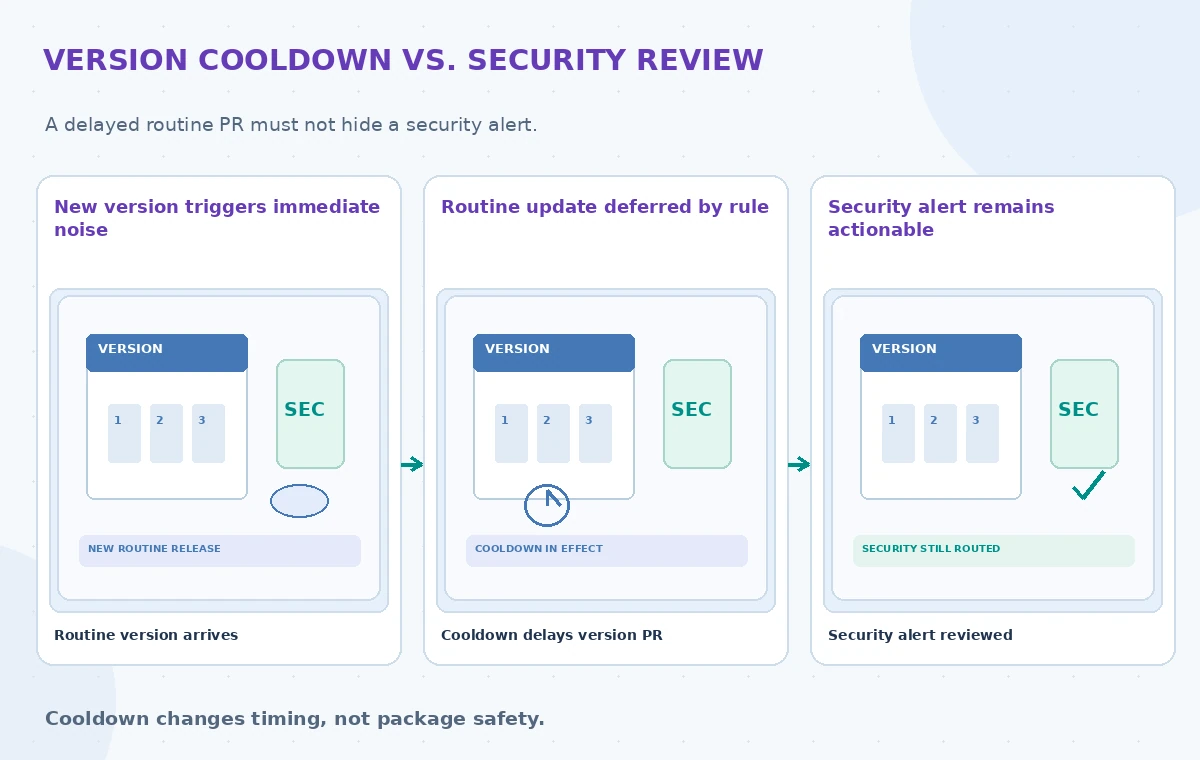
For an AI kiosk, the test plan should include keyboard-only navigation, emergency warning display, API error handling, speech input fallback and a clean deployment rollback. A routine update that breaks one of those behaviors is not ready for merge even if all unit tests pass. Conversely, a security update may require expedited but still documented testing and approval.
Guard the pipeline as well as the dependencies
Run version PR tests with least-privilege tokens and avoid exposing deployment secrets to untrusted pull requests. Treat dependency changelogs and imported build scripts as untrusted input. Dependabot configuration sets the timing of proposals; it does not attest to package provenance, validate lockfiles or enforce that every workflow is safe. Those duties belong to separate repository and CI controls.
Use required status checks and review policies appropriate to the branch. Ensure an automation account cannot bypass a mandatory human approval simply by opening a dependency PR. Pin critical third-party workflow actions where recommended, and preserve an ability to rebuild a release from a known lockfile. Document how staff respond when a dependency release is yanked or requires an emergency rollback.
Test policy with imaginary release dates
Construct a calendar showing a fictional library released on day zero, a routine major update inside its cooldown window, a patch update outside the window and a separate security advisory. Verify the expected category for each event using the documented rules, without making claims about a real package. Then verify the installed package manager supports the intended SemVer fields and wildcard patterns.
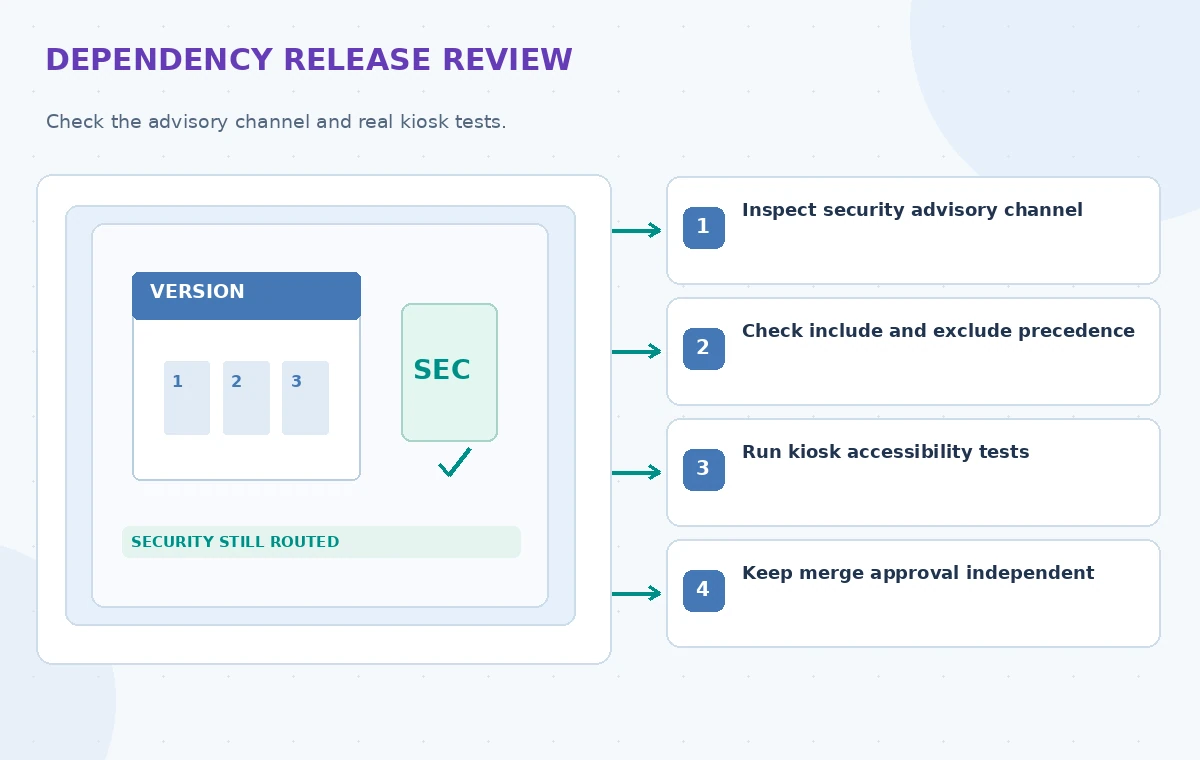
For a useful regression suite, compare the policy after a workflow change and after a package ecosystem is added. Check whether version PRs arrive in manageable groups and whether security notifications remain visible. Do not report ‘fewer vulnerabilities’ based solely on fewer PRs. Instead, audit response ownership and merge outcomes, and keep sample scenarios distinguishable from measured repository history.
Approve updates against kiosk behavior
Before merging an actual dependency change, review the release notes, security implications, lockfile diff and failure cases for the kiosk. Run end-to-end accessibility checks and confirm a tested rollback. A cooldown is a review scheduling tool, not approval. The decision record should specify why a delayed release was selected and who signed off on the change.
Revisit the GitHub options reference as support and defaults evolve. Keep security-update alerting and review channels independent of the routine version window. A maintainable kiosk depends on people seeing the right change at the right time, not on hiding all change traffic. The diagrams in this guide are original fictional examples, not a report from a repository or Dependabot installation.
How We Research
We researched this November 2026 article from official documentation: GitHub: Dependabot options reference; GitHub: Optimize version update pull requests; GitHub: Dependabot version updates overview. We compared the vendors’ documented fields, feature boundaries, and relevant support conditions with one hypothetical community organization workflow. The diagrams are original fictional teaching art, not product screenshots, measured benchmarks or verified customer cases. We did not submit API requests, run a service, process real personal files or test search accuracy. Implementers must verify current API versions, models, region support, costs, data handling and source permissions; a qualified staff member must confirm factual or safety-critical outcomes.
Frequently Asked Questions
No. GitHub documents cooldown as applying to version updates, not security updates.
GitHub documents a three-day default for routine version updates; verify the current behavior in its options reference.
For supported package managers, semver-major-days, semver-minor-days and semver-patch-days can be configured.
GitHub says an exclude match takes precedence over include.
No. Review advisories, provenance, tests and the release notes independently.