
A community archive plans to review five volumes of a century-old repair journal for potential exhibit excerpts. Different volunteers may inspect different volumes, but a parallel AI-assisted workflow could merge a warning from volume B into a citation from volume A. LangGraph’s Send mechanism supports dynamic fan-out: a conditional edge can invoke worker nodes with their own inputs, and reducers combine updates in shared graph state. That is a programming facility, not a provenance verifier. The volumes and results in this guide are illustrative, not evidence from a deployed agent.
Define what a worker is allowed to claim
Create a list of approved volume IDs, revision hashes, page ranges and retrieval permissions. Each worker’s task should be narrow: identify candidate excerpts, capture exact page references and flag uncertain readings. No worker should be authorized to publish, revise archival catalog records or grant permissions. The source set must be versioned before fan-out so later consolidation can distinguish work on revision A from work on revision B.
Write the output contract before the agent prompt: volume_id, source_revision, page, quotation status, evidence reference and error fields. The format should permit ‘no supported finding’ and ‘page unavailable.’ A system that requires every worker to produce a confident finding will encourage invented citations. A separate human review step should check any claim selected for public display.
Use Send to pass per-volume inputs
LangGraph documents Send for runtime-determined fan-out. A conditional edge returns one or more Send objects; each identifies a node and carries custom state for that invocation. This differs from normal edges that advance fixed graph transitions using shared state. An archive dispatcher might create a Send for volume A with its allowed pages and another for volume B with a different subset. Never rely on a global mutable variable to guess which source a worker is reading.
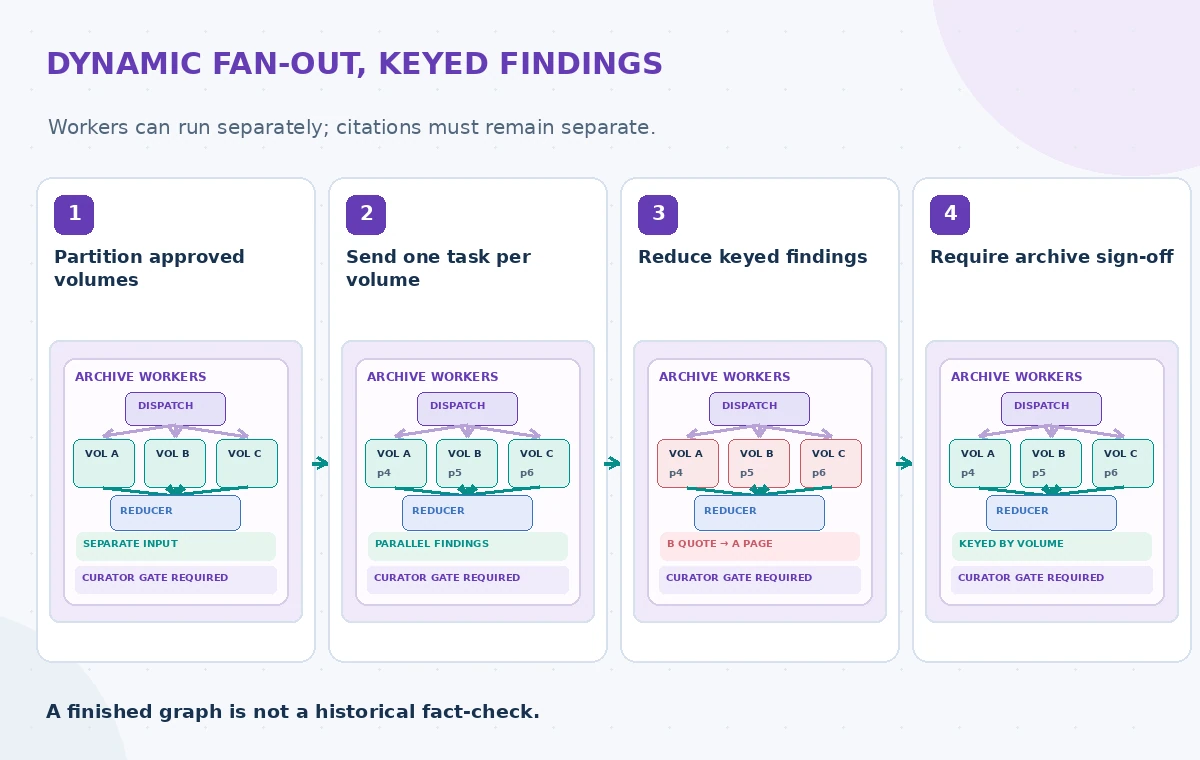
Make worker state minimal and explicit. Include volume ID, source revision and allowed input references in the invocation, and enforce access before retrieving content. If a volume is restricted, do not create a worker for an unauthorized public job. The diagram of diverging volume paths is architectural teaching art, not a recording of actual concurrent calls or a claim about speedup.
Specify reducers for data that must merge
LangGraph’s Graph API treats state fields as channels. Without a reducer, updates typically overwrite prior values. Concurrent workers writing to the same findings key therefore need a defined combination rule, such as accumulating a list of typed findings. The reducer must preserve volume_id and source_revision with every entry, not flatten all prose into an unlabeled paragraph. Other fields, such as overall approval, should not be naively merged as though several worker successes equal a curator decision.
A reducer should reject structurally invalid entries or route them to a separate error collection. Decide whether duplicate finding IDs represent retries or genuinely separate observations. If the code uses list concatenation, downstream de-duplication still needs stable worker and source IDs. Reducers merge data; they do not assess historical truth, access rights or the originality of an AI-generated summary.
Show a broken merge and the corrected association
A useful comparison depicts two source volumes and two findings. The middle state shows an unlabeled aggregate, where a safety warning from volume B sits under volume A’s citation. The corrected state carries the source ID and page on each finding before presenting a candidate exhibit excerpt. The visuals should show a real structural difference, not three identical cards with a checkmark added. No displayed citation should imply it was extracted by a real model.
Ask a reviewer to open the exact page linked by each candidate excerpt. If the text is paraphrased, make that explicit instead of displaying quotation marks. When a worker cannot provide a source path, hold the entry rather than guessing an adjacent page. Store edits to a finding as a new revision, preserving the worker result and the human correction side by side.
Treat retries as duplicate risks
Long-running workflows can be interrupted or retried. Any worker with external side effects must be designed so re-execution does not duplicate emails or change archival systems unexpectedly. For this project, worker nodes should ideally only read approved sources and return findings; publication belongs to a separate approved process. When a worker fails, record the affected volume rather than silently marking the whole archive pass.

Combine results with a stable finding key based on the task instance and source reference, not on the arrival order of parallel responses. Be explicit about timeouts and per-worker errors. A re-run against a different scan revision should not overwrite a previously reviewed result without notifying the curator. A completed graph run proves only that its configured transitions ended, not that all requested pages were inspected successfully.
Keep access controls outside model instructions
Filter which source documents may be fetched before dispatching workers. The conditional Send logic should never authorize broader access because a model requests a new citation. Attach tenant, volume and page restrictions to retrieval operations, and keep server-side permissions independent of natural-language instructions. Staff access to a restricted volume should not leak its contents into a public aggregate or debugging log.
A mixed-permission archive needs distinct paths for internal review and public release. Even if a worker returns text that appears harmless, the underlying consent terms may prohibit quoting it. Verify the final candidate list against approved public-access metadata. A developer should test that an unauthorized job receives neither source text nor identifying error details about a restricted record.
Test reducers and evidence links with fixtures
Construct synthetic workers for volumes A, B and C, including an empty volume, a missing page, a duplicate retry and an out-of-order completion. Run unit tests for the reducer, asserting that every finding retains the original ID and that duplicate attempts cannot create two publishable entries. Use a separate negative fixture that tries to attach B’s quote to A’s page. The test should fail without needing a language model to notice the mismatch.

Measure actual throughput and memory only after the graph is implemented; parallel execution is not inherently faster when external APIs throttle. Review the checkpointer, logging, state growth and error handling under the current LangGraph version. Preserve a minimal reproducible example of source IDs and expected joins for future maintainers, not a screenshot claimed as an actual benchmark.
Finish with one accountable curator decision
After reduction, sort findings by stable volume and page keys for editorial review. A curator should compare candidate quotes to original page scans, verify citation scope and approve the exact export revision. A single final release gate should require all designated volumes to be accounted for, including those with explicit no-findings or failure states. Do not convert a missing worker output into a blank approval.
These drawings show an educational graph design and fictional archive extracts. Consult LangGraph’s current Graph API, Send and reducer documentation and your institution’s permissions policy before implementing. The achievement is a traceable evidence list whose origins remain intact under parallel work—not a graph with the most nodes or the shortest elapsed time.
How We Research
For this November 2026 article, we compared named official references: LangGraph: Graph API overview; LangGraph: Use Send and Command; LangGraph: Thinking in the Graph API. We checked the documented request shape, output behavior, and important limits; then we developed an original hypothetical nonprofit workflow with source checking and explicit human authorization. This is documentation-based editorial research, not a laboratory test: we did not upload real files, run the vendors, measure accuracy or claim real customer outcomes. The illustrations are educational schematics, not platform screenshots or measured results. Before implementation, verify current API access, regional features, security, costs, consent and publication policies.
Frequently Asked Questions
Send dynamically invokes a node with custom input, supporting runtime-determined fan-out.
Without the right reducer, concurrent updates can overwrite rather than combine evidence.
No. Review each volume, page and quote against the original source.
As an explicit unresolved task with its source ID, not as an approved blank entry.
The safer design keeps worker nodes read-only and requires a separate authorized final approval.